Sermon: Our Lady of Guadalupe


The Feast of the Immaculate Conception of Mary was on Monday, the Feast of Our Lady of Loreto is today, and the Feast of Our Lady of Guadalupe is this coming Friday. We can’t cover them all, so I’ll share with you a report by Don Antonio Valeriano, a Native American author of the sixteenth century.

At daybreak one Saturday morning in 1531, on the very first days of the month of December, an Indian named Juan Diego was going from the village where he lived to Tlatelolco in order to take part in divine worship and listen to God’s commandments. When he came near the hill called Tepeyac, dawn had already come, and Juan Diego heard someone calling him from the very top of the hill: “Juanito, Juan Dieguito.”

He went up the hill and caught sight of a lady of unearthly grandeur whose clothing was as radiant as the sun. She said to him in words both gentle and courteous: “Juanito, the humblest of my children, know and understand that I am the ever virgin Mary, Mother of the true God through whom all things live. It is my ardent desire that a church be erected here so that in it I can show and bestow my love, compassion, help, and protection to all who inhabit this land and to those others who love me, that they might call upon and confide in me. Go to the Bishop of Mexico to make known to him what I greatly desire. Go and put all your efforts into this.”

When Juan Diego arrived in the presence of the Bishop, Fray Juan de Zumarraga, a Franciscan, the latter did not seem to believe Juan Diego and answered: “Come another time, and I will listen at leisure.”

Juan Diego returned to the hilltop where the Heavenly Lady was waiting, and he said to her: “My Lady, my maiden, I presented your message to the Bishop, but it seemed that he did not think it was the truth. For this reason I beg you to entrust your message to someone more illustrious who might convey it in order that they may believe it, for I am only an insignificant man.”

She answered him: “Humblest of my sons, I ask that tomorrow you again go to see the Bishop and tell him that I, the ever virgin holy Mary, Mother of God, am the one who personally sent you.”

The Bishop again did not believe and asked for a sign.

On Monday Juan Diego did not return. His uncle, Juan Bernardino, became very ill, and at night asked Juan to go to Tlatelolco at daybreak to call a priest to hear his confession.

Juan Diego set out on Tuesday, but he went around the hill and passed on the other side, toward the east, so as to arrive quickly in Mexico City and to avoid being detained by the Heavenly Lady. But she came out to meet him on that side of the hill and said to him: “Listen and understand, my humblest son. There is nothing to frighten and distress you. Do not let your heart be troubled, and let nothing upset you. Is it not I, your Mother, who is here? Are you not under my protection? Are you not, fortunately, in my care? Do not let your uncle’s illness distress you. It is certain that he has already been cured. Go up to the hilltop, my son, where you will find flowers of various kinds. Cut them, and bring them into my presence.”

When Juan Diego reached the peak, he was astonished that so many Castilian roses had burst forth at a time when the frost was severe. He carried the roses in the folds of his tilma (mantle) to the Heavenly Lady. She said to him: “My son, this is the proof and the sign which you will bring to the Bishop so that he will see my will in it. You are my ambassador, very worthy of trust.”

Juan Diego set out on his way, now content and sure of succeeding. On arriving in the Bishop’s presence, he told him: “My lord, I did what you asked. The Heavenly Lady complied with your request and fulfilled it. She sent me to the hilltop to cut some Castilian roses and told me to bring them to you in person. And this I am doing, so that you can see in them the sign you seek in order to carry out her will. Here they are; receive them.”

He immediately opened up his white mantle, and as all the different Castilian roses scattered to the ground, there was drawn on the cloak and suddenly appeared the precious image of the ever virgin Mary, Mother of God, in the same manner as it is today and is kept in her shrine of Tepeyac.

The whole city was stirred and came to see and admire her venerable image… they called her by the name that she herself had used: “the ever virgin holy Mary of Guadalupe.”

Sermon: Palm Sunday – “His Most Blessed Mother”


Today, in The Dolorous Passion by Anne Catherine Emmerich, we turn our attention to Jesus’ most Blessed Mother. From Chapter 45:

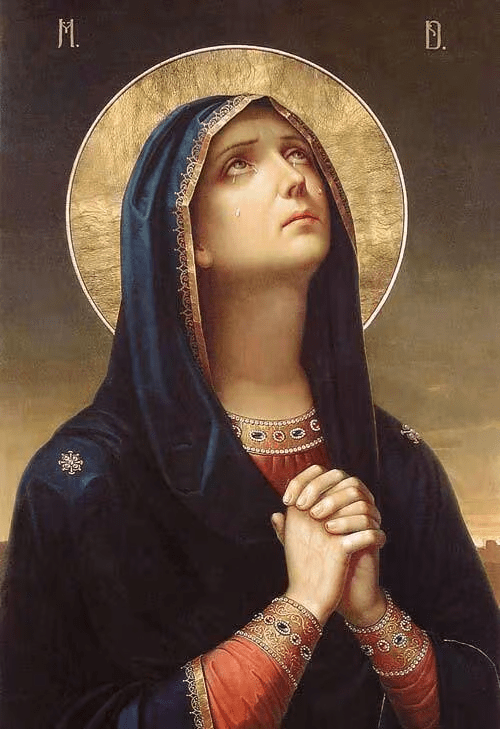
“What words can, alas, express the deep grief of the Blessed Virgin? Her eyes closed, a death-like tint overspread her countenance; unable to stand, she fell to the ground, but was soon lifted up, and supported by John, Magdalen, and the others. She looked once more upon her beloved Son—that Son whom she had conceived by the Holy Ghost, the flesh of her flesh, the bone of her bone, the heart of her heart—hanging on a cross between two thieves; crucified, dishonoured, condemned by those whom he came on earth to save; and well might she at this moment be termed ‘the queen of martyrs.’”

I wondered about all we have been discussing during this Season of Lent, and then I thought of Jesus’ most blessed Mother. It was thirty-three years ago that she gave birth to him, and she knew Him well. He didn’t have to speak for her to understand how He was feeling. She may have been present when he rode into town on the donkey, the crowds joyful and excited, waving palm branches and shouting, “Blessed is he who comes in the Name of the Lord.” However, one look at Jesus’ face, and she knew something was wrong—terribly wrong. 

Over the course of the next few days, she came to understand the inner torment He was experiencing, but there was nothing she could do. A day later, news arrived through one of Jesus’ terrified disciples that He had been arrested. There was the trial, the long road to Golgotha, the crucifixion, and now… now she sits at the foot of the cross, watching her Son die—the Son who was conceived in her by the Holy Spirit.

She was oblivious to the crowds around her, unconcerned about the danger she was placing herself in. Nothing distracted her from her Son on the cross. Not one thing could make her take her eyes off of God because she knew that if she was going to get through this, it would be only through Him, for He had come to save her as well.

We can learn many things from this most blessed of all women. We can learn love, patience, perseverance. We can learn what it means to hunger for God and to comfort one another. Therefore, I encourage you this Holy Week to take Mary as your companion. Ask her to reveal to you the things she witnessed and to help you experience the true Passion of our Lord. Ask her to guide you beyond your own fears and away from the crowds and the noise. Ask her to allow you to join her at the foot of the Cross, and then ask her to show you perfect love—perfect love that was crucified for her and for you.

Let us pray: O Holy Mary, my most gentle Lady, faithful Advocate of all Christians, in view of the extraordinary merits that were yours and which made you most pleasing to God, and in view of your every comforting gesture you made to your Son, as well as the countless tears you shed during his most bitter Passion, I ask you to have pity on me, poor creature that I am. Take me under your maternal care and include me among the number of your servants, whom you hold dear and embrace with your special love.

O glorious Virgin Mary, my only hope, before my soul should leave this body of mine, come and reveal your face to me. Direct your gentle and beautiful eyes of mercy toward me, the very eyes that had joyfully and so often looked upon the fruit of your womb, Jesus, and were wetted because the many tears shed during his Passion. Most holy Mother of Jesus, come and stand at my side together with your group of attending virgins and the holy assemblage of saints, as you had steadfastly and perseveringly stood unto the end, when your most beloved Son was about to die on the Cross. After my Lord Jesus Christ, your only Son, I find none so generous and eager to console someone in need as you, most amiable Mother of the Afflicted. Amen. (On the Passion of Christ: According to the Four Evangelists, p.117)

Sermon: Our Lady of Guadalupe


On December 9, 1531, fifty-seven-year-old Juan Diego was walking to Mass. He is a convert to the faith and a widower. As he walks, he begins to hear the most beautiful music. Following the sound, he climbs Tepeyac Hill, located in what is now Mexico City.

When Juan Diego arrives at the top, he sees a beautiful apparition of the Blessed Virgin Mary. She speaks to Juan Diego, calming him, then telling him that she would like a church to be built on that spot for the people of Mexico. It is to be a place where they can come for healing and worship. She instructs him to go to the local bishop and give him this message, adding, “Now go and put forth your best effort.” 

Juan Diego does as he is told, but the bishop is highly skeptical, thinking this peasant is either mad or a trickster. So, he sends him away. 

Juan Diego returns to Tepeyac Hill, where he sees the Virgin again. He tells her what she already knew—he had failed. Mary tells him that he is to go again on the following morning and try again. Juan Diego is obedient, but the result is essentially the same; however, the bishop tells him if the visions are real, he is to bring some sign the following day. Juan Diego agrees, but when he returns home, he finds his uncle, who he lives with, very ill—near death. He cannot return to the bishop but must stay and care for him. 

Two days later, Juan Diego is convinced that his uncle will die, so he goes in search of a priest. Along the way, he again encounters Our Lady. He explains everything that has happened, yet she says, “Am I not your mother? Are you not in the crossing of my arms?” In other words, she says, “Don’t you trust that I will care for you?” He says that he will believe, and she gives him additional instructions.

Juan Diego is to go that moment and again climb Tepeyac Hill. There, he will find flowers that he has never seen before. He is to gather the flowers in his tunic and take them to the bishop as a sign. It is the middle of December when all this is happening, so he doesn’t know how flowers could bloom, but he does as he is told. Arriving, he finds a beautiful field of flowers. Gathering them quickly in his tunic, he rushes to see the bishop.

The bishop is still skeptical, but Juan Diego drops the flowers, thinking they are the sign, but there is much more. On his tunic, in great detail, is the image of the Blessed Virgin. The image is the sign.

While Juan Diego is with the bishop, the Blessed Virgin appears to his uncle, whom he was caring for. The uncle is healed, and the Virgin tells him of Juan Diego’s mission and that she will be called “Santa Maria, de Guadalupe.” 

The bishop believed, and the church was built on Tepeyac Hill, the former site of an Aztec Temple—The Basilica of Our Lady of Guadalupe. Millions have come to faith in Christ Jesus through these events.

The tunic that Juan Diego was wearing was made of cactus fiber. It should have fallen to pieces within thirty years. After more than 500 years, it is miraculously preserved.

What started it all was the message that Our Lady gave to Juan Diego on their first meeting. “Know for certain, least of my sons, that I am the perfect and perpetual Virgin Mary, Mother of the True God through whom everything lives, the Lord of all things near and far, the Master of heaven and earth. It is my earnest wish that a temple be built here to my honor. Here, I will demonstrate, I will exhibit, I will give all my love, my compassion, my help, and my protection to the people. I am your merciful mother, the merciful mother of all of you who live united in this land, and of all mankind, of all those who love me, of those who cry to me, of those who seek me, of those who have confidence in me. Here, I will hear their weeping, their sorrow, and will remedy and alleviate all their multiple sufferings, necessities, and misfortunes.”

God used a simple peasant farmer, Juan Diego, to bring this all about. How might God use you?

Sermon: The Visitation of the Blessed Virgin Mary

“Visitation” with donor portrait, from Altarpiece of the Virgin (St Vaast Altarpiece) by Jacques Daret, c. 1435

I came across a brief study of the word preposterous.  Pre is something we are familiar with, which means “before.”  The Latin word posterous is a bit more tricky, but if you think of what you fall on when you slip on the ice, posterior (aka the derrière), then you know that posterous has something to do with the backside.  More accurately, it means “coming after” or “that which comes after.”  Therefore, preposterous means: that which comes before comes afterward… backward.  We take it to mean absurd or silly.

Donald K. McKim, the former Dean of Memphis Theological Seminary, used the word preposterous in a perspective on Christianity.  He wrote, “Now Christianity is a preposterous faith because it asks us actually to live backward.  Or, to put it another way, Christianity asks us to put some things before other things when more naturally, we’d choose to live the other way around.  The faith calls us as followers of Jesus Christ to a new lifestyle, a new way of living.  It asks us to hold new attitudes.  In short, Christianity asks us to live in a way the world may judge to be absurd.  Yet all the time, we are really only being truly preposterous.”  Christianity asks us “to live backward” lives that, by the world’s standards, are absurd, silly, and foolish.

How preposterous is Christianity?  Just in our Gospel account today, we are asked to believe that Elizabeth, a woman who was barren and “getting on in years,” was to bear a son; we are asked to believe that a virgin, Mary, conceived a child of the Holy Spirit, and we are asked to believe that this child is the Son of God, the long-awaited Messiah.  Nothing preposterous there.  We are also called to believe some preposterous ideas and are also called to live preposterous lives.  St. John writes in his First Epistle: “Do not love the world or the things in the world.  The love of the Father is not in those who love the world; for all that is in the world—the desire of the flesh, the desire of the eyes, the pride in riches—comes not from the Father but from the world.”  Yet, as preposterous as all this sounds to some, we believe.  We seek to live according to the call that the Father has placed on our lives.  For we know that he takes the weak, the broken, the blind, and even the crucified, and renews it, redeems it for his purposes.

In his first letter to the church in Corinth, Paul writes: “For the message about the cross is foolishness to those who are perishing, but to us who are being saved it is the power of God… we proclaim Christ crucified, a stumbling block to Jews and foolishness to Gentiles… Consider your call, brothers and sisters: not many of you were wise by human standards, not many were powerful, and not many were of noble birth.  But God chose what is foolish in the world to shame the wise; God chose what is weak in the world to shame the strong; God chose what is low and despised in the world, things that are not, to reduce to nothing things that are.”

When we consider a barren older woman giving birth to the greatest prophet ever born, a virgin conceiving a child by the Holy Spirit, a child born in a stable being the Son of God—when we consider all these weak, low, despised, preposterous individuals and the work God performed through them, then I ask you, why would you ever think God couldn’t do the same through you?

The French novelist, Colette, said, “You will do foolish things, but do them with enthusiasm.”  If our faith and our actions appear preposterous, if they appear foolish, so be it.  You be faithful in your work.  You be enthusiastically preposterous and reveal the Risen Christ to the world.

Sermon: St Mary the Virgin


Heavenly birthdays. You may be aware that the date we celebrate a saint is not on their birthday but on the day they died. That is considered the day they entered heaven or their heavenly birthday. However, there are two that Holy Scripture tells us did not die. For ten years off of purgatory, can anyone name those two saints? Enoch and Elijah.

For Enoch, we read in Genesis, “When Enoch had lived 65 years, he became the father of Methuselah.  After he became the father of Methuselah, Enoch walked faithfully with God 300 years and had other sons and daughters.  Altogether, Enoch lived a total of 365 years. Enoch walked faithfully with God; then he was no more, because God took him away.” And Paul tells us in his letter to the Hebrews, “By faith Enoch was taken from this life, so that he did not experience death.” Elijah, we learn about in 2 Kings as he was carried away in a fiery chariot. The term used to describe these events is an assumption or, to be assumed, taken up. The difference between Jesus’ ascension and the assumption of Enoch and Elijah is that whereas Jesus achieved heaven on his own power, Enoch and Elijah were carried up by God.

Today, we celebrate the Blessed Virgin Mary (her feast day was officially on Monday). For some, this is a heavenly birthday, the day of her death; however, for others who have more high church leanings, this is the celebration of the Assumption of Mary or the “falling asleep of Mary.” Although not attested to in Holy Scripture, the latter group believes that, like Enoch and Elijah, Mary never tasted death, but was carried up, assumed into heaven. Read carefully you will note that our collect of the day that we prayed is ambiguous enough to satisfy both groups, “O God, you have taken to yourself the blessed Virgin Mary, mother of your incarnate Son: Grant that we, who have been redeemed by his blood, may share with her the glory of your eternal kingdom.”

For Roman Catholics, Pope Pius XII decided on the matter when in 1950, he stated, “By the authority of our Lord Jesus Christ, of the Blessed Apostles Peter and Paul, and by our own authority, we pronounce, declare, and define it to be a divinely revealed dogma: that the Immaculate Mother of God, the ever Virgin Mary, having completed the course of her earthly life, was assumed body and soul into heavenly glory.” The thought is, why would God allow the body of Mary, the one who bore his Son, to be corrupted by death?

For us, whether dogma or “pious opinion,” our salvation is not dependent upon confessing Mary’s assumption. Our salvation is found solely in her Son, Jesus, but there is no denying the fact that she plays a role in that salvation, for it was her “Yes” to God that allowed Jesus to be born into the world, which makes her song, The Magnificat, also our song.

My soul proclaims the greatness of the Lord,
my spirit rejoices in God my Savior;
    for he has looked with favor on his lowly servant.
From this day all generations will call me blessed:
    the Almighty has done great things for me,
    and holy is his Name.

Not only did God look with favor upon Mary, He—through Jesus—looks with favor upon us. She is ever blessed, and so are we. He did great things through and for her, just as he has done great things through and for us; so, like Mary, we too proclaim the greatness of the Lord.

Sermon: Advent 4 RCL C – “Walk with Her”

Photo by Marites Allen on Unsplash

Over the last several years I’ve told you so many silly stories that I can’t remember when or where I told them, but in my opinion, a good joke is worth repeating and sometimes they can’t be helped. As I know I’ve told you, if I hear the word “unique”, then that stupid joke immediately pops in my head and it is a struggle not to tell it: “How do you catch a unique rabbit? You ‘neek up on him.” All that to say, as this is a day when our readings focus on the Blessed Virgin Mary, then I have to tell / re-tell this one…

The main place of worship at Nashotah House is The Chapel of St. Mary the Virgin. Perhaps this is why so many of the graduates of the House have such a love for the Blessed Virgin, myself included.

The joke tells of a priest that dies and finds himself standing before Peter at the Pearly Gates. The priest tells Peter who he is, but Peter says that he’s not on the list. “What do you mean. I faithfully served the Church for over 50 years! Please check again.” Peter checks, but comes up with nothing. “Would you please go get Jesus, so that I can talk with him?” Peter obliges, but even Jesus says he’s not on the list. The priest protests again, giving a litany of the things he has accomplished in service to the Lord, hoping something will spark a memory. Finally, having exhausted all other options, he blurts out, “I went to Nashotah House,” at which point Jesus holds up his hand and smiles. Jesus says, “That explains everything! Come on in. You’re a friend of Moms.”

I’m hoping that I can get into heaven because I’m on the list and Jesus knows me, but if necessary, it will not be beyond me to have his momma talk to him.

Today in our Gospel we read about Mary going to visit her cousin Elizabeth who was also pregnant with the forerunner of Jesus, John the Baptist. Elizabeth said to Mary, “Why has this happened to me, that the mother of my Lord comes to me? For as soon as I heard the sound of your greeting, the child in my womb leaped for joy.” Why did John leap in his mother’s womb? St. John Chrysostom tells us that in Mary, “The Lord is present, so [John] cannot contain himself or wait for nature to run its course; he wants to break out of the prison of his mother’s womb and he makes surefire he witnesses to the fact that the Savior is to come.” (From a sermon recorded by Metaphrastrus) Mary has brought Jesus very near and through the power of the Spirit, John recognizes that he is in the presence of his Lord, so even though he cannot speak, he proclaims the Savior by leaping for joy, just as David leapt for joy and danced before the Lord when the Ark of the Covenant was returned to Israel.

This all points to the most important role of Mary for us all: to bring us into the very presence of God, by bringing us to her son, Jesus. What can such an encounter look like?

I know of a man who, while praying the Rosary, had a vision of the Blessed Virgin Mary.

He had been walking along a country road. On one side of the road was a piney forest and on the other was a field and a pond. As he was walking, he had been searching for the Virgin, but unable to find her. Then in the distance, he saw her walking toward him down the road. He quickly turned and ran to meet her, but—and this is probably funny—the closer she got, the bigger she got so that when they finally met, she was able to reach down and pick him up and put him in her pocket.

He tried to see through the weave in the fabric of her dress to see the outside world and determine where she was taking him, but was unable to. Not only that, but the further they went, the darker it became until all was dark. Yet as the light had lessened, he had been able to detect something new: a sound. At first, it sounded like the soft beating of a drum, but a short distance on, the sound was unmistakable: it was the beating of a heart. He began to not only hear the heartbeat, but to also feel it in his entire body. Each beat was like a loving embrace. It was then the man realized that Mary had done what she had always done: she had brought him to Jesus. You see, it was not her pocket that she had placed the man into. No. Mary had placed the man in the wound in Jesus’ side so that the man could be near the beating loving heart of the Risen Lord. There the man learned even more of the great love of Jesus. He had been allowed to remain in that place for a short time and then was sent on his way to try and fulfill the Lord’s will.

There is always much confusion surrounding the role of Mary in the Church and in the life of God’s people, but that confusion only arrises when people fail to understand her purpose. The Venerable Fulton Sheen (I do like him) says, “Devotion to the Mother of our Lord in no way detracts from the adoration of her Divine Son. The brightness of the moon does not detract from the brilliance of the sun, but rather bespeaks its brilliance.” Because of who she is, Mary receives our devotion, but she never seeks to be worshipped. Instead, she seeks to draw people to herself so that she can then lead them or even take them to her Son. So that she can place them near His heart that they might know of His great salvific love for them.

I encourage you all to take a quiet walk with Mary. You may think that she is simply spending time with you, which she is, but when the walk is over, just like John, you will find yourself in the presence of the Lord, and your soul (if not your body as well) will leap with joy.

Father, source of light in every age,
the virgin conceived and bore Your Son
Who is called Wonderful God,
Prince of Peace.
May her prayer,
the gift of a mother’s love,
be Your people’s joy through all ages.
May her response,
born of a humble heart,
draw Your Spirit to rest on Your people.
Grant this through Christ our Lord.
Amen.