Sermon: Great Vigil


From Catherine Emmerich: “TOWARDS the close of the Sabbath-day, John came to see the holy women. He endeavoured to give some consolation, but could not restrain his own tears, and only remained a short time with them. They had likewise a short visit from Peter and James the Greater, after which they retired to their cells, and gave free vent to grief, sitting upon ashes, and veiling themselves even more closely.

Later that evening, “about nine o’clock at night,” the Blessed Virgin went out alone. Catherine Emmerich writes, “I saw her stop suddenly in a very solitary spot, and look upwards in an ecstasy of delight, for on the top of the town wall, she beheld the soul of our Lord, resplendent with light without the appearance of a wound, and surrounded by patriarchs. He descended towards her, turned to his companions, and presenting her to them, said, ‘Behold Mary, behold my Mother.’ He appeared to me to salute her with a kiss, and he then disappeared… This sight filled her with inexpressible joy, and she immediately rejoined the holy women, who were busily employed in preparing the perfumes and spices.

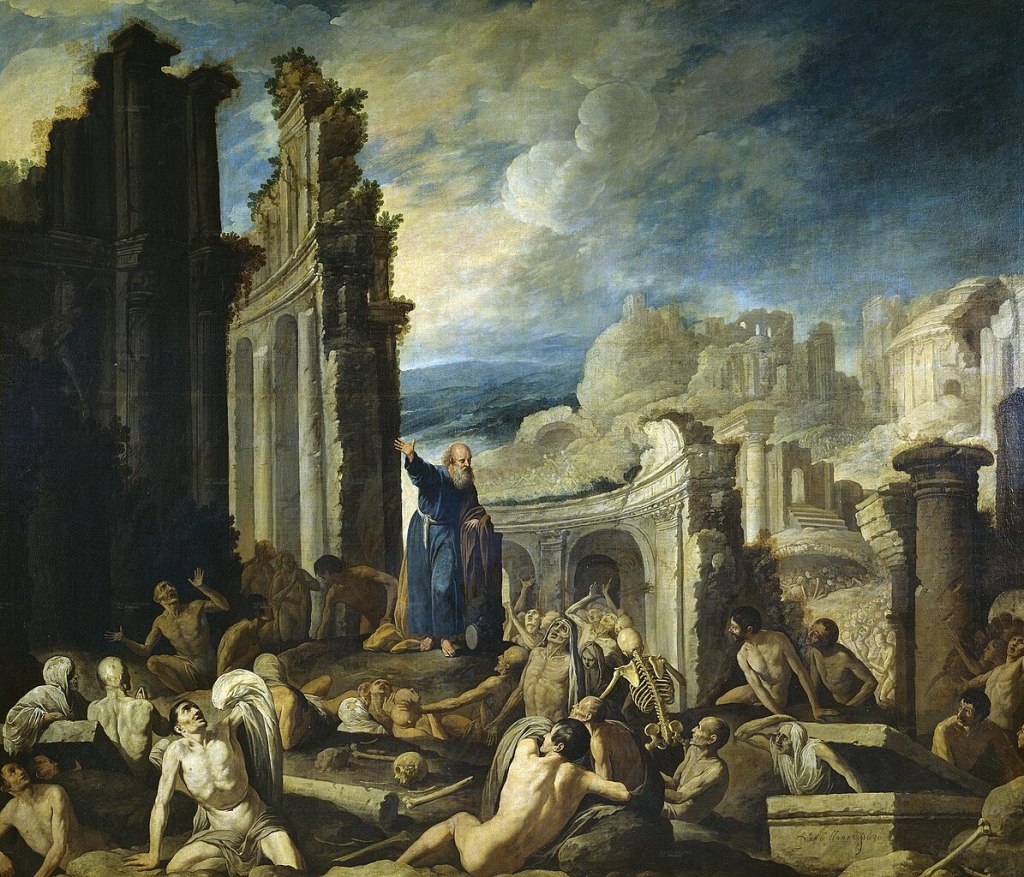
The Lord, speaking through the Prophet Ezekiel, said, “I am going to open your graves, and bring you up from your graves, O my people; and I will bring you back to the land of Israel. And you shall know that I am the Lord, when I open your graves, and bring you up from your graves, O my people. I will put my spirit within you, and you shall live, and I will place you on your own soil; then you shall know that I, the Lord, have spoken and will act.”

On this day, Jesus has been going about His Father’s business, descending into Hell and proclaiming release to those held captive. Now, He is bringing them forth, just as Ezekiel prophesied. 

The bones of those held captive in Hell were restored, and the flesh returned. The sinews and skin were knit back together, and their bodies became whole. Then “the breath came into them, and they lived, and stood on their feet, a vast multitude.” And Jesus, banner in hand, leads them out of the pit and into the light of God. It is this great exodus that Catherine describes and that the Virgin Mary witnessed.

In the end, it is all a mystery, yet we begin to see in that mirror dimly what has occurred; however, we also begin to glimpse our own future.

Gregory of Nyssa, one of the Cappadocian Fathers and a primary contributor to the Nicene Creed, wrote in the 4th century, “Ezekiel, with prophetic spirit, has surpassed all time and space and with his power of prediction has stood at the very moment of the resurrection. Seeing the future as already present, he has brought it before our eyes in his description.” 

There is the release of those held captive in Hell, but it is also a vision of our release from death. It is quite a spectacular scene and offers great hope to those who call upon the Name of the Lord. However, this resurrected life isn’t only about a distant future after we’ve been in the ground for so many years; Jesus has made it available to us today. 

St. Paul, writing to the Romans, states, “Do you not know that all of us who have been baptized into Christ Jesus were baptized into his death? We were buried therefore with him by baptism into death, in order that, just as Christ was raised from the dead by the glory of the Father, we too might walk in newness of life.” Through our baptism, we are raised—resurrected—with Christ Jesus, and the resurrected life is ours today.

So, ask yourself this: If I have been given the resurrected life today, do I still live as though I am nothing more than a pile of bones? Or do I take in this breath of God that has been breathed into me and allow it to fill me with faith, hope, and love? 

This is the night we declare, “Christ is risen!” Believe it. Embrace it. Rise with Him into a glorious new life.

Are you ready?

Alleluia! Christ is Risen!
Sermon: Lent 5 RCL A – “Institutionalized”


You all know that I’m a fan of Stephen King, but many people won’t pick up anything he’s written. Too scary for most, although much of what he writes isn’t what you think it is. To illustrate the point, King tells a story. He says, “I was in a supermarket down here in Florida, and I came around the corner, and there was a woman coming the other way. She pointed at me, she said, ‘I know who you are! You’re Stephen King! You write all of those horrible things. And that’s ok. That’s all right. But I like uplifting things, like that movie Shawshank Redemption.’ And I said, ‘I wrote that!’ And she said, ‘No, you didn’t. No, you didn’t.’” Well, he did write Shawshank Redemption, which is a fantastic story. This week, I was reminded of a particular scene in the movie version.

An old prisoner, Brooks Handlin, has learned that he will be paroled, but instead of being overjoyed, he begins acting very erratic, even threatening to kill another prisoner. It seems odd to most, but Red—another of the characters—understands. Red says, “Brooks is just institutionalized. The man’s been in here 50 years… 50 years! This is all he knows. You know what I’m trying to say? I’m telling you, these walls are funny. First, you hate them, then you get used to them. Enough time passes, you get to depend on them. That’s institutionalized.”

In reading our first lesson today, you would think that Stephen King wrote it—the Valley of Dry Bones. To understand what Ezekiel was writing, we must go back in history.

In Deuteronomy, the Lord says, “If you faithfully obey the voice of the Lord your God, being careful to do all his commandments that I command you today—that is, follow the Law—the Lord your God will set you high above all the nations of the earth.” (28:1) A few verses on comes the “but.” “But if you will not obey the voice of the Lord your God or be careful to do all his commandments and his statutes that I command you today, then all these curses shall come upon you and overtake you.” (28:15) There follows a litany of curses that will befall the people if they break God’s commands, one of which states, “The Lord will cause you to be defeated before your enemies. You shall go out one way against them and flee seven ways before them. And you shall be a horror to all the kingdoms of the earth. And your dead body shall be food for all birds of the air and for the beasts of the earth, and there shall be no one to frighten them away.” (28:25-26) In those days, the victor in a battle would shame the ones they conquered by refusing to allow the bodies of the dead to be retrieved and buried. Those bodies were to lay where they fell as a sign of defeat. God said, if you break my Law, this will happen to you.

We know that the people were disobedient, and in 587 b.c., God had had enough, and the promised curses fell upon the people. Nebuchadnezzar, the king of the Babylonians, sent in his army, sacked Jerusalem, destroyed the temple, and took the people into captivity and exile. During the battle, 4,200 people were killed.

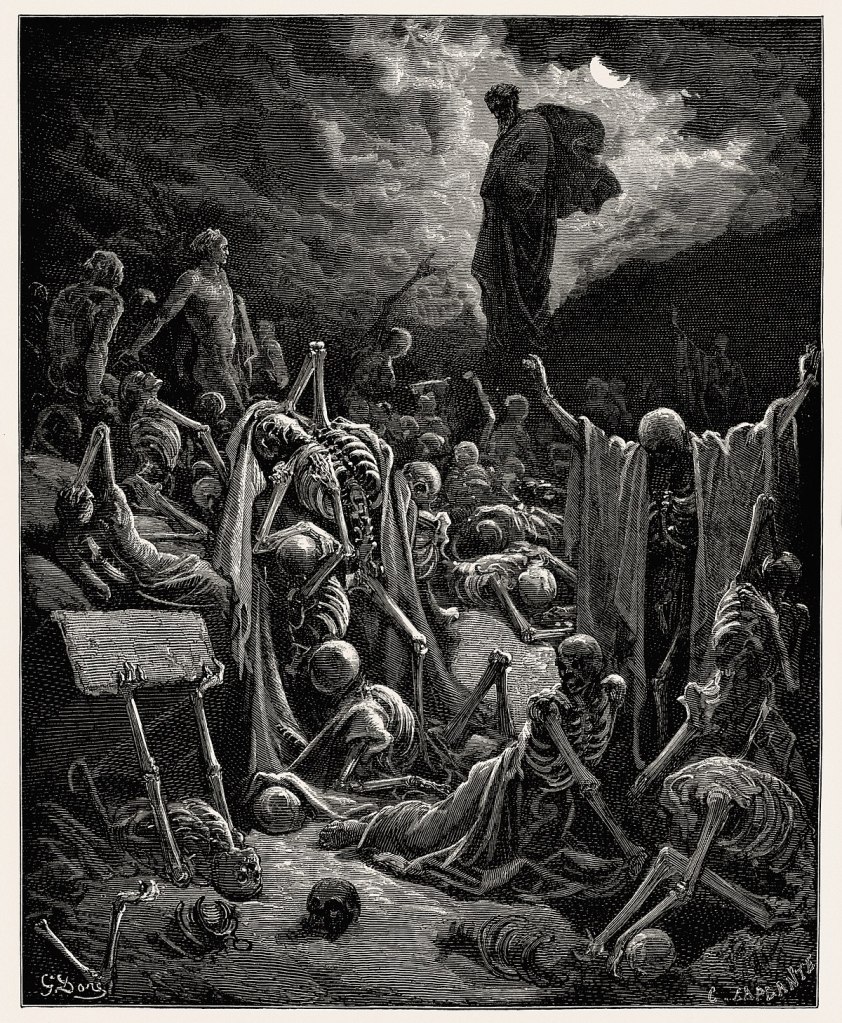
Ezekiel was a prophet and a preacher in Jerusalem. He was there in 587 when the Babylonians attacked, and he went with the people into exile. While in exile, he continued to preach and to have visions. What we read today is one of those visions. It began, “The hand of the Lord was upon me, and he brought me out in the Spirit of the Lord and set me down in the middle of the valley; it was full of bones.” There is no indication in the text that this valley of bones is the land surrounding Jerusalem, but it is safe to assume, given that Ezekiel was there and saw the dead. It is also safe to assume that the Babylonians would not have allowed the dead to be removed from the battlefield so that the Israelites would be further humiliated. So, in his vision, Ezekiel, who was in exile, stood amongst the dried bones of the dead. 

While there, God spoke, “Prophesy over these bones, and say to them, O dry bones, hear the word of the Lord.” As he spoke, the bones began to rattle. They put on flesh and skin. Everything was restored except for one thing—life. The Lord spoke to Ezekiel again and said, “Prophesy to the breath; prophesy, son of man, and say to the breath, Thus says the Lord God: Come from the four winds, O breath, and breathe on these slain, that they may live.” 

There is a Hebrew word for breath—rûah. There is also the word hārûah—The Breath. Breath is what those corpses needed to have life, but only The Breath—the very Spirit of God that breathed life into the first man, Adam—can give life-giving breath. Both of these words are in what God commanded Ezekiel to do-call on The Breath that life might be restored to those who had been killed, yet not only them but to all. Everyone. 

God allowed the Babylonians to conquer the Israelites. It was the fulfillment of the curse that God promised for disobedience. Ezekiel’s vision of The Breath breathing new life into the dead is the sign that God is lifting that curse and restoring the people. For those in exile with Ezekiel, this message is one of great hope because their exile was not only an exile from the land but also an exile from God. Now, they have been given new life. 

It is that same new life that we are given. The Breath of God is breathed into us, and we are no longer dried-up bones. Through Jesus, we are fully alive beings in relationship with our God. Yet, we so often still hang around in that valley of dry bones, clinging to our former life. Thomas Merton referred to this clinging as the life of the “old man.”

“For the ‘old man,’” Merton writes, “everything is old: he has seen everything or thinks he has. He has lost hope in anything new. What pleases him is the ‘old’ he clings to, fearing to lose it, but he is certainly not happy with it. And so he keeps himself ‘old’ and cannot change: he is not open to any newness. His life is stagnant and futile. And yet there may be much movement but change that leads to no change. The more it changes, the more it stays the same.

“The old man lives without life. He lives in death, and clings to what has died precisely because he clings to it. And yet he is crazy for change, as if struggling with the bonds of death. His struggle Is miserable, and cannot be a substitute for life.” (A Year with Thomas Merton, p.84) 

More simply put, Merton is saying that we are like Brooks Handlin in Shawshank Redemption. We are “institutionalized.” We’ve lived so long in that valley of dry bones that it is all we know. We’ve gotten so used to living that “old man” life that even though we want to change, we cling to… death.

Standing at the tomb of Lazarus, Jesus “cried with a loud voice, ‘Lazarus, come out!’ The dead man came out, his hands and feet bound with strips of cloth, and his face wrapped in a cloth. Jesus said to [the people], ‘Unbind him, and let him go.’” Jesus, The Breath of God, breathed new life into Lazarus, and Lazarus left the tomb, the valley of bones, and removed all that had bound him to it. We are invited to do the same.

Come out! Come out of the valley and enter into this new life. Merton wrote, “For the ‘new man’ everything is new…. The new man lives in a world that is always being created and renewed. He lives in this realm of renewal and creation. He lives in life.” Come out and live in life. It is a gift to you from God.

Let us pray:
Breathe in us O Holy Spirit, that our thoughts may all be holy.
Act in us O Holy Spirit, that our work, too, may be holy.
Draw our hearts O Holy Spirit, that we love but what is holy.
Strengthen us O Holy Spirit, to defend all that is holy.
Guard us, then, O Holy Spirit, that we always may be holy. Amen.