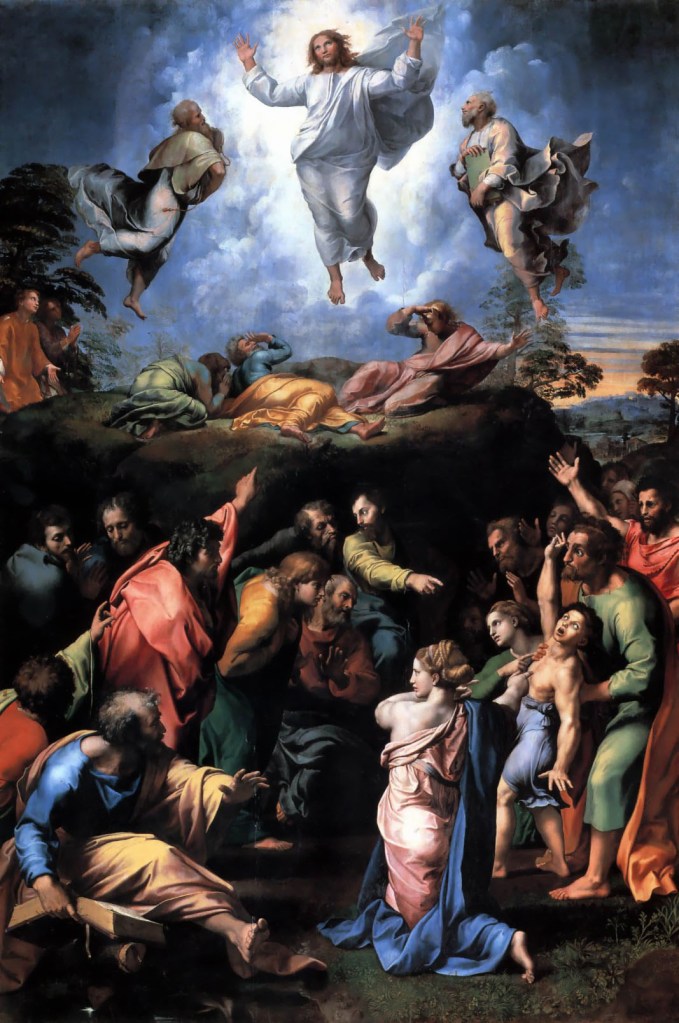
St. Leo the Great said that the Transfiguration revealed to the disciples “the excellence of [Jesus’] hidden dignity.” That is, it revealed Jesus’ true nature. St. Paul mentioned in his first letter to the Corinthians, “For now we see in a mirror, dimly, but then we will see face to face.” Seeing Jesus outside of the Transfiguration, it was as if the disciples saw Him dimly, but in that moment, they saw Him fully; however, He is not the only one called to be transfigured, because when the Lord says, “You shall be holy, for I am holy,” He is calling for all of us to be transfigured into His likeness.
Anglican Bishop, Brook Westcott writes, “The Transfiguration is the revelation of the potential spirituality of the earthly life in the highest outward form. Such an event, distinct in its teaching from the resurrection, and yet closely akin to it, calls for more religious recognition than it receives. Here the Lord, as Son of Man, gives the measure of the capacity of humanity, and shows that to which he leads all those who are united with him.”
The Transfiguration revealed to us our potential and our fullest capacity as children of God. Achieving this potential, at least in part, makes the saints we study on Wednesdays so extraordinary. They become light to us, radiating Christ. What is the outcome?
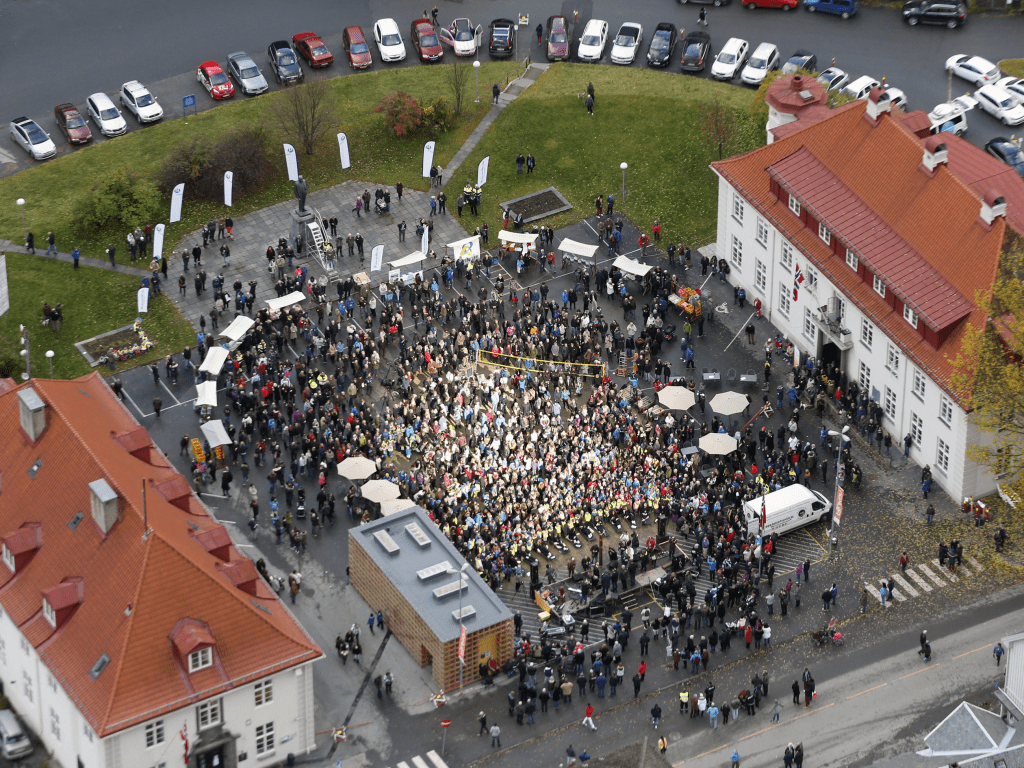
In south-central Norway, nestled in a mountain range (the name I won’t even attempt to pronounce), is the small community of Rjukan. The valley where the town is located is so narrow and the mountains so tall that, for six months each year, the town receives no direct sunlight; however, that changed in November 2013. Large mirrors were installed on one of the mountain peaks, and a computer tracks the sun’s movement and adjusts the mirrors’ angles so that a concentrated beam of light shines into the town square, creating a 6,500-square-foot patch of sunlight.
On the day the light started shining, one resident said, “People have been sitting there and standing there and taking pictures of each other. The town square was totally full. We are not that big of a town, so I think almost all the people in the town were on the town square.” She added, “It’s not very big, but it is enough when we are sharing.” (Source)
The saints we study are like mirrors, radiating—not their own light—but the light of Christ into the darkness of the world. As we say in the preface during the Eucharist on certain saints’ days, we give thanks to the Father, “For the wonderful grace and virtue declared in all your saints, who have been the chosen vessels of your grace, and the lights of the world in their generations.”
It is this same light that we also seek to reflect. We accomplish this by setting ourselves aside and putting on Christ, working on our salvation with “fear and trembling,” and striving for sanctification in our daily lives. Like all the capital “S” Saints, there will be days and seasons of failure, but each day we start fresh until we are clothed in the robes of white and standing eternally before our Father in Heaven, fully transfigured into his glory.
In 1909, Robert Stanton wrote an article in the New York Times regarding a journey to the Grand Canyon. He wrote of its colors and immensity, “But look again! Those terrifying walls are moving, are changing! A new light is not only creeping over them, but is coming out from their very shadows. See those flattened slopes above the dark sandstone on top of granite; even at this very moment they are being colored in gorgeous stripes of horizontal layers of yellow, brown, white, green, purple. What means this wondrous change? Wherein lies this secret of the great canyon?”
I’ve also had the privilege of seeing this great site and know how the Grand Canyon is one of those places that can make you feel terribly small. Its size is breathtaking, not to mention the formations, colors, and how it was formed. The day I was there was mostly clear, except for these big, fluffy clouds were moving across the sky. As I looked down into the canyon, I could see the shadows of those clouds drifting along the canyon floor and then racing up the far cliffs. For quite a while, I just stood there watching those shadows moving along. It was beautiful and mesmerizing.
Today, our gospel reading calls us to the Transfiguration of our Lord. The glory of the Lord wasn’t shining down upon Jesus, but instead, the glory of the Lord was emanating from Him. Peter, James, and John – that inner circle – were there with Him, and they witnessed this glory of the Lord, but they were terrified. As they watched further, they saw Moses and Elijah standing with Jesus and talking to him. A sight I’m certain was far more beautiful and mesmerizing than the Grand Canyon.
In considering the Transfiguration, we can understand it as the perfection of man, the result of following the will of God, because Jesus – both God and man – followed the will of God the Father to its perfect end. Through this image of the transfigured Christ, we can see the glorification of humankind and the perfection to come in our own lives. Archbishop Michael Ramsey wrote, “The Transfiguration is the revelation of the potential spirituality of the earthly life in the highest outward form. Here the Lord, as Son of Man, gives the measure of the capacity of humanity, and shows that to which he leads all those who are united with him.” That is perhaps one of those elusive ideas. Something we don’t have the mental or spiritual capacity to grasp, yet through Christ, eternal transfiguration is our end and our reward.
That may seem a long way off, even unattainable for us today. We consider our current state and wonder if perhaps we’ll ever be good enough, but as a Christian people, our hope of salvation is not dependent upon our work. As the Psalmist declares:
Our help is in the name of the Lord, who made heaven and earth.
God’s work may not yet be completed in us. We may not yet be there, but as the Apostle Paul wrote to the church in Philippi, “I am confident of this, that the one who began a good work among you will bring it to completion by the day of Jesus Christ.”
The glory the Transfigured Lord revealed on the mountain is not only a glimpse of His current state but also a glimpse of our future selves. The Lord is doing a great work in you. Rest assured that He will complete it.
At 55, Ol’ Boudreaux hadn’t been feeling all that well, so he made an appointment with Dr. Pierre. After undergoing a few basic tests and some questioning about how he lives his life, Boudreaux says, “Well, doc, what do you think?”
“From what I can see from your test results, Bou,” replies Dr. Pierre, “and from the answers you gave to my questions, you definitely need to make some significant changes to your lifestyle.”
“Like what?” asks Boudreaux, looking a bit worried.
Doc Pierre replies, “Like giving up drinking all those glasses of wine and whiskey, reducing all that fried food you have most nights of the week, and giving up smoking. Doing all this is the best way for you to improve your health and life expectancy. It’s your best course of action. So, what do you say?”
After taking some time to think about what he’s just heard, Boudreaux replies, “What would be the second best course of action?”
Have you ever played the game of chess? It is not a terribly difficult game to learn how to play, but that’s only the beginning. From there, it can become hugely complicated.
I’m not very good at it. I’m lucky to be able to see all the options of one move and usually lose because of some stupid option that I missed. However, it is reported that some chess masters can see some 20 moves ahead—moves and countermoves—and then select the best option. How complicated is that? Consider this. White always moves first, and with that first move, there are 20 options. (16 pawn moves and four knight moves). After black makes its first move, there are 400 distinct options for white. From there, it gets crazy. In seeing ahead, after only three moves per player, there are 120,921,506 total options. All told, “In a usual board [of chess], there are 30⁶⁰ possible pathways. This is greater than the number of atomic particles that exist in the known universe.” The rules of chess are easy enough to learn, but the game of chess is more complicated than any human mind (or computer) can fully grasp or master. (Source)
Jean-Luc Marion, a philosopher and Roman Catholic theologian, defines circumstances and events such as this as “‘saturated phenomena.’ According to Marion, some phenomena are filled with meaning and intuition to the point of exceeding any concepts or limiting horizons that one can impose on them. They are… saturated with relevance and thus inexhaustible, always undetermined.” (Source)
The game of chess, when viewed as a whole, is far too complicated for us to comprehend. It is a saturated phenomenon. Yet, even children can play it, not by seeing every available option, but by seeing a very limited spectrum of the available options.
“Jesus took with him Peter and James and John, and led them up a high mountain apart, by themselves. And he was transfigured… his clothes became dazzling white, such as no one on earth could bleach them… [Peter] did not know what to say, for they were terrified… a cloud overshadowed them, and from the cloud there came a voice, ‘This is my Son, the Beloved; listen to him!’”
When we read this, we believe that the Transfiguration is being described to us, but what is actually being described is a saturated phenomenon—an event far beyond understanding and description. Clothes so white that the white is beyond description. A fear, an awe-inspiring emotion so great that Peter is essentially babbling. A cloud appears that is real but also indicates the disciples’ inability to comprehend what they are seeing. And a voice that speaks that only provides a very limited understanding of it all—“This is My Son. This is God. Understand all that He says to you.”
Like a child who can play the highly complicated game of chess even though they cannot possibly comprehend all the options, Peter, James, and John were able to witness the Transfiguration but only grasp a very limited spectrum of understanding. They were not going to understand all the implications of the Transfiguration, so God the Father said to them, “Listen to what Jesus says and do what He does. In that way, you will begin to understand, and in doing and understanding, you will begin to be like Him—as He is…transfigured.”
And everyone says, “Thank you, Father John, for the academic exercise, but what has this got to do with me? What does it mean?”
It means that Jesus, by allowing us to witness His Transfiguration—showing us His true self as best we can comprehend—is saying to us, “Follow me. Be transfigured. I want you also to become a saturated phenomenon—someone so saturated in the holiness of God that your life is essentially beyond understanding to the dark world around you. So shine your light into the dark that it has no option but to see and understand something of God, if only a little.” How do we do this?
I came across a poem this week—Small Kindnesses by Danusha Laméris. I liked it so much that I wanted to share it with you, so, even though I don’t know her, I wrote Danusha and asked for permission to share it with you. She responded, “Poems should go where they are useful… So—a big yes!!!”
I’ve been thinking about the way, when you walk down a crowded aisle, people pull in their legs to let you by. Or how strangers still say “bless you” when someone sneezes, a leftover from the Bubonic plague. “Don’t die,” we are saying. And sometimes, when you spill lemons from your grocery bag, someone else will help you pick them up. Mostly, we don’t want to harm each other. We want to be handed our cup of coffee hot, and to say thank you to the person handing it. To smile at them and for them to smile back. For the waitress to call us honey when she sets down the bowl of clam chowder, and for the driver in the red pick-up truck to let us pass. We have so little of each other, now. So far from tribe and fire. Only these brief moments of exchange. What if they are the true dwelling of the holy, these fleeting temples we make together when we say, “Here, have my seat,” “Go ahead—you first,” “I like your hat.”
How do we shine in the darkness? It begins with recognizing those brief moments of loving connection with others—even the stranger in our midst—are, in fact, holy moments. They are moments of the brightest white because, in them, we truly see the other, and we set ourselves aside and not only desire but work toward the good of the other. A person who lives in such a way has not only witnessed the Transfiguration of Jesus but is also beginning to understand it and put that understanding into action.
A quote from a person named Anonymous: “Someone once told me the definition of hell: on your last day on earth, the person you could have become will meet the person you became.” The person you become depends upon hearing and responding to Jesus’ call to follow Him and be transfigured. That is the best course of action. Don’t be like ol’ Boudreaux and ask about the second-best course of action. There’s not one. Be transfigured and enter into those holy temples of great and small kindnesses. Become that saturated phenomenon of God’s love and let the world around you encounter God in a way it has never experienced before.
Let us pray: Eternal God, you revealed to the disciples the everlasting glory of Your Son, Jesus. Grant us, who have not seen and yet believe, the gift of your Holy Spirit, that we may boldly live the Gospel and shine with your transforming glory, as people changed and changing through the redeeming presence of our Savior. Amen.
The time came for Acadia, Thibodeaux’s wife, to deliver her twins. All was set as they rushed into the hospital, and everything was prepped. However, the delivery was too much for Thibodeaux, and he passed out cold. It took hours to revive him, but in the meantime, the doctors insisted on naming the babbies. Since Thib was still out, Acadia turned to Thib’s brother, Remi, to help name the girl and the boy.
“My brother named my kids?!” Thib’s shouted when he woke up. “But my brother’s an idgit! He barely knows his own name.” Pausing and taking a breath, he says, “Ok, what he done name the girl.”
“He named her Denise.”
“Denise?” Said, Thib. “Well, that’s not such a bad name. I kind of like it. And what did he call the little boy?”
“De Nephew.”
Even though it’s relatively common, I kind of like my name, but not everyone can say the same. For example, there was Issur Danielovitch Densky. He changed his name to Kirk Douglas. Frances Gum didn’t think her name would sell, so she became Judy Garland. Archibald Leach became Cary Grant. And who do you think Marion Morrison would become? John Wayne.
How great would it be if all it took was to change your name and become rich and famous? Or to become anything you wanted? To become an astronaut, I’ll become Neil Armstrong. To become a famous writer, call me Stephen King. But what about becoming a Saint? Call me Josemaría, and I’ll be holy.
In the end, “A rose by any other name….” As the philosopher Alan Watts said, “The menu is not the meal.”
Inside all of us is dark and light, and on any given day, one will be more prominent than the other, but the goal of the Christian life is for the light to illuminate every dark crevice and reveal the content of every shadow. Technically, this is known as sanctification.
Simply put, sanctification is the process of becoming holy, allowing the light to shine through every aspect of our lives. There are three major components in the process, and all three are a form of grace given by God: baptism, living a life directed by God, and entry into the Kingdom of Heaven.
Although some traditions believe that a person must make an adult profession of faith before being baptized, we do not—for us, that falls into the category of works; that is, you must do something in order to “earn” God’s grace. Instead, we believe that baptism is God’s undeserved grace being poured out on us, providing us “union with Christ in his death and resurrection, birth into God’s family the Church, forgiveness of sins, and new life in the Holy Spirit.” (BCP 858)
The third component, entry into the Kingdom of Heaven, is also a grace, which we have absolutely nothing to do with. For those who believe, St. Paul tells us, “Neither death nor life, nor angels nor rulers, nor things present nor things to come, nor powers, nor height nor depth, nor anything else in all creation, will be able to separate us from the love of God in Christ Jesus our Lord.” (Romans 8:38-39)
We can view our baptism and ultimate entry into the Kingdom of Heaven as bookends to our life with God, but that bit between those two events gives us so much trouble. It is grace that allows us to live for God, but the sanctification—the making holy—process during our earthly lives is not exactly a smooth ride. Why? The light and the dark are both within us.
Remember the parable of the wheat and tares/weeds? God sowed the good seed of the wheat, but at night, the devil came in and sowed the weeds so that when they began to grow, the wheat and the weeds grew up together. That speaks of the world and the people in it, but it also speaks of the soul. The light and the dark, the wheat and the weeds, are both within us. When we apply the parable to ourselves, the difference is that, with God’s grace, we can actually do something about the darkness, those weeds within our souls. That is the process of sanctification in this life. It is the transfiguration of the individual.
“While [Jesus] was praying, the appearance of his face changed, and his clothes became dazzling white,” Jesus was revealed in His glory. No darkness. No weeds. Not showing us the process of becoming holy, but showing us The Holy and the true image of God. But He was also showing us what we can become.
Brooke Foss Wescott was a 19th-century bishop in the Church of England. He was also someone whom Archbishop Michael Ramsey admired and studied. Bishop Wescott wrote, “The Transfiguration is the revelation of the potential spirituality of the earthly life in the highest outward form…. Here the Lord, as Son of Man, gives the measure of the capacity of humanity, and shows that to which he leads all those who are united with him.” (Glory: The Spiritual Theology of Michael Ramsey, p.59)
The Transfiguration of Christ sets before us a goal for the work of sanctification—the work of becoming holy—in our lives, and this work is the means “by which men and women are restored to the image and likeness of God Himself.” (Ibid.) As Christ was transfigured on the mountain, we seek in our daily lives to be transfigured into the same glory that Jesus revealed on the mountain. So what’s stopping you?
Charlie Brown and Linus were leaning against the fence, both looking rather contemplative. Chuck then asks Linus, “What would you do if you felt that nobody liked you?”
Linus gives it a thought, then says, “I’d try to look at myself objectively, and see what I could do to improve… that’s my answer, Charlie Brown.”
In the final frame, Charlie Brown is not looking so happy and says, “I hate that answer.”
What is stopping you from being transfigured, from becoming holy as your Heavenly Father is holy? From continuing the process of sanctification? There are many factors, but it seems there are two primary ones, and the first one is that we don’t want to put in the effort.
Most of you know that I’ll be taking a sabbatical next year, and for part of the time, I want to walk the Camino de Santiago—a short walk of 500 miles across northern Spain. In order to do this and live to tell about it, I will need to get in better shape. More walking, more strength building, losing a bit more weight, etc. In other words, I need to be training. “I hate that answer.” I really want to walk the Camino, but I’m not putting in the effort to be able to.
The same applies to being holy. I want to be holy. I want to enter into a deeper relationship with my Savior, but am I putting in the effort? Praying as I should, studying as I should, loving as I should, and the list goes on. We know that we need to put in the effort and practice our faith, training our souls, but… “I hate that answer.” Why?
The second factor is also as simple but equally challenging—we don’t want to. Yes, we want to be holy, but we don’t want to change our lives to attain that holiness. Back to the Camino—I need to lose more weight, but I don’t want to put down the cookie. I like the cookie. I’m a big fan, and I’ll become an even bigger if I’m not careful, so I need to put down the cookie. “I hate that answer.” To be sanctified, I need to be willing to set aside those things in my life that separate me from God. I need to be willing to allow the transfiguring light of Christ to shine and banish the darkness within me.
We will not be wholly sanctified until we enter the Kingdom of God, but if we put in some effort and allow our love of God to override our love of self, then we will progress in our sanctification. We’ll be pulling some of the weeds that are growing up with the good wheat of our souls.
We know the names of Saints like Francis, Josemaría, Mary Magdalene, John Paul, and many others. We hold them up as examples of the Christian life, but we also view such a life as unattainable for ourselves. However, we should see the lives of the Saints as something to strive for. In the same way, we should look upon our Transfigured Lord. In seeing Him transfigured, we are witnessing what—by the grace of God—we have the potential to become.
Don’t shy away from this work of sanctification or squelch the desire to attain it. Instead, through your love of God, seek out every opportunity to take steps in the sanctification of your soul.
A few words toward the end of St. Paul’s first letter to the Thessalonians make for a good blessing. I’ll close with them. “May God himself, the God of peace, sanctify you through and through. May your whole spirit, soul and body be kept blameless at the coming of our Lord Jesus Christ. The one who calls you is faithful, and he will do it.” Amen.