Today is a feria, which is a weekday when there are no feast day celebrations. In such cases, we go back to the readings we heard this past Sunday—the fourth Sunday of Easter.
The Gospel lesson we read comes at the end of what is known as the Good Shepherd Discourse. It gets its name from a passage a few verses before what we read—Jesus said, “I am the good shepherd. I know my own and my own know me, just as the Father knows me and I know the Father; and I lay down my life for the sheep.” (John 10:14-15)
As I mentioned on Sunday, the Shepherd has long been understood in the context of Holy Scripture and among the Israelites as one who guides the people in their daily activities and leads them in battle. We can understand this person to be someone who is obligated to perform these duties, but in truth, the Good Shepherd fulfills these duties out of love for the sheep. That love means the Shepherd will go to any extent to save the sheep. This saving does not always involve some great and terrible battle, but more often than not, it is a struggle that only the singular sheep and the Shepherd are aware of.
A member of a certain church who had previously attended services regularly stopped going. After a few weeks, the pastor decided to visit him. It was a chilly evening, and the pastor found the man at home alone, sitting before a blazing fire.
Guessing the reason for his pastor’s visit, the man welcomed him, led him to a large chair near the fireplace, and waited. The pastor made himself comfortable but said nothing. In the grave silence, he contemplated the dance of the flames around the burning logs.
After a few minutes, the pastor took the fire tongs, carefully picked up a brightly burning ember, and placed it to one side of the hearth all alone. Then, he sat back in his chair, still silent. The host watched all this in quiet fascination.
As the lone ember’s flame faded, a momentary glow appeared, and then its fire was no more. Soon, it became cold and dead.
Not a word had been spoken since the initial greeting.
Just before the pastor was ready to leave, he picked up the cold, dead ember and placed it back in the center of the fire. Immediately, it began to glow once more with the light and warmth of the burning coals around it.
As the pastor reached the door to leave, his host said, “Thank you so much for your visit and especially for the fiery sermon. I shall be back in church next Sunday.” (Source: Unknown)
Taking up a little child in His arms, Jesus said, “What do you think? If a man has a hundred sheep, and one of them has gone astray, does he not leave the ninety-nine on the mountains and go in search of the one that went astray? And if he finds it, truly, I say to you, he rejoices over it more than over the ninety-nine that never went astray. So it is not the will of my Father who is in heaven that one of these little ones should perish.” (Matthew 18:12-14)
The Good Shepherd—“He revives my soul and guides me along right pathways for his Name’s sake.” (Psalm 23:3)
I’ll close with a prayer. Thomas Merton wrote it on one of those days when he was struggling to stay on track. Let us pray: Good Shepherd, You have a wild and crazy sheep in love with thorns and brambles. But please don’t get tired of looking for me! I know You won’t. For You have found me. All I have to do is stay found.
You all know that I’m a fan of Stephen King, but many people won’t pick up anything he’s written. Too scary for most, although much of what he writes isn’t what you think it is. To illustrate the point, King tells a story. He says, “I was in a supermarket down here in Florida, and I came around the corner, and there was a woman coming the other way. She pointed at me, she said, ‘I know who you are! You’re Stephen King! You write all of those horrible things. And that’s ok. That’s all right. But I like uplifting things, like that movie Shawshank Redemption.’ And I said, ‘I wrote that!’ And she said, ‘No, you didn’t. No, you didn’t.’” Well, he did write Shawshank Redemption, which is a fantastic story. This week, I was reminded of a particular scene in the movie version.
An old prisoner, Brooks Handlin, has learned that he will be paroled, but instead of being overjoyed, he begins acting very erratic, even threatening to kill another prisoner. It seems odd to most, but Red—another of the characters—understands. Red says, “Brooks is just institutionalized. The man’s been in here 50 years… 50 years! This is all he knows. You know what I’m trying to say? I’m telling you, these walls are funny. First, you hate them, then you get used to them. Enough time passes, you get to depend on them. That’s institutionalized.”
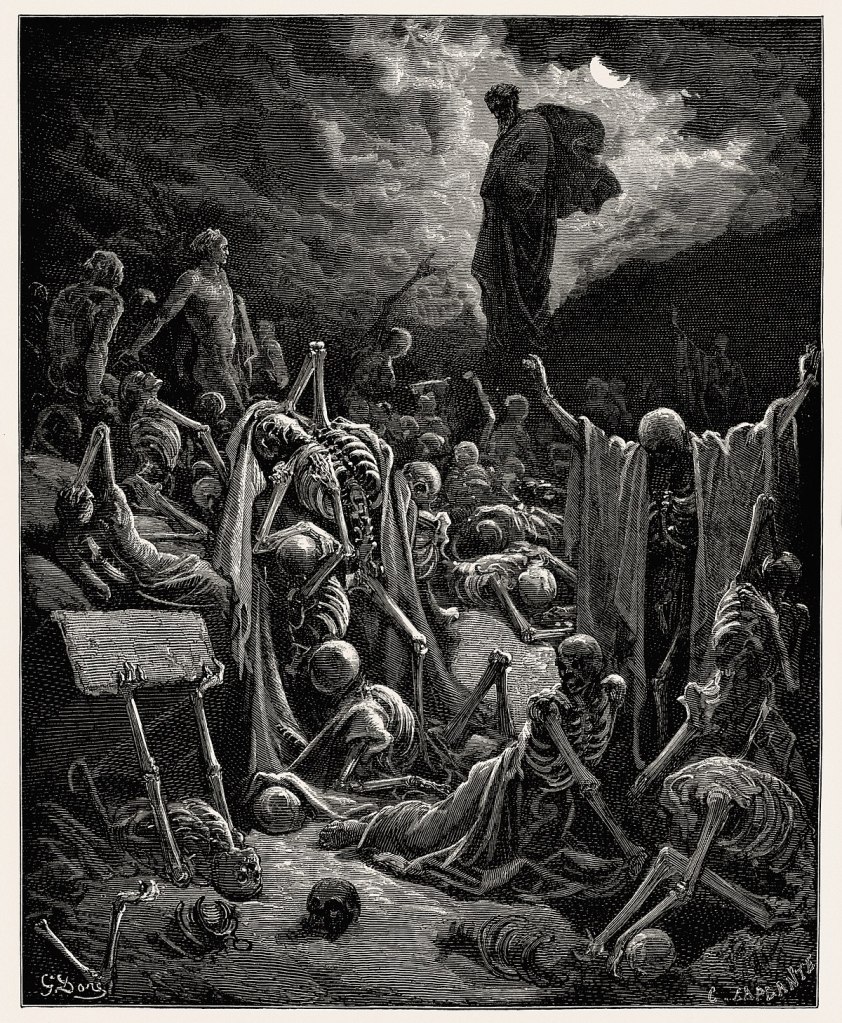
In reading our first lesson today, you would think that Stephen King wrote it—the Valley of Dry Bones. To understand what Ezekiel was writing, we must go back in history.
In Deuteronomy, the Lord says, “If you faithfully obey the voice of the Lord your God, being careful to do all his commandments that I command you today—that is, follow the Law—the Lord your God will set you high above all the nations of the earth.” (28:1) A few verses on comes the “but.” “But if you will not obey the voice of the Lord your God or be careful to do all his commandments and his statutes that I command you today, then all these curses shall come upon you and overtake you.” (28:15) There follows a litany of curses that will befall the people if they break God’s commands, one of which states, “The Lord will cause you to be defeated before your enemies. You shall go out one way against them and flee seven ways before them. And you shall be a horror to all the kingdoms of the earth. And your dead body shall be food for all birds of the air and for the beasts of the earth, and there shall be no one to frighten them away.” (28:25-26) In those days, the victor in a battle would shame the ones they conquered by refusing to allow the bodies of the dead to be retrieved and buried. Those bodies were to lay where they fell as a sign of defeat. God said, if you break my Law, this will happen to you.
We know that the people were disobedient, and in 587 b.c., God had had enough, and the promised curses fell upon the people. Nebuchadnezzar, the king of the Babylonians, sent in his army, sacked Jerusalem, destroyed the temple, and took the people into captivity and exile. During the battle, 4,200 people were killed.
Ezekiel was a prophet and a preacher in Jerusalem. He was there in 587 when the Babylonians attacked, and he went with the people into exile. While in exile, he continued to preach and to have visions. What we read today is one of those visions. It began, “The hand of the Lord was upon me, and he brought me out in the Spirit of the Lord and set me down in the middle of the valley; it was full of bones.” There is no indication in the text that this valley of bones is the land surrounding Jerusalem, but it is safe to assume, given that Ezekiel was there and saw the dead. It is also safe to assume that the Babylonians would not have allowed the dead to be removed from the battlefield so that the Israelites would be further humiliated. So, in his vision, Ezekiel, who was in exile, stood amongst the dried bones of the dead.
While there, God spoke, “Prophesy over these bones, and say to them, O dry bones, hear the word of the Lord.” As he spoke, the bones began to rattle. They put on flesh and skin. Everything was restored except for one thing—life. The Lord spoke to Ezekiel again and said, “Prophesy to the breath; prophesy, son of man, and say to the breath, Thus says the Lord God: Come from the four winds, O breath, and breathe on these slain, that they may live.”
There is a Hebrew word for breath—rûah. There is also the word hārûah—The Breath. Breath is what those corpses needed to have life, but only The Breath—the very Spirit of God that breathed life into the first man, Adam—can give life-giving breath. Both of these words are in what God commanded Ezekiel to do-call on The Breath that life might be restored to those who had been killed, yet not only them but to all. Everyone.
God allowed the Babylonians to conquer the Israelites. It was the fulfillment of the curse that God promised for disobedience. Ezekiel’s vision of The Breath breathing new life into the dead is the sign that God is lifting that curse and restoring the people. For those in exile with Ezekiel, this message is one of great hope because their exile was not only an exile from the land but also an exile from God. Now, they have been given new life.
It is that same new life that we are given. The Breath of God is breathed into us, and we are no longer dried-up bones. Through Jesus, we are fully alive beings in relationship with our God. Yet, we so often still hang around in that valley of dry bones, clinging to our former life. Thomas Merton referred to this clinging as the life of the “old man.”
“For the ‘old man,’” Merton writes, “everything is old: he has seen everything or thinks he has. He has lost hope in anything new. What pleases him is the ‘old’ he clings to, fearing to lose it, but he is certainly not happy with it. And so he keeps himself ‘old’ and cannot change: he is not open to any newness. His life is stagnant and futile. And yet there may be much movement but change that leads to no change. The more it changes, the more it stays the same.
“The old man lives without life. He lives in death, and clings to what has died precisely because he clings to it. And yet he is crazy for change, as if struggling with the bonds of death. His struggle Is miserable, and cannot be a substitute for life.” (A Year with Thomas Merton, p.84)
More simply put, Merton is saying that we are like Brooks Handlin in Shawshank Redemption. We are “institutionalized.” We’ve lived so long in that valley of dry bones that it is all we know. We’ve gotten so used to living that “old man” life that even though we want to change, we cling to… death.
Standing at the tomb of Lazarus, Jesus “cried with a loud voice, ‘Lazarus, come out!’ The dead man came out, his hands and feet bound with strips of cloth, and his face wrapped in a cloth. Jesus said to [the people], ‘Unbind him, and let him go.’” Jesus, The Breath of God, breathed new life into Lazarus, and Lazarus left the tomb, the valley of bones, and removed all that had bound him to it. We are invited to do the same.
Come out! Come out of the valley and enter into this new life. Merton wrote, “For the ‘new man’ everything is new…. The new man lives in a world that is always being created and renewed. He lives in this realm of renewal and creation. He lives in life.” Come out and live in life. It is a gift to you from God.
Let us pray: Breathe in us O Holy Spirit, that our thoughts may all be holy. Act in us O Holy Spirit, that our work, too, may be holy. Draw our hearts O Holy Spirit, that we love but what is holy. Strengthen us O Holy Spirit, to defend all that is holy. Guard us, then, O Holy Spirit, that we always may be holy. Amen.
The day before Ash Wednesday brings to an end the parades of Mardi Gras (French for ‘Fat Tuesday). Those celebrations likely have their history in some of the pagan festivals of Europe, but when those festivals came to France, they became more closely related to the Church. When they went to England, they became Shrove Tuesday or Pancake Day. Here, at St. Matthew’s, we get the best of both—and now that we’ve done it two years in a row, making it a time-honored tradition—we’ll have to call it Gumbo Day. When these festivals traveled south to the Caribbean and further into Brazil, they became known as Carnivale. Of all the names given, this one perhaps describes it best.
The word carnival comes from the combining of two Latin words: carnem (“flesh”) + levāre (“lighten, raise”)—carnem vale meaning, “Farewell to the flesh.” Farewell to those things that separate us from God. It is this definition that inspired Thomas Merton, in 1953, to write in his journal:
Carnivale, farewell to the flesh. It is a poor joke to be merry about leaving the flesh, as if we were to return to it once again. What would be the good of Lent, if it were only temporary?
Jesus nevertheless died in order to return to His flesh; in order to raise His own body glorious from the dead, and in order to raise our bodies with Him. “Unless the grain of wheat, falling into the ground, dies, itself remains alone.” So we cast off the flesh, not out of contempt, but in order to heal the flesh in the mercy of penance and restore it to the Spirit to which it belongs. And all creation waits in anguish for our victory and our bodies’ glory.
God wills us to recover all the joys of His created world in the Spirit, by denying ourselves what is really no joy—what only ends in the flesh. “The flesh profits nothing.” (A Year with Thomas Merton: Daily Meditations from His Journals, February 19)
“What would be the good of Lent if it were only temporary?” What would be the good of Lent if all the practices we establish for our lives in order to draw nearer to God during this season were cast off on Easter Sunday? What would be the good of Lent if we returned to Fat Tuesday lives?
One of the things I give up most Lents is social media—all that scrolling. I’m not sure how much time I spend on it, which tells me it is probably too much. I also know that I’ll pick it back up again after Easter. It is something I enjoy. That’s a Lenten practice that I think can be temporary, but what if I decided that I would also spend more time in prayer or more time reading the Word of God? Should that be temporary? “Oh, it’s just a Lent thing. Only temporary.” I’ll give a bit of time to God for a few weeks, but when the season is over, I can quit that silliness. That’s not how it is supposed to work. Our Lenten practices should bring about permanent changes, transformations in our lives.
“Remember that you are dust, and to dust, you shall return.” Remember that you are God’s, and your life with Him is not temporary. Let your Lenten practices become—not just something you are doing for a season, but instead, let them become a part of who you are.
After a long dry sermon, the minister announced that there would be a brief meeting of the board immediately after the benediction. Following the services, a stranger was the first to meet the minister up front. “You must have misunderstood the announcement,” said the minister. “I announced a meeting of the board.”
“So I heard,” replied the stranger, “and if there was anyone here more bored than I was, I’d like to meet him.”
To be bored or boredom. A scientist, Winifred Gallagher, says, “[In the English language] boredom has no derivation: That is, it doesn’t come from any other word but was specially created. Moreover, the word didn’t appear in English until the later eighteenth century.” Someone was so bored that they sat around and created a word to express their boredom, and it began with them thinking about a “bore.” Not as a person but as a tool: an augur. A tool that goes round and round, drilling a hole.
Lord Byron, in Don Juan, made use of the new meaning:
“Society is now one polished horde,
Formed of two mighty tribes, the Bores and Bored.”
What’s interesting is that westerners are really the only societies that have this idea of boredom. For the rest of the world, tedium/boredom is just a part of life, so they don’t run around saying, “I’m so bored.” They accept that there are times when nothing is happening—and we think we’re the smart ones. Regardless, we get bored.
We get bored with our work, our hobbies, and our lives. We can even get bored in the relationships we are in. Why is that?
There are many studies on the topic, but much of it leads back to or rewords what is known as hedonic adaptation or the hedonic treadmill. Hedonic relates to those things experienced as pleasurable or unpleasant.
Think about falling in love. When you first fall in love, you’re always thinking about the person, you stay up late talking, you can’t wait to see them again, you worry over things like keeping them happy, how you look—is the hair nicely coiffed, the beer belly hidden, makeup perfect, and so forth. You pour all your energy into it. You are not bored, but the body and the mind cannot maintain this level of tension and enthusiasm. At some point, you will need sleep. You understand that she will eventually recognize that you don’t have a Jason Momoa body. You have other things that you must do, so the mind and the body work to bring all these emotions back down to a more manageable level, the status quo. When this happens… Liza Minnelli. Love Liza. She has a song, You’ve Let Yourself Go. A few of the stanzas:
And where’s that slender youth I knew I fear he’s grown an inch or two Not up and down my joy and pride But more precisely side to side
You never care the way you dress You stay unshaven, you look a mess The smallest thing is too much to do I even hold the door for you
You see the point. There’s all this excitement, but over time, you return to who you really are.
The hedonic treadmill demonstrates how this happens with those things that are pleasant and unpleasant. There are highs and lows, but our minds and bodies work to bring about more of an equilibrium between the two. When we hit that equilibrium, we say, “I’m so bored.” I’m bored with my job, my hobbies, my life, my relationship, etc., etc., etc. Put another way, you’ve lost your passion.
The boredom we experience in our relationships is not limited to our relationships with other people; we can also experience boredom in our relationship with God. It’s not that you no longer love God, but it can be like the Liza Minnelli song, you’ve let yourself go.
I wondered about this as I studied the calling of the Apostles. Jesus called Peter and Andrew, and we are told, “Immediately they left their nets and followed him.” It was similar to the calling of James and John, “Immediately they left the boat and their father, and followed him.” There it is, the new relationship—places to go. People to see. Excitement. Things to learn. Miracles to witness. The curve on the hedonic treadmill leaps, yet, after being with him for three years, things become boring. “Do we really have to go to Jerusalem again? We were just there.” “I mean, seriously, hasn’t he already healed one leper? Now ten more.” “Hey, Jesus, are we there yet? My feet hurt.” “Do you think you could make a nice Cabernet next time? I’m tired of this Chardonnay.”
That is not what happened. In fact, it would seem that it was just the opposite. The disciples became more intense and passionate as time passed, to the point of giving up their own lives for the sake of Jesus and the Gospel.
Andrew – crucified
Bartholomew – flayed
James – beheaded
Peter – crucified upside down
Philip – crucified
The list goes on, but living for the Gospel to such an extent that you are martyred in such a way is not the action of someone who is bored. These individuals were so passionately in love and relationship with God that they cared nothing for their own lives. It is this sense of passion that we need to kindle in our hearts—a passion for Jesus, God, and His Church.
Today we have our Annual Meeting. It is a bit like a stockholders’ meeting for a corporation. Those who own stock, the investors, gather with the board members and other executives. Then there are a series of presentations on what the corporation accomplished in the past twelve months, where they are financially, and what they expect for the future. However, at the end of it, no one at a stockholders’ meeting ever walks away, pumping their fists in the air and shouting, “Let’s do this! This is gonna be great!” Maybe they’re not to the point of being bored, but no one ever leaves those meetings feeling passionate about what’s ahead. Based on my twenty-plus years of Annual Meetings, I can assure you that no one walks away from them feeling passionate either. More likely, it’s, “Thank God that’s done for another year.” But…
For the last few years, my daily meditation (the first thing I read in the morning) has been from Bishop Robert Barron; however, this year, I switched to Thomas Merton (A Year with Thomas Merton: Daily Meditations from His Journals). The meditations are less than a page long, yet, almost every day has provided some excellent spiritual food for thought. At the top is January 12th. It has held my attention the longest. Merton writes: “I am obscurely convinced that there is a need in the world for something I can provide, and there is a need for me to provide it. True, someone else can do it, God does not need me. But I feel He is asking me to provide it…. The wonder of being brought, by God, around a corner and to realize a new road is opening up, perhaps—which He alone knows. And that there is no way of traveling it but in Christ and with Him. This is joy and peace—whatever happens.” (p.12)
“The wonder of being brought, by God, around a corner and to realize a new road is opening up….” It was that wonder and that realization that gave the Apostles the passion that never wained in their lives. It was never about, “We’ve done this before.” It was always, “What is God going to do next?” And not only that but also, “I get to be a part of it.”
God could have chosen anyone and any church to accomplish the work that He has called you as an individual to and us as a church, but He chose you, and He chose us. He doesn’t need us, but He wants us, and because God wants us, we should be deeply passionate about Him and this work.
The hedonic treadmill trundles on in many areas of our lives, but we must step off of it regarding our relationship with God. Restore your passion for God and let it burn as bright as the Holy Spirit will allow. The road that God is opening up before us is calling.
Let us pray: Heavenly Father, look upon our community of faith which is the Church of your Son, Jesus Christ. Help us to witness to his love by loving all our fellow creatures without exception. Under the leadership of our Bishop keep us faithful to Christ’s mission of calling all people to your service so that there may be one fold and one shepherd. We ask this through Christ, our Lord. Amen.




 Candle in a Cave