
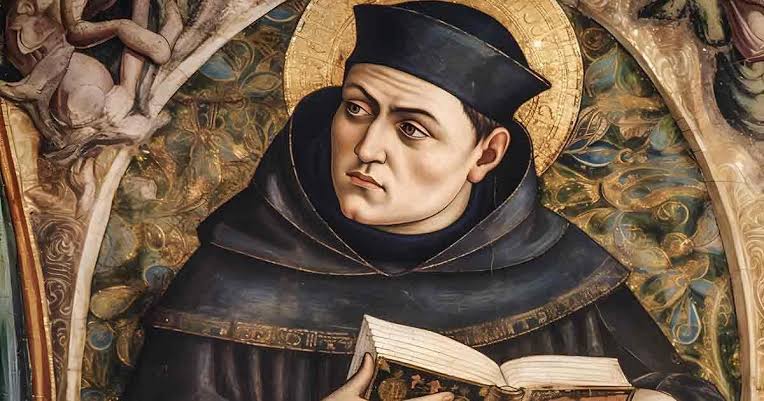
G.K. Chesterton, in his biography of Thomas Aquinas, wrote, Aquinas “was called the Dumb Ox. He was the object, not merely of mockery, but of pity…[St. Albert the Great knew] that the dunce is not always a dunce.. his famous cry and prophecy [about Thomas] – “You can call him a Dumb Ox; I tell you this Dumb Ox shall bellow so loud that his bellowings will fill the world.”
Chesterton also says, Aquinas “would not be an Abbot; he would not be a Monk; he would not be a Prior or ruler in his own fraternity; he would not be a prominent or important Friar; he would be a Friar. It is as if Napoleon has insisted on remaining a private soldier all his life.”
Given the expanse of his mind, Thomas Aquinas could have done just about anything he chose. Instead, he chose to think deeply about his faith and then share with us what he learned.
An excerpt from one of those writings—The cross exemplifies every virtue
“Why did the Son of God have to suffer for us? There was a great need, and it can be considered in a twofold way: in the first place, as a remedy for sin, and secondly, as an example of how to act.
“It is a remedy, for, in the face of all the evils which we incur on account of our sins, we have found relief through the passion of Christ. Yet, it is no less an example, for the passion of Christ completely suffices to fashion our lives. Whoever wishes to live perfectly should do nothing but disdain what Christ disdained on the cross and desire what he desired, for the cross exemplifies every virtue.
“If you seek the example of love: Greater love than this no man has, than to lay down his life for his friends. Such a man was Christ on the cross. And if he gave his life for us, then it should not be difficult to bear whatever hardships arise for his sake.
“If you seek patience, you will find no better example than the cross. Great patience occurs in two ways: either when one patiently suffers much, or when one suffers things which one is able to avoid and yet does not avoid. Christ endured much on the cross, and did so patiently, because when he suffered he did not threaten; he was led like a sheep to the slaughter and he did not open his mouth. Therefore Christ’s patience on the cross was great. In patience let us run for the prize set before us, looking upon Jesus, the author and perfecter of our faith who, for the joy set before him, bore his cross and despised the shame.
“If you seek an example of humility, look upon the crucified one, for God wished to be judged by Pontius Pilate and to die.
“If you seek an example of obedience, follow him who became obedient to the Father even unto death. For just as by the disobedience of one man, namely, Adam, many were made sinners, so by the obedience of one man, many were made righteous.
“If you seek an example of despising earthly things, follow him who is the King of kings and the Lord of lords, in whom are hidden all the treasures of wisdom and knowledge. Upon the cross he was stripped, mocked, spat upon, struck, crowned with thorns, and given only vinegar and gall to drink.
“Do not be attached, therefore, to clothing and riches, because they divided my garments among themselves. Nor to honors, for he experienced harsh words and scourgings. Nor to greatness of rank, for weaving a crown of thorns they placed it on my head. Nor to anything delightful, for in my thirst they gave me vinegar to drink.”
He wrote over 20,000 pages (some estimates say up to 100,000), and the way we think about your faith is directly related to those writings. His influence is beyond measure. Even so, on December 6, 1273, Aquinas had a deeply moving religious experience. He never wrote of it.“[E]verything he had written,” shared a friend, “seemed like straw to him by comparison with what he had seen and what had been revealed to him. He believed that he had at last clearly seen what he had devoted his life to figuring out and, by comparison, all he had written seemed pale and dry. Now that he could no longer write, he wanted to die.” He died four months later on March 7, 1274. Perhaps, one day, we’ll learn what he learned.

 Candle in a Cave