Sermon: Proper 17 RCL C – “The Lord’s Possession”


A father told his daughter, “You graduated with honors; here is a car I bought many years ago. It’s quite old now. But before I give it to you, take it to the used car lot downtown and tell them I want to sell it to see how much they’ll offer.” The daughter went to the used car lot, came back, and said, “They offered me $1,000 because it looks very worn out.” The father then said, “Take it to the pawnshop.” The daughter went to the pawnshop, returned, and said, “They offered $100 because it is a very old car.” The father then asked his daughter to show the car at a car club. The daughter took the car there, came back, and told her father, “Some people in the club offered $100,000 because it’s a Nissan Skyline R34, an iconic car that’s highly sought after.” The father said, “The right place values you the right way. If you are not valued, don’t be upset; it means you are in the wrong place. Those who recognize your worth are the ones who appreciate you. Never stay in a place where no one sees your value.”

While he was in Corinth, the Apostle Paul wrote a letter to the church in Rome—The Letter to the Romans. He had not yet visited the city, but news of the church there had reached him.

Broken down, Romans provides guidance on several topics, but overall, Paul’s main concern is the conflict between Jewish Christians and Gentile Christians. This was actually a common issue in the early Church. 

We know that the Israelites are God’s chosen people. The word “chosen” is defined as “selected or marked for favor or special privilege.” That very much describes the Covenant God made with Abraham and explains why the Israelites were chosen. When making the Covenant, God said, “Go from your country and your kindred and your father’s house to the land that I will show you. And I will make of you a great nation, and I will bless you and make your name great, so that you will be a blessing. I will bless those who bless you, and him who dishonors you I will curse, and in you all the families of the earth shall be blessed.” (Genesis 12:2-3)

It is easy to see the “marked for favor or special privilege” in those words. And it is also easy to overlook why the Israelites were so marked, but it is right there in the middle—“And I will make of you a great nation, and I will bless you and make your name great, so that you will be a blessing.”

Yes, God says, I am setting you apart for blessing and honor, but I am doing so for a very specific purpose. I am blessing you so that you will be a blessing to the world. The Lord stated it clearly through the Prophet Isaiah.

“It is too light a thing that you should be my servant
    to raise up the tribes of Jacob”

(The “tribes of Jacob” is understood to be all the Jewish people—the Israelites.)

“It is too light a thing that you should be my servant
    to raise up the tribes of Jacob
    and to bring back the preserved of Israel;
I will make you as a light for the nations,
    that my salvation may reach to the end of the earth.” (Isaiah 49:6)

God selected the Israelites to be His chosen people so they could bless others, and in return, He promised to bless them. However, somewhere along the way, it seems that the Israelites focused more on being blessed than on blessing others. They viewed their chosen-ness as a privilege and a right to look down on those around them.

Following the death and resurrection of Jesus, many Israelites became Christians and brought their Jewish practices with them. This wasn’t a problem as long as they didn’t impose these practices on the Gentiles. However, they also carried with them a false idea of being chosen and privileged. So, in his letter to the Romans, Paul asks, “What then? Are we Jews any better off? No, not at all. For we have already charged that all, both Jews and Greeks, are under sin.” (Romans 3:9) A few paragraphs later, he asks, “Is God the God of Jews only? Is he not the God of Gentiles also? Yes, of Gentiles also, since God is one—who will justify” both by faith. (Romans 3:29-30) In other words, no one has any special privileges except those who come to God in faith. Therefore, Paul says in chapter 12 of Romans, “Let love be genuine. Abhor what is evil; hold fast to what is good. Love one another with brotherly affection. Outdo one another in showing honor.” (Romans 12:9-10) and “Live in harmony with one another. Do not be haughty, but associate with the lowly.” (Romans 12:16a)

This theme recurs often in Paul’s letters. In his letter to the Philippians: “Do nothing from selfish ambition or conceit, but in humility count others more significant than yourselves. Let each of you look not only to his own interests, but also to the interests of others.” (Philippians 2:3-4) To the Ephesians, he says, “I… urge you to walk in a manner worthy of the calling to which you have been called, with all humility and gentleness, with patience, bearing with one another in love, eager to maintain the unity of the Spirit in the bond of peace.” (Ephesians 4:1-3)

This all connects back to and could have originated from the events in our Gospel reading today. 

Jesus was invited to the home of a Pharisee to share a Sabbath meal. As we know, most Pharisees were not real fond of Jesus and were happy to let him know. Usually, when they had Him around, they looked for ways to trap Him. This time is no different. 

The Pharisees closely resembled the Jewish Christians of Paul’s time. They, more than any other Israelites, were called to be the priests—if you will, the light of the lights of the world. Instead, they became a burden to the people and saw themselves as superior. In their eyes, they were the truly chosen. Remember the Pharisee and the tax collector praying in the Temple, and how the Pharisee prayed, “God, I thank you that I am not like other men, extortioners, unjust, adulterers, or even like this tax collector. I fast twice a week; I give tithes of all that I get.” (Luke 18:11-12) 

And, in the time of Jesus, this one-upmanship wasn’t limited to the religious leaders. Remember when James’ and John’s momma got into the mix? “Say that these two sons of mine are to sit, one at your right hand and one at your left, in your kingdom.” (Matthew 20:21) Then there was the argument over who is the greatest. On and on and round and round. It all boils down to the same thing—they all wanted the best seat at the party or, at the very least, a place at the head table. 

You’re probably thinking, I know where he’s going with this one. He’s going to tell us how we wrongfully assign value to others based on influence, income, status, and similar factors. That’s a sermon I’ve preached before, but today, I want you to focus on yourself. What value do you place on your own soul? 

I know many people who believe their worth to the world doesn’t even reach 100 dollars—pocket change, if that. They think that not only are they unworthy of a good place at the table, but they shouldn’t even be invited to the banquet. Yet, Jesus the Good Shepherd would leave the ninety-nine to find you. No matter how you see yourself, Jesus looked at you and said, You are worth dying for. Each individual soul is of the utmost value to God. To paraphrase St. Augustine, “The whole universe, with all its good things, is not worth as much as the soul of one humble person.”

St. Paul said, “For none of us lives for ourselves alone, and none of us dies for ourselves alone. If we live, we live for the Lord; and if we die, we die for the Lord. So, whether we live or die, we are the Lord’s possession.” (Romans 14:7-8)

We are given the freedom to set aside concerns about which seat we hold at the table. Why? Because we are all the Lord’s possessions. He bought us with His very own blood. Therefore, our one and only concern should be whether or not we are living a life worthy of an invitation to the banquet. That is why Paul and Jesus both became upset about this argument. It was never about who was the greatest or who would sit at the head table. It has always been about who would be invited to the banquet—who would attain salvation. 

Jesus’ life, every word and action, proclaims to you, You are worth more to me than life itself. I invite you to the banquet. I have a seat set aside just for you. Here, He says, is your invitation. All you need to do is accept.

Let us pray: O God, source of all life and goodness, you fashion human lives in your image and likeness, and through your love, give each human life dignity, sacredness, and priceless worth; awaken in every heart new reverence for the least of your children, and renew among your people a readiness to nurture and sustain your precious gift of human life at all stages, and in all conditions. Amen.

Sermon: Epiphany 4 RCL B – “Be Silent!”


One of the great comedians was Red Skelton. He could bring down the house without a single foul word, but his wife tended to be the topic of more than a few one-liners.

“Two times a week, we go to a nice restaurant, have a little beverage, good food, and companionship. She goes on Tuesdays, I go on Fridays.

We also sleep in separate beds. Hers is in California, and mine is in
Texas.

I take my wife everywhere….but she keeps finding her way back.

I asked my wife where she wanted to go for our anniversary. ‘Somewhere I
haven’t been in a long time!’ she said. So I suggested the kitchen.”

He does concede that he is also to blame. He said, “The last fight was my fault, though. My wife asked, ‘What’s on the TV?’ He said, ‘Dust!’”

Like all married couples, they had their ups and downs, but there are those special few that seem to transcend the norms. Marriages where there are differences, but the love shared between the two is far greater than all those differences combined. Take a young couple from the Netherlands as an example.

As their names are Dutch, I don’t have a chance of pronouncing them correctly, so we’ll describe them as the Colonel and the Lady. During their lifetimes in the Netherlands, the separation between Protestants and Catholics was severe. Separate schools, hospitals, neighborhoods, and even sections of the cemetery were divided by an eight-foot wall. All of these rules of separation were strictly enforced. 

The Colonel was born and raised Protestant, and the Lady was Catholic. They shouldn’t have gotten along at all, so it created a great controversy when they decided to get married. Their love was greater, and despite the obstacles and objections, in 1842, they wed, living happily ever after for thirty-eight years until the Colonel’s death in 1880. Because he was born and raised Protestant, he was buried in the Protestant section of the cemetery. Eight years later, when the Lady died, she was to be buried in the family plot on the Catholic side, but she had other ideas. She had no intention of being separated from her husband, so she made arrangements to be buried next to the wall that separated the Protestant and Catholic sections of the cemetery. She then had their tombstones constructed tall enough so that a pair of hands could be joined over the top of the eight-foot dividing wall. (A picture is on the front of your bulletin.)

Remember a few weeks back when we talked about signs—as in signs and wonders? I would suggest that these joined tombstones are a sign. Something that is pointing to something even greater. They are a sign that demonstrates how, within the human soul, the love between two people can overcome many obstacles, which then points to how this same love can overcome the barriers between peoples. This love reaches over walls to meet the other and to bring healing to individuals, cultures, and nations. It is a sign that points outward—to something greater than one couple—but it is also a sign that points inward to the soul of each of us. That’s the direction I would like to focus on today—the healing of the soul—because within… it is almost like two people are living in each of us (No. I’m not schizophrenic.) 

This pointing inward relates to what St. Paul says in his letter to the Romans, “We know that the law is spiritual, but I am of the flesh, sold under sin. For I do not understand my own actions. For I do not do what I want, but I do the very thing I hate.” (Romans 7:14-15) Within is a side that knows what God calls us to, and within—on the other side of the wall—there is a side that does whatever the heck it pleases. A life with God and a life in the world—both working independently and often having very different desires. However, our goal as a Christian people is to have those two operating together. Not so that our worldly side can drag down our faith but so that our faith and our life with God can cooperate and inform our life in the world. Within, we need to join hands over the wall so that our life in the world and our life of faith are in concert with one another.

For example, working in the world is necessary. We have jobs to do and responsibilities to our families and communities. Working in the world is not a bad thing; it is actually very good and beneficial, but while there, we don’t always act in a manner that reflects what we profess on Sunday morning. In the world, we may gossip, become angry, cheat, be uncharitable toward others, and so on. In our Baptismal Creed, we say we will “seek and serve Christ in all persons, loving our neighbor as ourselves.” On Sunday, we love our neighbor. Monday through Saturday, all bets are off. That wall, a very solid division between our Sunday selves and our Monday through Saturday selves, keeps those two selves within us separated. What is curious—almost humorous, but not in a funny way—is that when our God side tries to reign in our world side, the world side gets a little bent out of shape.

Think about our Gospel reading. The man with the unclean spirit. What did the unclean spirit say when it encountered Jesus? “What have you to do with us, Jesus of Nazareth? Have you come to destroy us? I know who you are, the Holy One of God.” When our God side attempts to reign in our world side, our world side can sometimes say the same thing. “What have you got to do with us, Jesus? Your day is Sunday! This is a Thursday. Get back on your side of the wall!” That’s not how it is supposed to work. 

Jesus said, “If you were of the world, the world would love you as its own; but because you are not of the world, but I chose you out of the world, therefore the world hates you.” (John 15:19) We must live in the world, but we are from God, so our life in the world must reflect our life in God. Our life in the world and our life in God must reach over that wall and take hands so that they both follow the way that leads to eternal life in Jesus.

Jesus responded to the unclean spirit: “Be silent, and come out of him!” That must also be our response when the world part of us attempts to reign over God within us. “Be silent! You are not the one who rules over my life.” In doing so, we begin to bring healing to our souls. Repairing the brokenness within.

Have you noticed that some people cross themselves during the Lord’s Prayer when we pray, “Deliver us from evil?” Ever wonder why? 

The Lord’s Prayer is given to us in Matthew 6:9-13. The second part of verse 13 is “deliver us from evil,” but looking at the footnotes in most Bibles, you will see that this can be translated in two ways. The first is what we pray it. In that context, evil is very general, and we can take it to mean those bad things or people that come against us. However, the second way of translating the verse is “deliver us from the evil one.” (This is how the Eastern Orthodox churches pray it.) In this case, evil is not general. Instead, evil is very specific and personified. We cross ourselves as a means of blessing and protection from this evil one. Sometimes, as I pray that line, I take a little liberty with it and pray, “And lead me not into temptation, but deliver me from the evil one that is within me.” It is a way for me to say, “Be silent!” to the side of me that wants to rule over the ways of God. It is a way for God to reach over the internal wall and take the hand of the side of me that must be in the world and show it the way.

When you sense any voice attempting to lead you from the voice of God, speak to it clearly and boldly, “Be silent!” Then pray, “Deliver me from the evil one,” join hands with Jesus, and live out your faith in every aspect and every day—Monday through Sunday—of your life.

Let us pray: Saint Michael the Archangel, defend us in battle. Be our protection against the wickedness and snares of the devil. May God rebuke him, we humbly pray; and do Thou, O Prince of the Heavenly Host, by the Power of God, cast into hell Satan and all the evil spirits, who prowl through the world seeking the ruin of souls.  Amen.

Sermon: RCL C – “All Saints Sunday”

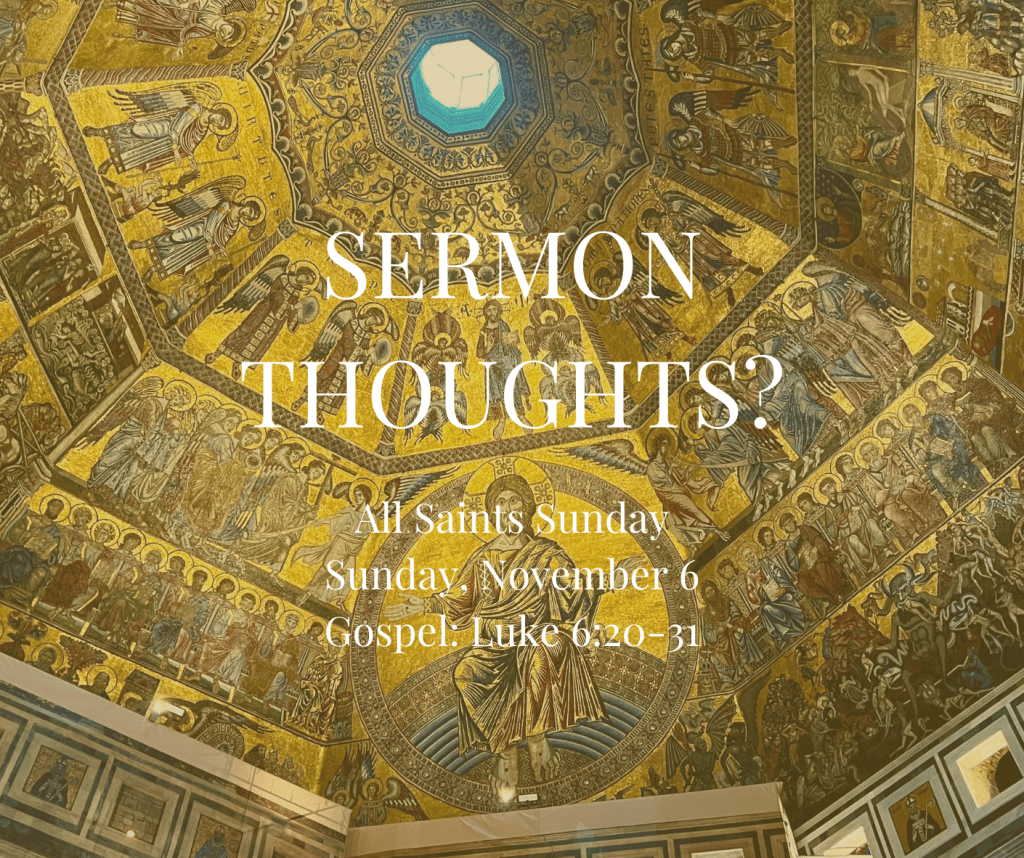
A picture I took while in Florence, Italy, of the ceiling in The Baptistery of St. John at the Duomo

Irish History: Stingy was a miserable, old drunk who liked to play tricks on everyone: family, friends, his mother, and even the Devil himself.  He once invited the Devil to have a drink with him. True to his name, Stingy didn’t want to pay for his drink, so he convinced the Devil to turn himself into a coin he could use to buy their drinks. Once the Devil did so, Stingy decided to keep the money and put it into his pocket next to a silver cross, which prevented the Devil from changing back into his original form. He eventually freed the Devil under the condition that he would not bother him for one year.

As the story goes, Stingy, one day, tricked the Devil into climbing up an apple tree. Once the Devil climbed up the apple tree, Stingy hurriedly placed crosses around the trunk of the tree. The Devil was then unable to get down the tree. Stingy made the Devil promise not to take his soul when he died. Once the devil promised not to take his soul, Stingy removed the crosses and let the Devil down. 

When Stingy finally died many years later, he went to the pearly gates of Heaven and was told by Saint Peter that he was too mean and cruel and had led a miserable and worthless life on earth. He was not allowed to enter heaven. He then went down to Hell and the Devil. The Devil kept his promise and would not allow him to enter Hell. Stingy was scared and had nowhere to go but to wander about forever in the darkness between heaven and hell. He asked the Devil how he could leave as there was no light. The Devil tossed him an ember from the flames of Hell to help him light his way. Stingy placed the ember in a hollowed-out turnip, one of his favorite foods he always carried around whenever he could steal one. From that day onward, Stingy (a.k.a. Stingy Jack) roamed the earth without a resting place, lighting his way as he went with his “Jack O’Lantern.” 

On all Hallow’s eve, which would have been this past Monday, the Irish hollowed out turnips, rutabagas, gourds, potatoes, and beets. They placed a light in them to ward off evil spirits and to keep Stingy Jack away. These were the original Jack O’Lanterns. In the 1800s, Irish immigrants came to America and quickly discovered that Pumpkins were bigger and easier to carve out.

This past week we celebrated All Saints’/Hallows Eve, All Saints’ Day, and All Soul’s Day. In other words, we celebrated all the saints—capital “S” and lowercase “s”—who carried the bright light of the faith. The idea of caring for the soul is—as you know—one that has been ruminating in my mind for several months now. I suppose it comes with the territory, but this past week I wondered if our souls were happy, content, sad, angry, peaceful, or something else. And, of course, the answer depends on the person, but for all of us, we must consider: is our soul in such a condition to allow us into Heaven or, like Stingy Jack, whether will we be denied admittance? 

The Lord has constantly been providing the information we need to remain on the path that leads to Him, yet no matter how hard he tries, we, as his ultimate creation, have a difficult time staying on that path.

The first attempt was the Garden of Eden: “You may surely eat of every tree of the garden, but of the tree of the knowledge of good and evil you shall not eat, for in the day that you eat of it you shall surely die.” One rule: don’t eat the apple. That didn’t work out, so God gave Moses The Law: “Thou shall have none other Gods but me… no graven images… keep the Sabbath Holy… don’t steal or murder or commit adultery.” You know them all. Right?

God provided these laws not to keep us under his thumb but to keep us safe. To protect our souls and to save us from sin, and by golly, we break them at every opportunity. So the condition of our soul comes into question once again. Are we headed to heaven or hell? Yet, out of his great love for us, God makes another way available: Jesus. Romans 10:13—“Everyone who calls on the name of the Lord will be saved.” We hear that and think, “That’s the ticket. Bought and paid for.” We respond, “Amen. I’ll take it!” 

No more of the “Thou shall not” business. Instead, we get “blessed are the poor, the meek, the merciful, the peacemaker, and so on.” We think, “It’s all good!” The beatitudes present the very heart of Jesus; however, the catch is that the beatitudes are not an abolishing of the “Thou shall not’s.” Jesus is not making things easier! He is intensifying the Ten Commandments and taking them to their most radical end. How?

“Thou shall not kill.” Fine. I haven’t killed anyone (yet).. but I haven’t! However, Jesus said, “You have heard that it was said to those of old, ‘You shall not murder; and whoever murders will be liable to judgment.’ But I say to you that everyone who is angry with his brother will be liable to judgment; whoever insults his brother will be liable to the council; and whoever says, ‘You fool!’ will be liable to the hell of fire.” I thought I was golden with not killing, but as it turns out, I’m not even close.

“Thou shall not steal.” You don’t take from others but go back to what we talked about a few weeks back: things done and left undone. There are sins of commission and sins of omission. “Thou shall not steal.” You did not take when you were not supposed to, but “Thou shall not steal” also means, did you give when you were supposed to give? Not stealing is the bare minimum.

How far would we fall short if we began to analyze, “Blessed are the pure in heart for they shall see God” in the same manner? I’ll let you do that alone because I’m not brave enough to do it for myself. Yet, even though I am not courageous enough and seem unable to fulfill the calling God places on my life… the calling is still the truth. It is the one path that Christ calls us to in order to be his disciples. Could we soften it? Make it less difficult?

Lee is the cook and housekeeper for the Trask family in John Steinbeck’s East of Eden. In one scene, Lee is talking to Adam Trask and says, my father said, “There’s more beauty in the truth even if it is dreadful beauty. The storytellers at the city gate twist life so that it looks sweet to the lazy and the stupid and the weak, and this only strengthens their infirmities and teaches nothing, cures nothing, nor does it let the heart soar.” The Beatitudes are the path that Christ Jesus has set for us. They are the truth we must come to grips with so that our hearts and souls may soar. So how do we fulfill them?

Speaking on The Beatitudes in a 2015 sermon, Pope Francis said, “This is the way of holiness, and it is the very way of happiness. It is the way that Jesus traveled. Indeed, He himself is the Way: those who walk with Him and proceed through Him enter into life, into eternal life. Let us ask the Lord for the grace to be simple and humble people, the grace to be able to weep, the grace to be meek, the grace to work for justice and peace, and above all the grace to let ourselves be forgiven by God so as to become instruments of his mercy.

“This is what the Saints did, those who have preceded us to our heavenly home. They accompany us on our earthly pilgrimage, they encourage us to go forward. May their intercession help us to walk on Jesus’ path, and to obtain eternal happiness.” (Source)

The Beatitudes are beauty, but they are Steinbeck’s “dreadful beauty” in that they are the truth and path of our life with God, but the truth and path that we fall so dreadfully short of. However, failure does not mean we quit. As Francis encouraged us, we pray for the grace to follow the path and the grace of forgiveness when we fail. As my friend, St. Josemaría Escrivá, said, “You — be convinced of it — cannot fail. You haven’t failed; you have gained experience. On you go!” Guided by the Saints, get back to the path lit—not by some ember in a gourd, but by the very light of Christ, so… On you go! We have work to do.

Let us pray: Almighty God, you have knit together your elect in one communion and fellowship in the mystical body of your Son Christ our Lord: Give us grace so to follow your blessed saints in all virtuous and godly living, that we may come to those ineffable joys that you have prepared for those who truly love you; through Jesus Christ our Lord, who with you and the Holy Spirit lives and reigns, one God, in glory everlasting. Amen.


Join the conversation on St. Matthew’s Facebook page.