Sermon: Advent 2 RCL A – “Prophet’s Call”


The American Film Institute has several “Top 100” lists: 100 best movies, 100 best musicals, 100 best heroes and villains, and so on. They also have the “100 top movie quotes.” Way down in the 80s, we have lines like, “Yo, Adrian,” and “My Precious.” Moving up into the 40s, there is “Shane. Shane. Come back,” and “Stella! Hey, Stella!” Then breaking into the top ten, there are “Go ahead, make my day,” and “I’m gonna make him an offer he can’t refuse.” Number one on the list, you’ve got to love Rhett Butler—“Frankly, my dear, I don’t give a….” However, the one I’m thinking of today comes in at number ten, spoken by Travis Bickle, played by Robert De Niro, in Taxi Driver. The line: “You talkin’ to me? You talkin’ to me!?” (Source)

In our Gospel reading, when John the Baptist confronts the Pharisees and Sadducees, I can picture them glancing at each other, then at John, and in their best Robert De Niro impression, asking, “You talkin’ to me?!” And then John firing back with number forty-four on the AFI list, “I see dead people.” Okay. Enough of that. 

As we know, John’s criticism didn’t stop with the religious leaders. He was an equal-opportunity rebuker, and later, he would criticize Herod for marrying his brother’s sister, which landed him in jail and eventually led to his beheading. Yet for the prophets, including John the Baptist, they were almost always upsetting someone and finding themselves in danger.

In the Acts of the Apostles, the first deacon was Stephen. He said to the religious leaders, “You stiff-necked people, uncircumcised in heart and ears, you always resist the Holy Spirit. As your fathers did, so do you. Which of the prophets did your fathers not persecute? And they killed those who announced beforehand the coming of the Righteous One.” (Acts 7:51-52) They then proceeded to stone him to death.

Despite the dangers of the job, the prophet’s role is to stir up the people and point out their errors, hoping they will return to God. In fact, they are responsible for the souls of the people before God. Speaking to Ezekiel, the Lord said, “So you, son of man, I have made a watchman for the house of Israel. Whenever you hear a word from my mouth, you shall give them warning from me. If I say to the wicked, O wicked one, you shall surely die, and you do not speak to warn the wicked to turn from his way, that wicked person shall die in his iniquity, but his blood I will require at your hand. But if you warn the wicked to turn from his way, and he does not turn from his way, that person shall die in his iniquity, but you will have delivered your soul.” (Ezekiel 33:7-9)

Prophet: a dangerous job before the people and before God, yet God calls those He chooses. The Prophet Jeremiah said, “The Lord put out his hand and touched my mouth. And the Lord said to me,
‘Behold, I have put my words in your mouth.
See, I have set you this day over nations and over kingdoms,
to pluck up and to break down,
to destroy and to overthrow,
to build and to plant.’”
(Jeremiah 1:9-10)

The Lord chooses and sends His prophets to speak His words, not their own. Knowing this, you might think they—dare I say, “We”?—would respond accordingly, but it was said, “The Lord, the God of their fathers, sent persistently to them by his messengers, because he had compassion on his people and on his dwelling place. But they kept mocking the messengers of God, despising his words, and scoffing at his prophets, until the wrath of the Lord rose against his people, until there was no remedy.” (2 Chronicles 36:15-16)

The same was true with John the Baptist. The people heard what was said, but they did not respond according to the will of God. Instead, they became angry with these messengers and persecuted them, often putting them to death. Thank goodness we are not like them. We accept criticism and correction very well. When someone offers Godly corrections to us, we don’t get angry. No, sir. We might get even, but we don’t get angry! Right?

Let me ask you this: you hear John the Baptist crying out, “Repent, for the kingdom of heaven has come near.” How do you respond? The human thing to do is to look at everyone around you and say, “Darn tooting! Y’all need to repent! Get right with the Lord!” The whole time, thinking John the Baptist couldn’t possibly be talking to you. Or what about this: Christian groups love to quote this one from 2nd Chronicles: “If my people who are called by my name humble themselves, and pray and seek my face and turn from their wicked ways, then I will hear from heaven and will forgive their sin and heal their land.” (2 Chronicles 7:15) What’s the first thing to go through your head? “If those left-wingers or the fascist right (I too am an equal opportunity rebuker) would just learn to pray and follow Jesus, then this whole thing could be sorted out overnight!” Can I get an “Amen”? Why do we think this way? Isn’t it obvious? This call to turn from wicked ways is about them, and has nothing to do with me! 

However, the prophet confronts us and says, “Oh, yes, it is. It is all about you. You are the one who needs to get right with God.” Like everyone else, we don’t much like hearing it, but we must be willing to listen to the words of John the Baptist—“Repent, for the kingdom of heaven has come near.”—and allow those words to be spoken to us personally and as the Church. We must let God correct us so we are not the ones provoking His wrath. Through this process of correction, we are allowing him to perfect us. As the Lord told the church in Laodicea, “Those whom I love, I reprove and discipline, so be zealous and repent.” (Revelation 3:19)

How can we let the prophets’ words speak to us and correct us? There is a powerful phrase from Martin Luther: “The Cross tests everything.”  

If we test our thoughts, actions, and deeds the same way the Pharisees and Sadducees evaluated theirs, we respond like they did—“You talking to me?” However, if we test those same thoughts, actions, and deeds by the Cross, we may discover a different outcome. It might not be what we want to hear, but it will be God’s truth.

I wonder, if we are willing and brave enough to look closely, which part of ourselves, our lives, our being would we hesitate to put to the test of the Cross? I suspect there are aspects of all our lives that are much safer tucked away in their own personal niches, their own special places of worship within our souls, even illuminated with one of those little votive candles—areas that are far too cherished by the Great “I” to be put to such a test. Yet, if we did, if we nailed those silly notions to that most sacred tree, the Cross, well, they would likely scream out in protest and blasphemy, just like the wicked thief did who was crucified with Jesus. But in the end, we would be set free from those things that bind us.

The prophets deliver messages to a world that is broken, but their messages are also for us. Jesus says, “He who has ears, let him hear.” (Matthew 13:9) I pray that if you hear in your soul John the Baptist calling you to repentance, don’t be like those who become proud and angry. Instead, submit to the call of repentance and accept the forgiveness of sins; for as St. John tells us, “If we confess our sins, [God] is faithful and just to forgive us our sins and to cleanse us from all unrighteousness.” (1 John 1:9)

Let us pray: 

O God,
You raised up St. John the Baptist
to prepare a perfect person for Christ.
We call upon St. John’s intercession
to properly prepare us with a true
sense of repentance to receive Your
grace and salvation.
Make us faithful to Truth and justice,
as You did Your servant,
John the Baptist, herald of Your Son’s
birth and death. Lord, may You increase
Your life within us.
Amen.


Sermon: Proper 16 RCL C – “Lifetime Sabbath”


I don’t consider myself a bona fide marriage counselor, so I depend on other sources to help me give good advice. For example, I’m particularly fond of a Home Economics book from the 1950s. I believe it gets to the heart of the matter.

The section heading is “How to be a Good Wife.”

HAVE DINNER READY: Plan ahead… Most men are hungry when they come home, and having a good meal prepared is part of the warm welcome they need.

PREPARE YOURSELF: Greet him with a smile.

CLEAR AWAY THE CLUTTER: Make one last walk through the main part of the house just before your husband arrives, gathering up children’s books and toys, papers, etc. Then run a dust cloth over the tables. Your husband will feel he’s reached a haven of rest and order, and—as a bonus—it will give you a lift too.

PREPARE THE CHILDREN.

MINIMIZE ALL NOISE.

SOME “DO NOT’S”: Don’t greet him with problems or complaints. Don’t complain if he’s late for dinner. Consider this a minor issue compared to what he might have gone through that day.

MAKE HIM COMFORTABLE: Have a cold or warm drink ready for him… Allow him to relax and unwind.

LISTEN TO HIM.

MAKE THE EVENING HIS: Never complain if he doesn’t take you to dinner or other entertainment. Instead, try to understand his world of stress and pressure, and his need to unwind and relax.

THE GOAL: TO MAKE YOUR HOME A PLACE OF PEACE AND ORDER WHERE YOUR HUSBAND CAN RELAX IN BODY AND SPIRIT.

Fellas, I’ll need some bodyguards following the service.

The truth is, we all need opportunities to rest and relax in body and spirit. In terms of our faith, such a rest is called a Sabbath.

As you know, keeping the Sabbath ranked in the top five of the top ten Laws of Moses—“Remember the Sabbath day, to keep it holy. Six days you shall labor, and do all your work, but the seventh day is a Sabbath to the Lord your God.…Therefore the Lord blessed the Sabbath day and made it holy.” (Exodus 20:8-9, 11b)

Philo of Alexandria was a Jewish philosopher who lived during the time of Jesus. Speaking of the Sabbath, he wrote, “On this day we are commanded to abstain from all work, not because the law inculcates slackness…. Its purpose is rather to give man relaxation from continuous and unending toil and by refreshing their bodies with a regularly calculated system of remissions to send them out renewed to their old activities. For a breathing spell enables not merely ordinary people but athletes also to collect their strength with a stronger force behind them to undertake promptly and patiently each of the tasks set before them.” (The Sabbath, p.14)

Rabbi Heschel tells us, “The Sabbath is not for the sake of the weekdays; the weekdays are for the sake of the Sabbath. It is not an interlude but the climax of living.” (Ibid.)

There is a great deal of writing on the Sabbath, so this is very much an oversimplification, but it is a gift—a gift from God. It is the opportunity for everyone to be renewed in body and spirit. We can see the Sabbath as just a Law, something that must be obeyed, but it’s so much more than that. It’s a Law that allows us to be with our God, but it’s also a Law because we need it. Our bodies need rest, as do our souls. A quote from St. Augustine I shared with you a few weeks back, “You have made us for yourself, O Lord, and our hearts are restless until they rest in you.” Not just at the end of our days, but each and every day.

From our Gospel reading: “Now Jesus was teaching in one of the synagogues on the sabbath. And just then there appeared a woman with a spirit that had crippled her for eighteen years. She was bent over and was quite unable to stand up straight.” I’m certain that this woman would have been thrilled with a weekly Sabbath free from her crippling pain. One day out of seven to rest and relax from it is better than none; however, what she truly needed was a daily Sabbath, a lifetime Sabbath from her burden, and she received it. “When Jesus saw her, he called her over and said, ‘Woman, you are set free from your ailment.’ When he laid his hands on her, immediately she stood up straight and began praising God.”

We also know that these signs and miracles of Jesus are multidimensional—they are healings, but they also point toward something even greater. Therefore, in this case, we could also say that the woman was burdened not with a physical malady but a spiritual one. We could say she was burdened with sin or the shame and guilt of sin or even the anger caused by another’s sin. We could say that she had been carrying this spiritual malady for so long that her soul was bent from the burden. Just like the physical issue, she would rejoice over one day of freedom, but what she truly needed was a lifetime Sabbath. Her entire life needed to find rest, and this, too, Jesus would give her. “Woman, you are set free from your ailment.”

Is that possible? Can a soul have a lifetime Sabbath from its burdens? St. Augustine tells us, “Our soul is weighed down by sin as by a burden. When it turns to You, Lord, it finds rest, for it finds forgiveness.” (Confessions, X.28) And St. Gregory of Nyssa writes, “True Sabbath is when the soul looks no longer at its own sins, nor is burdened with the memory of evil, but rejoices in the good alone.” 

Yes, it is possible to have a lifetime Sabbath from those things that burden our souls, and our souls need it. Just as our bodies break down without rest, so do our souls.

A professor walks to the front of the class and holds up a glass of water. She asks, “How heavy is this glass of water I’m holding?”

The students begin shouting out answers.

After a few guesses, she says, “From my perspective, the absolute weight of this glass doesn’t matter. It all depends on how long I hold it. If I hold it for a minute or two, it’s fairly light. If I hold it for an hour straight, its weight might make my arm ache a little. If I hold it for a day straight, my arm will likely cramp up and feel completely numb and paralyzed, forcing me to drop the glass to the floor. In each case, the weight of the glass doesn’t change, but the longer I hold it, the heavier it feels to me.”

She continues, “Your stresses and worries in life are very much like this glass of water. Think about them for a while, and nothing happens. Think about them a bit longer, and you begin to ache a little. Think about them all day long, and you will feel completely numb and paralyzed—incapable of doing anything else until you drop them.” (Source)

Stresses and worries, carried for too long, can make you completely numb and paralyzed. Sin, the shame and guilt of sin, the anger at another’s sin, can do the exact same thing. It can burden and cripple your soul. The weight, carried for too long, is too much. You need a Sabbath rest from it, but not just for a day. You need to live a Sabbath life, resting in Jesus. How do we rest in Jesus? Peter says, “Humble yourselves, therefore, under the mighty hand of God so that at the proper time he may exalt you, casting all your anxieties on him, because he cares for you.” (1 Peter 5:6-7) We find rest in Jesus by coming before our Lord and, with gratitude in our hearts, placing our burdens—the sin, the pain, the evil—in His strong hands. In doing so, we will hear the words of Jesus, “You are set free from your ailment.” 

Jesus said, “Come to me, all who labor and are heavy laden, and I will give you rest—I will give you a lifetime Sabbath. Take my yoke upon you, and learn from me, for I am gentle and lowly in heart, and you will find rest—Sabbath—for your souls. For my yoke is easy, and my burden is light.” (Matthew 11:28-30)

My marriage counseling might not be up to snuff, but this I know to be true:

“Cast your burden on the Lord,
    and he will sustain you;
he will never permit
    the righteous to be moved.” (Psalm 55:22)

Jesus died on the Cross and rose again, not only so that on the last day you might have an eternal Sabbath in Him, and not only so that you might have a Sabbath rest one day a week. Jesus died and rose again so that you might have a Sabbath in Him all the days of your life. “Cast your burden on the Lord,” so that you “may have life and have it abundantly.” (John 10:10b)

Let us pray:
Lord Jesus,
in our weariness and burdens, we come to You.
In Your gentle heart, we find rest.
Teach us to walk in Your humility
and to trust in Your love.
Yoke our lives to Yours, that we may carry our trials with grace,
knowing You are beside us.
Calm our restless souls, and let Your peace dwell within us.
In You alone is our refuge, our strength, and our home.
Amen.

Sermon: Proper 14 RCL C – “O My Jesus…”


A father reports that he used to have trouble getting his son to clean his room. The father would insist that he, “Do it now,” and the son would always agree to do so, but then he wouldn’t follow through—at least not right away. After high school, the son joined the Marine Corps. When he came home for leave after basic training, his father asked him what he had learned.

“Dad,” he said, “I learned what ‘now’ means.”

For me, when it comes to cleaning house, “Now” generally means the day or a few hours before I expect company; otherwise, there’s a good chance that there will be dirty dishes in the sink, dirty socks on the floor, a pile of clean laundry waiting to be folded on the dining room table, and if the cat got sick on my desk, it would be in better shape than it is now. I guess I agree with Phyllis Diller and Erma Bombeck when it comes to housework. Phyllis says, “Housework won’t kill you, but then again, why take the chance?” And Erma writes, “My theory on housework is, if the item doesn’t multiply, smell, catch fire, or block the refrigerator door, let it be. No one else cares. Why should you?” 

I’m guessing they weren’t real keen on the word “Now” when it comes to housework, either. 

The Bureau of Labor Statistics reports that, on average, we spend 2.01 hours per day on household chores, and yes, women spend more time than men—1.67 hours for men and 2.34 for women. (Source) Clearly, they’ve never been to my house. I eventually get everything nice and clean, but it doesn’t last. Give it a few days, and the dishes will start to stack up again, and the dirty socks will be on the floor. Before you know it, the whole place needs a solid napalm strike to clear it all up.

In our Gospel reading, Jesus talks about the servants in a house who remain awake and alert, and the owner of the house who guards against the thief. The servants fulfill their duties for the Master—taking care of his needs and property—and the owner protects against the thief who wishes to break in and steal. In both cases, we understand that the home Jesus is speaking about is our soul—the dwelling place for the Holy Spirit of God. As God’s children, we are to take care of our souls, keeping them pure and free of sin, and we need to guard them so that the devil cannot come in and destroy them. But for me, sometimes the inside of my soul looks a bit like my house—a little messy.

On July 13, 1917, Our Lady of Fatima appeared for the third time to the three children—Lucia dos Santos, Jacinta Marto, and Francisco Marto. During the visitation, she gave them a brief but terrifying vision of hell. Lucia wrote, “She opened Her hands once more, as She had done in the two previous months. The rays of light seemed to penetrate the earth, and we saw as it were a sea of fire. Plunged in this fire were demons and souls in human form.” She then goes on to describe what they saw.

It was so terrifying, she later wrote, “How can we ever be grateful enough to our kind Heavenly Mother, who had already prepared us by promising, in the first Apparition, to take us to Heaven. Otherwise, I think we would have died of fear and terror.” 

During this same visitation, the Virgin Mary gave the children a prayer that we now know as the Fatima Prayer or O My Jesus

“O my Jesus, forgive us our sins, save us from the fires of hell; lead all souls to heaven, especially those most in need of thy mercy.”

Mary asked that the children share with the world her desire for this prayer to be said at the end of each decade of the Rosary. It is also prayed just before starting the first decade—the Our Father and the first ten Hail Marys. 

When I pray my Rosary, it is during those opening prayers that I begin—or at least try—to gain some sort of focus, and on one particular day, it was the same. I recited the Creed, prayed the Our Father, the first three Hail Marys, and the Gloria Patri, and then began the Fatima Prayer, “O my Jesus…” I stopped. The next word, “forgive,” simply would not come out. I tried again. “O my Jesus…” I couldn’t go any further. Why?

There was a story circulating when I was in seminary. It told of a young man who had a vision of himself entering a room. Inside the room were all these small files—row after row of them. The drawers seemed to be large enough to hold a piece of paper no bigger than a note card. As he got closer, he saw that each of the file drawers had labels. These included such things as “Books I Have Read” and “Television Programs I Have Watched.” There were others—“Lies I Have Told” and “Comfort I Have Given.” There was one that read “Things Done in Anger” and one right next to it, “Things I Have Said in Anger.”

He pulled that one out just to see what was inside, and to his horror, he found that written on each card was something he had said in anger. Then he realized he was standing in the record room of his life. Every single event, from the very best to the most sinful, had been recorded and filed. 

As he examined more of the file drawer labels, he became absolutely convinced that no one—not anyone!—should be allowed to see what was written here. But, of course, there was One who would see, and that One, Jesus, was suddenly present, standing before the man. 

Without a word spoken, and instinctively, Jesus went to the drawer that held the cards depicting the most horrible of sins, pulled it out, and began to read each card. The man was horrified and heartbroken. He collapsed in shame, but as he watched, he witnessed the most remarkable thing: on each of the cards, Jesus wrote His Name, covering the sin. 

There I was, trying to pray my Rosary, “O my Jesus…,” but unable to ask for forgiveness. Why? Well, it’s a bit like my house. When my house gets messy, it’s nothing new. It’s always the same mess. Dirty dishes, dirty socks, a messy desk, etc. My soul ends up the same way. When Jesus has to come in and go through the files of my life, it’s not like He pulls out a card and says, “Wow, didn’t see that coming,” or “Hey, that’s original.” No. It’s the same thing each and every time. Entire file drawers dedicated to my life with the same thing written time and time again, and Jesus signing over it again and again… O my Jesus. I found myself—not out of disobedience, but out of shame and frustration—simply unwilling to ask Him once more to forgive me for the same damn thing I asked Him to forgive me for the day or week before. O my Jesus.

I could imagine Him standing there, pen in hand, poised and ready to sign, and there I was… O my Jesus.

In our Gospel reading, Jesus said, “Be dressed for action and have your lamps lit; be like those who are waiting for their master to return from the wedding banquet, so that they may open the door for him as soon as he comes and knocks.” Yet, I’m sitting there in the middle of a very dirty house, knowing I must do something but unable to act.

Joshua said, “Choose you this day whom you will serve.”

Quoting what the Lord said to the Prophet Isaiah, Paul wrote, “In a favorable time I listened to you, and in a day of salvation I have helped you.” Then Paul added, “Behold, now is the favorable time; behold, now is the day of salvation.” (2 Corinthians 6:2)

“Son, what did the Marines teach you?” 

“Dad, I learned what ‘now’ means.”

And I prayed, “O my Jesus, forgive us our sins, save us from the fires of hell; lead all souls to heaven, especially those most in need of thy mercy.”

I’ll share something you might find hard to accept, but it’s true: no matter how much effort you put in, your soul will get dirty. You can’t keep it clean; once it becomes dirty, you won’t be able to clean it with your own strength and power. So, when the Master comes back—when Jesus returns—He will walk into the house of your soul and He will see the mess. Your only recourse is to say to Him today—right now—“O my Jesus, forgive.” And John tells us, “If we confess our sins, he is faithful and just to forgive us our sins and to cleanse us from all unrighteousness.” (1 John 1:9) If we confess our sins, Jesus will sign His name on the card and cover our sins.

The Psalmist writes, “For you, O Lord, are good and forgiving, abounding in steadfast love to all who call upon you.” Jesus stands ready to forgive all those who call on Him. Whatever reasons or excuses you may have—pride, shame, ignorance, stubbornness, or anything else—set it aside and humbly come before your God and King.

Let us pray… would you repeat after me: O my Jesus, forgive us our sins, save us from the fires of hell; lead all souls to heaven, especially those most in need of thy mercy. Amen.

Sermon: Advent 2 RCL C – “Song of the Soul”


A violinist noticed that his playing had a hypnotic effect on his audience. They sat motionless as though they were in a trance. He found he had the same impact on his friends’ pets. Dogs and cats would sit spellbound while he played. Wondering if he could cast the same spell over wild beasts, he went to a jungle clearing in Africa, took out his violin, and began to play. A lion, an elephant, and a gorilla charged into the clearing stopped to listen, and sat mesmerized by the music. Soon, the clearing was filled with every kind of ferocious animal, each one listening intently. Suddenly, another lion charged out of the jungle pounced on the violinist, and killed him instantly.

The first lion, bewildered, asked, “Why did you do that?”

The second lion cupped his paw behind his ear. “What?”

If you ask the experts, they will tell you that a digital recording produces better sound quality than a vinyl record. If you ask me, I’ll tell you vinyl produces better quality. Why? For whatever reason, I can hear it better, and for someone who does not hear so well, that is reason enough to spend a few more dollars on the music I genuinely enjoy. 

When you look at a record, you can see it has grooves/lines that the needle settles into. However, when you put a vinyl record under a microscope, it looks like a mountain range: ridges, valleys, bumps, wiggles, and all. When you play a CD, it is reading a digital code made up of ones and zeroes. When you play a vinyl record, the needle (stylus for all you aficionados) reads all those ridges, valleys, bumps, and wiggles, converting them into electrical signals that are then played through the speakers. If all goes well… beautiful music, but you have to take care of records.

A scratch on a CD may or may not damage the sound quality, but even minor scratches on a vinyl record will produce a popping sound. Why? You’ve added a new element to the ridges and valleys, and the needle reads it. It may pop, but if the scratch is bad enough, the needle may jump out of the groove and skip part of the song.

Today, our Gospel reading begins with a list of who’s who. Luke, by providing all these details, isn’t dropping names. Instead, he is setting the timeframe for those who would read his Gospel. So, with the info provided, we know it is about 29/30 AD. (FYI: many believe that AD means “after death,” referring to the death of Jesus. However, it is an abbreviation for Anno Domini, meaning “the year of our Lord.”) What is Luke setting the timeframe for? The ministry of John the Baptist.

John, we are told, went about the region surrounding the Jordan River “proclaiming a baptism of repentance for the forgiveness of sins.” Luke then states, “as it is written in the book of the words of the prophet Isaiah.” In other words, Luke tells us that John’s ministry is a fulfillment of prophecy. 

“The voice of one crying out in the wilderness:

‘Prepare the way of the Lord,
make his paths straight.’”

That is Isaiah 4:3, but who is speaking those words? To learn this, we have to read the first two verses of Isaiah 40.

“Comfort, comfort my people, says your God.

Speak tenderly to Jerusalem,
    and cry to her
that her warfare is ended,
    that her iniquity is pardoned,
that she has received from the Lord’s hand
    double for all her sins.”

“Comfort, comfort my people, says your God.” Isaiah records the words, but it is as though he is sitting in the room with God, for it is God Himself speaking. God is calling for the comfort of His people. Why? 

You’ll remember from last week, we discussed the Babylonian Captivity—when the Israelites were taken slaves in Babylon following the sacking of Jerusalem. God is speaking comfort because that captivity is nearing its end. The people will soon be set free and allowed to return home, and it is God who will lead them. A few verses on, the Lord says,

“He will tend his flock like a shepherd;
    he will gather the lambs in his arms;
he will carry them in his bosom,
    and gently lead those that are with young.”

(Isaiah 40:11)

So, putting that all together, the Lord says that He will lead his people out of captivity and that the way ahead shall be made ready and made easy. As though calling on His Holy Angels, the Lord says to them, 

“Prepare the way of the Lord,
make his paths straight.
Every valley shall be filled,
and every mountain and hill shall be made low,
and the crooked shall be made straight,
and the rough ways made smooth.”

So, if Isaiah was talking about the release of captivity from Babylon, why then was Luke applying this passage to the ministry of John? Answer: the people are still being held captive. However, this time, it is not by some foreign adversary (although the Romans occupy the land); instead, they are being held captive by their sins.

John  came “proclaiming a baptism of repentance for the forgiveness of sins.” The call to “Prepare the way of the Lord” is not about preparing smoother roads. It is about preparing the soul. 

You were created in the Image of God, an image that is perfection. An image that was never meant to decay or even know death. People will say that “death is natural.” No, it is not. It is the most unnatural thing we do. We were created for life eternal, but through sin, death entered in—the Image of God that is within us became distorted.

Our bodies and souls were created to play the most beautiful music. Music that was in perfect harmony with our Creator. Yet, through the sin of Adam and Eve, we received our first “scratch.” Over time, and through our disobedience, we became even more damaged so that the music we now play contains discord—pops, skips, and missing pieces; therefore, John’s proclamation for repentance is still valid. Luke’s call to fill in the valleys and smooth the rough ways is a way of saying we need to repair the scratches so that we may again play beautiful music. How do we do this? 

Isaiah told those in captivity that God would lead them. Remember his words: “He will tend his flock like a shepherd.” God will also lead us. God, the Good Shepherd—Jesus—will lead us. It is He who leads us out of the captivity of our sins and restores the Image of God within us. In the next chapter of Luke, we hear Jesus also quote Isaiah.

“The Spirit of the Lord is upon me,
    because he has anointed me
    to proclaim good news to the poor.
He has sent me to proclaim liberty to the captives
    and recovering of sight to the blind,
    to set at liberty those who are oppressed,

to proclaim the year of the Lord’s favor.

And he rolled up the scroll and gave it back to the attendant and sat down. And the eyes of all in the synagogue were fixed on him. And he began to say to them, ‘Today this Scripture has been fulfilled in your hearing.’” (Luke 4:18-21)

Jesus will restore the image of God within, but just as we must protect and care for a vinyl record, we must also protect and care for our souls. This is not because Jesus will get tired and just quit repairing the scratches. Through grace, He never will, but to sin is to willingly place ourselves back into the captivity we were set free from. St. Paul also asked this same question.

“What shall we say, then? Shall we go on sinning so that grace may increase? By no means! We are those who have died to sin; how can we live in it any longer?” A few verses on, he says, “Sin shall no longer be your master, because you are not under the law, but under grace… Thanks be to God that, though you used to be slaves to sin, you have come to obey from your heart the pattern of teaching that has now claimed your allegiance. You have been set free from sin and have become slaves to righteousness.” (Romans 6:1-2, 14, 17-18) 

We are not those who willingly submit ourselves to captivity and the slavery of sin. Sin shall not be our master and defile the beautiful song of our souls. Instead, we submit ourselves to God and allow His ways to rule in our lives so that the song of our souls may once again be in harmony with the Lover of our souls.

St. James tells us, “Submit yourselves, then, to God. Resist the devil, and he will flee from you. Come near to God and he will come near to you…. Humble yourselves before the Lord, and he will lift you up.” (James 4:7, 10)

Submit yourself to God so that the Image of God within you may be restored.

Let us pray: Merciful God, who sent your messengers the prophets to preach repentance and prepare the way for our salvation: Give us grace to heed their warnings and forsake our sins, that we may greet with joy the coming of Jesus Christ our Redeemer; who lives and reigns with you and the Holy Spirit, one God, now and for ever. Amen.

Sermon: Christ the King RCL B – “Shadow”


I’ve no idea how I’ve ended up in the world of old radio programs—last week, it was Orson Welle’s broadcast of War of the Worlds—and this week, I’ve found another one. It began on July 31, 1930, as the Detective Story Hour radio program. Each episode starts with the narrator stating, “Who knows what evil lurks in the hearts of men? The Shadow knows!” Each episode concludes, “As you sow evil, so shall you reap evil! Crime does not pay…The Shadow knows!”

Later episodes reveal that Kent Allard is The Shadow but goes by many different aliases. His best-known alias is Lamont Cranston, a bit of a Batman/Bruce Wayne character. Living in New York, he is a vigilante with a vast network of assistants and informants and a trusty .45 Colt pistol that aids him in fighting crime. Through these, he can gain the information he needs to defeat the criminals. He is also where we get the phrase, “Only the Shadow knows.” (I actually had no idea what that meant until I started reading about it this week. It was just one of those things you said.)

In the end, The Shadow learned and knew what others did not. 

In our Saints Book Club this past week, we discussed Saint Catherine of Siena: Mystic of Fire—Preacher of Freedom. I think we all walked away, wanting to know more about her. Although uneducated and not learning to read or write until a later age, she was one who advised paupers and Popes. Very remarkable. In her writing, she also speaks of a shadow. Like the radio character, her shadow also learns and knows what others do not, but instead of it being about others, her shadow knows about herself. 

Catherine says, “Never leave the knowledge of yourself!” (p.41) What she is saying is that we need to know the shadow, our inner selves intimately, so that we can begin, in the words of St. Paul, to “work out [our] own salvation with fear and trembling, for it is God who works in [us], both to will and to work for his good pleasure.” (Philippians 2:12-13) 

How does it work? Someone can tell me, “You’re so kind and loving.” I can believe that and go on my merry way, but if I look at the shadow within, I know that is not really true. As David says in the Psalms,

“For I know my transgressions,
    and my sin is ever before me.” (Psalm 51:3)

Understanding your shadow means knowing yourself and rooting out even the slightest transgressions. This helps us temper the praise of others, which can build our ego to unmanageable levels and also keeps us from believing the lies we tell ourselves. It also keeps us humble and compassionate, for by recognizing our faults and weaknesses, we begin to understand the struggles that others are facing in their own lives. However, knowing your shadow comes with a warning.

When you discover the shadow within, those ugly bits about yourself, you start to believe what it says about you. Catherine writes, “[W]hen notions come into the heart that say, ‘What you are doing is neither pleasing nor acceptable to God; you are in a state of damnation.’ And little by little, after these notions have caused discouragement, they infiltrate the soul and point out a way disguised as humility, saying, ‘You can see that because of your sins you aren’t worthy of many graces and gifts’—and so the person stays away from communion and from other spiritual gifts and practices. This is the devil’s trick, the darkness he causes.” (p.60)

We can come to believe we are all that and a bag of chips based on what others say about us, but by understanding our shadow and the sinfulness within, we can also come to believe the devil, who tells us we are completely lost and outside of God’s redeeming work. Through self-condemnation, we become discouraged and may eventually walk away from God entirely, believing we will never be good enough. That is a lie of the devil, but what is the solution? The solution is recognizing that the shadow only distorts the image within you. The shadow is not who you truly are. To see the true you, you must look in what Catherine calls “the Gentle Mirror of God.” 

“In the gentle mirror of God,” Catherine writes, the believer when at prayer “sees her own dignity: that through no merit of hers but by his creation she is the image of God.” (p.47) 

The image of God within can reveal itself in a multitude of ways—how we give, how we serve, how we sacrifice ourselves—but for Catherine, all of these can be summed up in one word: fire.

Today, in our first lesson, Daniel relates a vision.

As I watched,
thrones were set in place,
 and an Ancient One took his throne,
his clothing was white as snow,
 and the hair of his head like pure wool;
his throne was fiery flames, 
and its wheels were burning fire.
A stream of fire issued
and flowed out from his presence.
(Daniel 7:9-10a)

Catherine is very much aware of the shadow within herself, but as she looks in the gentle mirror of God, she begins to understand the nature of God and, in so doing, understands her own nature, which is the image of God within her. Speaking to God, who she refers to as boundless Love, she says, “In your nature, eternal Godhead, I shall come to know my nature. And what is my nature, boundless Love? It is fire, because you are nothing but a fire of love.” (p.47) St. John says, “God is love, and whoever abides in love abides in God, and God abides in him.” (1 John 4:16b) God is love, and for Catherine, this love is revealed as fire. A fire that reveals the defects of the shadow and a fire that, through its love, restores us to the true Image of God.

She writes, “For just as you can better see the blemish on your face when you look at yourself in the mirror, so the soul who in true self-knowledge rises up with desire to look at herself in the gentle mirror of God… sees all the more clearly her own defects because of the purity she sees in him.” (p.47) 

This is not an easy process. It can be painful at times because recognizing the defects of your own shadow is recognizing the not-so-nice bits about yourself. However, it is also “sweet” because by identifying the defects of the shadow, you can begin to do something about them.

Today is Christ the King Sunday. The day we celebrate the Kingship of our Lord. Liturgically, this is the last Sunday of the Church year. Next Sunday we begin the Season of Advent, which will lead up to the birth of the Christ Child. Much like the Season of Lent, the Season of Advent is a time of preparation. In Advent, we prepare our hearts, minds, and souls to receive the great gift of our salvation given to us through the birth of Jesus. One of the ways that we can prepare is by doing as Catherine encourages—knowing the shadow within as revealed by the fire we see in the gentle mirror of God.

You can stop there, but there are times when it must be spoken to release a thing’s power. Catherine says, “When [evil] thoughts or strong temptations regarding some specific thing (no matter how ugly) come into your heart, never keep them inside, but reveal them to the father of your soul…. We mustn’t be afraid, but must reveal our every infirmity to the doctor of our soul.” (p.92) Don’t shoot the messenger, but she is talking about confession. There are times when, in order to release the power of sin, the sin must be spoken, and the Church provides the Sacrament of Reconciliation/Confession for this specific purpose.

The Book of Common Prayer teaches us, “[I]f, in your preparation, you need help and counsel, then go and open your grief to a discreet and understanding priest, and confess your sins, that you may receive the benefit of absolution, and spiritual counsel and advice; to the removal of scruple and doubt, the assurance of pardon, and the strengthening of your faith.” (BCP 317) No. Confession is not the Church’s way of learning about all the ugliness of your shadow. Instead, it is the Church’s way of helping the fire of God’s love within you burn away sin so that you might be set free. It is as simple as that.

“Only the Shadow knows.” The shadow within you knows your inner self. Get to know it, then get to work on it. Allow the fire of God… allow Jesus to set you free, which is true freedom. For as Jesus teaches, “If the Son sets you free, you will be free indeed.” (John 8:36)

Let us pray: (Prayer 12: My Nature Is Fire)

In your nature, eternal Godhead,
I shall come to know my nature.
And what is my nature, boundless love?
It is fire,
because you are nothing but a fire of love.
And you have given humankind
a share in this nature,
for by the fire of love you created us.
And so with all other people
and every created thing;
you made them out of love.
O ungrateful people!
What nature has your God given you?
His very own nature!
Are you not ashamed to cut yourself off from such a noble thing
through the guilt of deadly sin?
O eternal Trinity, my sweet love!
You, light, give us light.
You, wisdom, give us wisdom.
You, supreme strength, strengthen us.
Today, eternal God,
let our cloud be dissipated
so that we may perfectly know and follow your Truth in truth,
with a free and simple heart.
God, come to our assistance!
Lord, make haste to help us!

Amen.

Sermon: Proper 21 RCL B – “No Lifeguard on Duty”


Little Johnny had gone to the beach with his family. After a short time, Johnny asked his mom if he could go swimming in the ocean. His mother said, “Certainly not. The sea’s too rough, there’s a terrible rip tide and a dangerous offshore current, this coast is infested with jellyfish and sharks, and there’s no lifeguard on duty.” Johnny said, “But Daddy’s gone swimming!” His mother, looking out over the water, replied nonchalantly, “I know, but he has excellent life insurance.”

Last week, as we discussed the Epistle of James, we concluded that we can work at avoiding the sting of sin by drawing near to God and walking in the light. St. James, in his Epistle, said to us, “Submit yourselves therefore to God. Resist the devil, and he will flee from you. Draw near to God, and he will draw near to you.” (James 4:7-8)

From this, a good question would be: How do I draw near to God? How do I walk in the light? We know that through prayer and study, we can accomplish this to some extent. However, the devil is crafty. Even in the beginning in the Garden of Eden, we are told, “Now the serpent—the devil—was more crafty than any other beast of the field that the Lord God had made.” (Genesis 3:1) So, even though we may watch and pray and study, the devil is still looking for ways to deceive us. One of the more successful tactics the serpent may take is not by deceiving us directly but by convincing us to deceive ourselves. This goes back to how we, at times, will dabble in our sins or negotiate with them. As we learned last week, you can’t sin just a little. You are either sinning or not. We deceive ourselves when we think otherwise. Unfortunately, we do this, and even though we may be praying and studying, we can become increasingly mired and stuck in the sin that is killing us. 

This is akin to the general confession we make almost every time we gather. On a Sunday, the general confession is the one that we make together following the Creed. It is beneficial, but there needs to be real accountability. Sure, I during the General Confession,I can confess to stealing, but no one is holding me accountable for that sin. No one is asking me to make restitution. No one is around to help me overcome the sin. I confessed the sin of stealing, but I’ve got no skin in the game. So, I am more likely to continue in that sin because I haven’t been “called out” on it and have likely deceived myself and justified my actions. What I really need is for someone to come along and say, “You need to stop stealing, and I’m going to….” Not be your taskmaster, not ride you day in and day out, not condemn you, bash you about the head and neck, none of that. No. What I need is someone to come alongside me and say, “You need to stop stealing, and I’m going to help you to stop deceiving yourself. I’m going to hold you accountable. I’m going to come alongside you and love you.”

This morning, we read the last two verses of the Epistle of St. James. “My brothers and sisters, if anyone among you wanders from the truth—falls into sin—and is brought back by another, you should know that whoever brings back a sinner from wandering will save the sinner’s soul from death and will cover a multitude of sins.” (James 5:19-20) 

We come alongside each other and help one another because to save our souls, we need one another. Jesus never sent the disciples out alone, always two-by-two, so he certainly doesn’t want us to go it alone, either. Why? The world we live in can be like rough seas; there can be terrible rip tides and dangerous offshore currents, jellyfish and sharks that can harm us, and there is no lifeguard on duty.” If we go out alone, any number of things can befall us, but if we have someone with us, the chances for our safety are much greater. 

As I’ve told you several times before, Christianity does not exist in an individual. Christianity exists in a community. A community of believers that support and care for one another. A community of believers who are, despite all their differences, friends. 

If you want warm and sappy, you can always look up quotes about friendship; those quotes often speak about chance encounters. “Friendship is the beautiful chance encounter that enriches our lives.” “In the randomness of life, meeting a friend is a chance worth cherishing.” “A true friend is a rare gem discovered by chance in the vast sea of humanity.” But what if the community we build here and the friends we make are not random chance? 

In The Four Loves, C.S. Lewis discusses this. “In friendship,” he writes, “We think we have chosen our peers. In reality, a few years’ difference in the dates of our births, a few more miles between certain houses, the choice of one university instead of another…the accident of a topic being raised or not raised at a first meeting—any of these chances might have kept us apart. But, for a Christian, there are, strictly speaking, no chances. A secret master of ceremonies has been at work. Christ, who said to the disciples, ‘Ye have not chosen me, but I have chosen you,’ can truly say to every group of Christian friends, ‘Ye have not chosen one another but I have chosen you for one another.’ The friendship is not a reward for our discriminating and good taste in finding one another out. It is the instrument by which God reveals to each of us the beauties of others.” (The Four Loves, p.89)

The author of Ecclesiastes confirms the need for these friendships. “Two are better than one, because they have a good reward for their toil. For if they fall, one will lift up his fellow. But woe to him who is alone when he falls and has not another to lift him up!” (Ecclesiastes 4:9-10)

There is no lifeguard on duty, so, for many reasons, we need one another, one of which is to hold one another accountable. 

Thomas à Kempis tells us, “God has so ordained, that we may learn to bear with one another’s burdens, for there is no person without fault, no person without burden, no person sufficient to themself nor wise enough. Hence, we must support one another, console one another, mutually help, counsel, and advise, for the measure of every person’s virtue is best revealed in time of adversity—adversity that does not weaken a person but rather shows what they are.” (Imitation of Christ 1.16)

How do we do this? Numerous times, the Bible provides us with instruction, and they all speak of gentleness, love, and humility. However, before you set out on such a task, I suggest you check yourself because, so often, when we seek to correct another person, our actions have little or nothing to do with these traits. Remember the cartoon that made the social media rounds? “You were a believer, yes. But you skipped the

not-being-a-jerk-about-it part.” So often, those things we want to correct in another person have absolutely nothing to do with them and everything to do with us. If you want to hold someone accountable, ensure your heart is in the right place. If you feel that it is, then don’t be a jerk. Go to that person and, with kind and gentle words, speak to them. And don’t do it from a place of superiority or even as a parent would talk to a child. Instead, speak to them as an equal, recognizing that you, too, are a sinner in need of a loving God and also recognizing that tomorrow, it will likely be you who is being spoken to for your sins.

If your heart is in the right place and you truly believe a person needs to be held accountable, correct them. Their very soul may depend on your words. But do so with genuine humility and love. 

Jesus said to His disciples, “I no longer call you servants, because a servant does not know his master’s business. Instead, I have called you friends, for everything that I learned from my Father I have made known to you.” (John 15:15)

Jesus calls us friends, so we must be true friends with one another, and the strength of a true friendship can withstand loving one another in such a way that we can hold each other accountable. 

In the novel It, my friend Stephen King wrote, “Maybe there aren’t any such things as good friends or bad friends – maybe there are just friends, people who stand by you when you’re hurt and who help you feel not so lonely. Maybe they’re always worth being scared for, and hoping for, and living for. Maybe worth dying for too, if that’s what has to be. No good friends. No bad friends. Only people you want, need to be with; people who build their houses in your heart.” (p.1,043)

I believe this is the kind of friendship that Jesus desires for us. Be that friend to one another. 

Let us pray:
Guardian Angel,
watch over those who have built houses in my heart.
Guard over them with every care
and make their way easy and their labors fruitful.
Dry their tears if they weep;
sanctify their joys;
raise their courage if they weaken;
restore their hope if they lose heart,
their health if they be ill,
truth if they err,
repentance if they fail.
Amen.

Sermon: Proper 20 RCL B – “Corruption”


Part of the time I was in college, I worked at a kennel. During the week, we would be about half full, but on the weekend, the place was usually booked up—200+ dogs, 20 cats, and the occasional bird, snake, lizard, or other family pet. It could be interesting and loud (part of the reason I say, “Huh,” so much.) 

There’s quite a bit to do when caring for so many animals, but there are also times when not much happening—even the dogs like an afternoon nap. However, the owner of the place was not big on employees just sitting about, so he was always good at finding something for us to do. On one occasion, he decided that a two-story house on the property needed to be painted, and the job fell on me. I can paint, so no problem, but before I could get at it, I had to remove the thick vines that had grown and covered one entire side of the house. 

I worked the lower levels with no problem, then hauled out the ladder and started on the upper level. It was in the middle of summer in Texas, and it was hot, dirty work, so I had peeled off my shirt, so I’m about fifteen feet up, wearing a pair of shorts and sneakers. This is when I yank on one particular vine, which erupts in a horde of yellow jackets. In my humble opinion, the yellow jacket is not one of God’s creations. It is of the devil, for sure. 

I make it about three feet down the ladder before I get stung.

That little yellow cuss got me on top of the head, so I reached up to swat it—and this is where the real satanic powers of the yellow jacket kick in; unlike a honey bee, a yellow jacket can sting you as many times as it likes. So, when I swat it off my head, it stings me on the hand. When it stings me on the hand, I slap it to my chest, hoping to be rid of it, and, yes, it stung me on the chest. I’ve no idea how I managed not to fall the remaining twelve feet off the ladder. 

I’ve had kidney stones, but I’m pretty sure those three stings were more painful. The pain is absolutely excruciating and all-encompassing. As many of you know, when a yellow jacket stings, you don’t just feel it at the site of the sting; your entire body is jolted, as with an intense electrical shock that courses all the way through. 

St. Augustine (he died in the year 430) had a young friend and student, Alypius. Alypius had gone to Rome to study and attempted to keep himself from falling into traps on the seedier side of the great city, so he stayed away from many of the events, including the battles of the gladiators in the Colosseum. However, one day, his friends dragged him there. Alypius said to them, “You may drag me there bodily, but do you imagine that you can make me watch the show and give my mind to it?”

As if to prove they could, they hauled him in. The entire time, Alypius kept his eyes tightly closed, never peaking. However, a battle took place, and at one point, a great cry arose from the onlookers. It was too much. Augustine reports, “So Alypius opened his eyes, and his soul was stabbed with a wound more deadly than any which the gladiator, whom he was so anxious to see, had received in his body. He fell, and fell more pitifully than the man whose fall had drawn that roar of excitement from the crowd. The din had pierced his ears and forced him to open his eyes, laying his soul open to receive the wound which struck it down.

“When he saw the blood, it was as though he had drunk a deep draught of savage passion. Instead of turning away, he fixed his eyes upon the scene and drank in all its frenzy, unaware of what he was doing. He reveled in the wickedness of the fighting and was drunk with the fascination of bloodshed. He was no longer the man who had come to the arena, but simply one of the crowd which he had joined, a fit companion for the friends who had brought him.” (Confessions, VI.8)

The yellow jacket sting is all-encompassing, but after a short time, the pain subsides. When, like Alypius, we open ourselves, our eyes, and our bodies to sin, that “sting” is also all-encompassing, but the effects do not subside. Not only that, but the “sting” of sin infects and corrupts the body and the soul. Like Alypius, once infected, we want more. We get caught up in the madness that is so satisfying for a moment but will eventually kill us if we do not repent.

Matthew, Chapter Five is the beginning of the Sermon on the Mount. It starts with the Beatitudes—blessed are the meek, blessed are the merciful, blessed are the peacemakers—and then continues with a litany of teachings on anger, lust, retaliation, and enemies. While speaking on lust, Jesus says something quite startling, “If your right eye causes you to sin, tear it out and throw it away. For it is better that you lose one of your members than that your whole body be thrown into hell. And if your right hand causes you to sin, cut it off and throw it away. For it is better that you lose one of your members than that your whole body go into hell.” (Matthew 5:29-30)

Now, we know that Jesus does not intend for us to pluck out an eye or cut off our hands. These are deliberate exaggerations, but they are exaggerations that describe how ruthlessly we are to deal with our sins. No dabbling. Sinning a little bit is like being a little bit pregnant. No negotiations. I’ve shared it with you before: if you dance with the devil, the devil doesn’t change. The devil changes you. Be rid of it. Why? Because once you open your eyes to evil, once you touch that which should not be touched, once you begin to sin, it is all-encompassing.

You may have noticed that all this month, our New Testament lesson has been from the Epistle of James. He frequently speaks of this idea of the beginning of sin leading to all-encompassing sin.

In chapter two, James, speaking of the Mosaic Law, says, “You do well if you really fulfill the royal law according to the scripture, ‘You shall love your neighbor as yourself. But if you show partiality, you commit sin and are convicted by the law as transgressors. For whoever keeps the whole law but fails in one point has become accountable for all of it.” (James 2:8-10) It starts small, showing partiality, but it leads to a complete abandonment of all the Law.

Further on, he writes, “How great a forest is set ablaze by a small fire! And the tongue is a fire. The tongue is placed among our members as a world of iniquity; it stains the whole body, sets on fire the cycle of nature, and is itself set on fire by hell.” (James 3:5b-6) How many relationships, be they between individuals, families, friends, and even nations, have been utterly ruined by the tongue? By hurtful words? James is saying, don’t let it start. Don’t give that sin a single spark; it may bring everything down.

We heard today, “Those conflicts and disputes among you, where do they come from? Do they not come from your cravings that are at war within you? You want something and do not have it; so you commit murder. And you covet something and cannot obtain it; so you engage in disputes and conflicts.” (James 4)1-2a) Look at the wars in the world. What brings them on? Peoples or governments wanting what belongs to another. Whether it be land or oil or bragging rights. The same can happen to us if we seek to take what others have.

What is the solution? How can we work to avoid the “sting” of sin and the all-encompassing pain that begins with a single stick but consumes body and soul? Jesus’ exaggeration of plucking out an eye or cutting off a hand is defined for us in the words we heard from James this morning: “Submit yourselves therefore to God. Resist the devil, and he will flee from you. Draw near to God, and he will draw near to you.” (James 4:7-8)

Jesus said, “The light has come into the world, and people loved the darkness rather than the light because their works were evil. For everyone who does wicked things hates the light and does not come to the light, lest his works should be exposed. But whoever does what is true comes to the light, so that it may be clearly seen that his works have been carried out in God.” (John 3:19-21)

We work at overcoming sin by resisting the works of darkness and the devil. Therefore, come into the Light and draw near to God, and the Light of God will draw near to you and embrace you. 

“‘O death, where is your victory?
    O death, where is your sting?’

The sting of death is sin, and the power of sin is the law. But thanks be to God, who gives us the victory through our Lord Jesus Christ.” (1 Corinthians 15:55-57) Amen.

Let us pray: Holy Michael, the Archangel, defend us in battle. Be our safeguard against the wickedness and snares of the devil. May God rebuke him, we humbly pray; and do you, O Prince of the heavenly host, by the power of God, cast into hell Satan and all the evil spirits who wander through the world seeking the ruin of souls. Amen.

Sermon: Proper 21 RCL A – “Obdurate”

Photo by Bibake Uppal on Unsplash

The new priest was asked to teach a teens Sunday School class in the regular teacher’s absence. He decided to see what they knew, so he asked who knocked down the walls of Jericho. All the youth denied doing it, and the priest was appalled by their ignorance.

The priest told the members about the experience at the next vestry meeting. “Not one of them knows who knocked down the walls of Jericho,” he lamented. The group was silent until, finally, one seasoned veteran of disputes spoke up. “Father, this appears to be bothering you a lot. But I’ve known all those kids since they were born, and they’re good kids. If they said they didn’t know, I believe them. Let’s just take some money out of the repair and maintenance fund, fix the walls, and let it go at that.”

I’ve never had the experience of teaching in a school, but having taught a few lessons, I know that teaching can sometimes be a challenge. It can become more challenging and even frustrating when individuals are unteachable. I follow this guy on Instagram, Don Huley, who has the Daily Word. Earlier this week, the word was ‘obdurate.’ Don says, “Obdurate. Ob. Dur. It. Adjective. Obdurate is defined as stubbornly refusing to change one’s opinion or course of action.” Unteachable is obdurate. 

Is it a thing? Can we become obdurate? I could bring up politics, but you wouldn’t hear anything afterward, so let’s choose something less contentious: flat earth (which is a far more intellectual conversation than the current state of US politics.) 

If we have a room full of people, half of which believe planet Earth is a globe, and the other half think it is flat, you will be in a room full of obdurate people. Regardless of all the science and proof you can bring, you will not be able to change the mind of a single individual. They are entrenched in their beliefs, and not only are they mentally entrenched, but they are also emotionally entrenched. Heated arguments will ensue. Obdurate. Unteachable.

Today, in our Gospel, the chief priests and elders came to Jesus and asked him by whose authority He was speaking. Instead of answering directly, Jesus asked them, “Did the baptism of John come from heaven, or was it of human origin?” They refuse to answer because they are caught, and they are cowards. Then, Jesus tells the story of the two brothers. 

The father tells the first son to go and work in the vineyard. He tells his father, “No,” but then changes his mind and does as asked. The father also tells the second son to go and work in the vineyard. He says, “Yes,” but then does not. Jesus then asks which of the two sons was obedient. The religious leaders say the first. Jesus responds, “Truly, I tell you, the tax collectors and the prostitutes are going into the kingdom of God ahead of you. For John came to you in the way of righteousness, and you did not believe him, but the tax collectors and the prostitutes believed him; and even after you saw it, you did not change your minds and believe him.”

Jesus said the tax collectors and sinners are like the first son. Early in their lives, they did not follow the ways of God, but upon hearing the truth from John the Baptist, they changed their minds, repented, and followed God. However, you religious leaders who claim to know the truth already are… obdurate! You are unteachable; therefore, you are like the second son. You claim to have known the ways of God all along, but even when you heard the truth, you refused to change.

You are probably familiar with the adage, “A leopard cannot change his spots.” We take it to mean that a person cannot change, but did you know it comes from the Prophet Jeremiah? 

The Israelites because of their willful and prolonged lives of sin, God—through the Prophet Jeremiah—threatened them with exile by having the Babylonians come in and take them captive.

“Hear and give ear; be not proud,
for the Lord has spoken.
Give glory to the Lord your God
before he brings darkness,before your feet stumble
on the twilight mountains,and while you look for light
he turns it into gloom
and makes it deep darkness.
But if you will not listen,
my soul will weep in secret for your pride;my eyes will weep bitterly and run down with tears,
because the Lord’s flock has been taken captive….
And if you say in your heart,
‘Why have these things come upon me?’it is for the greatness of your iniquity.”
(Jeremiah 13:15-17, 22a)

You are in trouble and will be taken captive because of your sins.

The Lord then says,
“Can the Ethiopian change his skin
or the leopard his spots?”
(Jeremiah 13:23a)

The answer to both those questions is no. A person cannot change the color of their skin, and a leopard cannot change its spots. We always take that idea to have negative connotations. An evil person may appear to have changed, but they’re really still a bad person. It’s just a matter of time. But the Lord, when He spoke those words, meant it for the positive because immediately afterward, the Lord said,

“Then also you can do good
who are accustomed to do evil.”
(Jeremiah 13:23b)

The Lord said to the Israelites, through the Prophet Isaiah, “I will make you as a light for the nations, that my salvation may reach to the end of the earth.” (Isaiah 49:6b) The Lord said, “A leopard cannot change its spots and neither can you. And I, the Lord your God, created you to do good and to be a light to the nations, but—and there it is—you have become so accustomed to doing evil that you’ve become obdurate. Unteachable.” You’ve got it in your pointy little heads that you know all the answers and that your ways are correct, so when I sent my Prophet, John the Baptist, into the world to show you the error of your ways, the prostitutes and sinners listened, but you did not; therefore, they will enter the Kingdom of Heaven ahead of you. You’ve gotten so stubborn—“stiff-necked” is the phrase in the Bible—that you will not change your mind, repent, and be obedient to the Lord. We can fall into the same mindset. 

There are times when we fall into a specific sin. At first, it is a one-off event, but if we repeat it, it can become habitual. Over time, we can get to a place where we no longer even recognize it as a sin, and when someone points it out to us, we become unteachable. It is not that we can’t change; it’s that we willfully choose not to change. Like the Israelites, even though we are created for good, we’ve become accustomed to the evil. Therefore, as the prostitutes and sinners changed their minds about their lives and followed God, so must we. Can you do this on your own? In some cases, yes, but in many… no. What is to be done?

A man had a son who was possessed by an unclean spirit. He brought his son to the disciples, but they could not heal him, so when Jesus arrived, the man asked him to heal his son. Jesus did. Afterward, the disciples came to Jesus privately and asked, “Why could we not cast it out?” And he said to them, “This kind cannot be driven out by anything but prayer.” (Mark 9:28-29) 

St. Paul writes in the Letter to the Hebrews, “Take care, brothers, lest there be in any of you an evil, unbelieving heart, leading you to fall away from the living God. But exhort one another every day, as long as it is called “today,” that none of you may be hardened by the deceitfulness of sin. For we have come to share in Christ, if indeed we hold our original confidence firm to the end. As it is said,
‘Today, if you hear his voice,
do not harden your hearts as in the rebellion.’” (Hebrews 3:12-15)

If you have fallen into sin, do not harden your heart and become unteachable; instead, allow God to show you the error so you might be cleansed. In the process of confessing, also pray, for God hears the prayers of the humble. The Psalmist writes,

“The Lord is near to all who call on him,
to all who call on him in truth.
He fulfills the desire of all who fear him;
he also hears their cry, and saves them.” (Psalm 145:18-19)

St. Paul teaches, “If anyone is in Christ, there is a new creation: everything old has passed away; see, everything has become new!” (2 Corinthians 5:17) Humble yourself and become teachable, confess your sin, pray, and become that new creation in Christ. 

Let us pray:
Hear, Lord, the prayers we offer from humble hearts.
Have pity on us as we acknowledge our sins.
Lead us back to the way of holiness.
Protect us now and always from the wounds of sin.
May we ever keep safe in all its fullness
the gift your love once gave us
and your mercy now restores. Amen.

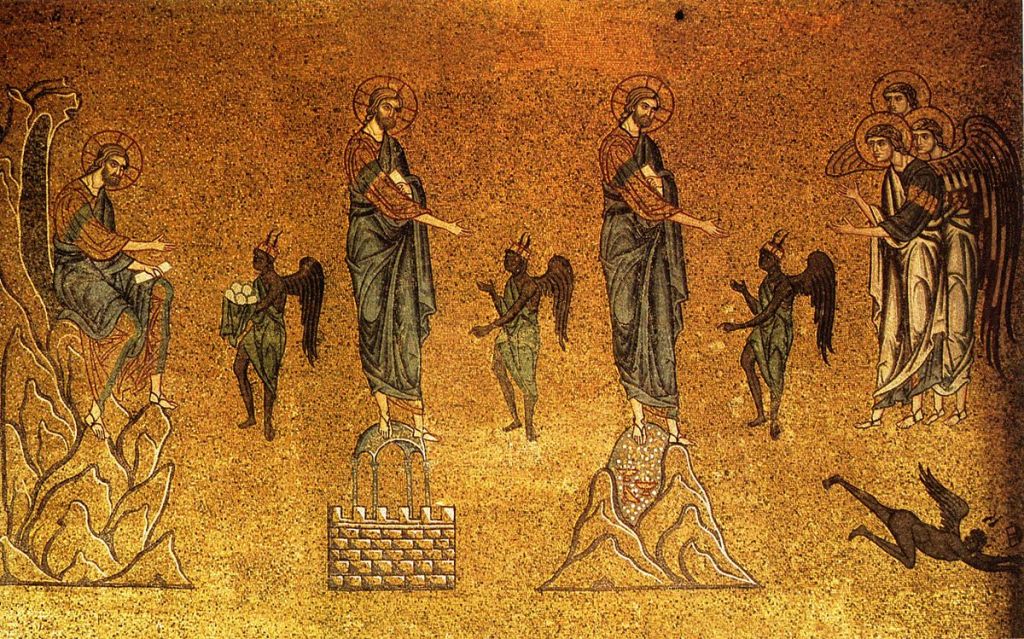
Sermon: Lent 1 RCL C – “Temptation”


A fella and his wife were shopping a kiosk in mall when a shapely young woman in a short, form-fitting dress strolled by.  The man couldn’t help himself and followed her with his eyes.

Without looking up from the item she was examining, his wife asked, “Was it worth the trouble you’re in?”

Temptation and sin: every preachers favorite topic.

I feel quite certain that most of us have at one time or another gone out looking for trouble, but I doubt any of us go out looking for temptation.  In most cases, temptation is something that arrives on your spiritual doorstep uninvited, but the temptation is not a sin.  What you do with that temptation will determine whether or not you’ve sinned.  Man sees a pretty girl, he can a) recognize her as pretty—there’s absolutely nothing wrong with that or b) let his mind loose with all kinds of desires and fall into sin.  Not all temptations are as simple as that, but in the end, most come down to that type of decision.  You can “Resist the devil [and the temptation], and he will flee from you.” (James 4:7b) or you can give in to its Siren like calling and sin.  Again, the temptation is not a sin.  It is what you do with the temptation that is the determining factor.

Another aspect of our temptations is that they are tailor made.  They suit our weaknesses and passions perfectly.  Some people like fast cars and they can’t help but be tempted to speed.  Others like to gossip and they can’t help but chat away when they’re around others.  Everything from shopping to alcohol to anger to… we don’t have time to include them all, but if you’ve shown a weakness to something in the past, then you know the devil is going to bring it your way again.  As my friend always said, the devil isn’t all that smart because he’s only got a few tricks, only trouble is we keep falling for them.  What’s a person to do?  In the words of Severus Snape (Harry Potter reference for all you muggles): “Control your emotions! Discipline your mind!”  And that really is the answer.

Our temptations are also referred to as “occasions of sin.”  If someone is a recovering alcoholic, then an occasion of sin or temptation would be for someone to unwittingly offer them an alcoholic drink.  There was no malice on the part of the person offering.  They were not some agent of the devil trying to bring the other person down, they were simply being friendly, but it has put the recovering alcoholic in an occasion of sin.  What is the person to do with the temptation?  “Control your emotions! Discipline your mind!”  The controlling of the emotions is something that occurs when the drink is offered, but the disciplining of the mind is something that takes practice over time, before the temptation is presented.  For whatever trick of the devil’s that you find yourself falling for time and time again, you have to know beforehand how you will respond or you stand a good chance of falling.  So, for the recovering alcoholic, they must mentally walk themselves through various scenarios and determine how it is they’re going to react.  “Ok.  If someone offers me a drink, I’m going to say, ‘Thank you, but I don’t drink.’”  And they have to repeat that to themselves over and over again, so that it is ingrained in their minds.  So that their minds are disciplined.  

When we talk about temptation and sin, we are talking about the battle for our souls, so this sounds like a rather dry / clinical approach, but ask yourself, “How’s my current method working out?”  Then look at the example of our Gospel lesson today: the temptation of Jesus in the wilderness.

Jesus did not go off into the wilderness to be tempted by the devil.  We are told that he was “led by the Spirit in the wilderness, where for forty days he was tempted by the devil.”  I don’t believe he went out there looking for trouble, but it did arrive on his spiritual doorstep.  Did he wring his hands and fret: “What do I do?  What do I do?”  Nope.  He answered the devil’s every temptation with Holy Scripture (specifically from the Book of Deuteronomy.)  He had control of his emotions and he had disciplined his mind.  He had prepared for just such an occasion of sin in advance.  Perhaps he did not know what the temptation would be, but he was not foolish to think that they wouldn’t come at all.

“Resist the devil, and he will flee from you.”  But you’re going to want a game plan for the resisting bit.  Abraham Lincoln said, “Give me six hours to chop down a tree and I will spend the first four sharpening the axe.”  Approach your spiritual battles in the same manner and you will be far more successful in defeating the temptations that wander up to your spiritual doorstep.

Above all your preparations, pray.  Pray for God’s strength to defeat your enemies from whatever direction they may come.  St. Paul tells us, “No temptation has overtaken you that is not common to all. God is faithful, and he will not let you be tempted beyond your ability, but with the temptation he will also provide the way of escape, that you may be able to endure it.”  That way of escape will be made clear to you through your prayer and your preparation.

One final note: if you fall into sin, learn from your mistakes, repent, confess, and get back in the fight.  You are a child of God.  You have work to do.

Let us pray: Saint Michael the Archangel, defend us in battle. Be our protection against the wickedness and snares of the devil; May God rebuke him, we humbly pray; And do thou, O Prince of the Heavenly Host, by the power of God, thrust into hell Satan and all evil spirits who wander through the world for the ruin of souls. Amen.