
West of the Denver suburbs is the community of Indian Hills, home of the Indian Hills Community Center. The Center had a sign out front, but in 2012, they asked a volunteer, Vincent, if he could build them a larger one.
The sign had the typical information you would expect from a sign until April Fools Day, which is when Vincent decided to have a bit of fun. I suppose the first message wouldn’t mean anything to those outside Indian Hills, but that community found it hysterical—“Indian Hills annexed by Morrison slow down.”
After that first message, the sign took on a life of its own, being changed regularly, and the punny messages became a town favorite. “Of course, I’m an organ donor. Who wouldn’t want a piece of this?!” “I’ll take the high road; you take the psycho path.” “Past, present, and future walked into a bar. It was tense.” “It’s easy to get back on your feet. Just miss two car payments. “My relationship with whiskey is on the rocks.” And my Stephen King favorite, “If clowns attack, go for the juggler.” The sign now has a Facebook page and many followers.
Signs are everywhere. Some are more complicated than others, but many have been used so much that we no longer need words to tell us what they mean. They have become simple symbols. You see a red octagon, and you know it means stop (unless, of course, you live in Enid, then it is a suggestion to stop). You see a cigarette with a red circle around it and a red slash, the prohibition symbol; you know it means no smoking. And, if you were to replace the cigarette with a penguin, you would know that you can’t take your pet penguin along.
Just as there are many signs around us, there are just as many symbols. The more complicated symbols are those that point to something beyond themselves. Take, for example, the American flag.
In some respects, the American flag is a simple symbol—it represents the United States. Easy enough, but when you ask people what that flag means, it takes on greater meaning—patriotism, honor, freedom, and so on. However, if you were to ask someone outside of the United States what the American flag represents, you would likely get a very different answer—opportunity, wealth, hope—but not all those who see it would have such positive responses. Others would see the American Flag as a symbol of oppression, imperialism, greed, the Great Satan, and more.
The American flag is, therefore, a simple symbol, but it is also very complex and nuanced. It points to something beyond itself—an idea.
Within our life with God and in Holy Scriptures, there is another kind of symbol—the prophetic or religious symbol. We can find many examples in both the Old and New Testaments.
In the Book of Jeremiah, there was a time when the Lord was angry with the people for their disobedience. To demonstrate how angry He was, God told Jeremiah to get a clay pot and go before the leaders and inhabitants of Jerusalem. Jeremiah is then to say, “Hear the word of the Lord… I am bringing such disaster upon this place.” Then Jeremiah is to take the clay pot and throw it to the ground. The Lord, speaking through Jeremiah, says, “Thus says the Lord of hosts: So will I break this people and this city, as one breaks a potter’s vessel, so that it can never be mended.”
The clay pot was used as a religious symbol. It is a symbol that points beyond itself, but it is a religious symbol because a) it points to an action of God that b) will affect the people and change them in some way.
From there, the religious symbol can become even more—a sacrament. Water is one such symbol.
Sometimes, water is just water, but throughout Scripture, water can be so much more. In the beginning, the Spirit of God hovered above the waters. With Noah, the earth was again covered by water, destroying almost all God had created. The people, being led by Moses, were saved through the waters of the Red Sea when the waters were parted, and all passed through safely, but then those same waters crashed down on the Egyptian army, killing both horse and rider. The waters are home to the great sea monster, the leviathan.
All together, this tells us that the waters are not necessarily a safe place. In fact, the water became a religious symbol of chaos and death. Then, along came Jesus, who stood before John the Baptist and was baptized by him. Jesus was pressed into the water, the chaos and death, and then pulled back up. Jesus did not need to be baptized, but He gave the water and these actions to us as a religious symbol, a sacrament. Together, they signify to us that at our baptism, we go into the waters, we go into chaos and death, but we come back up, washed, cleaned, restored, and once again made holy in the eyes of God. As St. Paul tells us, “Do you not know that all of us who have been baptized into Christ Jesus were baptized into his death? We were buried therefore with him by baptism into death, in order that, just as Christ was raised from the dead by the glory of the Father, we too might walk in newness of life.”
Water, a symbol that became a religious symbol, which, through Jesus, became a Sacrament. It is partly how we gained our definition of a Sacrament in the Catechism—“The sacraments are outward and visible signs of inward and spiritual grace, given by Christ as sure and certain means by which we receive that grace.”
Our Gospel reading from John begins with the words, “In the beginning was the Word, and the Word was with God, and the Word was God. He was in the beginning with God.” In that statement, the Word is more than a person; yet, it is also speaking, in part, of the person of Jesus, so we can say, “In the beginning was Jesus, and Jesus was with God, and Jesus was God. Jesus was in the beginning with God.”
Jesus confirms this later in John’s Gospel. One of the Disciples, Philip, says to Jesus, “Lord, show us the Father, and it is enough for us.” Jesus answers him, “Have I been with you so long, and you still do not know me, Philip? Whoever has seen me has seen the Father.”
In the beginning, Jesus was with God, and Jesus was God. Jesus says to Philip, ‘If you see Me, you see God the Father.” Jesus is not just a religious symbol of the Father. Jesus is the Sacrament—the outward and visible sign—of God the Father. Jesus’ nature shows us the very nature of God. For example, one aspect of God’s nature is love. Jesus said, “Just as I have loved you, you also are to love one another.” Jesus’ love for us is an outward and visible sign of God the Father’s love for us, for “God is love.”
Jesus is the Sacrament of God.
If it ended there, we could all go home, but there is one more step. Remember, a religious symbol is pointing to an action of God that will affect the people and change them in some way. Therefore, John told us, “To all who received [Jesus], who believed in his name, he gave power to become children of God, who were born, not of blood or of the will of the flesh or of the will of man, but of God.”
If you receive the Sacrament of God, Jesus, He gives you the power to become like Him—a child of God. In other words, if you receive Jesus, you become a Sacrament of Jesus—an outward and visible sign of God’s inward and spiritual grace.
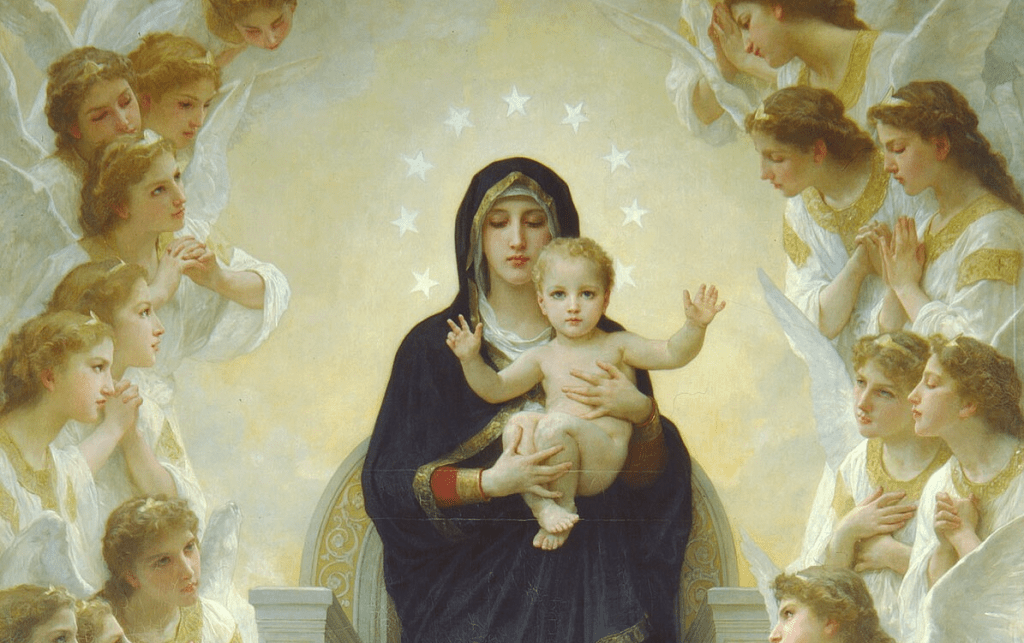
On a night like tonight, we are surrounded by symbols. The star which beckons us. The angels that call us. The shepherds who seek Him. Mary, who said “Yes” to Him, and Joseph, who is obedient and faithful. However, perhaps the symbol that most represents this night is the manger, where Jesus is to be born. Like all other religious symbols, the manger is a symbol pointing to something more, and in this case, and on this night, it is pointing to you.
Within each of us is a manger. It can remain commonplace, storing all parts of an ordinary life. Or we can clear it out and make a place for the Christ Child to be born. A place where the Sacrament of God—Jesus—can be born in us and affect such change in our lives. The transformation of the commonplace into a holy and extraordinary place. A place where not only is Christ Jesus born but also where we are reborn as children of God—ourselves becoming sacraments—Sacraments of Jesus.
On this night, allow Christ Jesus to be born within the manger of your entire being and become a Sacrament—an outward and visible sign to all those around you of God’s great love for His Children.
Let us pray: Almighty God, you have given your only-begotten Son to take our nature upon him, and to be born of a pure virgin: Grant that we, who have been born again and made your children by adoption and grace, may daily be renewed by your Holy Spirit; through our Lord Jesus Christ, to whom with you and the same Spirit be honor and glory, now and for ever. Amen.

 Candle in a Cave