Today is a feria, which is a weekday when there are no feast day celebrations. In such cases, we go back to the readings we heard this past Sunday—the fourth Sunday of Easter.
The Gospel lesson we read comes at the end of what is known as the Good Shepherd Discourse. It gets its name from a passage a few verses before what we read—Jesus said, “I am the good shepherd. I know my own and my own know me, just as the Father knows me and I know the Father; and I lay down my life for the sheep.” (John 10:14-15)
As I mentioned on Sunday, the Shepherd has long been understood in the context of Holy Scripture and among the Israelites as one who guides the people in their daily activities and leads them in battle. We can understand this person to be someone who is obligated to perform these duties, but in truth, the Good Shepherd fulfills these duties out of love for the sheep. That love means the Shepherd will go to any extent to save the sheep. This saving does not always involve some great and terrible battle, but more often than not, it is a struggle that only the singular sheep and the Shepherd are aware of.
A member of a certain church who had previously attended services regularly stopped going. After a few weeks, the pastor decided to visit him. It was a chilly evening, and the pastor found the man at home alone, sitting before a blazing fire.
Guessing the reason for his pastor’s visit, the man welcomed him, led him to a large chair near the fireplace, and waited. The pastor made himself comfortable but said nothing. In the grave silence, he contemplated the dance of the flames around the burning logs.
After a few minutes, the pastor took the fire tongs, carefully picked up a brightly burning ember, and placed it to one side of the hearth all alone. Then, he sat back in his chair, still silent. The host watched all this in quiet fascination.
As the lone ember’s flame faded, a momentary glow appeared, and then its fire was no more. Soon, it became cold and dead.
Not a word had been spoken since the initial greeting.
Just before the pastor was ready to leave, he picked up the cold, dead ember and placed it back in the center of the fire. Immediately, it began to glow once more with the light and warmth of the burning coals around it.
As the pastor reached the door to leave, his host said, “Thank you so much for your visit and especially for the fiery sermon. I shall be back in church next Sunday.” (Source: Unknown)
Taking up a little child in His arms, Jesus said, “What do you think? If a man has a hundred sheep, and one of them has gone astray, does he not leave the ninety-nine on the mountains and go in search of the one that went astray? And if he finds it, truly, I say to you, he rejoices over it more than over the ninety-nine that never went astray. So it is not the will of my Father who is in heaven that one of these little ones should perish.” (Matthew 18:12-14)
The Good Shepherd—“He revives my soul and guides me along right pathways for his Name’s sake.” (Psalm 23:3)
I’ll close with a prayer. Thomas Merton wrote it on one of those days when he was struggling to stay on track. Let us pray: Good Shepherd, You have a wild and crazy sheep in love with thorns and brambles. But please don’t get tired of looking for me! I know You won’t. For You have found me. All I have to do is stay found.
A young preacher was talking to the children about sheep. He said that sheep weren’t very clever and needed lots of guidance and that a shepherd’s job was to stay close to the sheep, protect them from wild animals and keep them from wandering off and doing foolish things that would get them hurt or killed.
He pointed to the children in the room and said they were sheep and needed lots of guidance.
Then the minister put his hands out to the side, palms up in a dramatic gesture, and with raised eyebrows said to the children, ‘‘If you are the sheep, then who is the shepherd?’’
He was pretty obviously indicating himself.
A silence of a few seconds followed.
Then Little Johnny said, “Jesus, Jesus is the shepherd.’’
The young minister, obviously caught by surprise, said to Johnny, ‘‘Well, then, who am I?’’
Little Johnny frowned thoughtfully and then said with a shrug, ‘‘I guess you must be a sheepdog.’’
I have been called many things in my career, some of which were good, but I have never been called a sheepdog. However, within the Church, the Bishops have always been viewed as shepherds. In Jeremiah 3:15, the Lord states, “I will give you shepherds after my own heart, who will feed you with knowledge and understanding.” So, as an extension of the Bishop’s ministry, I suppose the priests could be considered sheepdogs, but we all fall into that category when it comes to Jesus as the Good Shepherd.
Today, Jesus, the Good Shepherd, said to us, “Very truly, I tell you, I am the gate for the sheep. All who came before me are thieves and bandits; but the sheep did not listen to them. I am the gate. Whoever enters by me will be saved, and will come in and go out and find pasture.”
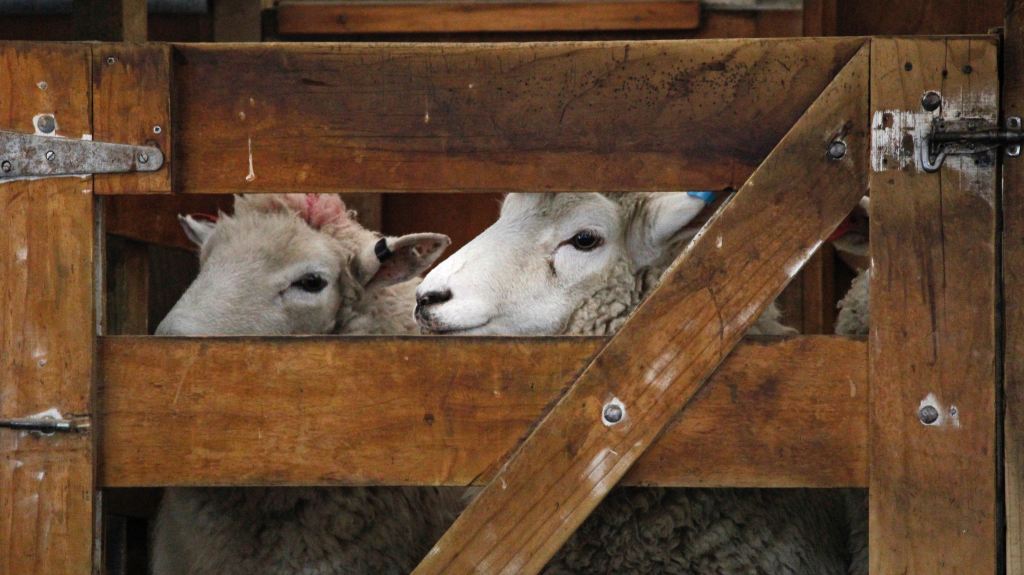
At night, the shepherd would lead the flock into a fenced area and lay at the gate. Anyone who came in must climb the fence or go over the shepherd. As for the sheep, any that tried to leave by the gate would wake the shepherd. Earlier this week, as I thought on this passage, I got to thinking about the fence, and—long story short—thinking about fences led me to the poet Robert Frost.
Christianity did not come easily for Frost, and whether or not he was is still up for debate for many; however, a few days before his death, he wrote to a friend and said, “Salvation, we will never have from anyone but God.” For me, that pretty much ends the argument.
Where do the fences come in? Frost’s poem, Mending Wall, was first published in 1914. Did Frost have a Christian theme in mind when he wrote it? Probably not, but it certainly lends itself to one. It even contains a line that most of you know.
The poem tells the story of two neighbors that come together each spring to mend the rock wall that is the boundary between their properties. The narrator tells us that the heaving of the frost in the ground during the winter or passing hunters who need access or even elves could cause the rocks to fall, making breaks in the wall that need to be mended. However, the narrator doesn’t really see the point of the wall, so he keeps asking his neighbor why they go through this exercise every spring, to which the neighbor replies, “Good fences make good neighbors.” The idea is that if everyone knows the boundaries, then there can be no disputes. It makes sense.
Good fences make good neighbors, but uncertain as to what caused each break, the narrator comments, “Something there is that doesn’t love a wall, that wants it down.” Regardless of the neighbor’s opinion on the goodness of the wall, something or someone doesn’t want it there because it keeps falling. And this is where I ran with my interpretation of the poem.
The enemy of God’s people would rather the walls not be there. Jesus tells us, “Very truly, I tell you, anyone who does not enter the sheepfold by the gate but climbs in by another way is a thief and a bandit… The thief comes only to steal and kill and destroy.” The enemy of God’s people would rather there not be a wall so that he can steal us away, so we allow Jesus and His holy host of angels to guard our souls, and under their protection, our souls remain quite safe.
The Psalmist tells us, “[The Lord] will cover you with his pinions, and under his wings you will find refuge; his faithfulness is a shield and buckler. You will not fear the terror of the night, nor the arrow that flies by day, nor the pestilence that stalks in darkness, nor the destruction that wastes at noonday…. For he will command his angels concerning you to guard you in all your ways.”
The Lord is the Good Shepherd and will guard our souls, so the fence serves as protection from those outside of ourselves, but perhaps more importantly, a fence keeps us in because we tend to wander off and get into trouble.
A little further in Matthew’s Gospel, Jesus says, “What do you think? If a man has a hundred sheep, and one of them has gone astray, does he not leave the ninety-nine on the mountains and go in search of the one that went astray?” (Matthew 18:12) That speaks of the goodness of God in seeking us out when we are lost and in trouble. Still, it also speaks of a sheep that didn’t know what was good for it and went astray. Good fences help keep us from wandering off, so how do we build and maintain a fence around our souls? The author of Proverbs provides us with some good advice.
“Keep your heart with all vigilance, for from it flow the springs of life. Put away from you crooked speech, and put devious talk far from you. Let your eyes look directly forward, and your gaze be straight before you. Ponder the path of your feet; then all your ways will be sure. Do not swerve to the right or to the left; turn your foot away from evil.”
It is amazing how often our words can get us into trouble or how entertaining gossip can bring about problems. Erma Bombeck said, “Some say our national pastime is baseball. Not me. It’s gossip.” Guard your speech and what you listen to, and you’ll guard your soul. Consider the things you allow yourself to look at or linger over, whether it be something that leads to feelings of inappropriate desire or coveting and jealousy. Custodia occulorum, or custody of the eyes—“means holding ourselves accountable for what we choose to look at.” (Source) In guarding our eyes, we are guarding our hearts. Finally, consider where you are going. Is what you are doing following in the footsteps of Christ, or have you seen something off to the side that causes you to deviate from that path? Guard your steps, and you will be guarding your heart.
“Good fences make good neighbors.” And guarding our tongues, eyes, and steps will go a long way in building a fence around our souls to keep us from becoming sheep that go astray. And, if you occasionally need a sheepdog to nip your heels, I’ll see what I can do.
I’m unsure if this is a proper prayer, but it comes from my new friend, Thomas Merton—Let us pray: Good Shepherd, You have a wild and crazy sheep in love with thorns and brambles. But please don’t get tired of looking for us. We know You won’t. For You have found us. All we have to do is stay found. Jesus, in Your Name, we pray. Amen.


 Candle in a Cave