
Reader’s Digest reported an incident where medical staff who transcribed medical audiotapes were confounded when one of them came upon a perplexing diagnosis: “This man has pholenfrometry!” [spell it out] Being unfamiliar with that condition, they checked the medical dictionary and with co-workers, to no avail. Finding the doctor in charge, they asked him. He listened to the tape, shook his head, and translated: “This man has fallen from a tree!”
There is a wonderful little acronym most are familiar with: KISS—keep it simple, stupid. That is advice we should follow; however, many are more prone to go in the direction of what we could call MESS—make it sound sophisticated. Complicate it. Confuse it.
Chapter 3 of the book of Daniel is a very familiar Bible story. We learned it as children. The story of Shadrach, Meshach, and Abednego (a.k.a. My Shack, Yo Shack, and A Bungalow). They are also known as the three young men.
The Babylonian king, Nebuchadnezzar, has made a statue and decreed that everybody is “to fall down and worship the golden image” or face death. (Daniel 3:5)
Even though they are captured Jews, the three young men and Daniel have risen to high places in Nebuchadnezzar’s court. Their rise to power and fame has also heightened jealousy among many, so these others are looking for a way to destroy them. When the jealous ones learn that the three young men are not worshiping the statue, they turn them over to Nebuchadnezzar.
Nebuchadnezzar confronts them. He tells them, you can worship the statue and live, but if you do not worship, you shall immediately be cast into a burning fiery furnace.” (Daniel 3:15a) It is then, in his ignorance, Nebuchadnezzar adds, “And who is the god who will deliver you out of my hands?” (Daniel 3:15b)
The three young men reply, “If this be so, our God whom we serve is able to deliver us from the burning fiery furnace, and he will deliver us out of your hand, O king. But if not, be it known to you, O king, that we will not serve your gods or worship the golden image that you have set up.” (Daniel 3:16-18)
Hear what they say: “Our God is faithful, and our God is able to save us.” Notice, they did not say, “Our God will save us, only that He is able to save us.” Then they add, “But if not.” That is, “Our God can save us, but if not, if our God chooses not to, so be it. We will remain faithful.”
Nebuchadnezzar is furious. He orders the furnace heated to seven times its normal temperature; the three men are bound and cast into it.
Nebuchadnezzar then watches, scratching his head. He asks his aides, “Did we not cast three men bound into the fire?” (Daniel 3:24b) You are correct; the aides answer. “But,” Nebuchadnezzar says, “I see four men unbound, walking in the midst of the fire, and they are not hurt; and the appearance of the fourth is like a son of the gods.” (Daniel 3:25) He calls the three out of the furnace, and they are unharmed. “The hair of their heads was not singed, their cloaks were not harmed, and no smell of fire had come upon them.” (Daniel 3:27b)
Nebuchadnezzar had asked, “Who is the god who will deliver you out of my hands?” He learns the answer. It is the God of Shadrach, Meshach, and Abednego, who can save. He declares, “There is no other god who is able to rescue in this way.” (Daniel 3:29b)
Looking at this one episode in the lives of these three young men, what can we learn about faith? (Remember KISS and not MESS.) Their faith was not contingent upon whether God saved them or allowed them to die. Their faith was simply in God and His divine providence, without qualification.
Notice, we are not told the three weren’t afraid of burning to death, or that there would be no pain involved, or that they knew for certain what God’s plan was for them. However, their faith did declare, “Nebuchadnezzar, your kingship and your decrees do not rule over our lives; this furnace does not rule over our lives; pain, suffering, and even death do not get to decide who we will become.” The three defied all these things and declared, “We will be bound to no one and no thing, except to the one true God.” What happened? Well, duh. “God saved them from the fire.” However, for the three young men, that was not the main thing. What was? We see it in our reading from Exodus.
Moses is standing in front of the burning bush. The Lord tells Moses that he is sending him to Egypt to confront Pharaoh and free God’s people. Moses is an Israelite, and God wants him to return to the land he has escaped from—the land where he is a wanted man. The Lord wants Moses to confront and make demands of one of the most powerful individuals in the world—Pharaoh. “Moses,” God says, “I am sending you into the furnace.”
Moses says, “Who? Me? I’m a nobody.” In response, God did not say that it would be easy, that there was no need to be afraid, that Moses would be sleeping in five-star hotels the entire time. No. God said, “I am sending you into the furnace, and I will be with you.”
The Lord never spoke those words to Shadrach, Meshach, and Abednego, but through their faith, God proved they were true. How did Nebuchadnezzar put it? “But I see four men unbound, walking in the midst of the fire, and they are not hurt; and the appearance of the fourth is like a son of the gods.” (Daniel 3:25) God was with them.
For us, God never promises there will be no furnaces in our lives. He never says we’ll come out unscathed, but He does promise, “I will be with you.” Can we believe that?
In our Gospel, we are told, “Jesus began to show his disciples that he must go to Jerusalem and undergo great suffering at the hands of the elders and chief priests and scribes, and be killed, and on the third day be raised.” Jesus said, “I am headed into the furnace.” Peter’s response was very human. Perhaps he was terrified. Perhaps he simply couldn’t imagine losing Jesus. Whatever was going through Peter’s mind, he said, ‘This must never happen.’” Jesus rebuked him. Why? Because Jesus knows He will not be alone in the furnace. He has already said, “The hour is coming, indeed it has come, when you will be scattered, each to his own home, and will leave me alone. Yet I am not alone, for the Father is with me.” (John 16:32-33) Jesus says to Peter, “Follow me.” It is as though Jesus were saying, “I know the furnace is a terrifying place, but follow me, because when you face your own furnace, I will be with you. I will lead you through.”
The three young men defied the furnace. They did not allow it to dictate who they would become. Instead, in their defiance, they declared, “We believe in God.”
Moses defied the furnace in his life and through his words. In doing so, he declared, “God is with me.”
Jesus, fully aware of the furnace, defied it. He declared, “I believe in the Father.”
Jesus says to us, “Follow me, and I will lead you through the furnace, and we will defy it together.”
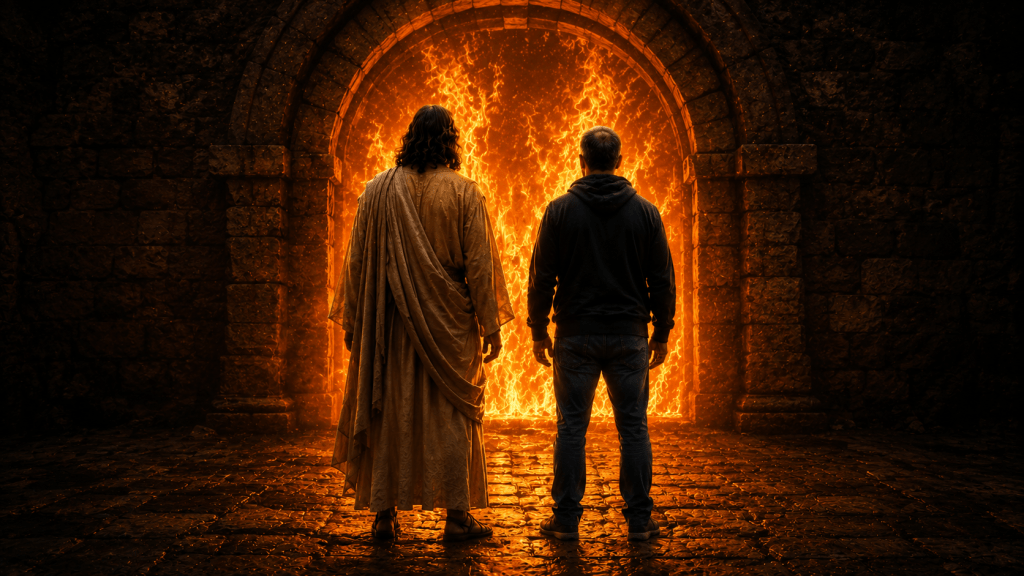
When you are standing in front of the furnace, all the complicated answers do you no good. If you can even remember them, they fall away. When they do, what remains of your faith?
Imagine: there you are, standing in front of the furnace, burning seven times hotter than ever before.
Why did this happen? How did you end up in such a place?
I don’t know.
Will God save you from all the hurt and the pain?
I don’t know.
How is it going to turn out? Will you live?
I don’t know.
You don’t seem to know very much. Is there anything you do know?
Yes.
What’s that?
“I believe in one God, the Father Almighty. I believe in one Lord Jesus Christ, the only Son of God. I believe in the Holy Spirit, the Lord, the giver of life.” I may not know much, but I do know there is a God and that He is with me.
We can all find ourselves standing in front of any number of furnaces. And it is in those furnaces that our faith becomes costly. They bring with them pain in various forms—evil, loss, death, pain, suffering.
While standing in front of that furnace, we may have no answers as to why any of this is happening or what the outcome will be, but there is one thing we can hold fast to—I believe. We can defy the furnace. It does not mean it won’t hurt. It does not mean that we will not experience great fear, or that we will see a happy outcome, all tied up with a pretty little bow. However—I believe—does mean we are not walking into the furnace alone. So follow Jesus. He has gone before us into the furnace, and He promises, ‘I am with you always, to the end of the age.’”
I believe.
I’ll share with you a portion of Psalm 116:1-10 as a closing prayer. Let us pray: I love the Lord, because he has heard
my voice and my pleas for mercy.
Because he inclined his ear to me,
therefore I will call on him as long as I live.
The snares of death encompassed me;
the pangs of Sheol laid hold on me;
I suffered distress and anguish.
Then I called on the name of the Lord:
“O Lord, I pray, deliver my soul!”
Gracious is the Lord, and righteous;
our God is merciful.
The Lord preserves the simple;
when I was brought low, he saved me.
Return, O my soul, to your rest;
for the Lord has dealt bountifully with you.
For you have delivered my soul from death,
my eyes from tears,
my feet from stumbling;
I will walk before the Lord
in the land of the living.
I believed, even when I spoke:
“I am greatly afflicted.”
Amen.

