
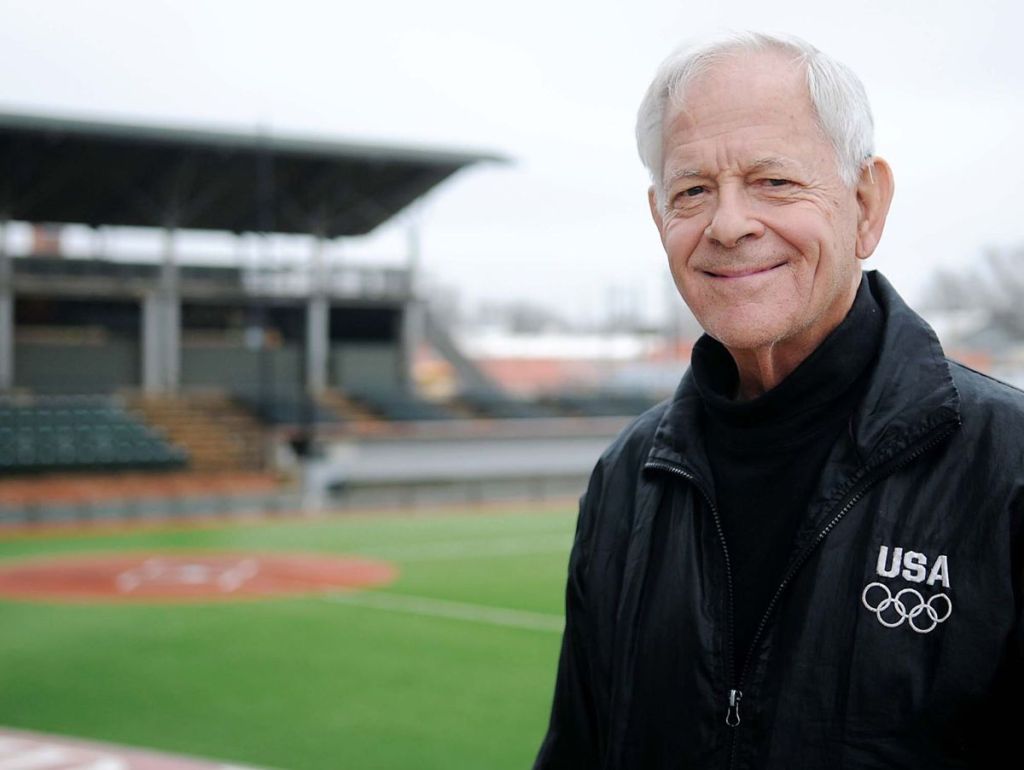
Before moving to Enid, I never once in my life said, “You know, I think I wanna live in Oklahoma.” It never really crossed my mind. I suspect the same is true for many of you gathered here today. This may be the first and last time you will ever be in Enid. And that’s OK. We all have our lives, and God allows us to live them.
However, due to this, you probably don’t know Paul in the same way as those who live here. I believe it would be very hard for someone who does not live here to grasp what he meant to this community. That’s not a criticism, and please don’t take it as such. It’s just the way things are. Even so, you won’t understand what he meant to Enid, America. He has left a remarkable legacy. It’s a legacy that you can be very, very proud of.
On the surface, that legacy is easy to see. There are the companies he built, the projects he funded, the ballparks, and the soccer fields. There are all sorts of things, and everywhere you turn, you’ll see his name. But that’s not because Paul was a big flashy kind of guy. He wasn’t running around trying to make a name for himself. He didn’t drive a fancy sports car… and can I just say thanks be to God for that, because he was a really terrible driver. He didn’t wear the latest fashion. If you didn’t know who he was, he was just this nice old guy. In these last years, if you ran into him around town, it was more than likely at one of the grocery stores where he would be stocking the shelves with beef jerky. If you saw Tammy driving him somewhere, there’s a good chance they were out delivering meals to the poor and homebound. And if it were a Sunday morning, you would find him sitting right there in the front row. And, when it was time to pray, you would find him there on his knees.
There’s the outward legacy that everyone knows, but there’s another that you had to be here to truly witness in order to understand why this town loves him the way they do.
You see, Paul was a builder. Yes, he built companies, but more importantly, and the reason he could build companies is that instead of seeing a company as something made of brick and steel, he saw the company as the people. Paul built companies because he built people. He gave them the tools they needed to succeed. He provided the encouragement for them to realize they could do great things and become builders themselves.
In our Gospel reading today, the disciples wanted to send the people away so that they could go and find something to eat. Jesus said to him, “They do not need to go away. You give them something to eat.” So often when we read that text, we think that Jesus is simply talking about food. Feed the hungry. They’re broke, they don’t have money. They don’t have food. Give them something to eat. However, there are many different ways to give someone something to eat, because the phrase is a way of saying give them what they need to grow, to have a life, to have joy, to fulfill potential. Give them what they need to have life, and to have it abundantly. When Jesus said, “Give them something to eat,” he was saying, “Build them up,” and that is Paul’s legacy. He was a builder. He was a builder of people, helping them to realize their own great worth.
For some of you, this may very well be the last time you’re in Enid, America. Even so, Paul has passed on this legacy to you. It’s a legacy that conveys the same message that Jesus said to his disciples, “You give them something to eat.” In your communities, with your families and friends and the strangers in your midst, you give them something to eat. Take this legacy and pass it along. Become builders yourselves.
Today, we mourn our loss, and today we give thanks. We mourn because, for a time, we are separated from all those who have gone before us. We give thanks because, on this day, through the power of the resurrection, Paul has been reunited with Joan and David, his mom and dad, and with all those who have gone before. Above all this is the fact that Paul has entered Our Father’s House and has been welcomed into the very Kingdom of God. In the words of the Psalmist, “This is the Lord’s doing, and it is marvelous in our sight.”

 Candle in a Cave