A rural middle school in Northwest Florida was recently faced with a unique problem. A new fad arose amongst the 8th-grade girls with the use of lipstick. They began bringing, sharing, and trading with their friends to try out all the latest styles and shades. The gathering point for this activity was one specific bathroom at the school. That was fine, but after they tried out all of these lipsticks, they would press their lips to the mirror, leaving dozens of lip prints every day.
Every night the custodian had to clean them off, but the next day the girls would put more lip prints on the mirror. Finally, the principal decided that something had to be done. So class by class, the principal paraded 8th-grade girls to the bathroom to meet with the custodian.
She explained that all these lip prints were causing a major problem for the custodian who had to clean the mirrors every night. To drive the point home, she asked the custodian to demonstrate to the girls what a pain it was for him to clean the mirrors. He took out a long-handled squeegee, dipped it in the toilet, and began cleaning off the lipstick. After repeating the process a few times, the mirror was clean. There was no more lipstick problem.
You have probably noticed that we’ve been remodeling the bathrooms. Many thanks to Sharon, Dora, Jackie, Gina, and Michael for all the work they’ve put in on this. There are a few more things to be done, but we’re close now. One of the last items will be the mirrors—one may be in the main women’s but not yet in the others. I told Gina the other day, “It may be a vanity thing, but it seems rather odd to walk into a bathroom and not have a mirror.” It’s not like I stand there preening, but it’s nice to make sure there’s nothing stuck in the teeth—I would say check the hair but not much of a problem there.
The odd thing—and perhaps you’ve experienced it also—is that I can look at myself in a mirror and think, “Not too bad,” but then I see a picture of myself, and it’s, “Who in the world…?” As it turns out, there is a bit of science behind it.
The most familiar image we have of ourselves is the one we see in the mirror. The only problem is that the image in the mirror is reversed, so when we see a picture of our faces, something seems to be a bit “off.” There are differences—although often minor—between the left side of our faces and the right. So, perhaps not consciously, but subconsciously our minds say, “There’s something not right,” and so we end up disliking the pictures of us. You can all run home and try this: take several selfies—smiling, laughing, etc.—then take the same pictures of yourself in the mirror. See which ones you like best. Bottom line: the mirror is a distorted view of what you actually look like to others, but the photograph isn’t the real you either—through the mechanics of photography, distortions appear there also. It is true; the camera adds ten pounds (in my case, about forty!) What it all comes down to is that we really do have a distorted image of ourselves. The person we see is not the person others see.
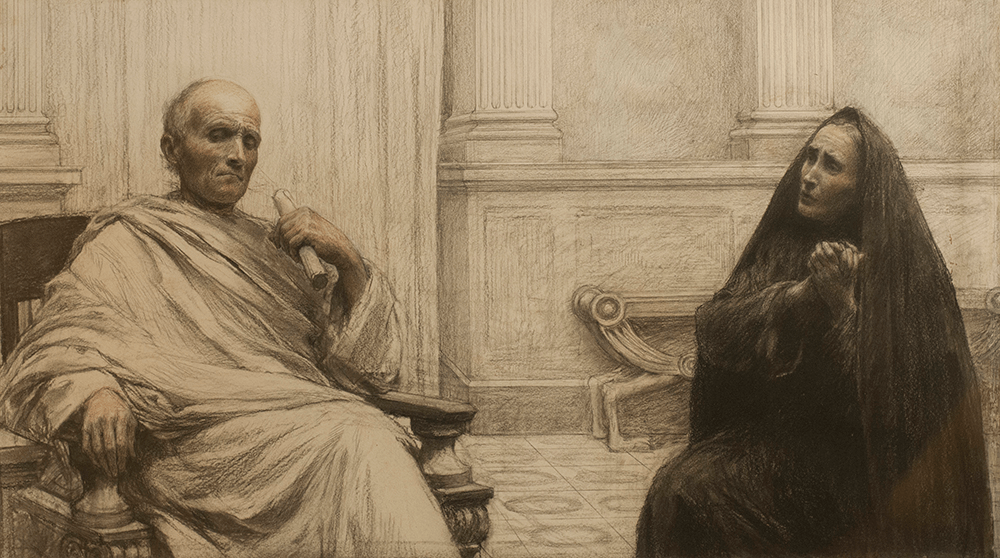
“Two men went up to the temple to pray, one a Pharisee and the other a tax collector. The Pharisee, standing by himself, was praying thus, ‘God, I thank you that I am not like other people: thieves, rogues, adulterers, or even like this tax collector. I fast twice a week; I give a tenth of all my income.’”
In a spiritual sense, the Pharisee looked at himself in the mirror and saw a distorted image of himself. On the other hand, “the tax collector, standing far off, would not even look up to heaven, but was beating his breast and saying, ‘God, be merciful to me, a sinner!’” In a spiritual sense, the tax collector did not rely on what he saw in the mirror. Instead, he looked within and saw his true self—a sinner. Ultimately, it wasn’t what either thought of themselves but what God thought of them. Jesus said, “I tell you, this man—the tax collector—went down to his home justified rather than the other.” The Pharisee was not likely a bad person, but he had fallen into a trap: God had bestowed upon him a great gift, yet instead of always viewing it as a gift, he came to view it as a possession. God had gifted him righteousness and holiness, and the Pharisee came to believe that this righteousness and holiness was his—of himself and not of God.
Luke Timothy Johnson, an outstanding theologian, writes, “What comes from another can so blithely be turned into self-accomplishment… The [Pharisee] is all convoluted comparison and contrast; he can receive no gift because he cannot stop counting his possessions. His prayer is one of peripheral vision. Worse, he assumes God’s role of judge: not only does he enumerate his own claims to being just, but he reminds God of the deficiency of the tax-agent, in case God hadn’t noticed.” (Sacra Pagina: The Gospel of Luke, p.274)
A gift does become a person’s possession, but regardless, it remains a gift. Take a child playing with their toys. Another child comes along and picks one of them up. What does the first child shout out? “Mine!” Yes. That is a true statement. It is theirs, but in the case of a child, it was a gift from a parent or someone else. The child had no means to gain the gift on their own. God gave the Pharisee the gift of righteousness and holiness, and the Pharisee cried out, “Mine!” In doing so, he created a distorted image of his spiritual self, but God would not be fooled. God saw the true person and was not pleased with what He saw.
We can look in the spiritual mirror and think we’re doing pretty good. In the words of Stuart Smalley, we declare, “I’m good enough, I’m smart enough, and doggone it, people like me,” when we should instead be standing with our heads bowed in prayer, repeating the words of the tax collector, “God, be merciful to me, a sinner!” I’m not saying you’re all a bunch of heathen destined for thousands of years in purgatory, but we must step away from the mirror and look within instead of looking out. How do we do this?
Most weeks, we use the Confession of Sin found on page 360 of the Book of Common Prayer. It begins, “Most merciful God, we confess that we have sinned against you in thought, word, and deed, by what we have done and by what we have left undone.” When we use Form VI of the Prayers of the People, we use the confession on page 393: “Have mercy upon us, most merciful Father; in your compassion, forgive us our sins, known and unknown, things done and left undone.” These are considered general confessions. A general recognition that we have sinned, but there are times when we need to make a particular confession, that is, for example, not just saying we have sinned in things left undone, but spending time identifying those times when we chose not to act or speak when we should have. This is what is known as an examination of conscience. It is a very deliberate time when you look within, not to beat yourself up for what you see as shortcomings or failings, but to identify those areas of your life where you can improve so that you can make a particular confession, not just one in general; and then, through the amendment of life, seek to make the necessary changes of character. In doing so, we will again recognize the holiness and righteousness we have in our lives as a gift from God, and the image that is revealed is the image of the One who created us: the image of God.
Let us pray:
Almighty God, Eternal Father,
from the fullness of our souls, we adore You.
We are deeply grateful that You have made us
in Your image and likeness
and that You ever hold us in Your loving embrace.
Direct our lives so that we may love You with all our hearts,
with all our souls, and with our whole minds,
so that we may love all Your children as we love ourselves.
Amen.