The Rev. Nicky Gumbel, the creator of the Alpha Course, discusses how so many Christians wear crosses. Still, he asks a rather interesting question: what if Jesus had been executed during the French Revolution? Would we all wear small guillotines around our necks? Or we could ask: what if he were executed in the United States? Would we all be wearing reproductions of an electric chair? The point is that the cross was a means of execution, not glory, but with all things, God took that means of execution and redeemed it for his purposes, and where there was once shame and horror, there is now glory and love. So, we take this very special day, the Feast of the Holy Cross, and celebrate this great work of our God.
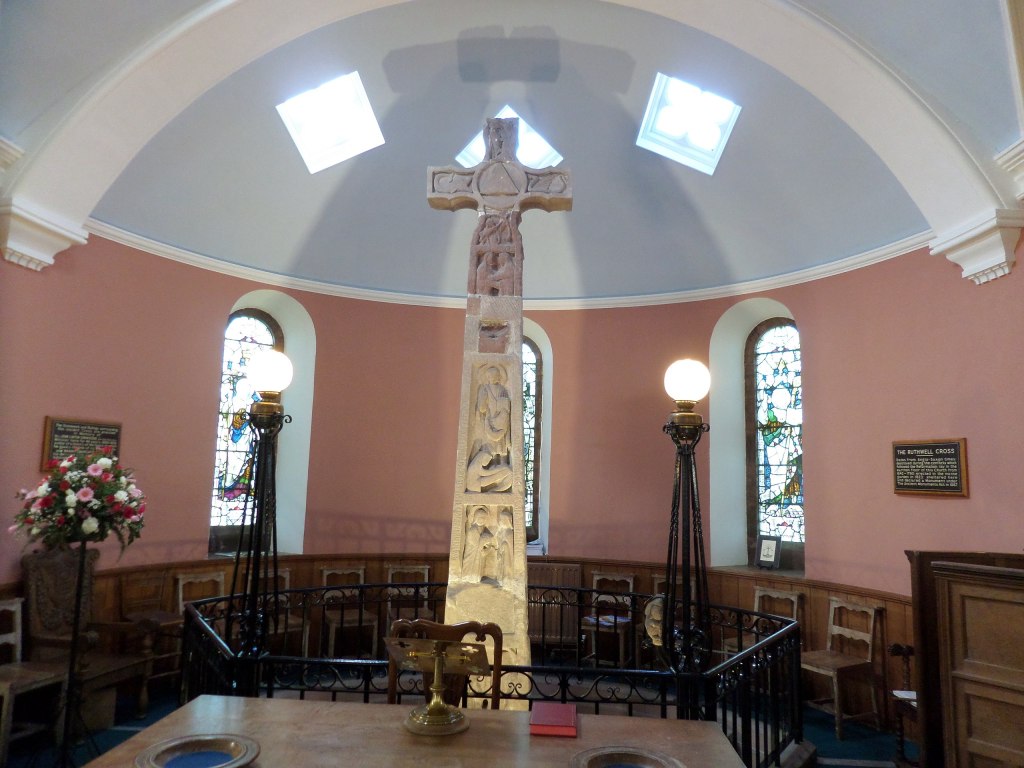
I’ve told you before about the preaching cross discovered in Ruthwell, Scotland, but it is such testimony to the cross of Christ that I’d like to share it with you again.
The cross in Ruthwell is eighteen feet tall and made of stone. It marks the place where an itinerant priest or monk would come to proclaim the word of God. Carved into this particular cross are scenes from the Bible, decorative vine work, and eighteen verses of an old English poem.
For centuries it was thought that the eighteen verses comprised the entire poem, but in 1822 a 10th-century book was found that contained the complete text. The poem is titled “The Dream of the Rood.”
In the poem, an unknown poet dreams of encountering a beautiful tree. It is the “rood” or cross on which Jesus was crucified. The cross is gloriously decorated with gold and gems, but the poet can still see ancient wounds inflicted upon it. The rood tells the poet how it had been forced to be the instrument of Christ’s death, describing how it, too, experienced the nails and thrusts of the spear.
The rood explains that the cross was once an instrument of torture and death but is now the dazzling sign of humanity’s redemption. Finally, the rood charges the poet to tell his vision to everyone so that all might be redeemed of sin.
Then the young hero – God Almighty – stripped himself. Firm and unflinching he mounted the high cross. brave in the sight of many, for he intended to redeem humanity. I trembled when the young hero clasped me, but dared not bow down to the earth No – I would not fall to the ground; I knew full well I must stand firm. As I, the cross, was raised up – I bore aloft the mighty king – the Lord of Heaven – I dared not stoop. They pierced me with dark nails – the wounds can still be seen in me – gaping gashes of malice. I dared do nothing to seal them up, for they mocked us both together. I was drenched with the blood shed from the man’s side after he had sent out his spirit. I endured many hard trials on the hill. I saw the God of hosts violently stretched out. Darkness with its clouds had covered the Lord’s corpse, the fair radiance, a shadow moved in, dark beneath the heavens. All creation wept – all lamented the King’s death. Christ was on the cross!
Christ and the cross endured the crucifixion, and you and I must endure our own spiritual crucifixion so that, as St. Paul, “If we have been united with him in a death like his, we shall certainly be united with him in a resurrection like his. We know that our old self was crucified with him in order that the body of sin might be brought to nothing, so that we would no longer be enslaved to sin. For one who has died has been set free from sin.” (Galatians 6:5-7)
Submit yourself to Christ; do not be afraid to take up the cross he offers and follow him.
A little something different for you today, and you’ll see the humor in that statement here shortly. I’ll also apologize for the amount of reading I have, but…
The liturgy we follow during our service is almost the same every week. The exact words, same order, even those serving are in the same places wearing the same vestments. For some, this is just boring, but for many of us, the liturgy—the ritual of a Sunday morning—brings comfort. We don’t have to worry about what we’re going to do next, which frees us up to worship without fretting over what we should be doing. It brings comfort. The same idea applies to children.
Even those without children know that many children like to hear the same story repeatedly. Read a bedtime story to them, and the following night, there’s a good chance they’ll ask for it again. Why is that? Those who study such things tell us that it is ritual. The repetition of crawling into bed, pulling up the covers, snuggling in, and hearing the same story becomes a ritual that brings comfort. I suppose I haven’t gotten past the comfort of this type of ritual because I’ll read the same books over and watch the same movies time and time again, even if I only recently finished them. I know how it will all play out, so all I have to do is sit back and enjoy. All this to justify the story I’m about to tell you. It is a story about me and one I’ve shared before when we worshipped with our AME friends. I’m not sure if I’ve shared it here before.
When I was a junior in high school, I attended St. Paul’s Episcopal Church in Shreveport, Louisiana. I was active in youth programs, but some unfortunate circumstances rolled around, and I found myself sitting alone at the Christmas Eve Mass. For many reasons, that upset me, so just before the service began, I walked out and didn’t step foot in another church for over a decade. What brought me back?
I had several Christian friends who would talk to me about Jesus, but I more or less laughed at them and changed the subject; however, some of them were quite persistent. Because they knew I loved to read, they constantly gave me Christian-based books, all of which went unread until one Friday night when the bookstore had closed. There was nothing else to read in the house but those books, so grumbling, I took one off the shelf: This Present Darkness, a novel by Frank Peretti. It is all about spiritual warfare, angels, and demons; crazy fun to read—I highly recommend it to you all. It was such a fun read—and that’s all I saw it as—that I wanted to read the sequel, Piercing the Darkness.
This one was also fun, but what made it also interesting and more than just fun was the main character, Sally Beth Roe. The life this woman had lived was remarkably similar to mine. Reading about her life was a bit like reading an autobiography of my own life, so I engaged with the book on a different level. Toward the end, when it came to the critical climax of the story, Sally Beth Roe recognized her need for a Savior—for Jesus—so she went into a secluded area and prayed, “Jesus… I want You to come into my heart. I want You to forgive me. Please forgive me.”
As I said, the book was about angels and so on, so Peretti always told you what was going on in the spiritual world while things were happening in our world, so other things were happening while she prayed. He writes:
“All around her, like spokes of a wondrous wheel, like beams of light emanating from a sun, angelic swords lay flat upon the ground, their tips turned toward her, their handles extending outward, held in the strong fists of hundreds of noble warriors who knelt in perfect concentric circles of glory, light and worship, their heads to the ground, their wings stretching skyward like a flourishing, animated garden of flames. They were silent, their hearts filled with a holy dread.
“As in countless times past, in countless places, with marvelous inscrutable wonder, the Lamb of God stood among them, the Word of God, and more: the final Word, the end of all discussion and challenge, the creator and the Truth that holds all creation together–most wondrous of all, and most inscrutable of all, the Savior, a title angels would always behold and marvel about, but which only mankind could know and understand.
“He had come to be the Savior of this woman. He knew her by name; and, speaking her name, He touched her. And her sins were gone….”
At this, the angels of the Lord began to shout with joy and strength, “Worthy is the Lamb who was slain… He has purchased Sally Beth Roe,” and at the same time as I read those words, I believe an angelic shout went up around me, “Worthy is the Lamb who was slain. He has purchased John Forest Toles.”
In the novel, a lost sheep was found, and so was I.
The book may just be a story to some, but it is one that I like to retell to myself because from the moment I read those words, “He has purchased John…,” my life has never been the same.
Our Gospel tells us that the religious leaders were angry with Jesus because he ate with tax collectors and sinners. He ate with Sally Beth Roe and John, and through the workings of the Holy Spirit, they believed in his word, so there was this angelic rejoicing in Heaven. As Jesus said, “I tell you, there is joy in the presence of the angels of God over one sinner who repents.” Because of the work that Jesus began in my life, what Saint Paul said to Timothy, I can say to you, “I am grateful to Christ Jesus our Lord, who has strengthened me because he judged me faithful and appointed me to his service, even though I was formerly a blasphemer, a persecutor, and a man of violence. But I received mercy because I had acted ignorantly in unbelief, and the grace of our Lord overflowed for me with the faith and love that are in Christ Jesus.”
Saint Peter tells us, “In your hearts honor Christ the Lord as holy, always being prepared to make a defense to anyone who asks you for a reason for the hope that is in you.” This is my defense and the reason for my hope.
Jesus tells us the story of the lost sheep and the lost coin, both of which were found, so Jesus says to us, “Rejoice with me, for I have found my sheep that was lost, my coin that was lost.” Jesus says, “Rejoice with me because I have found a soul—a part of me and a part of you—that was lost. Rejoice with me.”
When I look at the world around me or read the news, I see all the work that must be done, and much of it will only be done through the response of us fulfilling our responsibilities and calling as a Christian people. Because of this, I tend to preach sermon after sermon on choices, serving, sacrificing, caring for souls, preparing the soul, and so on. I firmly believe that these are necessary messages and these things must be said and accomplished, but… I can sometimes get so caught up in the needs and the work that I forget: “Rejoice with me!”
For our offertory hymn this morning, we’ll be hearing, Morning has Broken. The last stanza:
Mine is the sunlight! Mine is the morning born of the one light Eden saw play! Praise with elation, praise every morning, God’s re-creation, of the new day!
The day the angels sang for me and the day they sang for you is a day of re-creation. Every day since is a day worthy of rejoicing and praise, for we were purchased and re-created as God’s own children. Continue with all the work set before us, but don’t forget to rejoice, for you have been given a great gift in Jesus who redeemed you and made you his own.
This is the Lord’s doing, and it is marvelous in our eyes.
Let us pray: Precious Blood and Word of God, You are our eternal salvation. Lost in sin, You liberated us. You lifted us from eternal punishment. Treasuring our lost souls, You excused our constant failings. Forever, we are indebted to You. Your cost can never be repaid, for You bought our freedom with your very own Blood. We will always seek You out, Lord, Who are our beloved Deliverer! You are the Lamb of God! Amen.
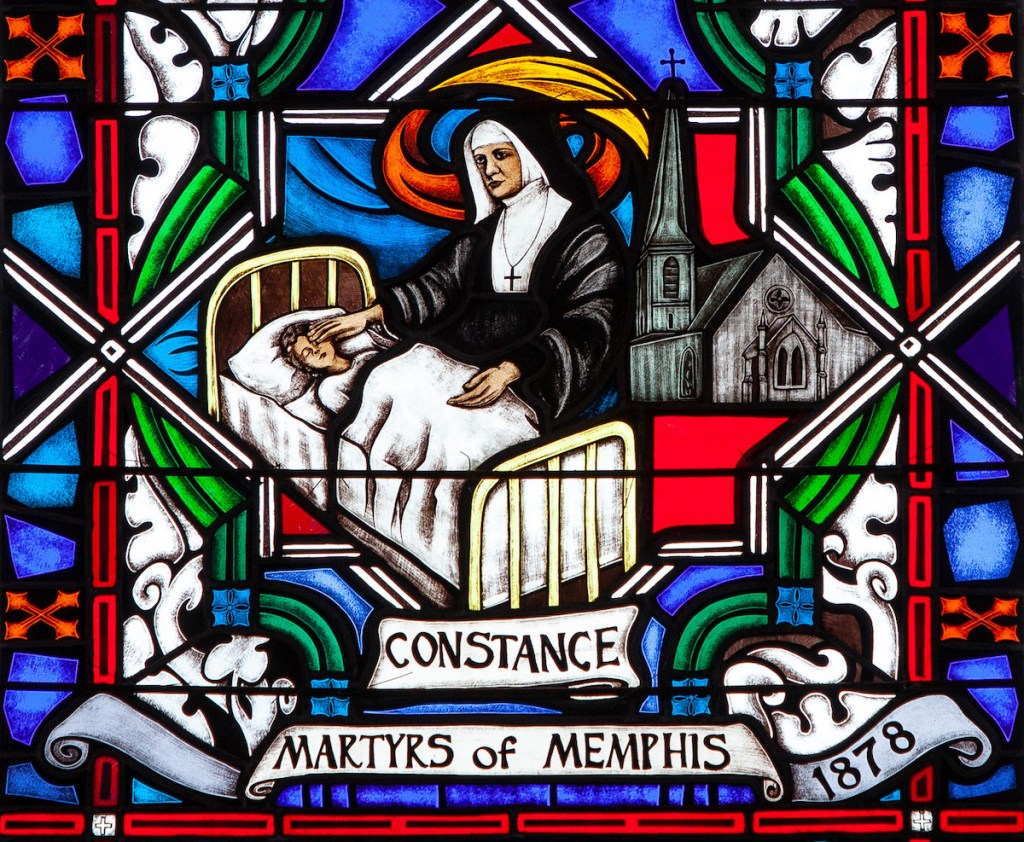
Many of the saints we celebrate seemed to have lived in lands far from here hundreds of years ago. However, Constance, an Episcopal nun, and her companions that we celebrated today are known for their work in Memphis, Tennessee, during a Yellow Fever epidemic in 1878.
The epidemic in that year was the third in a decade, and by the time it reached its height, 30,000 people had fled the city, and some 20,000 remained. Death tolls averaged 200 per day, and in the end, 5,000 died. Constance and many others who worked alongside her succumbed to the disease because instead of fleeing with so many others, they remained and cared for the sick, dying, and many orphaned children. The High Altar at St. Mary’s Cathedral in Memphis is a memorial to Constance and her Companions and a reminder of their sacrifice.
Until the COVID pandemic came rolling through, it didn’t seem like such events would ever come around again, but COVID showed us that there are still many out there willing to put their lives on the line for the sake of others. Even so, not everyone is in the position to do such great works, but our call to serve one another and to serve God is not always measured in extraordinary events. Quite often, it is the smaller day-to-day activities that have the most significant impact. Mother Teresa said, “Not all of us can do great things. But we can do small things with great love.” True. You may never be called to die while serving others, but we are all called to serve in the small things performed in great love.
When I read at night, it’s almost always brain candy. One that I completed a while back and that they are making the movies from is the Divergent series by Veronica Roth. Towards the end of the final book, Tobias, one of the main characters, says, “There are so many ways to be brave in this world. Sometimes bravery involves laying down your life for something bigger than yourself, or for someone else. Sometimes it involves giving up everything you have ever known, or everyone you have ever loved, for the sake of something greater. But sometimes it doesn’t. Sometimes it is nothing more than gritting your teeth through pain, and the work of every day, the slow walk toward a better life.”
Those like Constance and her Companions, those Martyrs of Memphis that made the ultimate sacrifice, become our inspiration and help us make the smaller sacrifices of day-to-day living. The types of sacrifices that allow us to set aside ourselves and love those around us. Sometimes those sacrifices don’t seem like much; they may just be a part of our everyday lives—going to work and doing an excellent job so that we might provide for our families, volunteering for a few hours at places like Loaves and Fishes, or sending a few dollars to Episcopal Relief and Develop so that they can purchase mosquito nets to fight disease—but those small sacrifices add up. In the words of Veronica Roth, those small sacrifices make up “the work of every day,” bringing all to a better life.
Look to Constance and her Companions as inspiration for the daily sacrifices you are called to make and realize that amid even the most difficult ones, our Lord will be with you; and in all these works, great and small, He is glorified.
Tee Boudreaux is 24 years old and still living at home. Boudreaux and Chlotile are starting to worry about what he is going to do with his future. Boudreaux tells Chlotile, “Cher, let’s do a little test. We goin’ to put a ten-dollar bill, a bible and a bottle of Jacque Daniel on de table, and when Tee Boudreaux comes in, we gonna be able to figure out what he’s gonna do. If he takes de ten-dollar bill, he’s gonna be a businessman, if he picks up de bible, he’s gonna be a preacher, but if he picks up de booze, I’m afraid he’s gonna be a bum de rest of his life.” So they put the stuff out and hid in the closet when they heard Tee coming in. Tee walks by the table, picks up the ten-dollar bill, looks at it, and puts it in his pocket. Then he picks up the bible, flips through it, and puts it under his arm. He picks up the Jacque Daniel, takes a healthy swig out of it, and walks off with the rest of the bottle. Boudreaux and Chlotile were watching all of this through the keyhole, and Boudreaux sighs, “Mais Cher, it looks like our son is gonna be a dang politician!”
Mark Twain was not kind to politicians. He wrote, “Reader, suppose you were an idiot. And suppose you were a member of Congress. But I repeat myself.” One of the places where so many politicians shine is in their campaign promises, but what if, instead of promising forty acres and a mule, they were honest? Or what if those promises were so negative that no one would vote for them? N.T. Wright says, “Imagine a politician standing on a soapbox addressing a crowd. ‘If you’re going to vote for me,’ he says, ‘you’re voting to lose your homes and families; you’re asking for higher taxes and lower wages, you’re deciding in favor of losing all you love best! So come on—who’s on my side?’” But as Wright points out, what Jesus was saying in our Gospel isn’t all that much better: “Whoever comes to me and does not hate father and mother, wife and children, brothers and sisters, yes, and even life itself, cannot be my disciple… So, therefore, none of you can become my disciple if you do not give up all your possessions.”
When you hear those words, is the first thought that comes to your mind: “Sign me up!” “He’s got my vote!” Hardly. Most likely, the first thought is: “I think I’ll vote for the forty acres and a mule.” But what if N.T. Wright’s politician has something else in mind. What if, instead of just some random goals, that person is asking you to give up family and friends, possessions and homes, and possibly your very life to follow him on a dangerous journey, but a journey that will provide the answer to the millions in this world that are hungry? Not just some pipe dream, but a “for fact” answer. If you go, risking everything, you will be a part of feeding the world, even though you may die in the process. Would that change how you viewed the offer? Yes. I think it would. Many would see it as a difficult choice, but many brave souls would see that the value for humanity far outweighs the cost, even if the cost is life.
This is the type of offer that Jesus is making. It sounds horrible—leave everything, give up your life, follow me—but it is an offer to be with him and have eternal life through the resurrection. The only problem, we see everything we’re being asked to do and none of what is to come. St. Paul writes, “If Christ has not been raised, then our preaching is in vain, and your faith is in vain… If Christ has not been raised, your faith is futile, and you are still in your sins… If in Christ we have hope in this life only, we are of all people most to be pitied.” If none of what Jesus has promised is true, we are fools, and even though we have faith in those promises, there can still be this inkling of doubt, and that inkling can have more significant sway over our lives than all our faith, which always leads to a choice: follow God or follow the inkling. In our reading of Deuteronomy, Moses put it a bit more bluntly, “See, I have set before you today life and prosperity, death and adversity.” He says, “If you obey the commandments of the Lord your God… the Lord your God will bless you… if your heart turns away and you do not hear but are led astray… you shall perish.” It is a choice. Moses says we are choosing between life and death, which means we are choosing between following Jesus and following the desires of self. So how does self lead us away from Jesus?
On Wednesday night, we’ve begun the study of Eat this Book by Eugene Peterson. This past week, Peterson was talking about choices. “By the time we can hold a spoon,” he writes, “we choose between half a dozen cereals for breakfast, ranging from Cheerios to Corn Flakes.” From there, he points out that throughout our lives, we are given all sorts of choices: the clothes we wear, the music we listen to, courses in school, career planning, on and on; and so he concludes, “We enter adulthood with the working assumption that whatever we need and want and feel forms the divine control center of our lives.” The self is leading the way.
The result, Peterson says, “My needs are non-negotiable. My so-called rights, defined individually, are fundamental to my identity. My need for fulfillment, for expression, for affirmation, for sexual satisfaction, for respect, my need to get my own way—all these provide a foundation to the centrality of me and fortify myself against diminution.” (di•mi•nu•tion: had to look that one up. It means decreasing in size or importance.) “My feelings are the truth of who I am.” (P.31-32)
Self leads us away from Jesus, away from God, because we won’t allow God or anyone else to interfere or even question our desires, so when Jesus says, “Give up everything—your possessions, your life, your will, your self—for the promises I have made to you and follow me,” combined with that inkling of doubt concerning those promises… we end up making poor choices.
In Mere Christianity, C.S.Lewis tells us, “Every time you make a choice, you are turning the central part of you, the part of you that chooses, into something a little different from what it was before. And taking your life as a whole, with all your innumerable choices, all your life long, you are slowly turning this central thing either into a heavenly creature or into a hellish creature: either into a creature that is in harmony with God, and with other creatures, and with itself, or else into one that is in a state of war and hatred with God, and with its fellow-creatures, and with itself. To be the one kind of creature is heaven: that is, it is joy and peace and knowledge and power. To be the other means madness, horror, idiocy, rage, impotence, and eternal loneliness. Each of us at each moment is progressing to the one state or the other.” (p.92)
The promises of Jesus are not like the promises of a politician. The promises of Jesus contain life itself. The path he calls us to walk is not always easy; it can be quite difficult and, more often than not, requires the exact opposite of the choice the self wants to make. So, as the man building a house or the king facing war, sit down and calculate the price. Not so that you can decide if following Jesus is worth it—that would be foolishness—but so that you can prepare your heart and mind to be obedient even in the most costly of times.
Let us pray: Loving Father, faith in Your Word is the way to wisdom. Help us to think about Your Divine Plan that we may grow in the truth. Open our eyes to Your deeds, our ears to the sound of Your call, so that our every act may help us share in the life of Jesus. Give us the grace to live the example of the love of Jesus, which we celebrate in the Eucharist and see in the Gospel. Form in us the likeness of Your Son and deepen His Life within us. Amen.
Along the Northeast coast of England was the kingdom of Bernicia. It changed hands several times between Christian and pagan kings, but in 633, it was conquered by Oswald, a devout Christian. Having the desire to spread the Good News throughout his kingdom, Oswald sent to Iona for a Bishop. The abbot of Iona agreed and sent to Oswald a bishop named Corman. He failed and returned to Iona, declaring that the “English have no manners; they behave like savages.”
So concerned was the abbot that he convened a synod of the monks. After hearing Corman’s report, one of the monks said, “I think, brother, that you may have been too severe for such ignorant listeners and that you should have led them on more gently, giving them first the milk of religion before its meat.” Agreeing with him, the abbot sent that priest, Aidan, back to Bernicia, where he engaged in the work of God among these savage English and was quite successful. His story was recorded for us by the Venerable Bede.
Bede wrote: “He neither sought nor loved anything of this world, but delighted in distributing immediately to the poor whatever was given him by kings or rich men of the world. He traversed both town and country on foot, never on horseback, unless compelled by some urgent necessity. Wherever on his way he saw any, either rich or poor, he invited them, if pagans, to embrace the mystery of the faith; or if they were believers, he sought to strengthen them in their faith and stir them up by words and actions to alms and good works.”
One story tells how the king, seeing Aidan traveling everywhere on foot, gave him a royal horse to ride; however, Aidan did not keep it long. He came across a beggar and, without hesitation, dismounted and gave the beggar the horse. Upon hearing this, the king was angry. He said that had he known that Aidan was going to give the horse away, he would have given him a less expensive one, but Aidan, full of wisdom, replied, “Do you mean to say, sire, that yonder son of a mare is dearer to you than the son of God to whom I gave the horse?” Recognizing the truth, the king repented, saying, “I will never speak of this matter again, nor find fault with you for giving as much of our wealth as you wish to such sons of God.”
Just off the coast and within eyesight of the castle was the island of Lindisfarne. The king gave the island to Aidan, who established a monastery, which became a great center of learning and writing. These may be fighting words for some, but of Aidan, one English scholar said, “It was not Augustine, but Aidan, who was the true apostle to England.”
There are many ways to convey the Gospel message so that those who do not yet know the Lord will listen and hear with their ears and hearts. Fortunately, Aidan recognized that those savage English would not hear it by being beaten over the head with the message, but they would hear it through mercy, truth, righteousness, and peace.
We owe all those saints that have gone before us, but we are particularly indebted to Aidan because it is partly due to his work and methods that you and I are here today, worshiping in an Episcopal / Anglican church. I give thanks that you all are not still those savage ill-mannered English or Oklahomans!
As a warning: I wrote this sermon in two sittings. The first bit came during the day on Wednesday. That night, I woke up at 1:55 a.m., and the second half was there. You may end up preferring that I don’t write sermons late at night.
Little Johnny’s family was having dinner with his mom and dad on Friday night at Granma’s house. Once seated around the table, little Johnny dug into the food immediately.
“Johnny!” his mother shouted. “You have to wait until we say a prayer.”
“No, we don’t,” Johnny replied.
“Of course we do,” his mother insisted, “we always say a prayer before eating at our house.”
“That’s at our house,” Johnny explained, “but this is Granma’s house. She knows how to cook.”
In almost all of the images of Jesus, he is portrayed as a very thin man, but I’m not sure how that is possible when you think of all the meals he attends in the Gospel of Luke. There are eight specifically mentioned and a few additional ones where it is implied. He’s having meals with tax collectors and sinners, Pharisees, Mary and Martha, Zacchaeus, the disciples, and more. All of which tells us of the significance of the meal and the breaking of bread together. It becomes even more important when we consider that the meal and gatherings like it were a source of entertainment and socializing. They couldn’t have a meal and quickly wash up the dishes (or just pile them up in the sink) and dash off to watch something on Netflix. The meal and the time spent together were important, so there was more significance placed around specific details that we don’t often consider, like who sits where and what their position at the table signifies. Perhaps the closest image of this comes from the artist Norman Rockwell with dad at the head of the table getting ready to carve the Thanksgiving turkey.
In our reading of Holy Scripture, we must also remember that one of the greatest gifts Jesus is going to give us is a meal, the Holy Eucharist, which was instituted at The Last Supper, so it is essential to have that meal in mind when reading about other meals in scripture. Today’s reading is no different. It began, “On one occasion when Jesus was going to the house of a leader of the Pharisees to eat a meal on the sabbath, they were watching him closely.” You may have noticed that we skipped verses two through six. They described the healing of a man on the Sabbath, then Jesus spoke to them about choosing the best seats: “When he noticed how the guests chose the places of honor, he told them a parable. ‘When you are invited by someone to a wedding banquet, do not sit down at the place of honor…’” What’s this all about, and how do you know where to sit?
Simon Kistemaker, in his book, The Parables, Understanding the Stories Jesus Told, explains. He writes, “Couches at a feast were arranged in the shape of an elongated horseshoe consisting of a number of tables. The man receiving the highest honor was at the head table, with second and third places to the left and right of this person. Every couch accommodated three people, with the middle man receiving the highest honor. The couch to the left of the head table was next in order of priority, and after that the couch to the right. Consequently, Jewish guests were governed by the social etiquette of the day to find the correct place at the table. However, if the privilege of choosing seats was given to the invited guest, they could very well display selfishness, conceit and pride. And this is exactly what happened at the house of the prominent Pharisee to which Jesus was invited.”
There are tables with long cushions to sit on. Each cushion will accommodate three individuals. The person who sits in the middle of the cushion is the most honored. The persons on the same cushion to the left and right of the one in the center are honored next. This may help further understand the request made by James and John’s mother in Matthew’s gospel: “Then the mother of the sons of Zebedee came up to [Jesus] with her sons, and kneeling before him she asked him for something. And he said to her, ‘What do you want?’ She said to him, ‘Say that these two sons of mine are to sit, one at your right hand and one at your left, in your kingdom.’” When asking for those seats, was she wanting her boys to be allowed to sit at the head table on the same cushion as Jesus?
Whatever the case, with the Pharisees, with James and John, in their pride, they were seeking to exalt themselves. Why? Very simple: they saw themselves as better than the others. Are they the only ones? Hardly. Consciously or subconsciously, we are all looking to elevate ourselves at the table, whether that be at the table of our personal lives (security, comfort, toys, etc.), our work lives (salary, position, promotion, recognition, etc.), and even in our faith (holiness, devotedness, service, and so on)—think of the story of the Pharisee and the publican praying in the Temple.
The Pharisee looked back and said, “I’m glad I’m not like that poor sinful schmuck.” He was elevating himself. He was taking a higher seat. So, with this teaching of Jesus in mind, we attempt to quell those desires. To take a more humble position, a lower seat. I think we all want to be that person, or we wouldn’t be here on a Sunday morning, but here’s a question: should we, as followers of Jesus, even seek to sit at the table? Jesus said, “Let the greatest among you become as the youngest, and the leader as one who serves. For who is the greater, one who reclines at table or one who serves? Is it not the one who reclines at table? But I am among you as the one who serves.”
Ok… so now we come to the 1:55 a.m. bit, and I won’t put you into it.
Hearing all this, I say, “OK. I won’t seek a seat at the table. I’ll be one who serves.” Jesus says, “That’s good,” but then he says, “Greater love has no one than this, that someone lay down his life for his friends.” So then I’m being asked to lay down my life, to give it all away in humble service to our God. If I can say “OK” to this, Jesus still doesn’t stop because he says, “Truly, truly, I say to you, unless a grain of wheat falls into the earth and dies, it remains alone; but if it dies, it bears much fruit.” So now Jesus is asking me to die to myself so that I might bear much fruit, many good works. Again, if I can say, “OK,” Jesus still isn’t done with me, for he says, “Whoever feeds on my flesh and drinks my blood has eternal life, and I will raise him up on the last day. For my flesh is true food, and my blood is true drink.” Do you see what Jesus is saying and what he is asking?
He who was seated on the cushion with Our Father in Heaven humbled himself through his incarnation, he became a servant to us all, he died, he rose, he ascended, and through the giving of the Holy Eucharist, the food for our souls, he became not only the servant at the table but the meal itself. That is the extent to which Jesus humbled himself. And what is so difficult us is that after humbling himself in such a way, he then turns and says, “Follow me.”
Jesus says, “You are jockeying for and squabbling over a good seat at the table, but you should be giving of yourself in the proclamation and building of the Kingdom of God to such an extent that you are like a meal that is being consumed.”
No more 1:55 a.m. sermon thoughts, please, because I’ll be honest: I don’t know how to live like that. For now, I’m falling back on Jesus’ statement to St. Paul, “My grace is sufficient for you,” but I can’t help but wonder what this kind of life we are all being called to would look like, even though I already know the answer: it would look like Jesus.
I don’t know that any of us will ever attain it, but it’d feel like an accomplishment if I could stop fretting over my seat at the table and be at peace. We all must start somewhere, so ask yourself, “How much do I truly resemble Jesus?” And then go to work because that’s what it means to become one of his disciples.
Let us pray: God, our Father, You redeemed us and made us Your children in Christ. Through Him, You have saved us from death and given us Your Divine life of grace. By becoming more like Jesus on earth, may we come to share His glory in Heaven. Give us the peace of Your kingdom, which this world does not give. By Your loving care, protect the good You have given us. Open our eyes to the wonders of Your Love that we may serve You with a willing heart. Amen.
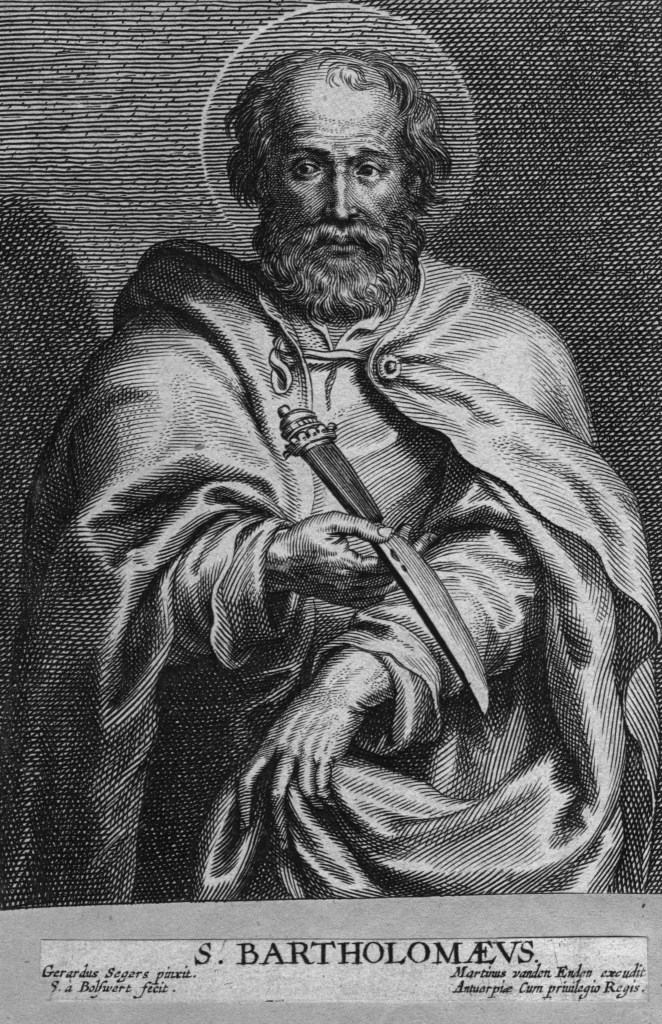
Circa 30 AD, Saint Bartholomew, son of Tolmai (or Talmai), one of the twelve apostles. (Photo by Hulton Archive/Getty Images)
The name of the apostle and saint we celebrate today, Bartholomew, only appears in the Gospels of Matthew, Mark, and Luke, not in John. However, an apostle in John does not appear in the other three: Nathanael. Some point to this as an inaccuracy in the Scriptures, but perhaps something else is happening.
The people who are much brighter than me have come up with the following possible answer. As it turns out, Bartholomew is a family name, the last name, if you will. In Hebrew, it would be translated Bar-Talmai or “Son of Talmai.” Nathaniel is the first name. Could they be one and the same – Nathanael Bar-Talmai – Nathanael Bartholomew? The theologians state there is a strong case for this, mainly since Nathanael/Bartholomew is a friend of the Apostle Philip in all four Gospels. It is only a theory, but it is a well-supported one. Outside of being included in the list of the apostles and an incident in John’s Gospel with Philip, there is no other mention of him in the Gospels. What little information we have comes from the legends built around him.
In one of the legends, Bartholomew stays overnight in a pagan temple and proceeds to bind up the powers of the god/demon that worked its deeds there. Following that night, the god failed to respond to any more petitions, so the pagans went to another god and asked why their god could do no more works. The demon inside the idol replied, “Our god is bound with fiery chains and does not dare to breathe or speak since the moment the apostle Bartholomew came in.” When asked who this Bartholomew was, the demon responded, “He is a friend of almighty God, and he came into this province to rid India of all its gods.” Asked to describe him, the demon said, “His hair is dark and curly, his complexion fair, his eyes wide, his nose even and straight, his beard thick, with a few gray hairs… Angels walk with him and never allow him to get tired or hungry. He is always cheerful and joyous in countenance and spirit. He foresees all and knows all, speaks and understands the language of every people.” Even if somewhat exaggerated, that certainly sounds like someone you want to have around.
If accurate, his eventual martyrdom was quite horrible. One where we don’t need the details… it was terrible.
Perhaps the legends hold only a small bit of truth, but even if they are mostly fiction, they still teach us what kind of Christian person we should strive to become. That is the kind of person whom the demons fear to speak about or breathe around. The type of person always accompanied by angels. The type of person who has faith and hope that always leads to a cheerful and joyous spirit. And, most importantly, the type of person called a “friend of almighty God.”
St. Theodore the Studite, the abbot of a monastery in the 9th century, had a great devotion to St. Bartholomew and wrote a prayer for him. We’ll close with it today. Let us pray: ”Hail, O blessed of the blessed, thrice-blessed Bartholomew! You are the splendor of Divine light, the fisherman of holy Church, expert catcher of fish which are endowed with reason, sweet fruit of the blooming palm tree! You wound the devil who wounds the world by his crimes! May you rejoice, O sun illumining the whole earth, mouth of God, tongue of fire that speaks wisdom, fountain ever flowing with health! You have sanctified the sea by your passage over it; you have purpled the earth with your blood; you have mounted to heaven, where you shine in the midst of the heavenly host, resplendent in the splendor of undimmable glory! Rejoice in the enjoyment of inexhaustible happiness!” Amen.
This story contains a disclaimer: I am not talking about our church. This is not about our church. This story you are about to hear in no way reflects our church. Does everyone understand the disclaimer? Good.
A new Pastor in a small Oklahoma town spent the first four days making personal visits to each member, inviting them to come to his first services.
The following Sunday, the church was all but empty. Accordingly, the Pastor placed a notice in the local newspapers, stating that it was everyone’s duty to give it a decent Christian burial because the church was dead. The funeral would be held the following Sunday afternoon, the notice said.
Morbidly curious, a large crowd turned out for the “funeral.” In front of the pulpit, they saw a closed coffin smothered in flowers. After the Pastor delivered the eulogy, he opened the coffin and invited his congregation to come forward and pay their final respects to their dead church.
Filled with curiosity about what would represent the corpse of a “dead church,” all the people eagerly lined up to look in the coffin. Each “mourner” peeped into the coffin and quickly turned away with a guilty, sheepish look.
In the coffin, tilted at the correct angle, was a large mirror.
No. That is not our church; however, over time, it can be the story of any church. By looking back into history, we can see how.
It’s been a while, but we’ve talked about how in 538 b.c. the Persian king, Cyrus, freed the Israelites and allowed them to return to Jerusalem. Once home, the Israelites began to rebuild the city that had been destroyed, starting with the walls. That project took almost one hundred and fifty years because of politics and infighting, but when Ezra and Nehemiah arrived on the scene, progress was made. In the year 385 b.c., the Prophet Nehemiah says, “The wall was finished on the twenty-fifth day of the month Elul, in fifty-two days. And when all our enemies heard of it, all the nations around us were afraid and fell greatly in their own esteem, for they perceived that this work had been accomplished with the help of our God.” (Nehemiah 6:15-16)
Following its completion, the people were all brought together, and the Book of the Law of Moses was read to them. The people now had a wall to guard their city and, in the Law, a wall to guard their souls.
The walls we build are meant to protect us from the elements, those who wish us harm, the wild beasts, and such. They provide security, yet sometimes the walls we build become so high that we become isolated, not seeing the world around us and not really caring about it either. The Israelites finished the wall around their city, but the religious leaders never stopped building the wall around their souls. It got higher and higher, and in the process, it no longer provided security for the soul; it became a prison for the heart, creating a heart that no longer cared, no longer had compassion, and no longer loved. It created a heart so rigid that it would become angry if a woman who had been sick and bent over for eighteen years was restored to health on the wrong day.
Scipio of Rome is considered one of the greatest generals of the Roman Empire. He did not put up with much nonsense. Writing of him in City of God, St. Augustine said, “He did not consider that republic flourishing whose walls stand, but whose morals are in ruins. But the seductions of evil-minded devils had more influence with you than the precautions of prudent men.” It is good to have strong fine walls to protect a city, but if the people living inside them are not good, then walls or not, the place itself is not good. That was the result the religious leaders had accomplished, and Jesus was angry with them, not because they were keeping the Sabbath holy, but because they had stopped caring, stopped loving, and not just on the Sabbath but the other six days as well. The spiritual wall that was given to protect the soul had become a prison for the heart, so everything that God had accomplished in the time of Ezra and Nehemiah was still standing but in ruins.
In calling out the religious leaders, Jesus was having a funeral for a dead church. He was holding up a mirror and showing them what they had become.
The words of Isaiah that we read this morning speak very clearly about what was happening but also point the way out of the prison they had created:
If you remove the yoke from among you, the pointing of the finger, the speaking of evil, if you offer your food to the hungry and satisfy the needs of the afflicted, then your light shall rise in the darkness and your gloom be like the noonday.
It is not about the walls around this building that matter. It is the wall around our souls. Should we have one around the soul? Yes. Absolutely. As we said last week, we must care for our souls, but to avoid becoming a dying or dead church, we can’t turn it into a prison. We guard our souls so that we can go outside these walls and care for the souls of others. How do we do this?
I enjoy the short films you can find on YouTube. They are five to twenty minutes in length. A few weeks back, I came across one that had been nominated for an Oscar: Feeling Through. It is about a young homeless man’s encounter with an older man who is both blind and deaf. Imagine trying to communicate with someone who is both blind and deaf. Not easy. The two meet when the younger man reads the sign that the other is holding: “I am blind and deaf. Tap me if you can help.” Tap me. Touch me so that I know you are there.
How do we care for the souls of those outside the walls? We touch them so that they know we are here. We help ease their burdens, both physically and spiritually, we bring reconciliation and not strife, we feed bodies as well as souls, and we care for and love the oppressed and afflicted. If we do these things, then it will be as Isaiah said: “The Lord will guide you continually, and satisfy your needs in parched places, and make your bones strong; and you shall be like a watered garden, like a spring of water, whose waters never fail. Your ancient ruins shall be rebuilt; you shall raise up the foundations of many generations; you shall be called the repairer of the breach, the restorer of streets to live in.”
Or, as Jesus said, “If anyone thirsts, let him come to me and drink. Whoever believes in me, as the Scripture has said, ‘Out of his heart will flow rivers of living water.’” If we touch those outside of these walls, then we will become stronger, and we will continue to provide rivers of living water to all who are thirsty.
There is a story about a tourist visiting Italy who came upon a construction site. “What are you doing?” he asked three stonemasons.
“I’m cutting the stone,” answered the first.
“I’m cutting stone for 1,000 lire a day,” the second said.
But the third answered, “I’m helping to build a cathedral!”
With the enthusiasm and joy of that third stonemason, let’s care for our souls but also build a church that is the source of living water so that the souls of many are touched and cared for.
Let us pray: Come, all who are thirsty says Jesus, our Lord, come, all who are weak, taste the living water that I shall give. Dip your hands in the stream, refresh body and soul, drink from it, depend on it, for this water will never run dry. Come, all who are thirsty says Jesus, our Lord. Amen.
Heavenly birthdays. You may be aware that the date we celebrate a saint is not on their birthday but on the day they died. That is considered the day they entered heaven or their heavenly birthday. However, there are two that Holy Scripture tells us did not die. For ten years off of purgatory, can anyone name those two saints? Enoch and Elijah.
For Enoch, we read in Genesis, “When Enoch had lived 65 years, he became the father of Methuselah. After he became the father of Methuselah, Enoch walked faithfully with God 300 years and had other sons and daughters. Altogether, Enoch lived a total of 365 years. Enoch walked faithfully with God; then he was no more, because God took him away.” And Paul tells us in his letter to the Hebrews, “By faith Enoch was taken from this life, so that he did not experience death.” Elijah, we learn about in 2 Kings as he was carried away in a fiery chariot. The term used to describe these events is an assumption or, to be assumed, taken up. The difference between Jesus’ ascension and the assumption of Enoch and Elijah is that whereas Jesus achieved heaven on his own power, Enoch and Elijah were carried up by God.
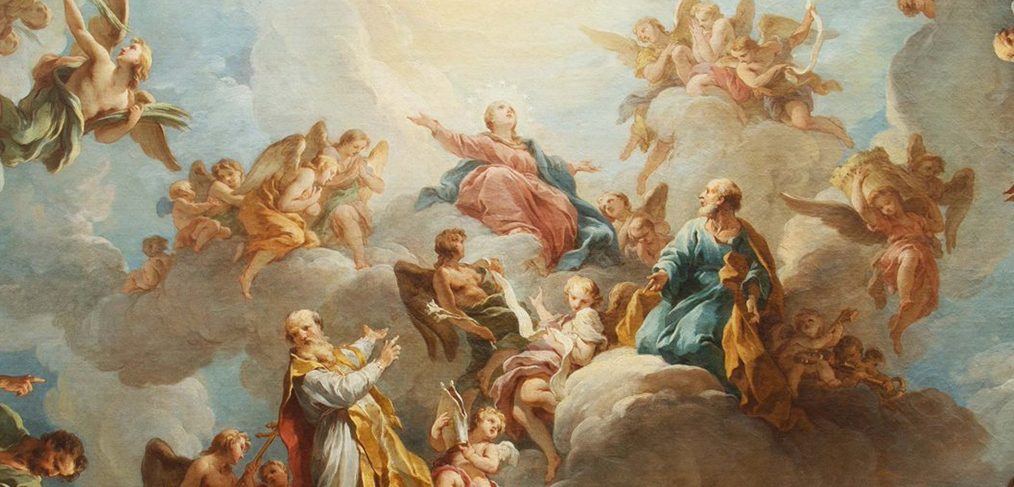
Today, we celebrate the Blessed Virgin Mary (her feast day was officially on Monday). For some, this is a heavenly birthday, the day of her death; however, for others who have more high church leanings, this is the celebration of the Assumption of Mary or the “falling asleep of Mary.” Although not attested to in Holy Scripture, the latter group believes that, like Enoch and Elijah, Mary never tasted death, but was carried up, assumed into heaven. Read carefully you will note that our collect of the day that we prayed is ambiguous enough to satisfy both groups, “O God, you have taken to yourself the blessed Virgin Mary, mother of your incarnate Son: Grant that we, who have been redeemed by his blood, may share with her the glory of your eternal kingdom.”
For Roman Catholics, Pope Pius XII decided on the matter when in 1950, he stated, “By the authority of our Lord Jesus Christ, of the Blessed Apostles Peter and Paul, and by our own authority, we pronounce, declare, and define it to be a divinely revealed dogma: that the Immaculate Mother of God, the ever Virgin Mary, having completed the course of her earthly life, was assumed body and soul into heavenly glory.” The thought is, why would God allow the body of Mary, the one who bore his Son, to be corrupted by death?
For us, whether dogma or “pious opinion,” our salvation is not dependent upon confessing Mary’s assumption. Our salvation is found solely in her Son, Jesus, but there is no denying the fact that she plays a role in that salvation, for it was her “Yes” to God that allowed Jesus to be born into the world, which makes her song, The Magnificat, also our song.
My soul proclaims the greatness of the Lord, my spirit rejoices in God my Savior; for he has looked with favor on his lowly servant. From this day all generations will call me blessed: the Almighty has done great things for me, and holy is his Name.
Not only did God look with favor upon Mary, He—through Jesus—looks with favor upon us. She is ever blessed, and so are we. He did great things through and for her, just as he has done great things through and for us; so, like Mary, we too proclaim the greatness of the Lord.





 Candle in a Cave