Sermon: Proper 17 RCL C – “The Meal”

Photo by Ibrahim Boran on Unsplash

As a warning: I wrote this sermon in two sittings. The first bit came during the day on Wednesday. That night, I woke up at 1:55 a.m., and the second half was there. You may end up preferring that I don’t write sermons late at night.

Little Johnny’s family was having dinner with his mom and dad on Friday night at Granma’s house. Once seated around the table, little Johnny dug into the food immediately.

“Johnny!” his mother shouted. “You have to wait until we say a prayer.”

“No, we don’t,” Johnny replied.

“Of course we do,” his mother insisted, “we always say a prayer before eating at our house.”

“That’s at our house,” Johnny explained, “but this is Granma’s house. She knows how to cook.”

In almost all of the images of Jesus, he is portrayed as a very thin man, but I’m not sure how that is possible when you think of all the meals he attends in the Gospel of Luke. There are eight specifically mentioned and a few additional ones where it is implied. He’s having meals with tax collectors and sinners, Pharisees, Mary and Martha, Zacchaeus, the disciples, and more. All of which tells us of the significance of the meal and the breaking of bread together. It becomes even more important when we consider that the meal and gatherings like it were a source of entertainment and socializing. They couldn’t have a meal and quickly wash up the dishes (or just pile them up in the sink) and dash off to watch something on Netflix. The meal and the time spent together were important, so there was more significance placed around specific details that we don’t often consider, like who sits where and what their position at the table signifies. Perhaps the closest image of this comes from the artist Norman Rockwell with dad at the head of the table getting ready to carve the Thanksgiving turkey.

In our reading of Holy Scripture, we must also remember that one of the greatest gifts Jesus is going to give us is a meal, the Holy Eucharist, which was instituted at The Last Supper, so it is essential to have that meal in mind when reading about other meals in scripture. Today’s reading is no different. It began, “On one occasion when Jesus was going to the house of a leader of the Pharisees to eat a meal on the sabbath, they were watching him closely.” You may have noticed that we skipped verses two through six. They described the healing of a man on the Sabbath, then Jesus spoke to them about choosing the best seats: “When he noticed how the guests chose the places of honor, he told them a parable. ‘When you are invited by someone to a wedding banquet, do not sit down at the place of honor…’” What’s this all about, and how do you know where to sit?

Simon Kistemaker, in his book, The Parables, Understanding the Stories Jesus Told, explains. He writes, “Couches at a feast were arranged in the shape of an elongated horseshoe consisting of a number of tables. The man receiving the highest honor was at the head table, with second and third places to the left and right of this person. Every couch accommodated three people, with the middle man receiving the highest honor. The couch to the left of the head table was next in order of priority, and after that the couch to the right. Consequently, Jewish guests were governed by the social etiquette of the day to find the correct place at the table. However, if the privilege of choosing seats was given to the invited guest, they could very well display selfishness, conceit and pride. And this is exactly what happened at the house of the prominent Pharisee to which Jesus was invited.” 

There are tables with long cushions to sit on. Each cushion will accommodate three individuals. The person who sits in the middle of the cushion is the most honored. The persons on the same cushion to the left and right of the one in the center are honored next. This may help further understand the request made by James and John’s mother in Matthew’s gospel: “Then the mother of the sons of Zebedee came up to [Jesus] with her sons, and kneeling before him she asked him for something. And he said to her, ‘What do you want?’ She said to him, ‘Say that these two sons of mine are to sit, one at your right hand and one at your left, in your kingdom.’” When asking for those seats, was she wanting her boys to be allowed to sit at the head table on the same cushion as Jesus? 

Whatever the case, with the Pharisees, with James and John, in their pride, they were seeking to exalt themselves. Why? Very simple: they saw themselves as better than the others. Are they the only ones? Hardly. Consciously or subconsciously, we are all looking to elevate ourselves at the table, whether that be at the table of our personal lives (security, comfort, toys, etc.), our work lives (salary, position, promotion, recognition, etc.), and even in our faith (holiness, devotedness, service, and so on)—think of the story of the Pharisee and the publican praying in the Temple.

The Pharisee looked back and said, “I’m glad I’m not like that poor sinful schmuck.” He was elevating himself. He was taking a higher seat. So, with this teaching of Jesus in mind, we attempt to quell those desires. To take a more humble position, a lower seat. I think we all want to be that person, or we wouldn’t be here on a Sunday morning, but here’s a question: should we, as followers of Jesus, even seek to sit at the table? Jesus said, “Let the greatest among you become as the youngest, and the leader as one who serves. For who is the greater, one who reclines at table or one who serves? Is it not the one who reclines at table? But I am among you as the one who serves.”

Ok… so now we come to the 1:55 a.m. bit, and I won’t put you into it.

Hearing all this, I say, “OK. I won’t seek a seat at the table. I’ll be one who serves.” Jesus says, “That’s good,” but then he says, “Greater love has no one than this, that someone lay down his life for his friends.” So then I’m being asked to lay down my life, to give it all away in humble service to our God. If I can say “OK” to this, Jesus still doesn’t stop because he says, “Truly, truly, I say to you, unless a grain of wheat falls into the earth and dies, it remains alone; but if it dies, it bears much fruit.” So now Jesus is asking me to die to myself so that I might bear much fruit, many good works. Again, if I can say, “OK,” Jesus still isn’t done with me, for he says, “Whoever feeds on my flesh and drinks my blood has eternal life, and I will raise him up on the last day. For my flesh is true food, and my blood is true drink.” Do you see what Jesus is saying and what he is asking?

He who was seated on the cushion with Our Father in Heaven humbled himself through his incarnation, he became a servant to us all, he died, he rose, he ascended, and through the giving of the Holy Eucharist, the food for our souls, he became not only the servant at the table but the meal itself. That is the extent to which Jesus humbled himself. And what is so difficult us is that after humbling himself in such a way, he then turns and says, “Follow me.” 

Jesus says, “You are jockeying for and squabbling over a good seat at the table, but you should be giving of yourself in the proclamation and building of the Kingdom of God to such an extent that you are like a meal that is being consumed.” 

No more 1:55 a.m. sermon thoughts, please, because I’ll be honest: I don’t know how to live like that. For now, I’m falling back on Jesus’ statement to St. Paul, “My grace is sufficient for you,” but I can’t help but wonder what this kind of life we are all being called to would look like, even though I already know the answer: it would look like Jesus.

I don’t know that any of us will ever attain it, but it’d feel like an accomplishment if I could stop fretting over my seat at the table and be at peace. We all must start somewhere, so ask yourself, “How much do I truly resemble Jesus?” And then go to work because that’s what it means to become one of his disciples.

Let us pray:
God, our Father,
You redeemed us
and made us Your children in Christ.
Through Him, You have saved us from death
and given us Your Divine life of grace.
By becoming more like Jesus on earth,
may we come to share His glory in Heaven.
Give us the peace of Your kingdom,
which this world does not give.
By Your loving care, protect the good You have given us.
Open our eyes to the wonders of Your Love
that we may serve You with a willing heart.
Amen.

Sermon: Bartholomew

Circa 30 AD, Saint Bartholomew, son of Tolmai (or Talmai), one of the twelve apostles. (Photo by Hulton Archive/Getty Images)

The name of the apostle and saint we celebrate today, Bartholomew, only appears in the Gospels of Matthew, Mark, and Luke, not in John. However, an apostle in John does not appear in the other three: Nathanael. Some point to this as an inaccuracy in the Scriptures, but perhaps something else is happening.

The people who are much brighter than me have come up with the following possible answer. As it turns out, Bartholomew is a family name, the last name, if you will. In Hebrew, it would be translated Bar-Talmai or “Son of Talmai.” Nathaniel is the first name. Could they be one and the same – Nathanael Bar-Talmai – Nathanael Bartholomew? The theologians state there is a strong case for this, mainly since Nathanael/Bartholomew is a friend of the Apostle Philip in all four Gospels. It is only a theory, but it is a well-supported one. Outside of being included in the list of the apostles and an incident in John’s Gospel with Philip, there is no other mention of him in the Gospels. What little information we have comes from the legends built around him.

In one of the legends, Bartholomew stays overnight in a pagan temple and proceeds to bind up the powers of the god/demon that worked its deeds there. Following that night, the god failed to respond to any more petitions, so the pagans went to another god and asked why their god could do no more works. The demon inside the idol replied, “Our god is bound with fiery chains and does not dare to breathe or speak since the moment the apostle Bartholomew came in.” When asked who this Bartholomew was, the demon responded, “He is a friend of almighty God, and he came into this province to rid India of all its gods.” Asked to describe him, the demon said, “His hair is dark and curly, his complexion fair, his eyes wide, his nose even and straight, his beard thick, with a few gray hairs… Angels walk with him and never allow him to get tired or hungry. He is always cheerful and joyous in countenance and spirit. He foresees all and knows all, speaks and understands the language of every people.” Even if somewhat exaggerated, that certainly sounds like someone you want to have around.

If accurate, his eventual martyrdom was quite horrible. One where we don’t need the details… it was terrible.

Perhaps the legends hold only a small bit of truth, but even if they are mostly fiction, they still teach us what kind of Christian person we should strive to become. That is the kind of person whom the demons fear to speak about or breathe around. The type of person always accompanied by angels. The type of person who has faith and hope that always leads to a cheerful and joyous spirit. And, most importantly, the type of person called a “friend of almighty God.”

St. Theodore the Studite, the abbot of a monastery in the 9th century, had a great devotion to St. Bartholomew and wrote a prayer for him. We’ll close with it today. Let us pray: ”Hail, O blessed of the blessed, thrice-blessed Bartholomew! You are the splendor of Divine light, the fisherman of holy Church, expert catcher of fish which are endowed with reason, sweet fruit of the blooming palm tree! You wound the devil who wounds the world by his crimes! May you rejoice, O sun illumining the whole earth, mouth of God, tongue of fire that speaks wisdom, fountain ever flowing with health! You have sanctified the sea by your passage over it; you have purpled the earth with your blood; you have mounted to heaven, where you shine in the midst of the heavenly host, resplendent in the splendor of undimmable glory! Rejoice in the enjoyment of inexhaustible happiness!” Amen.

Sermon: Proper 16 RCL C – “Walls”

Photo by Luc Constantin on Unsplash

This story contains a disclaimer: I am not talking about our church. This is not about our church. This story you are about to hear in no way reflects our church. Does everyone understand the disclaimer? Good.

A new Pastor in a small Oklahoma town spent the first four days making personal visits to each member, inviting them to come to his first services.

The following Sunday, the church was all but empty. Accordingly, the Pastor placed a notice in the local newspapers, stating that it was everyone’s duty to give it a decent Christian burial because the church was dead. The funeral would be held the following Sunday afternoon, the notice said.

Morbidly curious, a large crowd turned out for the “funeral.” In front of the pulpit, they saw a closed coffin smothered in flowers. After the Pastor delivered the eulogy, he opened the coffin and invited his congregation to come forward and pay their final respects to their dead church.

Filled with curiosity about what would represent the corpse of a “dead church,” all the people eagerly lined up to look in the coffin. Each “mourner” peeped into the coffin and quickly turned away with a guilty, sheepish look.

In the coffin, tilted at the correct angle, was a large mirror.

No. That is not our church; however, over time, it can be the story of any church. By looking back into history, we can see how.

It’s been a while, but we’ve talked about how in 538 b.c. the Persian king, Cyrus, freed the Israelites and allowed them to return to Jerusalem. Once home, the Israelites began to rebuild the city that had been destroyed, starting with the walls. That project took almost one hundred and fifty years because of politics and infighting, but when Ezra and Nehemiah arrived on the scene, progress was made. In the year 385 b.c., the Prophet Nehemiah says, “The wall was finished on the twenty-fifth day of the month Elul, in fifty-two days. And when all our enemies heard of it, all the nations around us were afraid and fell greatly in their own esteem, for they perceived that this work had been accomplished with the help of our God.” (Nehemiah 6:15-16)

Following its completion, the people were all brought together, and the Book of the Law of Moses was read to them. The people now had a wall to guard their city and, in the Law, a wall to guard their souls.

The walls we build are meant to protect us from the elements, those who wish us harm, the wild beasts, and such. They provide security, yet sometimes the walls we build become so high that we become isolated, not seeing the world around us and not really caring about it either. The Israelites finished the wall around their city, but the religious leaders never stopped building the wall around their souls. It got higher and higher, and in the process, it no longer provided security for the soul; it became a prison for the heart, creating a heart that no longer cared, no longer had compassion, and no longer loved. It created a heart so rigid that it would become angry if a woman who had been sick and bent over for eighteen years was restored to health on the wrong day.

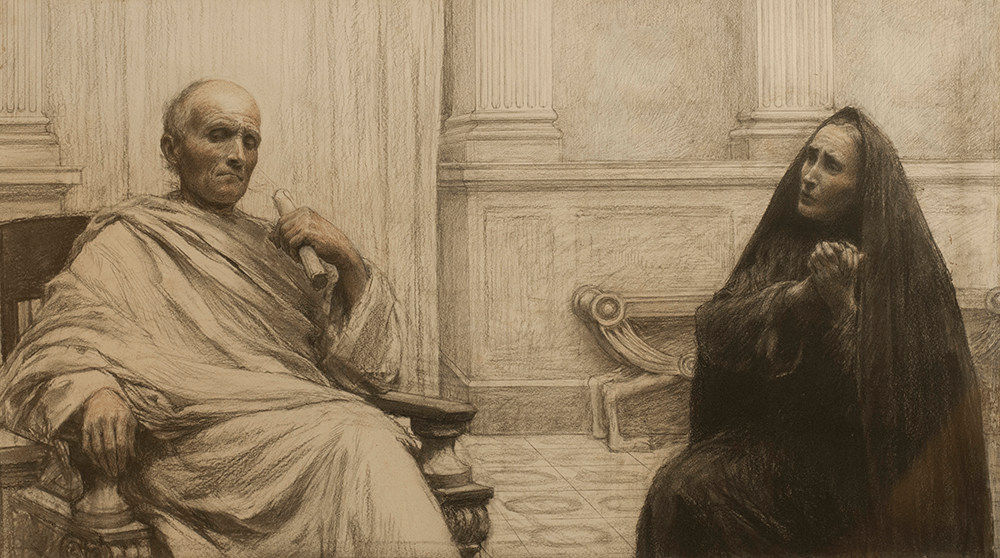
Scipio of Rome is considered one of the greatest generals of the Roman Empire. He did not put up with much nonsense. Writing of him in City of God, St. Augustine said, “He did not consider that republic flourishing whose walls stand, but whose morals are in ruins. But the seductions of evil-minded devils had more influence with you than the precautions of prudent men.” It is good to have strong fine walls to protect a city, but if the people living inside them are not good, then walls or not, the place itself is not good. That was the result the religious leaders had accomplished, and Jesus was angry with them, not because they were keeping the Sabbath holy, but because they had stopped caring, stopped loving, and not just on the Sabbath but the other six days as well. The spiritual wall that was given to protect the soul had become a prison for the heart, so everything that God had accomplished in the time of Ezra and Nehemiah was still standing but in ruins.

In calling out the religious leaders, Jesus was having a funeral for a dead church. He was holding up a mirror and showing them what they had become.

The words of Isaiah that we read this morning speak very clearly about what was happening but also point the way out of the prison they had created:

If you remove the yoke from among you,
the pointing of the finger, the speaking of evil,
if you offer your food to the hungry
and satisfy the needs of the afflicted,
then your light shall rise in the darkness
and your gloom be like the noonday.

It is not about the walls around this building that matter. It is the wall around our souls. Should we have one around the soul? Yes. Absolutely. As we said last week, we must care for our souls, but to avoid becoming a dying or dead church, we can’t turn it into a prison. We guard our souls so that we can go outside these walls and care for the souls of others. How do we do this?

I enjoy the short films you can find on YouTube. They are five to twenty minutes in length. A few weeks back, I came across one that had been nominated for an Oscar: Feeling Through. It is about a young homeless man’s encounter with an older man who is both blind and deaf. Imagine trying to communicate with someone who is both blind and deaf. Not easy. The two meet when the younger man reads the sign that the other is holding: “I am blind and deaf. Tap me if you can help.” Tap me. Touch me so that I know you are there.

How do we care for the souls of those outside the walls? We touch them so that they know we are here. We help ease their burdens, both physically and spiritually, we bring reconciliation and not strife, we feed bodies as well as souls, and we care for and love the oppressed and afflicted. If we do these things, then it will be as Isaiah said: “The Lord will guide you continually, and satisfy your needs in parched places, and make your bones strong; and you shall be like a watered garden, like a spring of water, whose waters never fail. Your ancient ruins shall be rebuilt; you shall raise up the foundations of many generations; you shall be called the repairer of the breach, the restorer of streets to live in.”

Or, as Jesus said, “If anyone thirsts, let him come to me and drink. Whoever believes in me, as the Scripture has said, ‘Out of his heart will flow rivers of living water.’” If we touch those outside of these walls, then we will become stronger, and we will continue to provide rivers of living water to all who are thirsty.

There is a story about a tourist visiting Italy who came upon a construction site. “What are you doing?” he asked three stonemasons.

“I’m cutting the stone,” answered the first.

“I’m cutting stone for 1,000 lire a day,” the second said.

But the third answered, “I’m helping to build a cathedral!”

With the enthusiasm and joy of that third stonemason, let’s care for our souls but also build a church that is the source of living water so that the souls of many are touched and cared for.

Let us pray:
Come, all who are thirsty
says Jesus, our Lord,
come, all who are weak,
taste the living water
that I shall give.
Dip your hands in the stream,
refresh body and soul,
drink from it,
depend on it,
for this water
will never run dry.
Come, all who are thirsty
says Jesus, our Lord.
Amen.

Sermon: St Mary the Virgin


Heavenly birthdays. You may be aware that the date we celebrate a saint is not on their birthday but on the day they died. That is considered the day they entered heaven or their heavenly birthday. However, there are two that Holy Scripture tells us did not die. For ten years off of purgatory, can anyone name those two saints? Enoch and Elijah.

For Enoch, we read in Genesis, “When Enoch had lived 65 years, he became the father of Methuselah.  After he became the father of Methuselah, Enoch walked faithfully with God 300 years and had other sons and daughters.  Altogether, Enoch lived a total of 365 years. Enoch walked faithfully with God; then he was no more, because God took him away.” And Paul tells us in his letter to the Hebrews, “By faith Enoch was taken from this life, so that he did not experience death.” Elijah, we learn about in 2 Kings as he was carried away in a fiery chariot. The term used to describe these events is an assumption or, to be assumed, taken up. The difference between Jesus’ ascension and the assumption of Enoch and Elijah is that whereas Jesus achieved heaven on his own power, Enoch and Elijah were carried up by God.

Today, we celebrate the Blessed Virgin Mary (her feast day was officially on Monday). For some, this is a heavenly birthday, the day of her death; however, for others who have more high church leanings, this is the celebration of the Assumption of Mary or the “falling asleep of Mary.” Although not attested to in Holy Scripture, the latter group believes that, like Enoch and Elijah, Mary never tasted death, but was carried up, assumed into heaven. Read carefully you will note that our collect of the day that we prayed is ambiguous enough to satisfy both groups, “O God, you have taken to yourself the blessed Virgin Mary, mother of your incarnate Son: Grant that we, who have been redeemed by his blood, may share with her the glory of your eternal kingdom.”

For Roman Catholics, Pope Pius XII decided on the matter when in 1950, he stated, “By the authority of our Lord Jesus Christ, of the Blessed Apostles Peter and Paul, and by our own authority, we pronounce, declare, and define it to be a divinely revealed dogma: that the Immaculate Mother of God, the ever Virgin Mary, having completed the course of her earthly life, was assumed body and soul into heavenly glory.” The thought is, why would God allow the body of Mary, the one who bore his Son, to be corrupted by death?

For us, whether dogma or “pious opinion,” our salvation is not dependent upon confessing Mary’s assumption. Our salvation is found solely in her Son, Jesus, but there is no denying the fact that she plays a role in that salvation, for it was her “Yes” to God that allowed Jesus to be born into the world, which makes her song, The Magnificat, also our song.

My soul proclaims the greatness of the Lord,
my spirit rejoices in God my Savior;
    for he has looked with favor on his lowly servant.
From this day all generations will call me blessed:
    the Almighty has done great things for me,
    and holy is his Name.

Not only did God look with favor upon Mary, He—through Jesus—looks with favor upon us. She is ever blessed, and so are we. He did great things through and for her, just as he has done great things through and for us; so, like Mary, we too proclaim the greatness of the Lord.

Sermon: Proper 15 RCL C – “Soul Care”


Thibodeaux had a momma horse that gave birth to twins. The two colts looked so much alike that he could never tell them apart, so he called up his good buddy Boudreaux to come and have a look.

“It’s uncanary how much they look alike,” Bou said. “Same eyes, same nose, same ears, even the same teeth, but I have a solution. You cut the tail hairs short on one and leave the other’s long.”

Thib thought that was a grand idea, and it worked for a while until the other twin got its tail caught in the bob-wire fence and pulled out all the hairs. So, he resigned himself to not being able to tell.

Months later, Boudreaux showed up again and asked if Thib was able to solve the problem.

“Sho nuff,” Thib’s said, “once they started growing. Now the white one’s two inches taller than the brown un.”

I’m not sure how those two boys manage to stay alive.

I hope we are as thick-headed as they are, but there are times when we can become so focused on a problem or so convinced of an answer that we become blind to other possibilities.

During World War II, the allied forces suffered heavy losses of bombers flying missions over Germany. They knew that they needed to add armor plating to the planes to make them more secure, but the problem with more armor and adding weight makes a plane slower and less maneuverable, so the armor had to be added in the most strategic places. With this in mind, they brought on some talented individuals to solve the problem, and through the study of the planes that were returning, they discovered a pattern of where the aircraft were being shot most often. You’ve got a picture of those results on the front of your bulletin.

Once identified, it was agreed that the places with the most holes were the places that required additional armor but then along came Abraham Wald.

Wald was Jewish, and as the Nazis came to power, he and his family were forced to flee Germany and immigrate to the United States. As a brilliant mathematician, he was brought into the military service, and the above problem with the planes and the solution were placed before him. He looked at the patterns of holes and said, ‘You’ve got it all wrong.’ The aircraft you are looking at are the ones that survived, demonstrating that a plane can be hit in the places indicated and still return home. Where there are no holes is where additional armor is required. Airplanes being hit in those areas are the planes that are not returning. He was right. They armored up the aircraft in those areas without holes, and afterward, many more planes returned home.

Jesus said, “When you see a cloud rising in the west, you immediately say, ‘It is going to rain’; and so it happens. And when you see the south wind blowing, you say, ‘There will be scorching heat’; and it happens. You hypocrites! You know how to interpret the appearance of earth and sky, but why do you not know how to interpret the present time?”

“You are properly seeing all the holes in the airplane, but you do not know how to interpret what they mean.”

Harvard biologist and writer E.O.Wilson said, “We are drowning in information while starving for wisdom.”

If we imagine our society or world as one of those airplanes, we could have fun going around the room and naming all the holes we see: the injustices, the wars, the oppression, the _____. But just like the airplanes, those holes aren’t the real problem. They are indicators that we are in a battle, but they are not what will destroy us. What destroys us, our society, and the world is the place where we are most vulnerable: our soul. Our soul and our collective soul, for “If one member suffers, all suffer together; if one member is honored, all rejoice together.” Even though we know this, those holes do distract us.

Most of you know that I like to write, and this summer, I’ve been working on the second Father Anthony mystery: The Marble Finger. I aim to complete the first draft by the end of the month, and after this weekend… almost there.

The story takes place in the same cathedral as the last book, and many characters are the same—Detective Stavlo, Miss Avery, Canon Bob. I can walk you through that cathedral, which doesn’t even exist. As I’m writing the dialogue, I’ve no idea what they will say. I just let them loose in my head and let them run around. Same with the events. Many writers will, but I’m not one for writing out a detailed outline. For me, everyone is going along, doing their thing, then out of nowhere, they do or say something I was not expecting. I become the voices of all these imaginary characters that exist in my imaginary place. The point is—I should be locked up somewhere. No! The point is, if that is one of the holes in the plane, then I’ve become so focused on it that, at that moment, I couldn’t tell you what time it was or even if I was hungry or thirsty. I’m sure we’ve all got hobbies like this that we can become so consumed with.

The hobbies and all are not a problem, just an example of how we can become so absorbed in one thing that we no longer properly interpret the world around us. Those holes in the plane do the same thing. We can become so fascinated and concerned with them or just one of them that we leave the aircraft itself in grave danger. We can become so consumed with issues and concerns that our souls are left unprotected. When this happens, not only does it affect the individual, but it affects us all. Therefore, before we can address the issues and concerns, we must care for the safety of our souls and the safety of the souls around us, and it is this care of souls that brings the division that Jesus spoke of:

Father against sonand son against father,
mother against daughter and daughter against mother,
mother-in-law against her daughter-in-law and daughter-in-law against mother-in-law.

And it is not just among family members that the divisions will come. In speaking of families, Jesus was telling us how severe the divisions will be, and those divisions come when we, as God’s people, declare that each person was made in the image of God and, therefore, each and every person—regardless of race or creed or religion—is deserving of love and respect. We bring division when we say God, His Kingdom, and His People are our greatest concern because we are all of one body, one soul. That does not go over well with those driven by power, wealth, and above all else, self. Therefore, it falls to us as a Christian people and followers of Jesus to care not just for our souls but also for the souls of those around us.

This is what Jesus was speaking about when he said, “Whoever would save his life will lose it, but whoever loses his life for my sake will find it. For what will it profit a man if he gains the whole world and forfeits his soul? Or what shall a man give in return for his soul? For the Son of Man is going to come with his angels in the glory of his Father, and then he will repay each person according to what he has done.” (Matthew 16:25-27)

As we move into this new school year and activities begin to pick up around the church, let’s continue to be a Body of Christ that looks in and cares for our soul but also continues to look out into our community and discover more ways we can care for the soul of us all.

Let us pray:
We pray You,
O almighty and eternal God!
Who through Jesus Christ
hast revealed Your glory to all nations,
to preserve the works of Your mercy, that Your Church,
being spread through the whole world,
may continue with unchanging faith
in the confession of your name.
Amen.

Sermon: Laurence

St. Lawrence Distributing the Treasures of the Church by Bernardo Strozzi

Laurence, whom we celebrate today, is considered by some to be “the most famous of all early Christian martyrs,” and his story is indeed worth telling.

Valerian was the Roman Emperor from 253 to 260 AD, and in 257, he began his persecution of Christians in Rome. At first, the Christians were only to be banished, but later they were executed. At that time, Sixtus II was Pope and the Bishop of Rome. Rome itself was broken into seven districts, each cared for by a deacon, and the archdeacon was Laurence; therefore, he was very close to Sixtus in the care of the funds and welfare of the Church but also personally.

In 258, the Romans came for Sixtus to execute him because he would not forsake his faith. Laurence is reported to have said to him, “Father, where are you going without your son? Where are you hastening, O priest, without your deacon? Never before did you offer the holy Sacrifice without assistants. In what way have I displeased you? In what way have you found me unfaithful in my office? Oh, try me again and prove to yourself whether you have chosen an unworthy minister for the service of the Church. So far, you have been trusting me with distributing the Blood of the Lord.”

Sixtus answered, “I am not forsaking you, my son; a severer trial is awaiting you for your faith in Christ. The Lord is considerate toward me because I am a weak old man. But for you, a most glorious triumph is in store. Cease to weep, for already, after three days, you will follow me.”

Hearing this, Laurence went and sold all the sacred vessels of the church and then took the money and gave it all to the poor of Rome. When the Roman magistrate received word of this, he arrested Laurence and said to him, “You Christians say we are cruel to you, but that is not what I have in mind. I am told that your priests offer in gold, that the sacred blood is received in silver cups, that you have golden candlesticks at your evening services. Now, your doctrine says you must render to Caesar what is his. Bring these treasures—the emperor needs them to maintain his forces. God does not cause money to be counted: He brought none of it into the world with him—only words. Give me the money, therefore, and be rich in words.”

Laurence acknowledged that the Church was of great wealth and said, “I will show you a valuable part. But give me time to set everything in order and make an inventory.” The magistrate agreed. Laurence then went and gathered all the poor, the lepers, and the lame brought them to one location, and invited the magistrate to come. When he did, Laurence showed him all those he had gathered and said, “These are the treasure of the Church.”

This did not go over well with the magistrate, who had Laurence arrested and promised that Laurence’s death would be long and painful. Laurence’s reply, “I do not fear your torments; this night shall become as brightest day and as light without any darkness.”

The magistrate had a griddle formed, tied Laurence to it, and placed it over the fire. Laurence, by the grace of God, is reported to have been spared the pain and, in jest, at one point, said to his executioners, “Now you may turn me over; my body is roasted enough on this side.”

Jesus said, “Whoever serves me, the Father will honor.” Laurence served the Lord in marvelous and miraculous ways, but to be honored by the Father only requires that we serve Him faithfully.

How is it your life can honor the Father? Look to Laurence, and you will have a model for what it means to serve God and to be honored for your good works.

Sermon: Proper 14 RCL C – “Why’s He Mad?”


During a game, the coach called one of his 9-year-old baseball players aside and asked, “Do you understand what cooperation is? What a team is?”

“Yes, coach,” replied the little boy.”

“Do you understand that what matters is whether we win or lose together as a team?”

The little boy nodded in the affirmative.

“So,” the coach continued, “I’m sure you know, when an out is called, you shouldn’t argue, curse the umpire, or call him bad names. Do you understand all that?”

Again, the little boy nodded in the affirmative.

The coach continued, “And when I take you out of the game so that another teammate gets a chance to play, it’s not an ignoramus decision, and I’m not some blankety-blank excuse for a coach?”

“No, coach.”

“Good,” said the coach. “Now go over there and explain all that to your grandmother.”

It is always relatively easy to find something to get angry about. Turn on the news—get angry. Drive to work—get angry. Look in the mirror—get angry. We aren’t angry all the time, but sometimes it rears its head, and there it is. We get angry. At events, people, even things we can’t control like the weather.

We can even get angry with God. “Why did this happen?” “How come he won’t answer my prayers?” “Can’t he do something about the condition of the world? Stop the wars? End hunger? Create justice?” There is always someone who will say, “When I get to heaven (provided I make it), I’m going to ask him about __! He’s got some explaining to do!”

So we get angry at others, events, and even God, but did you ever stop to think that maybe God gets angry, too? We like to think of him as that great and loving grandfather in the sky who is patient with our every action, but that doesn’t always seem to be the case. One of those funny cartoons came across the computer the other day. It said, “When someone asks you, ‘What would Jesus do?’, remind them that freaking out and flipping tables is a viable option.” Yes, God gets angry and it is pretty easy to spot these instances in the Old Testament.

For example, in the Book of the Prophet Hosea, the Lord says, “In a little while I will punish the house of Jehu for the blood of Jezreel, and I will put an end to the kingdom of the house of Israel. I will no longer have pity on the house of Israel or forgive them.” This week’s lesson from Isaiah isn’t any better. The Lord compares his people to those of Sodom and Gomorrah and states,

When you stretch out your hands,
I will hide my eyes from you;
even though you make many prayers,
I will not listen;
your hands are full of blood.

When God speaks such words, we need to listen. He is not happy. What is he angry about? He is unequivocal in Isaiah,

Remove the evil of your doings
from before my eyes;
cease to do evil,
learn to do good;
seek justice,
rescue the oppressed,
defend the orphan,
plead for the widow.

He is angry because the people have not been following his commandments. They are doing what they want to do and not what He wants them to do. They are sinning.

It’s like this, the Lord says a bit further in Isaiah,

Let the wicked forsake their ways
    and the unrighteous their thoughts.
Let them turn to the Lord, and he will have mercy on them,
    and to our God, for he will freely pardon.
“For my thoughts are not your thoughts,
    neither are your ways my ways,”
declares the Lord.
“As the heavens are higher than the earth,
    so are my ways higher than your ways
    and my thoughts than your thoughts.

The Lord says, “my ways are not your ways.” When we sin, we add to that, “but they should be!” Or worse, “I don’t care what you say!” We sin when we snub God’s ways and sing with Frank Sinatra, “I did it my way.” Then when everything falls apart, we wonder, “What’s he so mad about?”

And there’s the question: Why does God become angry? Is he angry so that he has an excuse to smite us? So he can give us cancer or have us fired from our jobs? Is he angry so that he can take away all of our toys and gleefully send us to our rooms? Is he angry so that he can shoot lightning bolts at us? The answer to all those questions is “No.” Again, “my ways higher than your ways and my thoughts than your thoughts.” Unlike ours’, God’s anger is not petty or arbitrary. God’s anger has a purpose: to turn us away from ourselves and the world and toward Him. He desires to turn us toward himself, and he will use whatever means, including his anger, so that he might do so. So that he may save us. Bless us. Love us. And guide us into holiness.

Is that true? Does God become angry so that we might look up from ourselves and our ways and turn to Him? Consider again his words through prophets Hosea and Isaiah: Through Hosea, he says that he will hide his eyes from us and that he will not listen to our prayers, but he also promised, “Yet the number of the people of Israel shall be like the sand of the sea, which can be neither measured nor numbered; and in the place where it was said to them, ‘You are not my people,’ it shall be said to them, ‘Children of the living God.’”

Through Isaiah, he said, “I have had enough of you and your prayers.. You shall be devoured by the sword,” but he also said,

Come now, let us argue it out…
though your sins are like scarlet,
they shall be like snow;
though they are red like crimson,
they shall become like wool.
If you are willing and obedient,
you shall eat the good of the land

And in our Gospel reading today, Jesus confirms it, “Do not be afraid, little flock, for it is your Father’s good pleasure to give you the kingdom… It is your Father’s good pleasure to give you the kingdom.”

As children, we probably all got sent to our rooms for misbehaving. As we trudged down the hall to endure our exile, there were likely those familiar words, “And while you’re in there, you think about what you did!” As children, we may not fully understand that punishment, but as adults, we should be able to grasp the intent fully. Our parents are loving. They sent us to our rooms not because they hated us but to get our attention. To make us stop and consider our actions. Their anger was an expression of their love. A love that says, “I want you to grow up knowing right from wrong. I want you to take a good path in life so that you can be happy.”

As a child, I don’t know that I ever “thought about it” when banished to my room, but I’ve now come to realize that if I did, I had two choices: I could respond in my heart, “I don’t care what you say or do to me, I’m just going to keep doing what I want!” And found myself continuously in trouble. Or I could stop, consider my ways and respond, “I will do my best to return to the proper path.”

The same is true with God. His anger is not because he hates us. His anger is because he loves us—God is love. His actions towards us do not exist outside of that one fact. He cannot act contrary to his nature. Therefore, when your spirit senses that he is angry with you, don’t blurt out, “What are you mad about this time?” Instead, sincerely ask yourself, “Why is he angry? What must I do to return to the path of righteousness that leads me into a deeper relationship with Him?”

What will the result be in returning? Jesus said in our Gospel, “Blessed are those slaves whom the master finds alert when he comes; truly I tell you, he will fasten his belt and have them sit down to eat, and he will come and serve them.” The result of our returning to the path of righteousness, to being prepared as sons and daughters of God Most High, is an invitation to the feast. A feast prepared by God for those who love him.

Let us pray: God, our Father, You have promised to remain forever with those who do what is just and right. Help us to live in Your presence. The loving plan of Your Wisdom was made known when Jesus, your Son, became a man like us. We want to obey His commandment of love and bring Your peace and joy to others. Keep before us the wisdom and love You have made known in Your Son. Help us to be like Him in word and deed. Amen.

Sermon: Proper 13 RCL C – “Eternal Inheritance”

Photo by Jacques LE HENAFF on Unsplash

A wise Israelite living some distance from Jerusalem sent his son to the Holy City to complete his education. During his son’s absence, the father became ill, and feeling that death was near, he made a will, leaving all his property to one of his slaves, on the condition that he should allow the son to select any one article which pleased him for an inheritance.

As soon as his master died, the slave, elated with his good fortune, hurried to Jerusalem, informed his late master’s son of what had taken place, and showed him the will.

The young man was surprised and grieved at the news, and after the allotted time of mourning had expired, he began to consider his situation seriously. He went to his teacher, explained the circumstances to him, read him his father’s will, and expressed his bitterness about the disappointment of his reasonable hopes and expectations. He could think of nothing he had done to offend his father and complained loudly of the in-justice.

“Stop,” said his teacher; “your father was a loving man with great wisdom. This will is a living monument to his good sense and far-sightedness. May you prove as wise in your day.”

“What!” exclaimed the young man. “I see no wisdom in the bestowal of his property upon a slave; no affection in this slight upon his only son.”

“Listen,” returned the teacher. “By his action, your father has secured your inheritance if you are only wise enough to understand it. When your father knew that his time was near, he thought to himself, ‘My son is away; when I am dead, he will not be here to take charge of my affairs; my slaves will plunder my estate and to gain time will even conceal my death from my son, and deprive me of the sweet savor of mourning.’ To prevent these things, he bequeathed his property to his slave, knowing full well that the slave, believing in his apparent right, would send you the news quickly and take good care of the inheritance, which he did and has done.”

“Well, how does this benefit me?” The son interrupted impatiently.

“Ah!” replied the teacher, “wisdom I see rests not with the young. Do you not know that what a slave possesses belongs to his master? Has not your father left you the right to select one article of all his property for your own? Choose the slave as your portion, and by possessing him, you will recover all that was your father’s. Such was his wise and loving intention.”

The young man did as he was advised and gave the slave his freedom afterward. But ever after, he was quick to say: “Wisdom resides with the aged, and understanding in length of days.”

(This illustration is from Sacred Books and Early Literature of the East: Ancient Hebrew, Vol. 3)

There are many morals to this story, but the one that struck me was that the young man was so consumed with the treasures that he thought he had not received that he was blind to the treasures that were his from the beginning. This may also be a problem for all of us, especially considering that our treasures are not limited to money and wealth. In Matthew’s Gospel, Jesus says, “Do not store up for yourselves treasures on earth, where moth and rust destroy, and where thieves break in and steal.  But store up for yourselves treasures in heaven, where moth and rust do not destroy, and where thieves do not break in and steal.  For where your treasure is, there your heart will be also.”

Our treasures are whatever consumes our hearts and distracts us from God, so like the young man in the story, we can become so caught up in worldly treasures that we become blind to the true and eternal treasure that we already have. We come to believe that the present—the treasures that are here and now—is all there is and all that matters, and while consumed with it, we neglect the other.

The Venerable Bede’s History of the English Church and People tells the story of St. Paulinus, a Roman missionary to the Anglo-Saxons, and how he tried to convert the English to Christianity. Paulinus visited King Edwin in the year 627. Edwin and his followers worshipped pagan gods and had no concept of a better afterlife to look forward to. Edwin was impressed with the ideas of Paulinus but decided to hear the views of his advisors before deciding whether to convert to Christianity. One of the advisors spoke in favor of Christianity and put the case like this:

“Your Majesty, when we compare the present life of man on earth with that time of which we have no knowledge, it seems to me like the swift flight of a single sparrow through the banqueting-hall where you are sitting at dinner on a winter’s day with your thanes and counsellors. Inside, there is a comforting fire to warm the hall; outside, the storms of winter rain or snow are raging. This sparrow flies swiftly in through one door of the hall and out through another. While he is inside, he is safe from the winter storms; but after a few moments of comfort, he vanishes from sight into the wintry world from which he came. So man appears on earth for a little while, but of what went before this life or of what follows, we know nothing. Therefore, if this new teaching has brought any more certain knowledge, it seems only right that we should follow it.”

What Edwin’s advisor has come to understand is that this life, although it is all that we can truly know, is not all that there is; therefore, it should not be of the greatest importance to us, nor should we give all that we have to make this world more comfortable for ourselves be our greatest goal.

This is a part of what Jesus is talking to us about in our Gospel. The rich man wants Jesus to mediate between him and his brother over the family inheritance.  Jesus’ response, “this is not my concern.”  Then Jesus tells the parable of the man who had a bumper crop one year, so he built for himself storage to keep it all, and finally said to himself, “I’m set. I can take life easy from here on out.”  Jesus’ response, “Fool!”  Jesus calls him a fool not because he was successful and wealthy—that was not the issue—Jesus calls the man a fool because he planned as though the life he was living was all there was.  To use the analogy of the sparrow that flew through the banquet hall, the man did not plan for what would happen after he flew out the other door.  He had this life all worked out—his treasure and his heart were in the here and now—but he had made no plan for what would happen to him after he died.

Jesus’ concern is not a matter of treasures. Instead, it is a matter of the heart – “for where your treasure is, there your heart will be also.”  We are not being asked to go off and live the life of a desert monk, but we are being asked to live our lives with the understanding that there is more to come. Like the young man who thought he had inherited nothing but had inherited it all, you and I must also recognize that our inheritance—that which makes us rich beyond compare—is not what we can see, feel, or count. Our inheritance, as St. Peter tells us, gives “us new birth into a living hope through the resurrection of Jesus Christ from the dead, and into an inheritance that can never perish, spoil or fade—kept in heaven for you, who through faith are shielded by God’s power until the coming of the salvation that is ready to be revealed in the last time.”  That is where our hearts should be, and no amount of earthly treasure should distract us from it. 

We are allowed, and it is God’s desire that we have other interests and concerns. Things and occupations that give us joys and challenges and peace and more. God has blessed us with these things so that we might have an abundant life, but we must look within and ask, “Have I placed my hope in them? Has my heart been so consumed by them that I have neglected God?” If you answer yes, consider where you will be when the sparrow flies out the other door and correct your heart, so God is first.

Let us pray: Loving God, you speak to us through all of life. Please help us to trust you and to trust that what you desire for us lies in the deepest part of our hearts. May we always center our lives on you and hear joyfully your call to be your companion. Help us to follow our desires to live our lives as best we can and to serve others with the unique treasures you have given us. Amen. 

Sermon: Proper 12 RCL C – “Loneliness and Boredom?”

Photo by Carlos Magno on Unsplash

Boudreaux and Thibodeaux got into a rather heated conversation over religion, so at one point, Boudreaux says to Thibs, “If you are so religious, let’s hear you quote the Lord’s Prayer.  I’ll bet you ten bucks you can’t,” he added, fishing a ten dollar bill out of his wallet. Thibs said, “You’re on.” And after putting on his thinking cap and staring up to heaven for several seconds, he began, “Now I lay my down to sleep, I pray the Lord, my soul, to keep. And If I die before I wake, I pray the Lord my soul to take.” Boudreaux handed the ten dollars to Thibs and said, “Wow! I didn’t think you could do it!”

Last week, I shared a quote from Thomas Merton from No Man is an Island: “We cannot be happy if we expect to live all the time at the highest peak of intensity. Happiness is not a matter of intensity but balance, order, rhythm, and harmony.  Music is pleasing not only because of the sound but because of the silence that is in it: without the alternation of sound and silence, there would be no rhythm.” (p.134) The idea was to provide our souls the opportunity to catch up in the midst of our busy lives. To find that silent space between the notes of our lives to discover God’s peace.  However, being alone and silent does not come easy to us. 

I remember being a kid and having a hard time sitting still.  Like most kids, I had a lot of energy that needed to be in motion, so time and time again, I heard the words, “Stop fidgeting!”  Ever heard or said it?  Most likely, yes. We all fidget, but when we get a bit older, we’re not allowed to sit in a meeting with a fidget wheel while the boss is speaking, so we learn to control those fidgets or at least make them less distracting to others. Take a newscaster, for example, I don’t know about FOX and CNN, but if you watch a more ‘normal’ newscaster, you will most often see them holding a pen or a stack of papers.  Either that, or they’ll have their hands clasped together in front of them. Remember Johnny Carson? What did he have? Yep.  His pencils with an eraser on both ends.  He might drum out the occasional beat with one, but mostly he just held it. It gave his hands something to do, just like holding a pen or paper gives the newscasters something to do with their own, so they don’t fidget about. Whether consciously or subconsciously, most learn to stop fidgeting, but that does not mean the impulse or desire is gone—only controlled. Our lives are the same way, there may be times of silence, but our minds are still fidgeting. The being alone and the silence does not come easy to us. We may have learned to control the external noise we make, but our minds are still ‘fidgeting’ away. 

There are probably many contributing factors to the mental fidgeting. Still, at the heart of them all, we can discover a central theme: fear, derived from equating solitude and silence with loneliness and boredom.

We are, by nature, social creatures.  Not many live as hermits, so we come together, for good or for worse, in larger and larger communities.  When we find ourselves outside of community, then we become anxious. There’s no one around, no one to talk to, nothing to do, and no one to do it with, so our minds begin to fidget, trying to fill the silence and solitude. When our minds fail, we try and distract ourselves with activities that may not always be good or healthy, but it is all because of that fear of being alone and bored. We become fearful, and in our fear, we forget the nearness of God. We say we are alone, but how can we be alone if we are friends with God? We say we are bored, but how can you be bored when we have access to the Creator of the Heavens and the Earth? Perhaps the solitude and silence, that space between the musical notes, doesn’t need to be filled with our fidgeting; maybe they are only wasted opportunities to be with God? If so, how do we take advantage of the silence and solitude instead of seeing them as a negative?

Maybe I’ve shared this with you before: the study of spirituality and prayer is known as Ascetical Theology, and when I was in seminary, Bishop Parsons was my Ascetical Theology professor. He told us that the number one thing our congregations would want from us, whether articulated or not, was precisely what the disciples asked of Jesus today: “Lord, teach us to pray.” Lord, we see you in such deep prayer, how important it is even for the Son of God to be in ‘community’ with the Father through prayer, and we want to know how to do that so that we can have it too. “Lord, teach us to pray.” In response, Jesus gave them the words to say, but before doing that, he modeled it for them.  What was the model? 

Mark 1:35—“And rising very early in the morning, while it was still dark, [Jesus] departed and went out to a desolate place, and there he prayed.” 

Luke 5:16—“[Jesus] would withdraw to desolate places and pray.”

There are many other examples of Jesus retreating to a solitary place and praying. Jesus did not avoid the solitude and silence. He sought it out. What did Jesus do when he saw the busyness of life, the fidgeting of minds, begin to wear on the disciples? 

Mark 6:31-32—Jesus said to the disciples, “‘Come away by yourselves to a desolate place and rest a while.’ For many were coming and going, and they had no leisure even to eat. And they went away in the boat to a desolate place by themselves.” Jesus said, Come away with me to a place of solitude and silence so that we can have community—or maybe a better way to say it—so that we can have communion.

We can see times of solitude and silence as times of loneliness and boredom, but what if we began understanding them as opportunities to have communion with God. Not just a time of prayer where we lay out the “Honey Do” list for God, but a time of companionship and friendship with Jesus.

The Syrian monk, Isaac of Nineveh (he lived in the 7th century), wrote, “More than all things, love silence; it brings you a fruit that tongue[/speaking] cannot describe. In the beginning, we have to force ourselves to be silent. But then there is born something that draws us to silence… If you only practice this, untold light will dawn on you in consequence. After a while, a certain sweetness is born in the heart of this exercise, and the body is drawn almost by force to remain in silence.”

What does the Psalmist say:

As a deer pants for flowing streams,
    so pants my soul for you, O God.

My soul thirsts for God,
    for the living God.

(Psalm 42:1-2)

Our minds push us into thoughts of loneliness and boredom, but our souls are crying out for times of solitude and silence where we might stop all the mental fidgeting and enter into communion with our God. When, through practice, you enter into that place, you can begin to speak, not with your lips, but from your soul, “Our Father, who art in heaven….” And, when you speak, it won’t just be you simply reciting something you’ve memorized. It will be you having a conversation with the One you love, and there will be nothing lonely or boring about it.

Let us pray together:
Our Father, who art in heaven,
    hallowed be thy Name,
    thy kingdom come,
    thy will be done,
        on earth as it is in heaven.
Give us this day our daily bread.
And forgive us our trespasses,
    as we forgive those
        who trespass against us.
And lead us not into temptation,
    but deliver us from evil.
For thine is the kingdom,
    and the power, and the glory,
    for ever and ever. Amen.