How easy is it for you to maintain your focus on any given thought or practice? For most of us, our minds wander. We get sidetracked by the demands of the world, by our ever-dinging and chiming devices, and by the random thoughts that ceaselessly stream through our minds. It is true for our life in the world, and it is true for our life with God. Because of this, learning to clearly focus on a single task is a practiced skill. If you’ve ever tried to sit down and pray, you know how this works. You are attempting to focus on God, then, without even the awareness of it occurring, you’re thinking about having curly fries for lunch.
My all-time favorite novel is The Stand by Stephen King. The publishers said it was too long, so they made him cut 150,000 words (500 pages) to make it more manageable. It would later be printed in its entirety, which made me a thrilled reader. It is now a hefty doorstop with 1,440 pages. How does someone write so much?
In his own words, Sai King says, “I used to tell interviewers that I wrote every day except for Christmas, the Fourth of July, and my birthday. That was a lie. I told them that because if you agree to an interview you have to say something, and it plays better if it’s something at least half-clever. Also, I didn’t want to sound like a workaholic dweeb (just a workaholic, I guess). The truth is that when I’m writing, I write every day, workaholic dweeb or not. That includes Christmas, the Fourth, and my birthday (at my age you try to ignore your … birthday anyway). And when I’m not working, I’m not working at all, although during those periods of full stop I usually feel at loose ends with myself and have trouble sleeping. For me, not working is the real work. When I’m writing, it’s all the playground, and the worst three hours I ever spent there were still pretty… good.” (On Writing, p.153)
King has learned the art of focus—approaching the task with unwavering attention and has become one of the most prolific writers ever. Can I focus like that? Nope. I’ve thought about what’s for lunch at least twice since we’ve been here. What’s this got to do with today?
“While Jesus was going up to Jerusalem, he took the twelve disciples aside by themselves and said to them on the way, ‘See, we are going up to Jerusalem, and the Son of Man will be handed over to the chief priests and scribes, and they will condemn him to death; then they will hand him over to the Gentiles to be mocked and flogged and crucified; and on the third day he will be raised.’” This is followed by James and John jockeying for positions.
Jesus said, “We are headed to Jerusalem, where I will be brutally murdered.” The disciples said, “Cool. Can we have a pony?” Like us, their minds could not focus on what Jesus was saying. It wandered here and there with all sorts of concerns.
The Season of Lent is marked by certain practices—“self-examination and repentance; by prayer, fasting, and self-denial; and by reading and meditating on God’s holy Word.” (BCP 265) Although we should, these are not always things that we practice, so it’s likely that we’re not very good at it. When we should be reading God’s holy Word, we get distracted by the latest Stephen King novel to come out or whatever. Therefore, we must be very intentional in our time with God. Disciplining our minds to focus on spiritual practices. At first, it is easy to become frustrated—“I just can’t seem to sit with Jesus for an hour!”—but over time, we will learn, and we will then say, “I just can’t seem to not sit with Jesus.”
“For everything there is a season, and a time for every matter under heaven.” That is true when it comes to thinking about getting a pony, and it is true when it is about spending time with God.
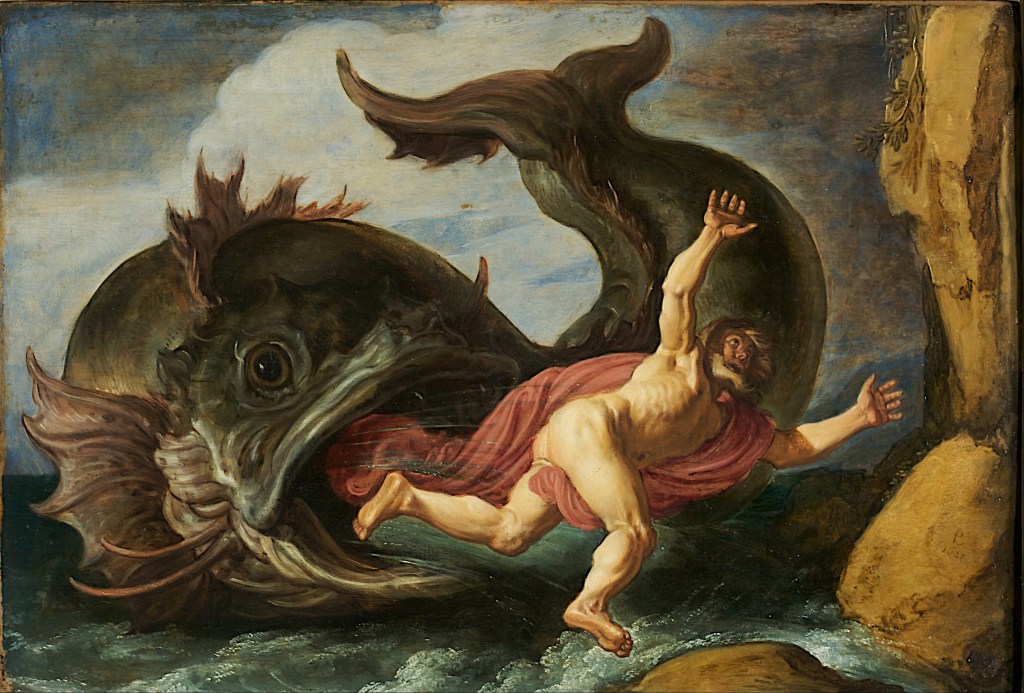
Jonah and the Whale (ca. 1603-1607) by Pieter Lastman
From the Book of Jonah 1:1, “Now the word of the Lord came to Jonah the son of Amittai, saying, ‘Arise, go to Nineveh, that great city, and call out against it, for their evil has come up before me.’” From there, most grade school children can tell you what happened next.
Jonah said, “No.” He believed that if he went to Nineveh and preached, the people would repent and be saved. He did not want that. He wanted them to pay for their wickedness, so he fled instead of doing as God asked. Going to the coast, he boarded a ship and set sail. While Jonah slept below deck, a great storm blew in. The sailors began praying to their various gods, to no avail. Finally, the captain found Jonah sleeping and demanded to know why Jonah wasn’t also praying. When Jonah realized that it was his fault that everyone was about to die, he said, “Pick me up and hurl me into the sea; then the sea will quiet down for you, for I know it is because of me that this great tempest has come upon you.”
At first, the other men hesitated, but when the storm only worsened, they picked up Jonah and pitched him into the sea. From there, we are told, “And the Lord appointed a great fish to swallow up Jonah. And Jonah was in the belly of the fish three days and three nights.” Then Jonah prayed. In the words of his prayer, you might also hear words Jesus may have prayed as he slept in the belly of the earth for three days.
“I called out to the Lord, out of my distress, and he answered me; out of the belly of Sheol I cried, and you heard my voice.
For you cast me into the deep, into the heart of the seas, and the flood surrounded me; all your waves and your billows passed over me.
Then I said, ‘I am driven away from your sight; yet I shall again look upon your holy temple.’
The waters closed in over me to take my life; the deep surrounded me; weeds were wrapped about my head
at the roots of the mountains. I went down to the land whose bars closed upon me forever; yet you brought up my life from the pit, O Lord my God.
When my life was fainting away, I remembered the Lord, and my prayer came to you, into your holy temple.
Those who pay regard to vain idols forsake their hope of steadfast love.
But I with the voice of thanksgiving will sacrifice to you; what I have vowed I will pay. Salvation belongs to the Lord!”
After Jonah’s prayer, on the third day, “The Lord spoke to the fish, and it vomited Jonah out upon the dry land.” And we know that, on the third day, Jesus rose from the earth, the tomb.
Jesus said, “This generation is an evil generation; it asks for a sign, but no sign will be given to it except the sign of Jonah.”
The sign of Jonah is the descending into the waters and the belly of the beast. It is entering into sin, chaos, and death, but it is also rising from chaos and death to new life. Therefore, the sign of Jonah is also our life with God, for as St. Paul tells us in his letter to the Ephesians, “You were dead in the trespasses and sins… But God, being rich in mercy, because of the great love with which he loved us, even when we were dead in our trespasses, made us alive together with Christ.”
Jonah prayed in the belly of the whale, and I feel that his words were near to the heart of Jesus as he lay in the belly of the earth. On those days of great trial, you can also make these words yours, knowing as they both did, “Salvation belongs to the Lord!”
A young boy’s sister was sick and needed a blood transfusion. Given the rare nature of her blood type, few could help. Fortunately, her brother shared the blood type. Also, the sister was suffering from a sickness that the brother had survived a few years back, so he had the antibodies necessary to help. The doctor explained all this to the young boy, pointing out that without the transfusion, his sister would likely die. The doctor asked, “Would you be brave and give your blood to your sister?” The boy hesitated, then, with a trembling lip, smiled and said, “For my sister, yes.” They were placed in a room together, and a needle was inserted in the boy’s arm, and a long tube joined the needle in his arm with the needle in his sister’s. The boy watched as his blood flowed from his body into his sister’s. After a time, the doctor asked the boy, “How are you feeling?” “Fine,” the boy said but added, “How much longer before I die?”
When was the last time you trusted so completely and committed so fully?
Jesus was baptized, then “a voice came from heaven, ‘You are my Son, the Beloved; with you I am well pleased.’ And the Spirit immediately drove him out into the wilderness. He was in the wilderness forty days, tempted by Satan; and he was with the wild beasts, and the angels waited on him.”
Jesus received the assurance of His Father’s love and then went into the wilderness. It was not easy. The other Gospels break down the major temptations that He experienced. Temptations that all others would have broken under or, if nothing else, caused them to flee the desert, but Jesus remained. He did not return until the ordeal, and the trial was complete.
Alessandro Pronzato, priest and theologian, wrote, “The desert is the threshold to the meeting ground of God and man. It is the scene of the exodus. You do not settle there, you pass through. One then ventures on to these tracks because one is driven by the Spirit towards the Promised Land. But it is only promised to those who are able to chew sand for forty years without doubting their invitation to the feast in the end.” (The Desert: An Anthology for Lent, p.26)
The Spirit drove Jesus into the desert. While there, He encountered the devil, but through the Father’s love, Jesus was given the strength to overcome the trials. Yet, when He died on the Cross, He still had sand in his mouth because the mission He was obedient to wasn’t just for forty days. It was for a lifetime. Afterward, He rose and ascended into Heaven, returning to the Promised Land of His Father’s House. In His life, Jesus trusted completely in His Father’s love and fully committed to what He was called to.
In The Inner Voice of Love, Henri Nouwen speaks about the old country and the new country. The old country is where we spend most of our lives, and while there, we search for those things that will bring us joy and peace. Unfortunately, this old country was never intended to provide those things. Instead, this old country keeps us on the hunt, searching but never finding.
Thankfully, there comes a time in our lives when we realize this. We say, “This is not the truth. This is a lie, just baiting me along,” so we go in search of the truth. Through God’s grace, we learn that the Truth we seek is not in this old country but in a new one. We are blessed because we heard the voice that said, “Follow me.” We follow and cross the border into the new country. Like Lot’s wife, the devil temps us, and we look over our shoulders to see what we’ve left behind. Although we are not turned into pillars of salt, we damage our faithfulness and resolve. What do we do? When we think no one is watching, we cross back over the border into the old country, just for a taste, a nibble. We take on the mindset of an addict who thinks, “I’ll just have a little hit, and then I’ll be good to go, never looking back again.” Intellectually, we know this is a lie, but we listen. What are we to do?
Nouwen writes, “It seems that you keep crossing and recrossing the border. For a while you experience a real joy in the new country. But then you feel afraid and start longing again for all you left behind, so you go back to the old country. To your dismay, you discover that the old country has lost its charm. Risk a few more steps into the new country, trusting that each time you enter it, you will feel more comfortable and be able to stay longer.” (The Inner Voice of Love, p. 21-22)
God the Father says to you, “You are my Son/ my daughter, the Beloved; with you I am well pleased.” Just as Jesus did, you have the assurance of My love for you. Trust in that love. It is the Truth. Risk another few steps into the new country, trusting completely in the Father’s love and fully committing to the life of the new country. The old country has promised you joy and peace but never provided. In the new country, you’ll still have to chew sand until the day you die, but once there, the blessings of God—His peace, His joy—are like a cup that is always overflowing.
Let us pray: (this is a prayer originating in the third/fourth century—the Sub Tuum Praesidium/“Under Thy Protection”) We fly to Thy protection, O Holy Mother of God; Despise not our petitions in our necessities, but deliver us always from all dangers, O Glorious and Blessed Virgin. Amen
If you’re wondering how to greet someone on this combination of Valentine’s Day and Ash Wednesday, simply say, “Happy Valentine’s Day; you’re going to die.”
One of the great dystopian novels is Fahrenheit 451 by Ray Bradbury. The opening paragraphs set the scene.
“It was a pleasure to burn.
“It was a special pleasure to see things eaten, to see things blackened and changed. With the brass nozzle in his fists, with this great python spitting its venomous kerosene upon the world, the blood pounded in his head, and his hands were the hands of some amazing conductor playing all the symphonies of blazing and burning to bring down the tatters and charcoal ruins of history. With his symbolic helmet numbered 451 on his stolid head, and his eyes all orange flame with the thought of what came next… Montag grinned the fierce grin of all men singed and driven back by flame.” (p.1 & 2)
We later learn that 451 degrees Fahrenheit is the ignition point of paper—the temperature it begins to burn—and Montag likes to burn books. I won’t spoil the story. Besides, my focus today isn’t on the burning; it is on the result. These last few weeks, as I was thinking on today, I kept returning to the ashes and that one line: “It was a special pleasure to see things eaten, to see things blackened and changed.”
You may have noticed a few things have changed as you walked into the church today. The mood is more somber, the colors have changed, candles are missing, there are no flowers, and the crosses are covered. It is as though a fire came through and ate these things. The ash already swept away, leaving only the bones, the basics. For our souls and bodies, Lent is to be the same.
Bishop N.T. Wright says, “Lent is a time for discipline, for confession, for honesty, not because God is mean or fault-finding or finger-pointing but because he wants us to know the joy of being cleaned out, ready for all the good things he now has in store.” Lent is a time of being cleaned out of all the extraneous in our lives that separates us from God and doing so with the right spirit—the right attitude. What does that mean? From Fahrenheit 451, Montag says, “It was a pleasure to burn,” we say, “Oh, woe is me… I have to give up chocolate.”
During these days of Lent, we see those things that we abstain from as burdens and trials, but what if, like Montag, we say, “It is a pleasure to burn. It is a pleasure to rid these things of my life so that I will have more to give to God.”
I’ll give up time looking at social media or watching TV and dedicate that time to looking at God—seeking Him in His Holy Temple. I’ll set aside an attitude of bitterness or anger and replace it with thanksgivings for my many blessings. I’ll seek to remove something that is unholy or harmful to my life and replace it with divine practices. I will burn these things, and not only will I burn them, but I will find joy in the burning because I know that each cleansing spiritual fire that I light removes another barrier between me and my God.
During this Season of Lent, I invite you to set fires in your soul and find pleasure in the burning. Find pleasure in drawing nearer to your God.
At 55, Ol’ Boudreaux hadn’t been feeling all that well, so he made an appointment with Dr. Pierre. After undergoing a few basic tests and some questioning about how he lives his life, Boudreaux says, “Well, doc, what do you think?”
“From what I can see from your test results, Bou,” replies Dr. Pierre, “and from the answers you gave to my questions, you definitely need to make some significant changes to your lifestyle.”
“Like what?” asks Boudreaux, looking a bit worried.
Doc Pierre replies, “Like giving up drinking all those glasses of wine and whiskey, reducing all that fried food you have most nights of the week, and giving up smoking. Doing all this is the best way for you to improve your health and life expectancy. It’s your best course of action. So, what do you say?”
After taking some time to think about what he’s just heard, Boudreaux replies, “What would be the second best course of action?”
Have you ever played the game of chess? It is not a terribly difficult game to learn how to play, but that’s only the beginning. From there, it can become hugely complicated.
I’m not very good at it. I’m lucky to be able to see all the options of one move and usually lose because of some stupid option that I missed. However, it is reported that some chess masters can see some 20 moves ahead—moves and countermoves—and then select the best option. How complicated is that? Consider this. White always moves first, and with that first move, there are 20 options. (16 pawn moves and four knight moves). After black makes its first move, there are 400 distinct options for white. From there, it gets crazy. In seeing ahead, after only three moves per player, there are 120,921,506 total options. All told, “In a usual board [of chess], there are 30⁶⁰ possible pathways. This is greater than the number of atomic particles that exist in the known universe.” The rules of chess are easy enough to learn, but the game of chess is more complicated than any human mind (or computer) can fully grasp or master. (Source)
Jean-Luc Marion, a philosopher and Roman Catholic theologian, defines circumstances and events such as this as “‘saturated phenomena.’ According to Marion, some phenomena are filled with meaning and intuition to the point of exceeding any concepts or limiting horizons that one can impose on them. They are… saturated with relevance and thus inexhaustible, always undetermined.” (Source)
The game of chess, when viewed as a whole, is far too complicated for us to comprehend. It is a saturated phenomenon. Yet, even children can play it, not by seeing every available option, but by seeing a very limited spectrum of the available options.
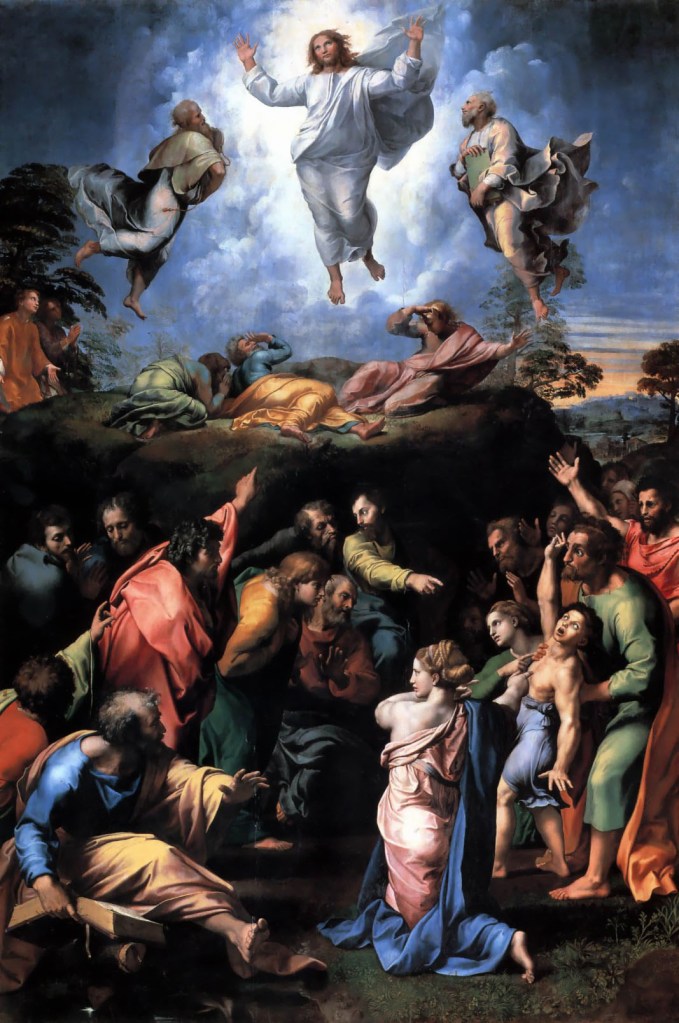
“Jesus took with him Peter and James and John, and led them up a high mountain apart, by themselves. And he was transfigured… his clothes became dazzling white, such as no one on earth could bleach them… [Peter] did not know what to say, for they were terrified… a cloud overshadowed them, and from the cloud there came a voice, ‘This is my Son, the Beloved; listen to him!’”
When we read this, we believe that the Transfiguration is being described to us, but what is actually being described is a saturated phenomenon—an event far beyond understanding and description. Clothes so white that the white is beyond description. A fear, an awe-inspiring emotion so great that Peter is essentially babbling. A cloud appears that is real but also indicates the disciples’ inability to comprehend what they are seeing. And a voice that speaks that only provides a very limited understanding of it all—“This is My Son. This is God. Understand all that He says to you.”
Like a child who can play the highly complicated game of chess even though they cannot possibly comprehend all the options, Peter, James, and John were able to witness the Transfiguration but only grasp a very limited spectrum of understanding. They were not going to understand all the implications of the Transfiguration, so God the Father said to them, “Listen to what Jesus says and do what He does. In that way, you will begin to understand, and in doing and understanding, you will begin to be like Him—as He is…transfigured.”
And everyone says, “Thank you, Father John, for the academic exercise, but what has this got to do with me? What does it mean?”
It means that Jesus, by allowing us to witness His Transfiguration—showing us His true self as best we can comprehend—is saying to us, “Follow me. Be transfigured. I want you also to become a saturated phenomenon—someone so saturated in the holiness of God that your life is essentially beyond understanding to the dark world around you. So shine your light into the dark that it has no option but to see and understand something of God, if only a little.” How do we do this?
I came across a poem this week—Small Kindnesses by Danusha Laméris. I liked it so much that I wanted to share it with you, so, even though I don’t know her, I wrote Danusha and asked for permission to share it with you. She responded, “Poems should go where they are useful… So—a big yes!!!”
I’ve been thinking about the way, when you walk down a crowded aisle, people pull in their legs to let you by. Or how strangers still say “bless you” when someone sneezes, a leftover from the Bubonic plague. “Don’t die,” we are saying. And sometimes, when you spill lemons from your grocery bag, someone else will help you pick them up. Mostly, we don’t want to harm each other. We want to be handed our cup of coffee hot, and to say thank you to the person handing it. To smile at them and for them to smile back. For the waitress to call us honey when she sets down the bowl of clam chowder, and for the driver in the red pick-up truck to let us pass. We have so little of each other, now. So far from tribe and fire. Only these brief moments of exchange. What if they are the true dwelling of the holy, these fleeting temples we make together when we say, “Here, have my seat,” “Go ahead—you first,” “I like your hat.”
How do we shine in the darkness? It begins with recognizing those brief moments of loving connection with others—even the stranger in our midst—are, in fact, holy moments. They are moments of the brightest white because, in them, we truly see the other, and we set ourselves aside and not only desire but work toward the good of the other. A person who lives in such a way has not only witnessed the Transfiguration of Jesus but is also beginning to understand it and put that understanding into action.
A quote from a person named Anonymous: “Someone once told me the definition of hell: on your last day on earth, the person you could have become will meet the person you became.” The person you become depends upon hearing and responding to Jesus’ call to follow Him and be transfigured. That is the best course of action. Don’t be like ol’ Boudreaux and ask about the second-best course of action. There’s not one. Be transfigured and enter into those holy temples of great and small kindnesses. Become that saturated phenomenon of God’s love and let the world around you encounter God in a way it has never experienced before.
Let us pray: Eternal God, you revealed to the disciples the everlasting glory of Your Son, Jesus. Grant us, who have not seen and yet believe, the gift of your Holy Spirit, that we may boldly live the Gospel and shine with your transforming glory, as people changed and changing through the redeeming presence of our Savior. Amen.
I wouldn’t even consider doing it today, but back in his prime, if someone told me that I was going to have to step into the boxing ring with Mike Tyson, I would have submitted my obituary to the newspaper and made all the necessary prearrangements with the funeral home. I would not have survived unless I could have somehow outrun him. I remember going to some friend’s house who had done a pay-for-view of one of Tyson’s fights. I don’t know how many seconds it lasted, but it was over before I got in from the kitchen. He was a beast when it came to boxing and apparently not such a great person out of the ring, having spent three years in jail for rape—a seemingly massive brutal, angry man.
John Saraceno interviewed Tyson for the USAToday Newspaper in 2005. Saraceno writes, “Almost 39, he is anything but at peace. Confused and humiliated after a decadent lifestyle left him with broken relationships, shattered finances, and a reputation in ruin, the fighter cannot hide his insecurities, stacked as high as his legendary knockouts….
“’I’ll never be happy,’ he says. ‘I believe I’ll die alone. I would want it that way. I’ve been a loner all my life with my secrets and my pain. I’m really lost, but I’m trying to find myself. I’m really a sad, pathetic case.’” (Source)
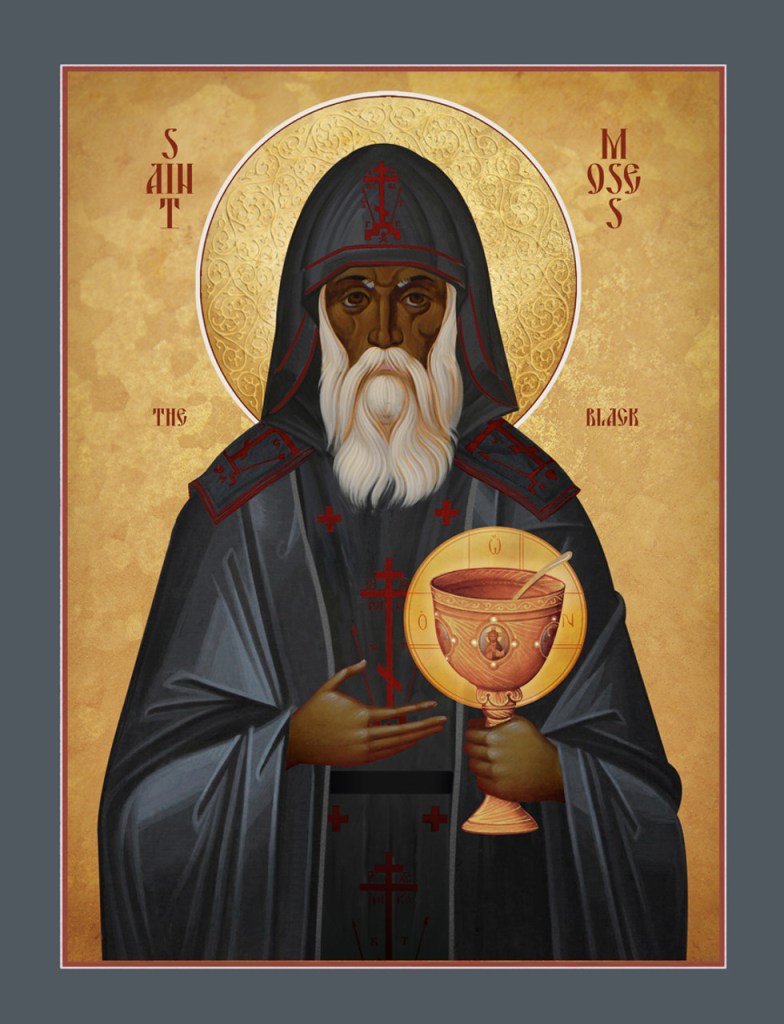
If you understand that ruthless but dejected temperament, you could also very easily be describing Moses the Black or Moses the Ethiopian, one of the Desert Fathers who lived during the 4th century in the deserts of northern Egypt.
Moses began his life as a slave, then became a murderer, an outlaw, and the leader of a vicious gang of some seventy other outlaws; however, after many years, he began to have a change of heart.
It is reported that he would look up at the sun and say, “O Sun!! if you are God, let me know it.” Then he would say, “And you, O God whom I do not know, let me know you.” On one occasion, he had a response. A voice said to him, “The monks of Wadi El-Natroun [of northern Egypt] know the real God. Go to them, and they will tell you.”
He went, but because the monks knew of him and his reputation, they were at first terrified but soon allowed him access to the teachings of the church. He became one of them, along with several of his former gang, but his battle with his demons continued and was equal to the battles he had fought in real life. In the end, he had seventy-five followers who, like him, bravely battled against the devil.
One day, it was reported to him that some of the same outlaws that he had run with were coming and that he would surely be killed. His followers urged him to flee with them, but he responded, “For many years now, I have awaited the time when the words which my Master, the Lord Jesus Christ, should be fulfilled: ‘All who take up the sword, shall perish by the sword.’” (Matthew 26:52) He died that day, a brutal sinner, redeemed by a loving God.
The good thief that had been crucified along with Jesus said to the other, “Do you not fear God, since you are under the same sentence of condemnation? And we indeed have been condemned justly, for we are getting what we deserve for our deeds, but this man has done nothing wrong.” Moses the Ethiopian would have agreed fully with this statement; even so, he found true hope in what was said next between Jesus and that good thief. “Jesus, remember me when you come into your kingdom.” Jesus replied, “Truly I tell you, today you will be with me in Paradise.”
The Kingdom of God was open to Moses the Black and remains so to all, even the hardest and most brutal, who will bend the knee to the King of Kings and seek to follow Him.
Charlie Brown heads up to the plate to bat. It is not pretty. “Strike one. Strike Two. STRIKE THREE,” calls the umpire. Chuck has struck out again and slumps over to the bench.
Plopping down on the bench, he says, “Rats! I’ll never be a big-league player. I just don’t have it! All my life I’ve dreamed of playing in the big leagues, but I know I’ll never make it.”
Lucy turns to console him. “Charlie Brown, you’re thinking too far ahead. What you need to do is set yourself more immediate goals.”
He looks up. “Immediate goals?”
Lucy says, “Yes. Start with this next inning when you go out to pitch. See if you can walk out on the mound without falling down!”
That little episode can teach us a couple of things. It is good to keep your friends around to offer support, but be sure to pick the right friends. It is also good to have goals in your life; just don’t tell anyone. The first one makes sense, but the second one seems a little questionable. Why wouldn’t you want to share your goals?
Many years back, I was a smoker. Picked it up casually in college and got stuck. Years later, I wanted to quit, so when I was ready, I announced—“I’m going to quit smoking.” Everyone was thrilled. They told me how great it was—talked about the money I would save, the health benefits, and all that jazz. I received a wealth of congratulations, support, and advice. All that was left to do was for me to quit smoking.
Problems: the simple announcement got me all the “atta boys” my mind needed. I hadn’t done anything, but I was the hero. Yay, me and I hadn’t done a thing. That night, I had the ritualistic last smoke and flushed the rest. The following morning, I woke up and asked, “What in the blue blazes were you thinking?” I had to go to work, and the pressure was on. Now, not only was I trying to do this for myself, but I had all these folks watching, which added pressure. Pressure of failure. Pressure of esteem. Pressure of doing the work. Pressure of pressure. When attempting to achieve a goal, added pressure is not what you need. And then, when I was having a good day, not even thinking about a smoke, someone would inevitably come up to me and ask, “How’s the no smoking thing going?” “Well,” I would say, at least in my mind, “it was going great UNTIL YOU BROUGHT IT UP!”
The bottom line is don’t tell people your goals. Just go to work. Then, one day, someone will ask you, “Didn’t you used to smoke?” “Have you lost weight?” “You wrote a book?” “When did you start your own business?” You’ve done the work, and now you can celebrate that work. Be selective in who you tell your business; remember, not everyone needs to know everything. Just do the work.
Last week, in our Gospel lesson, we read about Jesus healing the man possessed by the demon. Upon seeing Jesus, the demon cried out, “What have you to do with us, Jesus of Nazareth? Have you come to destroy us? I know who you are, the Holy One of God.” But Jesus rebuked him, saying, “Be silent, and come out of him!” A similar incident occurred in our Gospel reading today. Jesus “cured many who were sick with various diseases, and cast out many demons; and he would not permit the demons to speak, because they knew him.” Jesus did not allow the demons to say who He was, but the demons were not the only ones—those whom He heals will also be told to keep silent.
A leper came to Jesus and asked to be healed. Jesus does, but then “sternly charged him and sent him away at once, and said to him, ‘See that you say nothing to anyone, but go, show yourself to the priest and offer for your cleansing what Moses commanded, for a proof to them.’” (Mark 1:43-45)
Demons, and those who were healed, are told to keep silent, but then Jesus also tells the Apostles not to speak of His true identity. Remember when He asked the Apostles, “Who do people say that I am?” They had several answers, but finally, Peter got the gold star, “You are the Christ.” Yet, instead of allowing Peter and the gang to spread the word, Jesus “strictly charged them to tell no one about him.” (Mark 8:27, 29b-30)
Throughout his Gospel, Mark silences those who truly know who Jesus is. This is called the Markan or Messianic Secret, but why? If His purpose was to share the Good News of God, then why did Jesus want to keep it a secret?
Regarding our goals, we should be selective in who we tell our business, and remember, only some people need to know everything. We just need to do the work.
We have discussed that the Israelites were looking for a Messiah, but the Messiah they were looking for was a King like David—a warrior king—one who would vanquish their enemies and rule the land with righteousness. What no one was expecting was a Messiah like Jesus, who, in the end, would be crucified. They weren’t expecting that kind of Messiah, so they certainly wouldn’t accept it without some proof. Also, imagine the Roman military hearing about some wandering rabbi telling everyone He was the Messiah—the long-awaited King of the Jews. How long do you think they would’ve allowed Him to live? Jesus was selective in who knew the truth about Him, but He tried to keep others from finding out so that they would not interfere until He had met the objective.
Why silence the demons? They, of all creatures, could testify to the truth of who Jesus was. Then again, when’s the last time you heard of a demon telling the truth? To this day, the evil spirits lie about the person of Jesus so that many will not come to know that salvation is available to all.
Jesus also wanted His secret kept because the goal had yet to be met. He might be seen as a good teacher and a miracle worker, but until He died and rose again, He could not be seen as one who could save others from death.
Instead of broadcasting His true nature, Jesus tried to keep it a secret so that He could do the work without these external pressures interfering or detracting. But then, Jesus breathed His last breath upon the Cross, and it all changed. “When the centurion, who stood facing [Jesus on His cross], saw that in this way he breathed his last, [the centurion said], ‘Truly this man was the Son of God.’” (Mark 15:39) And there was no one there to tell the centurion to keep quiet. A few days later, Jesus “appeared to the eleven…And he said to them, ‘Go into all the world and proclaim the gospel to the whole creation.’” It is finished. The work is done. Now, you have everything you need to demonstrate and tell the world who I am. Go and tell the world of all the great things God has done. Proclaim the message of the Good News and eternal life.
So, the question I have for you this morning is this: the fact that Jesus is the Messiah, the Savior of the World, is no longer a secret, so why do we treat it as such? Jesus asked us to proclaim His secret, the Gospel, to all the world, but when given the opportunity, we are often silent. Why is that? You know the power of God working in your life and in the lives of others. Not the word of a few witnesses from 2,000 years ago, but things you’ve seen with your very eyes. Why is it so difficult to share?
When we hear Jesus command, “Go, and tell the world…,” we often translate that into missionary work—an intentional “going”/trip to proclaim. However, “Go” is also translated “as you are going.” As you are going about your life, tell the world—proclaim the Good News. Our lives are to be a proclamation of the Kingdom of God, but as we live our day-to-day lives, we are to proclaim with our lives and our mouths the Good News of Jesus.
Tell the secret. Let the cat out of the bag. Bring to light. Spill the beans. Go public. Divulge… break out the thesaurus. However you would like to phrase it, share the Good News, and if you’re not comfortable in doing it just yet, then invite them to church—I think St. Matthew’s Episcopal Church is one of the best-kept secrets in Enid, Oklahoma (don’t tell anyone!) Please. Invite others, and we’ll do our best to help you proclaim the Good News to those you bring. It is the primary reason we are here. The Messianic Secret is out. Be one who tells it.
Let us pray: Glorious St. Mark, through the grace of God our Father, you became a great Evangelist, preaching the Good News of Christ. May you help us to know Him well so that we may faithfully live our lives as followers of Christ and, like you, proclaim the Good News of God in Christ. Amen.
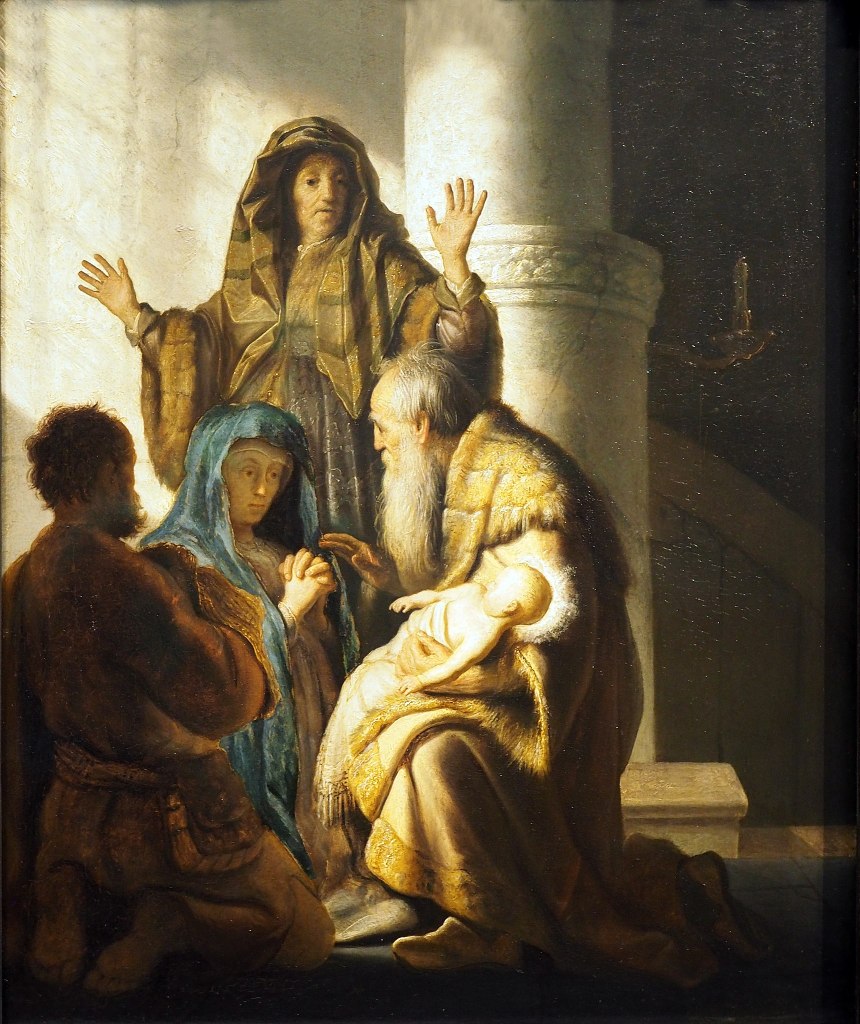
Luke does not tell us how old the Prophet Simeon was when he encountered the Holy Family, but there are several indicators that he was quite old. The Prophetess Anna was eighty-four, and it would be fair to say that Simeon was at least as old or older.
So, let’s do a bit of math. Most scholars believe that Jesus was born around 4 BC. If we place Simeon and Anna at nearly the same age, we can agree that they were born in approximately 88 BC. Who ruled Israel at that time? The Maccabees/Hasmoneans. Anna, for sure, and most likely Simeon, were both born in an era when Israel was free from foreign rule. Under the Hasmoneans, Jerusalem grew from a city of 5,000 to 25-30,000. It was prosperous and vital. Therefore, Simeon and Anna had seen a time in Israel when God reigned—when God was King. However, in 63 BC, the pendulum swung, and the Romans took control of Jerusalem. Anna and Simeon had seen the prosperity of Jerusalem, but now, for the last sixty years, they had been witness to the suffering of the people brought about by the occupying forces of Rome. Yet, instead of simply giving in, crying defeat, and lamenting the past and the current state of their lives, Simeon and Anna did the one thing that would actually make a difference—they prayed. Simeon “was righteous and devout, looking forward to the consolation of Israel, and the Holy Spirit rested on him.” Anna “never left the temple but worshiped there with fasting and prayer night and day… looking for the redemption of Jerusalem.”
Like so many others, they could have given themselves over to despair. Still, instead, they chose to have hope, always looking forward to the consolation, the comforting after the defeat, the redemption, and the saving of Israel by the hand of God. Not only did they believe that the Lord would save, but they knew the Lord would save. So, with hope, they patiently waited on the dawning of God’s light:
“A light for revelation to the Gentiles and for glory to your people Israel.”
Today, our lives may not always be rosy and beautiful, but for all of us, just like with Anna and Simeon, the pendulum will swing. It may be for a short while, a season, or much longer, but that swinging is not a matter of if. It is a matter of when. So, the question is: how will we respond? How do we wait for God in the dark days?
Henri Nouwen wrote a beautiful little daily devotional, Bread for the Journey: A Daybook of Wisdom and Faith. For November 20th he wrote, “How do we wait for God? We wait with patience. But patience does not mean passivity. Waiting patiently is not like waiting for the bus to come, the rain to stop, or the sun to rise. It is an active waiting in which we live the present moment to the full in order to find there the signs of the One we are waiting for.
“The word patience comes from the Latin verb patior which means ‘to suffer.’ Waiting patiently is suffering through the present moment, tasting it to the full, and letting the seeds that are sown in the ground on which we stand grow into strong plants. Waiting patiently always means paying attention to what is happening right before our eyes and seeing there the first rays of God’s glorious coming.”
Like Simeon and Anna, we must learn how to wait patiently, being confident in our faith that the Lord hears the cries of His people and will deliver them, even when all seems lost.
One of the great comedians was Red Skelton. He could bring down the house without a single foul word, but his wife tended to be the topic of more than a few one-liners.
“Two times a week, we go to a nice restaurant, have a little beverage, good food, and companionship. She goes on Tuesdays, I go on Fridays.
We also sleep in separate beds. Hers is in California, and mine is in Texas.
I take my wife everywhere….but she keeps finding her way back.
I asked my wife where she wanted to go for our anniversary. ‘Somewhere I haven’t been in a long time!’ she said. So I suggested the kitchen.”
He does concede that he is also to blame. He said, “The last fight was my fault, though. My wife asked, ‘What’s on the TV?’ He said, ‘Dust!’”
Like all married couples, they had their ups and downs, but there are those special few that seem to transcend the norms. Marriages where there are differences, but the love shared between the two is far greater than all those differences combined. Take a young couple from the Netherlands as an example.
As their names are Dutch, I don’t have a chance of pronouncing them correctly, so we’ll describe them as the Colonel and the Lady. During their lifetimes in the Netherlands, the separation between Protestants and Catholics was severe. Separate schools, hospitals, neighborhoods, and even sections of the cemetery were divided by an eight-foot wall. All of these rules of separation were strictly enforced.
The Colonel was born and raised Protestant, and the Lady was Catholic. They shouldn’t have gotten along at all, so it created a great controversy when they decided to get married. Their love was greater, and despite the obstacles and objections, in 1842, they wed, living happily ever after for thirty-eight years until the Colonel’s death in 1880. Because he was born and raised Protestant, he was buried in the Protestant section of the cemetery. Eight years later, when the Lady died, she was to be buried in the family plot on the Catholic side, but she had other ideas. She had no intention of being separated from her husband, so she made arrangements to be buried next to the wall that separated the Protestant and Catholic sections of the cemetery. She then had their tombstones constructed tall enough so that a pair of hands could be joined over the top of the eight-foot dividing wall. (A picture is on the front of your bulletin.)
Remember a few weeks back when we talked about signs—as in signs and wonders? I would suggest that these joined tombstones are a sign. Something that is pointing to something even greater. They are a sign that demonstrates how, within the human soul, the love between two people can overcome many obstacles, which then points to how this same love can overcome the barriers between peoples. This love reaches over walls to meet the other and to bring healing to individuals, cultures, and nations. It is a sign that points outward—to something greater than one couple—but it is also a sign that points inward to the soul of each of us. That’s the direction I would like to focus on today—the healing of the soul—because within… it is almost like two people are living in each of us (No. I’m not schizophrenic.)
This pointing inward relates to what St. Paul says in his letter to the Romans, “We know that the law is spiritual, but I am of the flesh, sold under sin. For I do not understand my own actions. For I do not do what I want, but I do the very thing I hate.” (Romans 7:14-15) Within is a side that knows what God calls us to, and within—on the other side of the wall—there is a side that does whatever the heck it pleases. A life with God and a life in the world—both working independently and often having very different desires. However, our goal as a Christian people is to have those two operating together. Not so that our worldly side can drag down our faith but so that our faith and our life with God can cooperate and inform our life in the world. Within, we need to join hands over the wall so that our life in the world and our life of faith are in concert with one another.
For example, working in the world is necessary. We have jobs to do and responsibilities to our families and communities. Working in the world is not a bad thing; it is actually very good and beneficial, but while there, we don’t always act in a manner that reflects what we profess on Sunday morning. In the world, we may gossip, become angry, cheat, be uncharitable toward others, and so on. In our Baptismal Creed, we say we will “seek and serve Christ in all persons, loving our neighbor as ourselves.” On Sunday, we love our neighbor. Monday through Saturday, all bets are off. That wall, a very solid division between our Sunday selves and our Monday through Saturday selves, keeps those two selves within us separated. What is curious—almost humorous, but not in a funny way—is that when our God side tries to reign in our world side, the world side gets a little bent out of shape.
Think about our Gospel reading. The man with the unclean spirit. What did the unclean spirit say when it encountered Jesus? “What have you to do with us, Jesus of Nazareth? Have you come to destroy us? I know who you are, the Holy One of God.” When our God side attempts to reign in our world side, our world side can sometimes say the same thing. “What have you got to do with us, Jesus? Your day is Sunday! This is a Thursday. Get back on your side of the wall!” That’s not how it is supposed to work.
Jesus said, “If you were of the world, the world would love you as its own; but because you are not of the world, but I chose you out of the world, therefore the world hates you.” (John 15:19) We must live in the world, but we are from God, so our life in the world must reflect our life in God. Our life in the world and our life in God must reach over that wall and take hands so that they both follow the way that leads to eternal life in Jesus.
Jesus responded to the unclean spirit: “Be silent, and come out of him!” That must also be our response when the world part of us attempts to reign over God within us. “Be silent! You are not the one who rules over my life.” In doing so, we begin to bring healing to our souls. Repairing the brokenness within.
Have you noticed that some people cross themselves during the Lord’s Prayer when we pray, “Deliver us from evil?” Ever wonder why?
The Lord’s Prayer is given to us in Matthew 6:9-13. The second part of verse 13 is “deliver us from evil,” but looking at the footnotes in most Bibles, you will see that this can be translated in two ways. The first is what we pray it. In that context, evil is very general, and we can take it to mean those bad things or people that come against us. However, the second way of translating the verse is “deliver us from the evil one.” (This is how the Eastern Orthodox churches pray it.) In this case, evil is not general. Instead, evil is very specific and personified. We cross ourselves as a means of blessing and protection from this evil one. Sometimes, as I pray that line, I take a little liberty with it and pray, “And lead me not into temptation, but deliver me from the evil one that is within me.” It is a way for me to say, “Be silent!” to the side of me that wants to rule over the ways of God. It is a way for God to reach over the internal wall and take the hand of the side of me that must be in the world and show it the way.
When you sense any voice attempting to lead you from the voice of God, speak to it clearly and boldly, “Be silent!” Then pray, “Deliver me from the evil one,” join hands with Jesus, and live out your faith in every aspect and every day—Monday through Sunday—of your life.
Let us pray: Saint Michael the Archangel, defend us in battle. Be our protection against the wickedness and snares of the devil. May God rebuke him, we humbly pray; and do Thou, O Prince of the Heavenly Host, by the Power of God, cast into hell Satan and all the evil spirits, who prowl through the world seeking the ruin of souls. Amen.






 Candle in a Cave