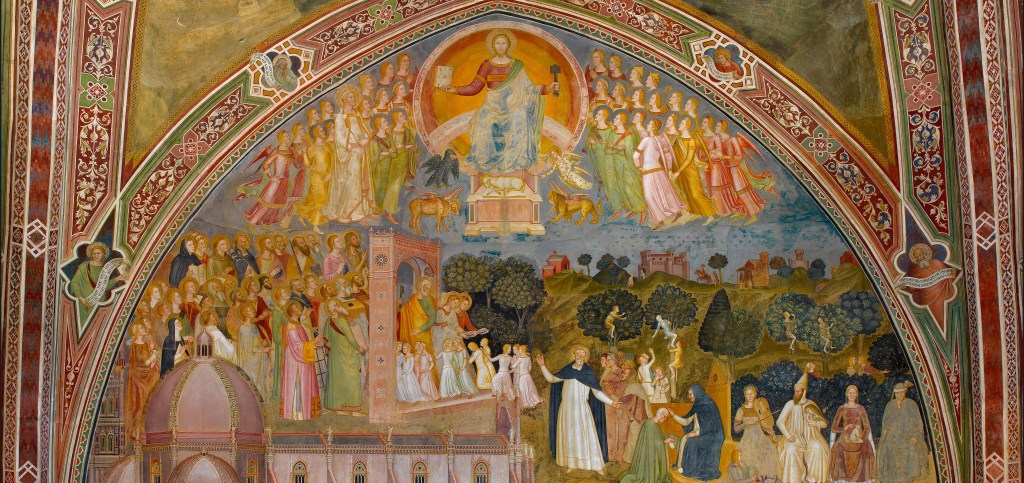
Sermon: All Saints Day – “be a Saint”


In the first Freshman English class of the semester, the teacher stated, “Let us establish some examples about opposites. Timothy, what is the opposite of joy?”

“Sadness,” said the student.

“Fine.

And the opposite of depression, Rachel?”

“Elation,” she replied with a smile.

“Very good.

And you, Johnny, what is the opposite of woe?”

“I believe that would be ‘giddy up’”

Scripturally speaking, the opposite of “woe” is “blessed,” and we heard those beautiful words, “Blessed are you,” but as beautiful as those words are, today is our celebration of All Saints, so instead of focusing on the words, we focus on those who heard the words and followed the one who spoke them. We focus on the ones who were blessed.

There are approximately 8.1 billion people living today out of the roughly 117 billion people who have ever been born. Of those 117 billion, only about 10,000 are recognized by the church as capital “S” saints: St. Mary, St. Matthew, St. Julian, and others. That’s roughly one Saint for every 11,700,000 people born. So, the question for you today is: what are the chances of you becoming a saint?

For me, I go along with what Brennan Manning said in The Ragamuffin Gospel: “When I get honest, I admit I am a bundle of paradoxes. I believe and I doubt, I hope and get discouraged, I love and I hate, I feel bad about feeling good, I feel guilty about not feeling guilty. I am trusting and suspicious. I am honest and I still play games. Aristotle said I am a rational animal; I say I am an angel with an incredible capacity for beer.” I prefer Scotch, but you get the point. I consider the odds 1/11,700,000 and think it could happen, but if we’re being honest… honesty is overrated. My one consolation is that I know I have a much better shot at it than you lot.

Perhaps, instead of asking “Who will become a Saint?” we should ask, “Who should strive to become a Saint?” It might seem a bit bold to us, but many of the great saints intentionally described themselves as working to become saints, and some went as far as to predict that they would. St. Joseph Cafasso writes, “I would be the happiest of men if I could become a saint soon and a big one.” Blessed Mary Fortunata Viti says, “I am fortunate to be given this opportunity to become a saint. I want to become a saint,” and St. Margaret of Cortona says, “A time will come when you will call me a saint, and you will go on a pilgrimage to my tomb with the staff and wallet of a pilgrim.” This might seem to negate the whole idea of humility we see in the saints, but instead it points to the fact that they took seriously Christ’s command to “be perfect as your heavenly Father is perfect,” and, in doing so, they are blessed.

Thomas Merton, in his autobiography The Seven Storey Mountain, describes a notable conversation he had with his friend Robert Lax. Apparently, they were arguing as they walked when Robert suddenly stopped and, turning to Merton, asked, “What do you want to be, anyway?” Merton had a few poor answers in his mind but finally said, “I don’t know; I guess what I want is to be a good Catholic.” Robert responded, “What do you mean you want to be a good Catholic? What you should say… what you should say is that you want to be a saint.” “How do you expect me to become a saint?” Robert replied. “By wanting to.” Merton said, “I can’t be a saint.” 

Remembering the mood of this conversation, years later, Merton wrote, “My mind darkened with a confusion of realities and unrealities: the knowledge of my own sins, and the false humility which makes men say that they cannot do the things that they must do, cannot reach the level that they must reach: the cowardice that says: ‘I am satisfied to save my soul, to keep out of mortal sin,’ but which means, by those words: ‘I do not want to give up my sins and my attachments.’” In their conversation, his friend Robert continued, “All that is necessary to be a saint is to want to be one. Don’t you believe that God will make you what He created you to be, if you will consent to let Him do it? All you have to do is desire it.” The next day, looking for a way out, Merton told another friend, “[Robert] is going around saying that all a man needs to be a saint is to want to be one.” His friend’s response, “Of course.” Of course! All you have to do to become a saint is to want to be one.

God’s love pulls us out of the places of sin where He finds us. He pulls us out because He wants more for us, and in pulling us out of those places, he calls us into another place—one where we can strive to become that one person in 11,700,000. And before you say, “I can’t,” consider the words of Thomas Merton when he said he couldn’t. You see, when we say we can’t, it’s because we become painfully aware of our sins. We are confronted with aspects of our lives that we’re often unwilling to change in order to be more saint-like. Remember St. Augustine’s words, “Lord, make me chaste—but not yet!”

Become a saint! I can’t. Why? Because of pride, gluttony, and anger? Then learn humility, moderation, and forgiveness. If you did those things, would you then be a saint? Probably not, but you might be a step closer. 

Consider a monk who lived on Mount Athos with Elder Paisos. The monk drank excessively, smoked two packs of cigarettes a day, and cursed like a sailor. One day, after the monk’s death, a few pilgrims approached Elder Paisos, who spoke of the monk so affectionately and regarded him as a saint afterward. The pilgrims were distraught; they discussed all the issues the monk had in his life and scolded Elder Paisos for failing to notice those faults. Elder Paisos understood their concerns but then told them that the monk had cut his twenty glasses of wine down to three and reduced his smoking from two packs to just one cigarette a day. Elder Paisos was certain that God saw a fighter, while the world saw a sinner.

Is this an easy task? Of course not—there are many reasons, but one of the main challenges is the need to turn our critical eye toward ourselves. This battle isn’t fought out there but within us, because “For our struggle is not against flesh and blood, but against the rulers, against the authorities, against the powers of this dark world and against the spiritual forces of evil in the heavenly realms.” Becoming a saint is difficult because many of the battles are unseen. They occur in a place where our greatest weapon is our faith. At times that faith may not seem like much; however, behind that faith stands the One True God who loves us. St. Paul reminds us, “Since then we have a great high priest who has passed through the heavens, Jesus, the Son of God, let us hold fast our confession. For we do not have a high priest who is unable to sympathize with our weaknesses, but one who in every respect has been tempted as we are, yet without sin. Let us then with confidence draw near to the throne of grace, that we may receive mercy and find grace to help in time of need.” (Ephesians 4:14-16)

You may never attain sainthood in this life, and you might never receive the title “Saint,” with a capital “S,” but that shouldn’t stop you from consistently and faithfully striving for it. St. John Vianney wrote, “We must never lose sight of the fact that we are either Saints or outcasts, that we must love for Heaven or for Hell; there is no middle path in this.” Don’t be satisfied with merely escaping to heaven “as one escaping through the flames”; instead, put up a good fight and strive to hear those words, “Well done, good and faithful servant!” Strive to become one among 11,700,000. Strive to be blessed.

Let us pray: (This prayer is called The Anima Christi, The Soul of Christ.)

Soul of Christ, sanctify me;
Body of Christ, save me;
Blood of Christ, inebriate me;
Water from the side of Christ, wash me;
Passion of Christ, strengthen me;
O good Jesus hear me;
Within your wounds hide me;
separated from you, let me never be;
From the evil one protect me;
At the hour of my death, call me;
And close to you bid me; That with your saints,
I may be praising you forever and ever. Amen.

Sermon: Sunday of the Transfiguration RCL A – “Sanctification”

Photo by Jurica Koletić on Unsplash

The time came for Acadia, Thibodeaux’s wife, to deliver her twins. All was set as they rushed into the hospital, and everything was prepped. However, the delivery was too much for Thibodeaux, and he passed out cold. It took hours to revive him, but in the meantime, the doctors insisted on naming the babbies. Since Thib was still out, Acadia turned to Thib’s brother, Remi, to help name the girl and the boy. 

“My brother named my kids?!” Thib’s shouted when he woke up. “But my brother’s an idgit! He barely knows his own name.” Pausing and taking a breath, he says, “Ok, what he done name the girl.”

“He named her Denise.”

“Denise?” Said, Thib. “Well, that’s not such a bad name. I kind of like it. And what did he call the little boy?”

“De Nephew.”

Even though it’s relatively common, I kind of like my name, but not everyone can say the same. For example, there was Issur Danielovitch Densky. He changed his name to Kirk Douglas. Frances Gum didn’t think her name would sell, so she became Judy Garland. Archibald Leach became Cary Grant. And who do you think Marion Morrison would become? John Wayne.

How great would it be if all it took was to change your name and become rich and famous? Or to become anything you wanted? To become an astronaut, I’ll become Neil Armstrong. To become a famous writer, call me Stephen King. But what about becoming a Saint? Call me Josemaría, and I’ll be holy.

In the end, “A rose by any other name….” As the philosopher Alan Watts said, “The menu is not the meal.”

Inside all of us is dark and light, and on any given day, one will be more prominent than the other, but the goal of the Christian life is for the light to illuminate every dark crevice and reveal the content of every shadow. Technically, this is known as sanctification. 

Simply put, sanctification is the process of becoming holy, allowing the light to shine through every aspect of our lives. There are three major components in the process, and all three are a form of grace given by God: baptism, living a life directed by God, and entry into the Kingdom of Heaven. 

Although some traditions believe that a person must make an adult profession of faith before being baptized, we do not—for us, that falls into the category of works; that is, you must do something in order to “earn” God’s grace. Instead, we believe that baptism is God’s undeserved grace being poured out on us, providing us “union with Christ in his death and resurrection, birth into God’s family the Church, forgiveness of sins, and new life in the Holy Spirit.” (BCP 858)

The third component, entry into the Kingdom of Heaven, is also a grace, which we have absolutely nothing to do with. For those who believe, St. Paul tells us, “Neither death nor life, nor angels nor rulers, nor things present nor things to come, nor powers, nor height nor depth, nor anything else in all creation, will be able to separate us from the love of God in Christ Jesus our Lord.” (Romans 8:38-39) 

We can view our baptism and ultimate entry into the Kingdom of Heaven as bookends to our life with God, but that bit between those two events gives us so much trouble. It is grace that allows us to live for God, but the sanctification—the making holy—process during our earthly lives is not exactly a smooth ride. Why? The light and the dark are both within us. 

Remember the parable of the wheat and tares/weeds? God sowed the good seed of the wheat, but at night, the devil came in and sowed the weeds so that when they began to grow, the wheat and the weeds grew up together. That speaks of the world and the people in it, but it also speaks of the soul. The light and the dark, the wheat and the weeds, are both within us. When we apply the parable to ourselves, the difference is that, with God’s grace, we can actually do something about the darkness, those weeds within our souls. That is the process of sanctification in this life. It is the transfiguration of the individual.

“While [Jesus] was praying, the appearance of his face changed, and his clothes became dazzling white,” Jesus was revealed in His glory. No darkness. No weeds. Not showing us the process of becoming holy, but showing us The Holy and the true image of God. But He was also showing us what we can become.

Brooke Foss Wescott was a 19th-century bishop in the Church of England. He was also someone whom Archbishop Michael Ramsey admired and studied. Bishop Wescott wrote, “The Transfiguration is the revelation of the potential spirituality of the earthly life in the highest outward form…. Here the Lord, as Son of Man, gives the measure of the capacity of humanity, and shows that to which he leads all those who are united with him.” (Glory: The Spiritual Theology of Michael Ramsey, p.59) 

The Transfiguration of Christ sets before us a goal for the work of sanctification—the work of becoming holy—in our lives, and this work is the means “by which men and women are restored to the image and likeness of God Himself.” (Ibid.) As Christ was transfigured on the mountain, we seek in our daily lives to be transfigured into the same glory that Jesus revealed on the mountain. So what’s stopping you?

Charlie Brown and Linus were leaning against the fence, both looking rather contemplative. Chuck then asks Linus, “What would you do if you felt that nobody liked you?”

Linus gives it a thought, then says, “I’d try to look at myself objectively, and see what I could do to improve… that’s my answer, Charlie Brown.”

In the final frame, Charlie Brown is not looking so happy and says, “I hate that answer.”

What is stopping you from being transfigured, from becoming holy as your Heavenly Father is holy? From continuing the process of sanctification? There are many factors, but it seems there are two primary ones, and the first one is that we don’t want to put in the effort. 

Most of you know that I’ll be taking a sabbatical next year, and for part of the time, I want to walk the Camino de Santiago—a short walk of 500 miles across northern Spain. In order to do this and live to tell about it, I will need to get in better shape. More walking, more strength building, losing a bit more weight, etc. In other words, I need to be training. “I hate that answer.” I really want to walk the Camino, but I’m not putting in the effort to be able to. 

The same applies to being holy. I want to be holy. I want to enter into a deeper relationship with my Savior, but am I putting in the effort? Praying as I should, studying as I should, loving as I should, and the list goes on. We know that we need to put in the effort and practice our faith, training our souls, but… “I hate that answer.” Why?

The second factor is also as simple but equally challenging—we don’t want to. Yes, we want to be holy, but we don’t want to change our lives to attain that holiness. Back to the Camino—I need to lose more weight, but I don’t want to put down the cookie. I like the cookie. I’m a big fan, and I’ll become an even bigger if I’m not careful, so I need to put down the cookie. “I hate that answer.” To be sanctified, I need to be willing to set aside those things in my life that separate me from God. I need to be willing to allow the transfiguring light of Christ to shine and banish the darkness within me.

We will not be wholly sanctified until we enter the Kingdom of God, but if we put in some effort and allow our love of God to override our love of self, then we will progress in our sanctification. We’ll be pulling some of the weeds that are growing up with the good wheat of our souls.

We know the names of Saints like Francis, Josemaría, Mary Magdalene, John Paul, and many others. We hold them up as examples of the Christian life, but we also view such a life as unattainable for ourselves. However, we should see the lives of the Saints as something to strive for. In the same way, we should look upon our Transfigured Lord. In seeing Him transfigured, we are witnessing what—by the grace of God—we have the potential to become. 

Don’t shy away from this work of sanctification or squelch the desire to attain it. Instead, through your love of God, seek out every opportunity to take steps in the sanctification of your soul.

A few words toward the end of St. Paul’s first letter to the Thessalonians make for a good blessing. I’ll close with them. “May God himself, the God of peace, sanctify you through and through. May your whole spirit, soul and body be kept blameless at the coming of our Lord Jesus Christ. The one who calls you is faithful, and he will do it.” Amen.