Sermon: Proper 14 RCL C – “O My Jesus…”


A father reports that he used to have trouble getting his son to clean his room. The father would insist that he, “Do it now,” and the son would always agree to do so, but then he wouldn’t follow through—at least not right away. After high school, the son joined the Marine Corps. When he came home for leave after basic training, his father asked him what he had learned.

“Dad,” he said, “I learned what ‘now’ means.”

For me, when it comes to cleaning house, “Now” generally means the day or a few hours before I expect company; otherwise, there’s a good chance that there will be dirty dishes in the sink, dirty socks on the floor, a pile of clean laundry waiting to be folded on the dining room table, and if the cat got sick on my desk, it would be in better shape than it is now. I guess I agree with Phyllis Diller and Erma Bombeck when it comes to housework. Phyllis says, “Housework won’t kill you, but then again, why take the chance?” And Erma writes, “My theory on housework is, if the item doesn’t multiply, smell, catch fire, or block the refrigerator door, let it be. No one else cares. Why should you?” 

I’m guessing they weren’t real keen on the word “Now” when it comes to housework, either. 

The Bureau of Labor Statistics reports that, on average, we spend 2.01 hours per day on household chores, and yes, women spend more time than men—1.67 hours for men and 2.34 for women. (Source) Clearly, they’ve never been to my house. I eventually get everything nice and clean, but it doesn’t last. Give it a few days, and the dishes will start to stack up again, and the dirty socks will be on the floor. Before you know it, the whole place needs a solid napalm strike to clear it all up.

In our Gospel reading, Jesus talks about the servants in a house who remain awake and alert, and the owner of the house who guards against the thief. The servants fulfill their duties for the Master—taking care of his needs and property—and the owner protects against the thief who wishes to break in and steal. In both cases, we understand that the home Jesus is speaking about is our soul—the dwelling place for the Holy Spirit of God. As God’s children, we are to take care of our souls, keeping them pure and free of sin, and we need to guard them so that the devil cannot come in and destroy them. But for me, sometimes the inside of my soul looks a bit like my house—a little messy.

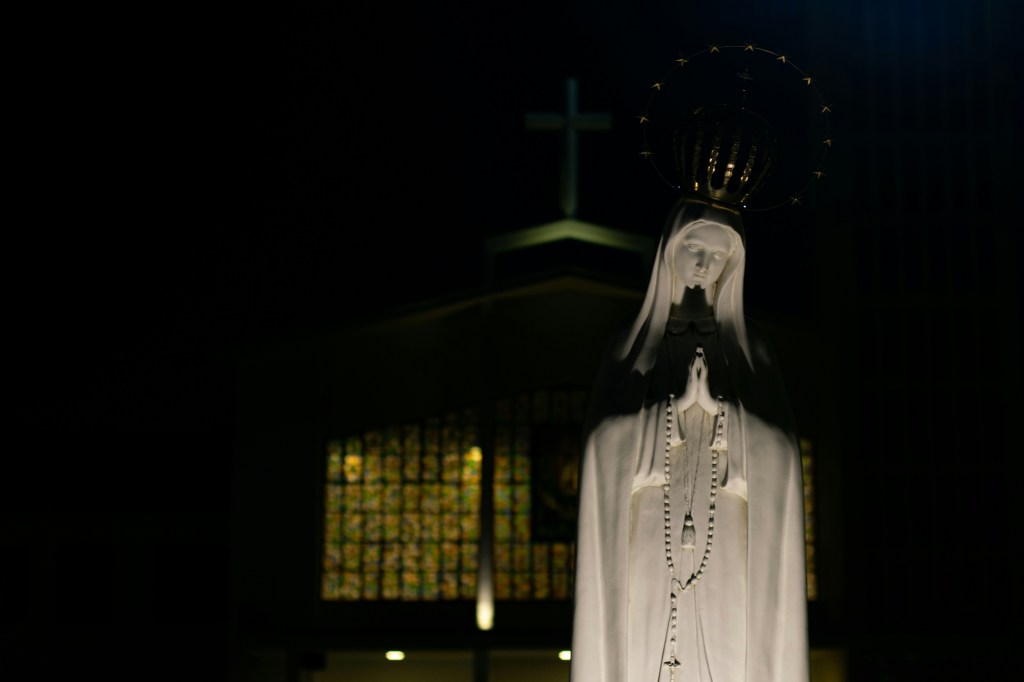
On July 13, 1917, Our Lady of Fatima appeared for the third time to the three children—Lucia dos Santos, Jacinta Marto, and Francisco Marto. During the visitation, she gave them a brief but terrifying vision of hell. Lucia wrote, “She opened Her hands once more, as She had done in the two previous months. The rays of light seemed to penetrate the earth, and we saw as it were a sea of fire. Plunged in this fire were demons and souls in human form.” She then goes on to describe what they saw.

It was so terrifying, she later wrote, “How can we ever be grateful enough to our kind Heavenly Mother, who had already prepared us by promising, in the first Apparition, to take us to Heaven. Otherwise, I think we would have died of fear and terror.” 

During this same visitation, the Virgin Mary gave the children a prayer that we now know as the Fatima Prayer or O My Jesus

“O my Jesus, forgive us our sins, save us from the fires of hell; lead all souls to heaven, especially those most in need of thy mercy.”

Mary asked that the children share with the world her desire for this prayer to be said at the end of each decade of the Rosary. It is also prayed just before starting the first decade—the Our Father and the first ten Hail Marys. 

When I pray my Rosary, it is during those opening prayers that I begin—or at least try—to gain some sort of focus, and on one particular day, it was the same. I recited the Creed, prayed the Our Father, the first three Hail Marys, and the Gloria Patri, and then began the Fatima Prayer, “O my Jesus…” I stopped. The next word, “forgive,” simply would not come out. I tried again. “O my Jesus…” I couldn’t go any further. Why?

There was a story circulating when I was in seminary. It told of a young man who had a vision of himself entering a room. Inside the room were all these small files—row after row of them. The drawers seemed to be large enough to hold a piece of paper no bigger than a note card. As he got closer, he saw that each of the file drawers had labels. These included such things as “Books I Have Read” and “Television Programs I Have Watched.” There were others—“Lies I Have Told” and “Comfort I Have Given.” There was one that read “Things Done in Anger” and one right next to it, “Things I Have Said in Anger.”

He pulled that one out just to see what was inside, and to his horror, he found that written on each card was something he had said in anger. Then he realized he was standing in the record room of his life. Every single event, from the very best to the most sinful, had been recorded and filed. 

As he examined more of the file drawer labels, he became absolutely convinced that no one—not anyone!—should be allowed to see what was written here. But, of course, there was One who would see, and that One, Jesus, was suddenly present, standing before the man. 

Without a word spoken, and instinctively, Jesus went to the drawer that held the cards depicting the most horrible of sins, pulled it out, and began to read each card. The man was horrified and heartbroken. He collapsed in shame, but as he watched, he witnessed the most remarkable thing: on each of the cards, Jesus wrote His Name, covering the sin. 

There I was, trying to pray my Rosary, “O my Jesus…,” but unable to ask for forgiveness. Why? Well, it’s a bit like my house. When my house gets messy, it’s nothing new. It’s always the same mess. Dirty dishes, dirty socks, a messy desk, etc. My soul ends up the same way. When Jesus has to come in and go through the files of my life, it’s not like He pulls out a card and says, “Wow, didn’t see that coming,” or “Hey, that’s original.” No. It’s the same thing each and every time. Entire file drawers dedicated to my life with the same thing written time and time again, and Jesus signing over it again and again… O my Jesus. I found myself—not out of disobedience, but out of shame and frustration—simply unwilling to ask Him once more to forgive me for the same damn thing I asked Him to forgive me for the day or week before. O my Jesus.

I could imagine Him standing there, pen in hand, poised and ready to sign, and there I was… O my Jesus.

In our Gospel reading, Jesus said, “Be dressed for action and have your lamps lit; be like those who are waiting for their master to return from the wedding banquet, so that they may open the door for him as soon as he comes and knocks.” Yet, I’m sitting there in the middle of a very dirty house, knowing I must do something but unable to act.

Joshua said, “Choose you this day whom you will serve.”

Quoting what the Lord said to the Prophet Isaiah, Paul wrote, “In a favorable time I listened to you, and in a day of salvation I have helped you.” Then Paul added, “Behold, now is the favorable time; behold, now is the day of salvation.” (2 Corinthians 6:2)

“Son, what did the Marines teach you?” 

“Dad, I learned what ‘now’ means.”

And I prayed, “O my Jesus, forgive us our sins, save us from the fires of hell; lead all souls to heaven, especially those most in need of thy mercy.”

I’ll share something you might find hard to accept, but it’s true: no matter how much effort you put in, your soul will get dirty. You can’t keep it clean; once it becomes dirty, you won’t be able to clean it with your own strength and power. So, when the Master comes back—when Jesus returns—He will walk into the house of your soul and He will see the mess. Your only recourse is to say to Him today—right now—“O my Jesus, forgive.” And John tells us, “If we confess our sins, he is faithful and just to forgive us our sins and to cleanse us from all unrighteousness.” (1 John 1:9) If we confess our sins, Jesus will sign His name on the card and cover our sins.

The Psalmist writes, “For you, O Lord, are good and forgiving, abounding in steadfast love to all who call upon you.” Jesus stands ready to forgive all those who call on Him. Whatever reasons or excuses you may have—pride, shame, ignorance, stubbornness, or anything else—set it aside and humbly come before your God and King.

Let us pray… would you repeat after me: O my Jesus, forgive us our sins, save us from the fires of hell; lead all souls to heaven, especially those most in need of thy mercy. Amen.

Sermon: Proper 23 RCL B – “Thanks be to God”

Screenshot

Once, there was an elder in the lower parts of Egypt, and he was a very famous hermit who lived alone in a desert.  Two young men knew of the old hermit’s pious life, and they often scoffed and ridiculed him. Knowing this, Satan brought it about that a woman of easy virtue came to the two young men and said, “What will you give me if I can cause the hermit to stumble and sin?” The young men loved the idea, so they agreed on a certain sum of money they would give her. Going out the following evening, the woman came to the hermit’s cell, pretending to have lost her way. She knocked at his door, and he came out. Seeing her, he was disturbed and said. “How did you get out here?” She pretended to weep and said, “I have lost my way.” So, being moved to pity, he let her into the front room of his cell, and for his part, he went on to the inner room and locked the door. But the unfortunate woman cried out, “Father, the wild animals will eat me out here.” Once again, the hermit was disturbed, thought of the Judgment of God, and said, “How did this dreadful thing ever happen to me?” But opening his door, he let her in. It was then that the devil began to shoot flaming arrows of lust into his heart. But he said within his soul, “The ways of the enemy are darkness, and the Son of God is light.” So he lit a lantern, but the temptation continued, and he said, “Well, let’s see if you will be able to bear the flames of hell if you stumble and fall into sin by this temptation.” So he put a finger into the lantern’s flame, but though the flame burned him, he did not feel it because the fire of lust burned so brightly in him.” It went on like this all night until morning. He had burned all his fingers. The unfortunate woman, watching what he was doing, was so struck with terror that she almost turned into stone. In the morning, the two young men came to the hermit and said, “Did a woman come here last night?” “Yes,” said the hermit. “She is over there asleep.” Seeing her, they said, “Father, she is dead!” Then the hermit, throwing back the cloak he was wearing, showed them his hands and said, “Look what she did to me, that child of Satan! She has cost me all my fingers.” (Naturally, it was the woman’s fault that the hermit lusted after her.) However, having told them all that had taken place, he said, “It is written, ‘Thou shalt not render evil for evil.’” So he said a prayer and the young woman was revived, converted, and lived chastely for the rest of her life.

The hermit had done all he knew to do to live an ascetic life—a life free of outside influence and stimulus—so that he might dedicate himself to a life of solitude and prayer. This might seem odd to us today, but it is, in fact, a very noble and holy calling. He believed he was doing everything necessary to please God, but then the woman appeared. For him, she was a temptation, a stumbling block in his walk with God. He overcame the temptation, but the price of his obedience was his fingers—a very high price, indeed.

In our gospel reading, we are told that a young man came to Jesus and asked, “Good Teacher, what must I do to receive eternal life?” Jesus answered, “You know the commandments: ‘You shall not murder; You shall not commit adultery; You shall not steal; You shall not bear false witness; You shall not defraud; Honor your father and mother.’” Excitedly, the young man replies, “I’ve done all this since I was a child.” In love, Jesus responds, “You lack one thing; go, sell what you own, and give the money to the poor, and you will have treasure in heaven; then come, follow me.”

Like the hermit, the young man believed he was doing everything right. He was following the Law to the letter and walking the path of righteousness, but it wasn’t enough for his salvation. Jesus knew that this young man was wealthy and had many possessions, so Jesus said, “Give it all away and follow me.” The young man went away sad. For him, the price of his obedience might as well have been all his fingers. But even then, it would not have been enough for his salvation.

Jesus is asking the young man, “Do you want to try and save yourself through your actions, your abilities, and possessions, or are you willing to set all that aside and walk by faith?”

In this incident, the young man represents the people of Israel. All their lives, they have believed they could bring about their salvation by adhering to the Law of Moses. That is, by their works (the idea that doing good deeds or following the Law allows you to earn your salvation), but now, Jesus says it is not enough. They must have faith, follow him, and accept God’s grace that is being offered. 

In his letter to the Romans, St. Paul provides a fascinating discussion on salvation by works, which he compares to salvation by faith. Paul writes, the “Gentiles who did not pursue righteousness have attained it, that is, a righteousness that is by faith; but that Israel who pursued a law that would lead to righteousness did not succeed in reaching that law. Why? Because they did not pursue it by faith, but as if it were based on works. They have stumbled over the stumbling stone, as it is written, ‘Behold, I am laying in Zion a stone of stumbling, and a rock of offense; and whoever believes in him will not be put to shame.’” (Romans 9:30-33)

The people said to themselves, “If we burn all our fingers, we will be saved. If we follow the Law of Moses, we will be saved. If we do this, that, or the other, we will be saved. Through our works—the things we do—we can earn our salvation.” This belief was their stumbling block. And they so stubbornly believed in their ability to save themselves that they did not recognize the salvation Jesus was offering—a salvation that was far more costly than anything they could earn through their works.

In a day and age when we are so concerned with the stock market, inflation, wars, monkeypox, or whatever, I don’t know that the issue of our salvation and eternal life ever enters our minds, except, perhaps, when we gather here. However, when we do gather, we are the hermit in his cell, and we are the rich young man kneeling before Jesus, and like them, we ask, “What must I do to receive eternal life?” Like with the young man, Jesus may answer our question with a question. “What are you doing to receive eternal life?” We respond, “Well, I go to church, I say my prayers, I give to the poor, I read my Bible, I confess my sins, I receive communion, and more.” Jesus looks at us lovingly and responds, “You lack one thing. You must die to yourself. You must give me your life, then come, follow me.”

Jesus has just laid a large stumbling block in our path. The price is too high. It is too much.

I always get a little tickled when I think of the second part of our Gospel reading. I get this cartoon image of a camel, and he has this big ol’ bug eyes as he stares through the eye of a needle, trying to figure out how he will get through it. A thought balloon pops up over his head. “Nope,” he thinks. “Not a snowball’s chance in the Sahara!” That is us. The price is too high. We simply cannot do it. The stumbling block placed before us plants us face down in the dirt, with no chance of recovering. 

The disciples thought the same thing and asked, “Then who can be saved?” Can you see Jesus smiling when He answers? “For mortals, it is impossible, but not for God; for God, all things are possible.” Once, the apostle Paul was ranting against himself because of the stumbling block in his life, so he said in his despair, “Wretched man that I am! Who will deliver me from this body of death?” In the confession of his failing, he discovered the answer. “Thanks be to God through Jesus Christ our Lord!” (Romans 7:24-25a)

With all my talking about sin these last several weeks, you may have thought it was the Season of Lent. We talked about confessing our sins, walking in the Light of Jesus, drawing near to God, and being true friends by holding each other accountable. However, even with our very best efforts, we are the camel staring through the eye of the needle, and we respond in despair, “Nope. Not going to happen.” Not because we don’t want to but because we don’t have it within us. 

We are to make our very best efforts to follow the commandments of God, but in the end, for our salvation and eternal life, it is too expensive for us; therefore, we need another way. We need God to forgive us our sins. We need mercy. We need grace.

“I lift up my eyes to the hills.
    From where does my help come?

My help comes from the Lord,
    who made heaven and earth.”

(Psalm 121:1-2)

“Thanks be to God through Jesus Christ our Lord!” Thanks be to God, for through Jesus, the camel can pass through the eye of the needle.

Let us pray:
Father of Mercy,
forgive our failings,
keep us in Your Grace,
and lead us in the way of salvation.
Give us strength in serving You
as followers of Christ.
May the Eucharist bring us Your Forgiveness
and give us freedom to serve You all our lives.
May it help us to remain faithful
and give us the grace we need in Your service.
May it teach us the way to eternal life.
Amen.

Sermon: Great Vigil

Photo by zhang kaiyv on Unsplash

The words of the Exsultet, “This is the night, when…”

This is the night when the Church attempts to read all of Holy Scripture in one sitting.

This is the night when the choir and organist threaten to go on strike if I add one more piece of music.

This is the night when the parish administrator double-dog dares me to make one more change to the bulletin.

This is the night when the congregation asks, “Are we there yet?”

This is the night, the eve of our salvation when we enter into the darkness of the tomb and create a spark that becomes a flame that sets the whole world ablaze with the Light of Christ.  

This is the night when we baptize Nolan, and Crawford receives his first communion.

From the song, December, 1963, by Frankie Valli and the Four Seasons, “O, what a night!”

Of all the liturgies throughout the church year, this is the highest and most grand. It is the culmination of all the other days and festivals, from the Incarnation to the Transfiguration to Good Friday to Easter. On this night, we remember all that God has done for His people, we give thanks for what He has done for us, and we celebrate the bringing into the Kingdom those new members who receive the cleansing that comes through Baptism and the participation of others in Christ’s body by becoming one with Jesus through receiving the Holy Sacrament. O, what a night.

Tonight is a reminder that we are not alone in this world. It is a reminder that the Church Triumphant—those who have gone before us—and the Chruch Militant—we today—are bound together in love through baptism into Christ’s death and resurrection. That through Jesus’ giving of Himself, we truly become one with Him and each other.

I will not be long-winded tonight because everything you see and hear is a sermon. So, I’ll encourage you to be one in Christ Jesus. So many things seek to divide us, but the bonds of love are stronger than any of these, and the only way those bonds can be severed is if we intentionally cut them ourselves. 

You are Christ’s one holy catholic and apostolic Church. Let us receive Nolan into our family through her baptism and then participate with Crawford in his first communion. O, what a night.

“The candidate for Holy Baptism will now be presented.” BCP p.301.