Sermon: Our Lady of Guadalupe


The Feast of the Immaculate Conception of Mary was on Monday, the Feast of Our Lady of Loreto is today, and the Feast of Our Lady of Guadalupe is this coming Friday. We can’t cover them all, so I’ll share with you a report by Don Antonio Valeriano, a Native American author of the sixteenth century.

At daybreak one Saturday morning in 1531, on the very first days of the month of December, an Indian named Juan Diego was going from the village where he lived to Tlatelolco in order to take part in divine worship and listen to God’s commandments. When he came near the hill called Tepeyac, dawn had already come, and Juan Diego heard someone calling him from the very top of the hill: “Juanito, Juan Dieguito.”

He went up the hill and caught sight of a lady of unearthly grandeur whose clothing was as radiant as the sun. She said to him in words both gentle and courteous: “Juanito, the humblest of my children, know and understand that I am the ever virgin Mary, Mother of the true God through whom all things live. It is my ardent desire that a church be erected here so that in it I can show and bestow my love, compassion, help, and protection to all who inhabit this land and to those others who love me, that they might call upon and confide in me. Go to the Bishop of Mexico to make known to him what I greatly desire. Go and put all your efforts into this.”

When Juan Diego arrived in the presence of the Bishop, Fray Juan de Zumarraga, a Franciscan, the latter did not seem to believe Juan Diego and answered: “Come another time, and I will listen at leisure.”

Juan Diego returned to the hilltop where the Heavenly Lady was waiting, and he said to her: “My Lady, my maiden, I presented your message to the Bishop, but it seemed that he did not think it was the truth. For this reason I beg you to entrust your message to someone more illustrious who might convey it in order that they may believe it, for I am only an insignificant man.”

She answered him: “Humblest of my sons, I ask that tomorrow you again go to see the Bishop and tell him that I, the ever virgin holy Mary, Mother of God, am the one who personally sent you.”

The Bishop again did not believe and asked for a sign.

On Monday Juan Diego did not return. His uncle, Juan Bernardino, became very ill, and at night asked Juan to go to Tlatelolco at daybreak to call a priest to hear his confession.

Juan Diego set out on Tuesday, but he went around the hill and passed on the other side, toward the east, so as to arrive quickly in Mexico City and to avoid being detained by the Heavenly Lady. But she came out to meet him on that side of the hill and said to him: “Listen and understand, my humblest son. There is nothing to frighten and distress you. Do not let your heart be troubled, and let nothing upset you. Is it not I, your Mother, who is here? Are you not under my protection? Are you not, fortunately, in my care? Do not let your uncle’s illness distress you. It is certain that he has already been cured. Go up to the hilltop, my son, where you will find flowers of various kinds. Cut them, and bring them into my presence.”

When Juan Diego reached the peak, he was astonished that so many Castilian roses had burst forth at a time when the frost was severe. He carried the roses in the folds of his tilma (mantle) to the Heavenly Lady. She said to him: “My son, this is the proof and the sign which you will bring to the Bishop so that he will see my will in it. You are my ambassador, very worthy of trust.”

Juan Diego set out on his way, now content and sure of succeeding. On arriving in the Bishop’s presence, he told him: “My lord, I did what you asked. The Heavenly Lady complied with your request and fulfilled it. She sent me to the hilltop to cut some Castilian roses and told me to bring them to you in person. And this I am doing, so that you can see in them the sign you seek in order to carry out her will. Here they are; receive them.”

He immediately opened up his white mantle, and as all the different Castilian roses scattered to the ground, there was drawn on the cloak and suddenly appeared the precious image of the ever virgin Mary, Mother of God, in the same manner as it is today and is kept in her shrine of Tepeyac.

The whole city was stirred and came to see and admire her venerable image… they called her by the name that she herself had used: “the ever virgin holy Mary of Guadalupe.”
Sermon: Transfiguration


St. Leo the Great said that the Transfiguration revealed to the disciples “the excellence of [Jesus’] hidden dignity.” That is, it revealed Jesus’ true nature. St. Paul mentioned in his first letter to the Corinthians, “For now we see in a mirror, dimly, but then we will see face to face.” Seeing Jesus outside of the Transfiguration, it was as if the disciples saw Him dimly, but in that moment, they saw Him fully; however, He is not the only one called to be transfigured, because when the Lord says, “You shall be holy, for I am holy,” He is calling for all of us to be transfigured into His likeness.

Anglican Bishop, Brook Westcott writes, “The Transfiguration is the revelation of the potential spirituality of the earthly life in the highest outward form. Such an event, distinct in its teaching from the resurrection, and yet closely akin to it, calls for more religious recognition than it receives. Here the Lord, as Son of Man, gives the measure of the capacity of humanity, and shows that to which he leads all those who are united with him.”

The Transfiguration revealed to us our potential and our fullest capacity as children of God. Achieving this potential, at least in part, makes the saints we study on Wednesdays so extraordinary. They become light to us, radiating Christ. What is the outcome?

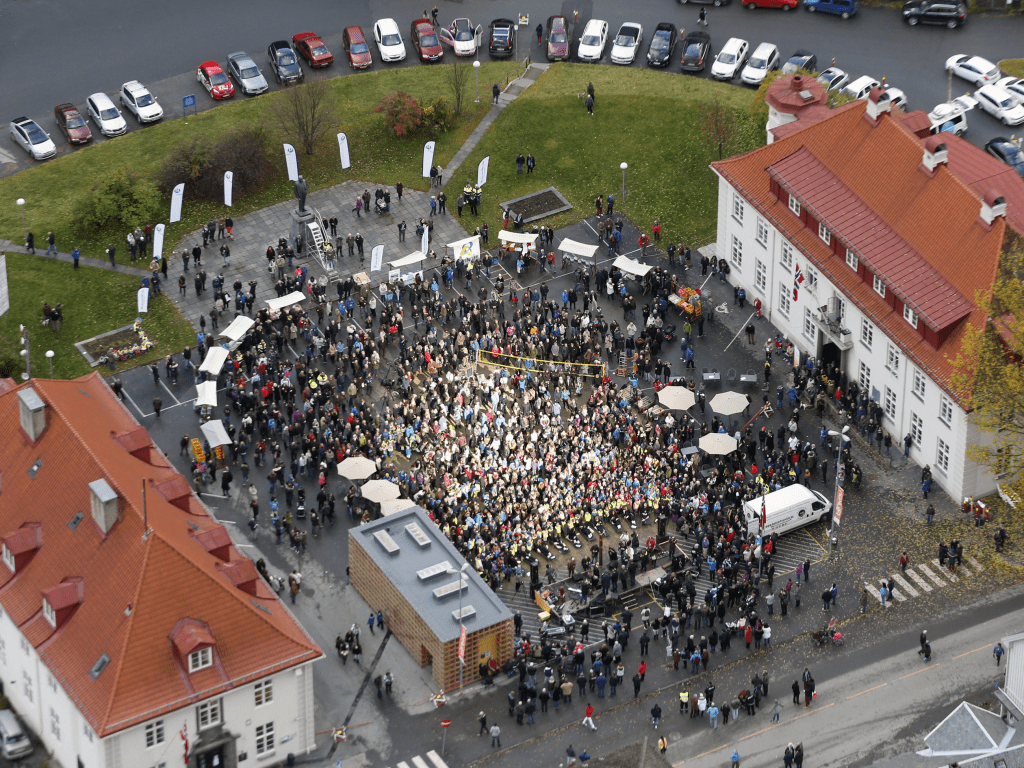
In south-central Norway, nestled in a mountain range (the name I won’t even attempt to pronounce), is the small community of Rjukan. The valley where the town is located is so narrow and the mountains so tall that, for six months each year, the town receives no direct sunlight; however, that changed in November 2013. Large mirrors were installed on one of the mountain peaks, and a computer tracks the sun’s movement and adjusts the mirrors’ angles so that a concentrated beam of light shines into the town square, creating a 6,500-square-foot patch of sunlight.

On the day the light started shining, one resident said, “People have been sitting there and standing there and taking pictures of each other. The town square was totally full. We are not that big of a town, so I think almost all the people in the town were on the town square.” She added, “It’s not very big, but it is enough when we are sharing.” (Source)

The saints we study are like mirrors, radiating—not their own light—but the light of Christ into the darkness of the world. As we say in the preface during the Eucharist on certain saints’ days, we give thanks to the Father, “For the wonderful grace and virtue declared in all your saints, who have been the chosen vessels of your grace, and the lights of the world in their generations.”  

It is this same light that we also seek to reflect. We accomplish this by setting ourselves aside and putting on Christ, working on our salvation with “fear and trembling,” and striving for sanctification in our daily lives. Like all the capital “S” Saints, there will be days and seasons of failure, but each day we start fresh until we are clothed in the robes of white and standing eternally before our Father in Heaven, fully transfigured into his glory.

Sermon: Our Lady of Guadalupe


On December 9, 1531, fifty-seven-year-old Juan Diego was walking to Mass. He is a convert to the faith and a widower. As he walks, he begins to hear the most beautiful music. Following the sound, he climbs Tepeyac Hill, located in what is now Mexico City.

When Juan Diego arrives at the top, he sees a beautiful apparition of the Blessed Virgin Mary. She speaks to Juan Diego, calming him, then telling him that she would like a church to be built on that spot for the people of Mexico. It is to be a place where they can come for healing and worship. She instructs him to go to the local bishop and give him this message, adding, “Now go and put forth your best effort.” 

Juan Diego does as he is told, but the bishop is highly skeptical, thinking this peasant is either mad or a trickster. So, he sends him away. 

Juan Diego returns to Tepeyac Hill, where he sees the Virgin again. He tells her what she already knew—he had failed. Mary tells him that he is to go again on the following morning and try again. Juan Diego is obedient, but the result is essentially the same; however, the bishop tells him if the visions are real, he is to bring some sign the following day. Juan Diego agrees, but when he returns home, he finds his uncle, who he lives with, very ill—near death. He cannot return to the bishop but must stay and care for him. 

Two days later, Juan Diego is convinced that his uncle will die, so he goes in search of a priest. Along the way, he again encounters Our Lady. He explains everything that has happened, yet she says, “Am I not your mother? Are you not in the crossing of my arms?” In other words, she says, “Don’t you trust that I will care for you?” He says that he will believe, and she gives him additional instructions.

Juan Diego is to go that moment and again climb Tepeyac Hill. There, he will find flowers that he has never seen before. He is to gather the flowers in his tunic and take them to the bishop as a sign. It is the middle of December when all this is happening, so he doesn’t know how flowers could bloom, but he does as he is told. Arriving, he finds a beautiful field of flowers. Gathering them quickly in his tunic, he rushes to see the bishop.

The bishop is still skeptical, but Juan Diego drops the flowers, thinking they are the sign, but there is much more. On his tunic, in great detail, is the image of the Blessed Virgin. The image is the sign.

While Juan Diego is with the bishop, the Blessed Virgin appears to his uncle, whom he was caring for. The uncle is healed, and the Virgin tells him of Juan Diego’s mission and that she will be called “Santa Maria, de Guadalupe.” 

The bishop believed, and the church was built on Tepeyac Hill, the former site of an Aztec Temple—The Basilica of Our Lady of Guadalupe. Millions have come to faith in Christ Jesus through these events.

The tunic that Juan Diego was wearing was made of cactus fiber. It should have fallen to pieces within thirty years. After more than 500 years, it is miraculously preserved.

What started it all was the message that Our Lady gave to Juan Diego on their first meeting. “Know for certain, least of my sons, that I am the perfect and perpetual Virgin Mary, Mother of the True God through whom everything lives, the Lord of all things near and far, the Master of heaven and earth. It is my earnest wish that a temple be built here to my honor. Here, I will demonstrate, I will exhibit, I will give all my love, my compassion, my help, and my protection to the people. I am your merciful mother, the merciful mother of all of you who live united in this land, and of all mankind, of all those who love me, of those who cry to me, of those who seek me, of those who have confidence in me. Here, I will hear their weeping, their sorrow, and will remedy and alleviate all their multiple sufferings, necessities, and misfortunes.”

God used a simple peasant farmer, Juan Diego, to bring this all about. How might God use you?

Sermon: Monica

Saint Augustine and His Mother, Saint Monica (1846), by Ary Scheffer

St. Francis de Sales died in the year 1622 and although a bishop he is perhaps best known for his work as a spiritual director.  His book, Introduction to the Devout Life, received criticism from the clergy because Francis believed that it wasn’t just the clergy or religious that could become saints, but the laity as well, which was a novel idea at the time. 

In a collection of letters, The Consoling Thoughts of St. Francis de Sales, the first sentence of the 21st chapter, “How Much God Loves the Saints, Notwithstanding Their Defects and Imperfections”, Francis writes, “To every man, however holy he may be, there always remains some imperfection.”  He goes on to say, “We do no injury to the saints when, in recounting their virtues, we relate their sins and defects; but, on the contrary, those who write their lives seem, for this reason, to do a great injury to mankind by concealing the sins and imperfections of the saints, under pretense of honoring them, not referring to the commencement of their lives, for fear of diminishing the esteem of their sanctity.”  A bit further in the chapter he says, “Our miseries and weaknesses, however great they may be, ought not to discourage us, but ought rather to humble us and make us cast ourselves in the arms of divine mercy.” (Source)  With that understanding, it is no wonder that the last word he is reported to have spoken was, “humility.”

Why this talk of St. Francis de Sales on the Feast of St. Monica?  

Monica was the mother of the great theologian St. Augustine of Hippo.  Much of what we understand about the Christian faith comes from his teachings/writings, but he attributes his faith to the prayers of his mother, as he says, “who for a little space was to my sight dead, and who had wept long years for me that in your[/God’s] sight I might live.”  For her devotion to God and the prayers for her son, she is seen as a great and holy woman—and she is!  Yet, as St. Francis de Sales wrote, “there always remains some imperfection.”  Could such a great and holy woman have imperfections, she who is the patron saint of wives, mothers, conversion, and… alcoholics?  Why alcoholics?

Augustine tells us in his Confessions, that in her family, Monica was the one assigned the chore of bringing the dinner wine up from the cellar.  In secret, she innocently began wetting her lips with the wine but over the years the habit grew to her downing entire glasses of wine before coming up.  A servant, much out of line, caught her in the act and referred to her as a “wine-bibber.”  Monica was so taken aback that she stopped drinking from that day forward.  

Does knowing this defect make her less of a Saint?  Does it take away from her holiness or, as St. Francis de Sales asks, does “beholding the defects of the saints while admiring their lives, [allow us to] learn how great is the goodness of God, who forgave them.”  Does it not also allow us to see that our own defects are not the end of us but are instead those things we must pray to overcome, and in the process of the struggle, allow them to teach us humility and compassion for others who struggle?  Yes, our defects teach us to say to the Lord, “Your grace is sufficient for me, for your power is made perfect in my weakness.” (cf. 2 Cor. 12:9)

Monica and the lives of all the capital “S” Saints demonstrate to us that the path to holiness is not always smooth but that it is passable for those who are humble, confronting their own defects and persevering in the daily struggle to be holy as our Father in Heaven is holy.