
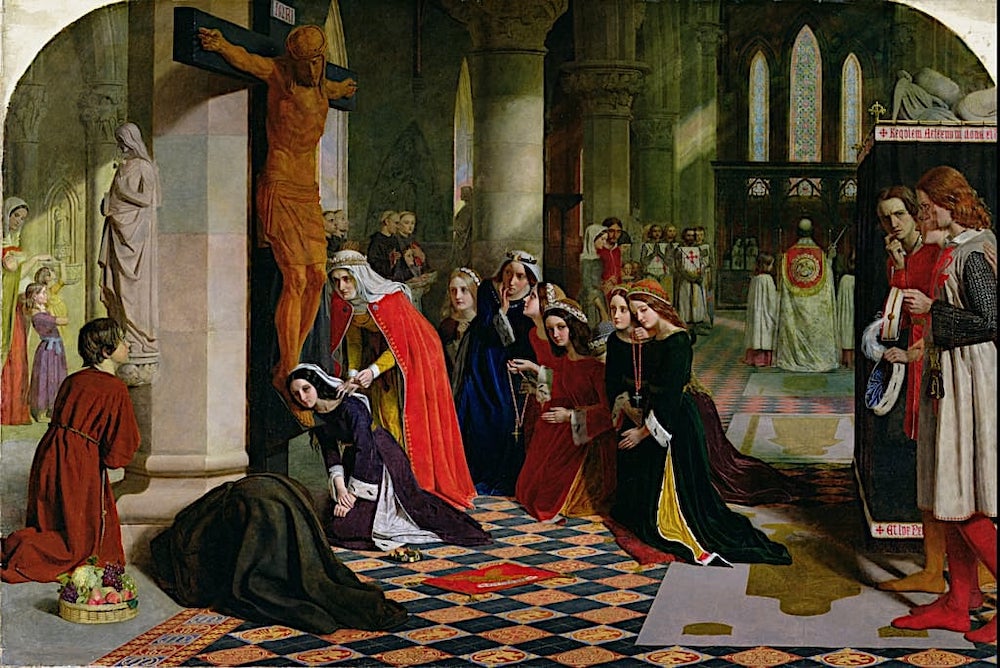
Elizabeth of Hungary was born into nobility in 1207 AD. However, from a very young age, she saw it as her duty to care for the poor. She would sneak food from the castle’s kitchen to the poor at the gates and tend to their other needs as best she could. She was married young, but even then, continued to give as much as she had, saying, “How could I bear a crown of gold when the Lord bears a crown of thorns? And bears it for me!”
At 20, her husband died, and her in-laws turned her out, not caring for the fact that she was giving everything away. She wrote, “Today, there is an inescapable duty to make ourselves the neighbor of every individual, without exception, and to take positive steps to help a neighbor whom we encounter, whether that neighbor be an elderly person abandoned by everyone, a foreign worker who suffers the injustice of being despised, a refugee, an illegitimate child wrongly suffering for a sin of which the child is innocent, or a starving human being who awakens our conscience by calling to mind the words of Christ: ‘As long as you did it for one of these, the least of my brethren, you did it for me’”
She was later reinstated to some extent, but she never stopped her work for the poor and those in need.
Conrad of Marburg, Elizabeth’s spiritual director, wrote, “She was a lifelong friend of the poor and gave herself entirely to relieving the hungry. She ordered that one of her castles should be converted into a hospital in which she gathered many of the weak and feeble. She generously gave alms to all who were in need, not only in that place but in all the territories of her husband’s empire. She spent all her own revenue from her husband’s four principalities, and finally, she sold her luxurious possessions and rich clothes for the sake of the poor.
“Twice a day, in the morning and in the evening, Elizabeth went to visit the sick. She personally cared for those who were particularly repulsive; to some she gave food, to others clothing; some she carried on her own shoulders, and performed many other kindly services. Her husband, of happy memory, gladly approved of these charitable works. Finally, when her husband died, she sought the highest perfection; filled with tears, she implored me to let her beg for alms from door to door.
“On Good Friday of that year, when the altars had been stripped, she laid her hands on the altar in a chapel in her own town, where she had established the Friars Minor, and before witnesses she voluntarily renounced all worldly display and everything that our Savior in the gospel advises us to abandon. Even then she saw that she could still be distracted by the cares and worldly glory which had surrounded her while her husband was alive. Against my will she followed me to Marburg. Here in the town she built a hospice where she gathered together the weak and the feeble. There she attended the most wretched and contemptible at her own table.
“Apart from those active good works, I declare before God that I have seldom seen a more contemplative woman. When she was coming from private prayer, some religious men and women often saw her face shining marvelously and light coming from her eyes like the rays of the sun.
“Before her death I heard her confession. When I asked what should be done about her goods and possessions, she replied that anything which seemed to be hers belonged to the poor. She asked me to distribute everything except one worn out dress in which she wished to be buried. When all this had been decided, she received the body of our Lord. Afterward, until vespers, she spoke often of the holiest things she had heard in sermons. Then, she devoutly commended to God all who were sitting near her, and as if falling into a gentle sleep, she died.” She was twenty-four.
Elizabeth had the Spirit of God working in her in a way I don’t fully understand, but I believe it’s one we should all try to imitate as best as we can, whether we fully grasp it or not.

 Candle in a Cave