
Sermon: Proper 11 RCL B – “Come Away with Me”

Photo by Ante Hamersmit on Unsplash

Little Johnny got himself a drum for his birthday. It was one like the drummer boy in the infantry might have carried into battle, and Johnny loved his drum. He banged on the drum at home, and even worse; he would go up and down the neighborhood streets making all kinds of racket.  No amount of coaxing would get him to stop, and it was for lack of trying. 

One person told Johnny that he would if he continued to make so much noise, perforate his eardrums. This reasoning was too advanced for Johnny, who was neither a scientist nor a scholar.

A second person told Johnny that playing the drum was a special activity and should be carried out only on rare occasions. A third person offered the neighbors earplugs; a fourth gave Johnny a book; a fifth gave him meditation exercises to make him placid and docile. Nothing worked. Johnny banged away on his drum.

One day, Johnny’s grandpa came to town and wondered what all of the ruckus was about. He surveyed the situation, then went out to the garage. When he came back, he had a hammer and a chisel. He set them on the table in front of Johnny. As he turned to walk away, he said, “I wonder what’s on the inside of that drum?”

Grandpa was nominated for the Nobel Peace Prize.

You are familiar with the story of Elijah, but for a refresher… Elijah showed the strength of the Lord and put to shame the 450 priests of Baal. When the people saw this, they had those priests put to death. When Jezebel, the wife of King Ahab, heard this, she became furious and sent word to Elijah, essentially saying, “I’m coming for you.” Fearing for his life, Elijah ran. Scripture says he “went a day’s journey into the wilderness and came and sat down under a broom tree. And he asked that he might die, saying, ‘It is enough; now, O Lord, take away my life, for I am no better than my fathers.’” (1 Kings 19:4)

Elijah worked tirelessly to convince and convert the people and the king to cease their worship of Baal and follow God. He had performed miracles. He had preached. For his efforts, he received a death sentence. He had done all that he knew to do and was tired, so he said to God, “I’m done. I don’t care anymore. Kill me and let me rest.” 

The drum of Elijah’s life had been pounding and pounding. He had no peace, which drove him to the point of not caring. Not caring for his own life and not really caring anymore about what God had called him to.

We are told that when Elijah reached this point, he had just quit, lay down under a tree, and gone to sleep. After a while, an angel of the Lord came to him, woke him up, and gave him something to eat. Then Elijah slept a bit more. And after another while, the angel of the Lord came to him again, fixed a meal, and woke Elijah, saying, “Arise and eat, for the journey is too great for you.” Elijah did and then continued on his journey to Mt. Horeb, where he would encounter God in the still, small voice. There’s a funny meme that’s made its way around the internet. It reads, “This is your gentle reminder that one time in the Bible, Elijah was like, ‘God, I’m so mad! I want to die!’ So God said, ‘Here’s some food. Why don’t you have a nap?’ So Elijah slept, ate, and decided things weren’t so bad.” The conclusion, “Never underestimate the spiritual power of a nap and a snack.” 

The angel of the Lord said to Elijah, “Arise and eat, for the journey is too great for you.” Through the angel, the messenger, the Lord said, “All that you’ve been through really is too much. I understand that, but I need you to continue in this work, so for a time, quiet the drum of your life and rest for a minute.”

Last week, we spoke about desiring God above all things and how God makes Himself available to us when we do. The Lord says, “You will seek me and find me when you seek me with all your heart.” (Jeremiah 29:13) The Psalmist writes, “The Lord is near to all who call on him, to all who call on him in truth.” (Psalm 145:18) However, there are times in our lives when the drum is beating so quickly and so loudly that we say, “I desire you Lord, but I don’t have the time to seek you. The banging of the drum of my life is so “loud” that I can’t shout above all the racket to call on You.” Like Elijah, the journey is too much for us, and we may reach a point where we love God, but we just can’t find the energy to care.

Thomas Merton writes, “We live in a state of constant semi-attention to the sound of voices, music, traffic, or the generalized noise of what goes on all the time around us. This keeps us immersed in a flood of racket and words… Resigned and indifferent, we share semiconsciously in the mindless mind of Muzak and radio commercial which pass for ‘reality.’” 

The beat of the drum becomes so loud that it drives out everything else and makes us indifferent to many things, including God. This is the “demon of acedia, [defined as] the restless spiritual boredom and disgust with existence that would lure one from prayer into ultimately dissatisfying distractions… and eventually away from God.” (The New Ressourcement, “Thomas Aquinas, the ‘Nones,’ and the ‘Dones’”)

When the beat of the drum, the Muzak, life, the journey becomes too much, the acedia sets in, and we shut down and may even shut off our connection to God. When it happened to Elijah, God said, “Here, have a cookie. Take a nap. Find some silence and rest for a bit. You’ll feel better and then be able to continue.” He did, and it worked. Jesus did the same thing with His disciples after they had been going strong.

We do not know how long they were gone, but prior to our Gospel reading today, we know that Jesus sent the disciples out, two-by-two, and “they went out and proclaimed that people should repent.  And they cast out many demons and anointed with oil many who were sick and healed them.” (Mark 6:12-13) Today’s Gospel begins with their return from this mission trip, and Jesus says to them, “‘Come away to a deserted place all by yourselves and rest a while.’ For many were coming and going, and they had no leisure even to eat. And they went away in the boat to a deserted place by themselves.”

The Lord knew how loudly the drum had been beating in the disciples’ ears. He knew they were exhausted, so instead of allowing them to reach the used-up condition of Elijah, He said to them, “Come away to a quiet place with me. Let’s have a cookie, maybe take a nap, and ‘hang out’ for a while.” As with Elijah, who encountered God in the stillness of the mountain, the disciples were also able to have an encounter with Jesus in the stillness of that place. Sure, the crowds eventually find them, and they all have to go back to work, but for a time, like in the beginning, they were allowed to walk with God in the Garden—to be with one another and enjoy each other’s company and fellowship. In doing so, God was able to heal their weary bodies and souls.

When was the last time you just ‘hung out’ with God? When was the last time you went away to a quiet place and rested in Him? Jesus says, “Come to me, all who labor and are heavy laden, and I will give you rest.” (Matthew 11:28) This rest is a gift offered to us today—the gift of healing, renewal, and refreshment. Give yourself permission to stop. Grab a hammer and a chisel and go to work on that drum. Have a cookie, lie down in the green pasture beside the still waters, take a nap, and spend time being with God. By doing so, He will revive your soul. Like Elijah and the disciples, you can be renewed and then continue with the work He has set before you.

Edwina Gateley is a speaker and spiritual writer. She wrote the poem, Let Your God Love You. It makes for a beautiful prayer.

Let us pray: 

Be silent.
Be still.
Alone.
Empty
Before your God.
Say nothing.
Ask nothing.
Be silent.
Be still.
Let your God look upon you.
That is all.
God knows.
God understands.
God loves you
With an enormous love,
And only wants
To look upon you
With that love.
Quiet.
Still.
Be.

Let your God—
Love you.

(Psalms of a Laywoman, p.59)
Sermon: Proper 18 RCL B – “Time Alone”

Photo by Nick Kwan on Unsplash

A man made an appointment with the famous psychologist Carl Jung to get help for chronic depression. Jung told him to reduce his fourteen-hour workday to eight, go directly home, and spend the evenings in his study, quiet and all alone. The depressed man went to his study each night, shut the door, read a little Hermann Hesse or Thomas Mann, played a few Chopin études or some Mozart.

After weeks of this, he returned to Jung, complaining that he could see no improvement. On learning how the man had spent his time, Jung said, “But you didn’t understand. I didn’t want you to be with Hesse or Mann or Chopin or Mozart. I wanted you to be completely alone.” The man looked terrified and exclaimed, “I can’t think of any worse company.” Jung replied, “Yet this is the self you inflict on other people fourteen hours a day”

For several weeks, we talked about the Holy Eucharist and Communion.  The benefits, the mystery and also the way in which it binds us together as a community.  When we spoke of the community, I shared with you the statement from the Archbishop of Canterbury, Michael Ramsey: “Individualism therefore has no place in Christianity, and Christianity verily means its extinction. The individual Christian exists only because the body exists already. In the body the self is found, and within the individual experience the body is present.”  However, without further investigation, we could come to believe that we can only practice our faith when gathered together as a community, but with all things, we must seek the proper balance, because there are also times, in practicing our faith, that we must be alone with Jesus.  There are so many fine lessons in our Gospel reading this morning, but that was what I kept thinking on.

First there was the encounter with the Gentile woman, of Syrophoenician origin and the tongue-in-cheek bantering between her and Jesus.  Then, in a different town, the people bring Jesus a deaf/mute and asked Jesus to heal him.  It is here that we read, Jesus “took him aside in private, away from the crowd, and put his fingers into his ears, and he spat and touched his tongue. Then looking up to heaven, he sighed and said to him, ‘Ephphatha,’ that is, ‘Be opened.’ And immediately his ears were opened, his tongue was released, and he spoke plainly.”  Jesus healed him.  The man could hear and speak, but in order to do this great work in his life, Jesus brought him to a private place, away from everyone else.

Christianity cannot exist outside of the community of the faithful, but the individual needs private time with Jesus, so that Jesus can do great work within them.  However, like the fella who went to visit Carl Jung, so many of us, when we have time alone, will fill the air with all sorts of noise, because the idea of being alone or even alone with Jesus, is terrifying.  Yet the truth remains: we must have community and we must have this time alone with Jesus.  Dietrich Bonhoeffer said it best in Life Together: “One who wants fellowship without solitude plunges into the void of words and feelings, and one who seeks solitude without fellowship perishes in the abyss of vanity, self-infatuation, and despair.”  His conclusion, “Let him who cannot be alone beware of community.  Let him who is not in community beware of being alone.”  His reasoning for time alone with God: “Alone you stood before God when he called you; alone you had to answer that call; alone you had to struggle and pray; and alone you will die and give an account to God.  You cannot escape from yourself; for God has singled you out.” (p.77f)  Therefore we need community, but we need the alone time as well.

What does this alone with Jesus while at the same time being in community look like?  It is about like this very moment we have now.  We are gathered here as a community, but there is also this reverence, awe, (and when the preacher shuts up) silence.  A time of being together, but also a time to listen to ourselves and to God.  A place of encounter between the Creator and the created.  A time to be alone with Jesus so that he might perform a great work within us.  It sounds easy—sit quietly with Jesus—but it is actually hard work and requires practice.  Why?  Because we don’t know how to stop.  To stop doing, talking, digesting every form of media… we simply do not know how to do what our parents and everyone else tried to get us to do the entire time we were growing up: we do not know how to sit still and be quiet, but… we can learn.  If there were two pieces of advice I would give you on how to sit still and quiet with God, it would be these 1) be intentional and 2) have a pen and paper handy.

First, intentionality.  I have one of those brains that’s always traveling somewhere, but if I’m focused on one particular task, I can stick with it.  However, if I’m going to be focused on a task, I have to schedule that time.  I make an intentional “appointment” to accomplish a certain work.  I think that the same is true with our private time with Jesus.  Yes, we can have those moments throughout the day, but in order for that greater work to be accomplished, we need to intentionally schedule time to meet with God.  That might sound ridiculous to some, “Excuse me God, but tomorrow I have the 9 a.m. hour free.  Would that work for you to meet?”  Sounds silly, but if you don’t schedule that 9 a.m. hour with God, then I guarantee you something else will fill it and it won’t be God.

Second, pen and paper.  Best friends.  I love the post-it note.  I’ve scheduled my appointment to complete a particular task.  I’m focused and in the groove.  Yet, even though I’m focused, some random piece of information pops into my head, “I need to write that message to the Bishop.”  At that point, I have a couple of options: I can stop what I’m doing and write the message or I can go on with what I’m doing, but afraid I’ll forget to do it or… I can pop off a post-it note and jot it down: “Write message to Bp.”  I can confidently stay focused on what I’m doing, knowing I won’t forget the other bit.  The same is true with that scheduled time with God.  All sorts of things are going to come up during it.  If I let a thought or concern persist, then my time with God is a wash, but if I’ll take just a moment to write down that thought, then I know it is safely dealt with for the time and I can get back to God.

Again, this may all sound a bit too pragmatic in our relationship with God and spending time with him, but let me ask you this: how’s your current system working out for you?

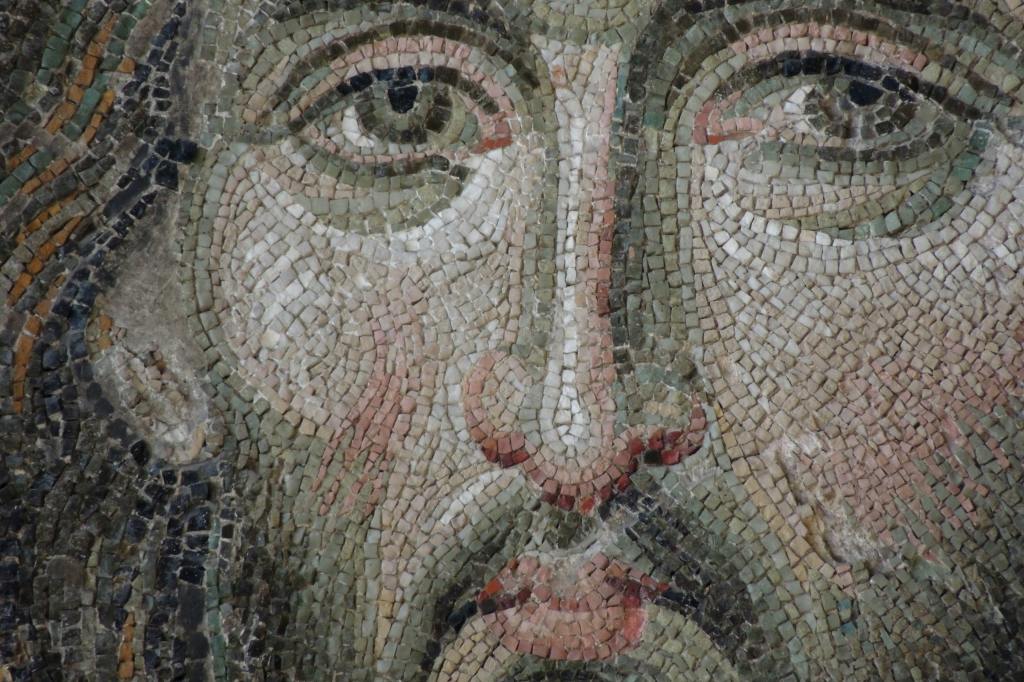
Just as we were intentional in coming here today to spend time with God in the family of the faithful, we must also do the same in our private time with Jesus, because we need both: community and time alone with our God.  The two are inseparable.  What is the end result? Henri Nouwen, in Can You Drink this Cup?, described it best: “Community is like a large mosaic. Each little piece seems so insignificant. One piece is bright red, another cold blue or dull green, another warm purple, another sharp yellow, another shining gold. Some look precious, others ordinary. Some look valuable, others worthless. Some look gaudy, others delicate. We can do little with them as individual stones except compare them and judge their beauty and value. When, however, all these little stones are brought together in one big mosaic, portraying the face of Christ, who would ever question the importance of any one of them? If one of them, even the least spectacular one, is missing, the face is incomplete. Together in the one mosaic, each little stone is indispensable and makes a unique contribution to the glory of God. That’s community, a fellowship of little people who together make God visible in the world.”

Let us pray: Heavenly Father, author and inspirer of all things holy, hear our prayers for our Church.  Send forth Your Spirit that we may humbly be guided by your Divine Will.  Touch our hearts with true generosity to raise up a house of God for the inspiration and renewal of all your faithful.  We ask this in Jesus’ Name. Amen.