
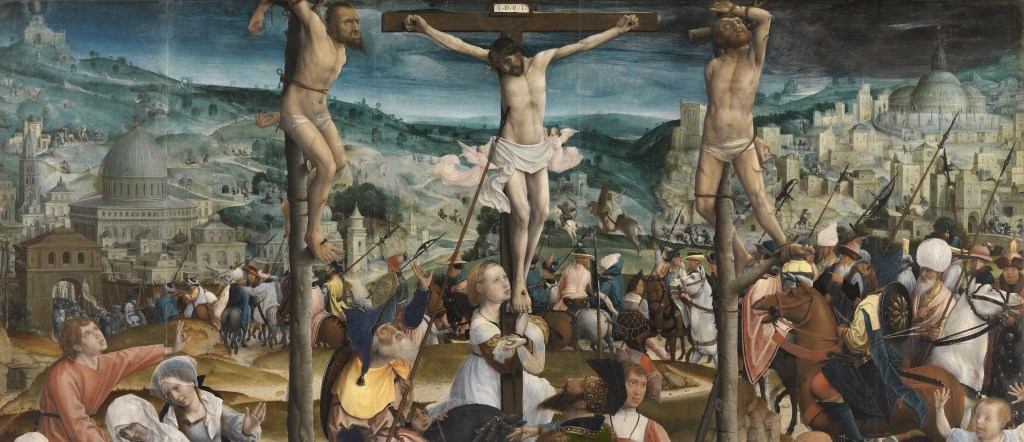
Jesus has spoken His final words, “It is finished” (John 19:30), and given up His spirit, yet the soldiers doubt He is dead. Anne Catherine Emmerich, in The Dolorous Passion of Our Lord Jesus Christ, picks up the story from there in chapter 48, “The Opening of the Side of Jesus.”
The executioners still appeared doubtful whether Jesus was really dead, and the brutality they had shown in breaking the legs of the thieves made the holy women tremble as to what outrage they might next perpetrate on the body of our Lord. But Cassius, the subaltern officer, a young man of about five-and-twenty, whose weak squinting eyes and nervous manner had often excited the derision of his companions, was suddenly illuminated by grace, and being quite overcome at the sight of the cruel conduct of the soldiers, and the deep sorrow of the holy women, determined to relieve their anxiety by proving beyond dispute that Jesus was really dead. The kindness of his heart prompted him, but unconsciously to himself he fulfilled a prophecy. He seized his lance and rode quickly up to the mound on which the Cross was planted, stopped just between the cross of the good thief and that of our Lord, and taking his lance in both hands, thrust it so completely into the right side of Jesus that the point went through the heart, and appeared on the left side. When Cassius drew his lance out of the wound a quantity of blood and water rushed from it, and flowed over his face and body.
The Prophet Ezekiel received a vision from God. In this vision, an angel of the Lord guided him, and Ezekiel saw the heavenly temple and the New Jerusalem, where God brought about the salvation of His people. He reports that the angel led him to “the temple, and behold, water was issuing from below the threshold of the temple toward the east (for the temple faced east). The water was flowing down from below the south end of the threshold of the temple, south of the altar. Then he brought me out by way of the north gate and led me around on the outside to the outer gate that faces toward the east; and behold, the water was trickling out on the south side.” (Ezekiel 47:1-2) However, if we refer back to the original Hebrew Scriptures, we discover that, while accurate, they do not state that the waters originated from the south side of the Temple. Instead, the Hebrew Scriptures indicate that they came from the “right side” of the Temple.
How should we understand the nature of the Temple that Ezekiel describes?
Following the Triumphant Entry, Jesus went to the Temple in Jerusalem. Upon his arrival, He became enraged because, as He stated, “It is written, ‘My house shall be called a house of prayer,’ but you make it a den of robbers.” (Matthew 21:13) He then drove the moneychangers and others out with a whip. When asked by what authority he was doing these things, Jesus replied, “Destroy this temple, and in three days I will raise it up.” They responded, “It has taken forty-six years to build this temple, and will you raise it up in three days?” But he was speaking about the temple of his body. (John 2:19-21)
Ezekiel prophesied that water would flow from the right side of the Temple and the Temple was Jesus. Catherine spoke of this, and it is confirmed in Scripture: “One of the soldiers pierced his side with a spear, and at once there came out blood and water.” (John 19:34)
What purpose does the water serve? Fifty years after Ezekiel, the Prophet Zechariah tells us, “On that day”—that is, the day the Lord intends to bring salvation to His People—“On that day there shall be a fountain opened for the house of David and the inhabitants of Jerusalem, to cleanse them from sin and uncleanness.” (Zechariah 13:1)
The stream flowed from the right side of the Temple, and the Temple was Jesus. Water and blood flowed from Jesus’ right side after He was pierced with the spear, and this water and blood offered forgiveness of sins to all who would believe in Him. Jesus says, “If anyone thirsts, let him come to me and drink.” (John 7:37)
Today, it may seem that the stream from the side of Jesus is only available to us in a spiritual sense, but that’s not the case. Writing in the fourth century, St. Augustine tells us, “The Sacraments flowed out of the side of Christ.”
We who are touched by the waters of Baptism and who partake of the Lord’s body and blood in Holy Communion are the recipients of the same water and blood that flowed from the side of the crucified Lord and in the words of the Eucharistic Prayer, we receive “the innumerable benefits procured unto us by the same.” (BCP 335) That’s good stuff right there. You should say “Amen.”
When Jesus’ side was opened, and his most Sacred Heart pierced, the very Gates of Heaven were opened. The blood and water, the River of Life, flowed out, creating a pathway for the healing of our souls and bodies.
Following the great tribulation in the Book of Revelation, John tells us, “The angel showed me the river of the water of life, bright as crystal, flowing from the throne of God and of the Lamb through the middle of the street of the” New Jerusalem. (Revelation 22:1-2)
On a scorching day in July 1864, weary from the heat, Robert Lowry, a Baptist minister, lay on a couch with no energy to do anything else. As he rested there, he meditated on this vision of the river of the water of life in John’s Revelation. The story goes, “While he was thus breathing heavily in the sultry atmosphere of that July day, his soul seemed to take new life from that celestial outlook. He began to wonder why the hymn-writers had said so much about “the river of death,” and so little about “the pure river of water of life, clear as crystal, proceeding out of the throne of God and of the Lamb.” (Source)
With this in mind, a hymn started to take shape in his mind. When the lyrics and music finally came together, he leaped up from the couch, sat down at his organ, and composed it in its entirety. You’ve likely heard it. The first stanza and refrain:
Shall we gather at the river,
where bright angel feet have trod,
with its crystal tide forever
flowing by the throne of God?
Refrain:
Yes, we’ll gather at the river,
the beautiful, the beautiful river;
gather with the saints at the river
that flows by the throne of God.
Through the sacraments, we participate in and receive the blood and water that flowed from Jesus’ pierced side. Therefore, with Robert Lowry, we can confidently say, “Yes, we will gather at the river, the beautiful, beautiful river.”
Give thanks to the Lord our God, for He has literally opened Himself for you so that you may have access to Him.
Let us pray: Lord Jesus Christ, inexhaustible Fountain of love and grace, I bless and thank you for the ruthless piercing of your sacred side after you died. It was then that you, holiest of all who are holy, were brutally struck on your right side by one of the soldiers holding a military lance. It pierced so deeply that it entered the most tender part of your heart and from that wide-open wound there flowed a life-giving fountain of blood and water. Would that the whole world had been sprinkled, it might then be saved!
O most devoted Jesus, you are the source of all our hearts’ secrets and you dwell in the hearts of those who love you! O crucified Lord; you are the object of all contemplation! O Divine Treasury of all gifts and graces, Christ the King and Redeemer of the faithful, you permitted your sacred side to be pierced by the head of a lance. Open for me, I ask, the door of your mercy and permit me to enter through that wide opening in your side to the innermost recesses of your most sacred heart so that my heart may become powerfully inflamed and be united to you by the insoluble bond of love. May I live in you and you in me and may we remain united forever. Amen.

 Candle in a Cave