

The reign of Queen Victoria, known as the Victorian Era of the British Empire, lasted from 1837 to 1901. A Tale of Two Cities by Charles Dickens primarily focuses on the French Revolution; however, Dickens, an Englishman, had Victorian London and its issues in mind while writing that great novel. He recognized that what was happening in Paris could very easily happen in London too, so the beginning of the book references both Paris and London and aptly captures the spirit of the Victorian Era. “It was the best of times, it was the worst of times, it was the age of wisdom, it was the age of foolishness, it was the epoch of belief, it was the epoch of incredulity, it was the season of light, it was the season of darkness, it was the spring of hope, it was the winter of despair.”
During that era, there was a focus on morality, proper conduct, and manners. Therefore, Victorian etiquette was sometimes quite charming—we could still use some of it today—while at other times, downright silly.
One rule that was once good and should still be followed, although with the rise of smartwatches, it would never be reinstated, was: “Pulling out your watch in company unasked, either at home or abroad, is a mark of ill breeding… If at home, it appears as if you were tired of your company, and wish them to be gone; if abroad, as if the hours dragged heavily, and you wished to be gone yourself. If you want to know the time, withdraw.” On the sillier side, we have, “A lady should not ever say ‘my husband,’ except among intimates; in every other case she should always address him by his name, calling him ‘Mr.’ It is equally proper, except on occasions of ceremony, and while she is quite young, to designate him by his Christian name. Never use the initial of a person’s name to designate him; as ‘Mr. P.,’ ‘Mr. L.,’ etc. Nothing is so odious as to hear a lady speak of her husband, or, indeed, anyone else, as ‘Mr. B.’”
All of these rules point to a society governed by various regulations that are followed by many—primarily the elite—and scorned by others as being foolish. However, rules and laws, written or otherwise, have always been a fundamental part of any society. Aristotle noted, “At his best, man is the noblest of all animals; separated from law and justice, he is the worst.”
Today, we continue our study of the seven Heavenly Virtues. As you’ll recall, they are made up of the four Cardinal Virtues and the three Theological Virtues. In particular, today, we’ll look at temperance and prudence. Together, these speak of reason and wisdom in creating, applying, and observing laws and rules.
Technically, “Prudence is the virtue that disposes practical reason to discern our true good in every circumstance and to choose the right means of achieving it. It is not to be confused with timidity or fear, nor with duplicity or dissimulation. It is called auriga virtutum (the charioteer of the virtues); it guides the other virtues by setting rule and measure. It immediately guides the judgment of conscience.” “Temperance is the moral virtue that moderates the attraction of pleasures and provides balance in the use of created goods. It ensures the will’s mastery over instincts and keeps desires within the limits of what is honorable. The temperate person directs the sensitive appetites toward what is good and maintains a healthy discretion.” Those are the technical definitions and are supported by Holy Scripture, yet when I think about them in a less technical way, I think of paint-by-numbers.
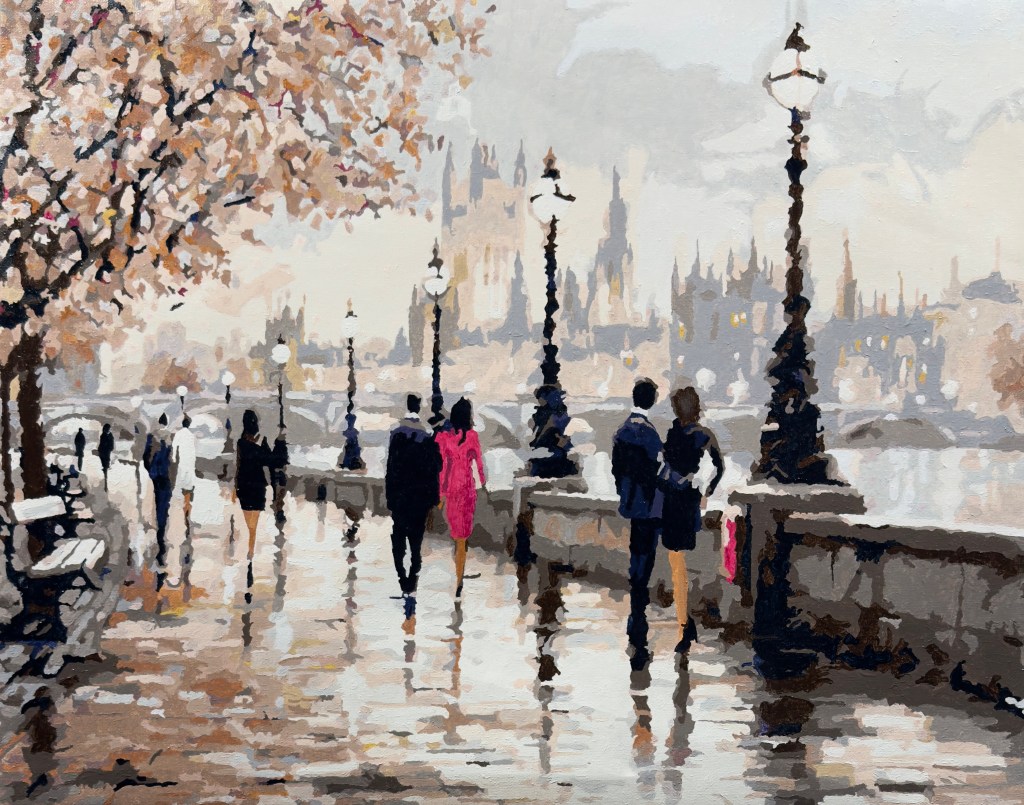
As a kid, I’m sure most of us did dome paint-by-numbers. You’d get a nice 8×12 image of a bluebird or a dog and a dozen or so small pods of paint, along with a single paintbrush. They were fun and fairly simple projects. Now, as an adult, I’ve rediscovered paint-by-numbers. I have no idea why, but I can spend hours searching for 17s and be perfectly content. I recently finished my first one, and an example of that project is on the bulletin cover.
These are not the paint-by-numbers you did as a kid. Although it looks fairly complicated, this particular project is classified as beginner. How involved have I become? I have purchased an easel, scores of brushes, clear gesso to prepare the canvas before painting, and sealer for when it’s finished. I have watched hours of YouTube videos and studied techniques. Long story short: although I haven’t reached obsession level, I do invest a significant amount of time. The bonus: it’s cheaper than collecting antique cars.
Technically, prudence “guides the other virtues by setting rule and measure.” In paint-by-numbers, prudence is best represented by the lines. Let’s say that #17 is red. When you are painting 17s without any other color around it, you’ll have an odd-shaped patch of red in the middle of a field of white canvas. That odd-shaped patch of red might seem meaningless at first. It is just there. However, when finished, you might realize it’s part of the lips of the main subject. In the short term, the adherence to the lines, the rule of prudence, may not make much sense, but in the long term, without following the rules, something is amiss. Prudence, the lines, guide everything else.
Temperance “ensures the will’s mastery over instincts and keeps desires within the limits of what is honorable.” In the world of paint-by-numbers, which can be even more challenging with a cat that enjoys swatting at your brush, temperance is twofold. First, it means staying within the lines that prudence provides. Remember the first coloring a young child proudly delivers as a masterpiece? The page has a printed image of a floppy-eared bunny. The child, in their innocence, has taken the brightest of all the crayons, gripped them in one hand, and created a fine rendition of a Jackson Pollock. In paint-by-numbers, you can do the same—throw paint everywhere—and, though this is no judgment of your artistic flair, you too can create a Pollock, but you will never end up with the image you intended.
The second part of temperance is using the right color. I have a new project in progress. This one has much more vibrant colors than the last. When I got home Wednesday night, I sat down and started working on #6. However, at some point, I got it in my pointy little head that I was working on #16, and away I went. Then, things started to make no sense. Trusting the process, I pressed on for a while longer, but then it just started to look wrong. #6 is a nice olive green. #16 is a rather bright orange. Had I desired it, I could have continued, but instead, I went back and painted over what I had done with the correct color, and the image began to emerge once again. St. Paul tells us, “‘All things are lawful,’ but not all things are helpful. ‘All things are lawful,’ but not all things build up” (1 Corinthians 10:23). Temperance: just because you can do something, doesn’t mean you should.
Together, temperance and prudence speak of wisdom and reason in creating, applying, and following laws and rules. Adhere to the rules and laws, and in the end, you’ll likely end up with a fairly nice picture. You can see for yourself how I did. The finished painting is hanging in the lounge.
These two virtues, temperance and prudence, along with the two we discussed a few weeks ago—fortitude (spiritual courage) and justice (seeking the common good)—supported by humility, are known as the Cardinal Virtues. St. Augustine helps us understand their purpose and how they function together. “As to virtue leading us to a happy life, I hold virtue to be nothing else than perfect love of God. For the fourfold division of virtue, I regard as taken from four forms of love… So we may express the definition thus: that temperance is love keeping itself entire and incorrupt for God; fortitude is love bearing everything readily for the sake of God; justice is love serving God only, and therefore ruling well all else, as subject to man; prudence is love making a right distinction between what helps it towards God and what might hinder it.” (Source)
To live such a life and to love in such a way isn’t always easy, but it does not lead to a life void of color or flavor. Instead, it represents the highest calling and the fulfillment of who we were created to be. St. Peter writes, “Keep your conduct among the Gentiles honorable, so that when they speak against you as evildoers, they may see your good deeds and glorify God on the day of visitation” (1 Peter 2:12). By practicing the Cardinal Virtues, we are well on our way to living such a life, but three more virtues are needed—the Theological Virtues of faith, hope, and love. As for these, I say… to be continued.
Let us pray (from St. Thomas Aquinas): Plant in me, O Lord, all virtues: that I may be devoted to divine things, provident in human affairs, and troublesome to no one in bodily cares. Grant me, O Lord, fervour in contrition, sincerity in confession, and completeness in satisfaction. Deign to direct my soul to a good life: that what I do may be pleasing to Thee, meritorious for myself, and edifying to my neighbour. Amen.

 Candle in a Cave