Sermon: Peter and Paul

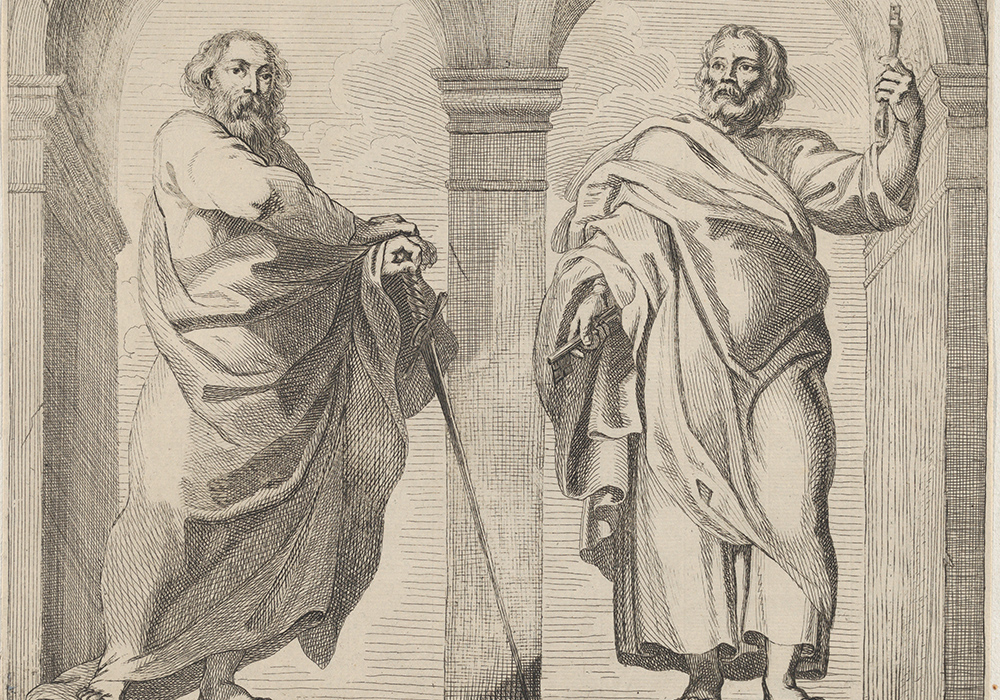
“Saints Peter and Paul in a vestibule,” etching by Rombout Eynhoudts after Peter Paul Rubens, circa 1630-80 (Metropolitan Museum of Art)

After his resurrection, Jesus appeared to his disciples on several occasions. Toward the end of Luke’s Gospel, we hear of the disciples on the road to Emmaus:

That same day, two of them were going to a village called Emmaus, about seven miles from Jerusalem. They were talking with each other about everything that had happened. As they talked and discussed these things, Jesus himself came up and walked along with them, but they were kept from recognizing him. He asked them, “What are you discussing together as you walk along?”

Later, in the Acts of the Apostles, we read that Jesus appeared to Paul as he was on the road to Damascus:

“Saul, Saul, why do you persecute me?”

“Who are you, Lord?” Saul asked.

“I am Jesus, whom you are persecuting,” he replied. “Now get up and go into the city, and you will be told what you must do.”

The men traveling with Saul stood there speechless; they heard the sound but did not see anyone. Saul got up from the ground, but he could see nothing when he opened his eyes.

The Gospels record several instances when Jesus appeared to Peter. Today we read of his restoration. There is also a legend of Jesus appearing to Peter many years later.

Peter eventually made his way to Rome, and after a time, one of the persecutions of the Christian church began. The legend picks up:

His friends, so runs the story, had entreated the Apostle to save his life by leaving the city. Peter finally consented, but on the condition that he should go away alone. But when he wished to pass the city gate, he saw Christ meeting him. Falling down in adoration, he said to Him, ‘Lord, whither goest Thou?’ And Christ replied, ‘I am coming to Rome to be again crucified.’ And Peter said to Him, ‘Lord, wilt Thou again be crucified?’ And the Lord said to him, ‘Even so, I will again be crucified.’ Peter said to Him, ‘Lord, I will return and will follow Thee.’ And with these words, the Lord ascended into Heaven.

The encounter on the road out of Rome gave Peter the courage to return to Rome and face his death, which Jesus also spoke of in our Gospel: “When you grow old, you will stretch out your hands, and someone else will fasten a belt around you and take you where you do not wish to go.” You will stretch out your hands—you will be crucified.

Today, I have a question for you. Three different encounters and three different roads. Jesus asked, “What are you discussing together as you walk along?” Jesus asked, “Saul, Saul, why do you persecute me?” Jesus said, “I am coming to Rome to be again crucified.”

Now imagine, if you will: you are walking down an old dirt road in Oklahoma. It is pleasantly warm, the sun is beginning to set, and you are at peace, simply enjoying your time, when you encounter Jesus. You say a little prayer: “Speak, Lord, for your servant is listening.”

What does Jesus ask you? What does he say?

Sermon: Sts. Peter and Paul

Sts. Peter and Paul by Guido Reni

If you’ve ever read any of the Old Testament, you know that early on it speaks a good bit about the sacrificial system during the time of the Temple in Israel.  The rules were very specific on how, when, who, and other details.  One part of certain sacrifices was the “libation offering.”  In Exodus, for a specific sacrifice, the people were to offer two lambs; furthermore, it says, “And with the first lamb a tenth measure of fine flour mingled with a fourth of a hin of beaten oil, and a fourth of a hin of wine for a drink offering.”  So with this offering of the lamb, you would also include about a quart of oil and a quart of wine.  Why?  Scripture seems to indicate that these additions of oil and wine would make an aroma that was pleasing to God.  Having done a bit of cooking myself, I would have to agree.

Today, we read in Paul’s second letter to Timothy, “As for me, I am already being poured out as a libation, and the time of my departure has come.”  Paul is alluding to the libation offering in the Old Testament.  His life has been poured out with the sacrifice, the sacrifice of Jesus, and is even now rising, as an aroma that is pleasing to God.

As we celebrate two of the greatest apostles of Jesus, Peter and Paul, we can see in them both, lives that were poured out for the purpose of the Gospel, that were sacrificed to God, and in a spiritual sense, rose as an aroma pleasing to God.

Question: Is the “aroma” of your life pleasing to God?  Is your life mingled with the sacrifice of Jesus and poured out upon the altar of God?  If it is do you think your part, especially when compared to that of the Peters and Pauls of this world, as insignificant?  Maybe a flash in the skillet, but definitely nothing that any would take notice of or get excited about?

During World War II, England needed to increase its production of coal. Winston Churchill called together labor leaders to enlist their support. At the end of his presentation, he asked them to picture in their minds a parade that he knew would be held in Picadilly Circus after the war. 

First, he said, would come the sailors who had kept the vital sea lanes open. Then would come the soldiers who had come home from Dunkirk and then gone on to defeat Rommel in Africa. Then would come the pilots who had driven the Luftwaffe from the sky.

Last of all, he said, would come a long line of sweat-stained, soot-streaked men in miner’s caps.  Someone would cry from the crowd, “And where were you during the critical days of our struggle?” And from ten thousand throats would come the answer, “We were deep in the earth with our faces to the coal.”

My grandaddy was one like that.  They wouldn’t call him up to serve because he had a vital job working in a paper mill.  We all have these purposes, ordained by God, and the work we do – great or small, noticed by the world or ignored by all—as one of my seminary professors said, “Sometimes the work God calls us to just isn’t all that sexy”—but if done for the Father’s glory is beautifully fragrant to Him.  For by pouring out our lives in service to His purpose, we are feeding His lambs and tending His sheep.  By pouring out our lives for His purposes, we are answering the question that, three times, Jesus asked Peter: Do you love me?  The libation offering of our lives, our lives poured out in His service, answers that question by saying, “Yes, Lord; you know that I love you.”