The canonical books of Holy Scripture run from Genesis through Revelation, and the Episcopal Church also recognizes the Apocrypha—Bel and the Dragon, the Book of Wisdom, and others—but does not use them to establish doctrine, rather as suitable “for example of life and instruction of manners.” (BCP 868) However, these are not all. Many other books have been passed down that are hard to classify and are known as the New Testament Apocrypha and Pseudepigrapha, such as the Infancy Gospel, the Ascent of Isaiah, and the Apocalypse of Peter, to name a few. The one where our story begins today is the Acts of the Holy Apostle Thomas.
It is primarily the story of Thomas and how he evangelized India, but it begins in Jerusalem. “At that time we the apostles were all in Jerusalem — Simon called Peter, and Andrew his brother; James the son of Zebedee, and John his brother; Philip and Bartholomew; Thomas, and Matthew the tax-gatherer; James of Alphæus and Simon the Cananæan; and Judas of James; — and we portioned out the regions of the world, in order that each one of us might go into the region that fell to him, and to the nation to which the Lord sent him.”
If this is to be trusted, our Patron Saint Matthew was in attendance, but from there the legends and traditions take many different directions. Today, I’m using Jacobus de Voragine’s Golden Legend because that legend is linked to the painting on the cover of your bulletin.
In Acts of the Apostles, an angel instructed Philip to go to Gaza. There, he met “an Ethiopian, a eunuch, a court official of Candace, queen of the Ethiopians.” The Ethiopian was trying to understand a passage from the Book of the Prophet Isaiah. Philip explained it, and the Ethiopian was converted.
Years later, according to the Golden Legend, after the meeting in Jerusalem when they divided up the known world, we are told that Matthew went down to Ethiopia, where he “stayed with the eunuch of Candace the Queen, whom Philip had baptized.”
Using the Eunuch’s home as his base, Matthew went out and began evangelizing. Along the way, he had some rather interesting encounters with magicians. On one occasion, “a man came to them and reported that the magicians had arrived with two dragons, which breathed fire and sulfur from their mouths and nostrils and killed everyone they encountered.” Matthew, armed with the sign of the cross, went out to meet these magicians and their dragons. As soon as they saw Matthew, the two dragons approached him, lay down at his feet, and went to sleep.
A verbal confrontation with the magicians follows, ending with Matthew waking the dragons and sending them away. Is that a true story? Let me ask you, when was the last time you saw a fire-and-sulfur-breathing dragon?
Later, the king’s son died, and Matthew raised him to life. The king declared far and wide, “Come and see God in the likeness of a man.” The people came, bringing gold and wanting to make sacrifices to Matthew, but he said to them, “What are you doing? I am not God. I am the servant of our Lord.” He commanded that the gold and silver be taken and used to build a magnificent church, completed in thirty days. From this church, Matthew ministered the Gospel for thirty-three years, converting all of Ethiopia.
During that time, Matthew established a convent where some two hundred virgins lived and prayed. One of them, Ephigenia, caught the eye of the new king, Hirtacus, who ascended the throne after the king whose son Matthew had raised died.
Hirtacus greatly desired Ephigenia and pleaded with Matthew to release her and persuade her to come and be his bride. In response, Matthew told the king to do as his predecessor had done and come to church on Sunday. The king was happy, thinking Matthew would do as he commanded.
In concluding his sermon, Matthew said that marriage is good when it is faithfully preserved in a good covenant. But then he said: “You who are gathered here know well that if a servant were to take the wife of a king, he would not only offend the king but would deserve death—not simply because he wished to marry her, but because in taking his lord’s bride he would violate the marriage that already joined them.”
“And you, O king, know that Ephigenia has become the bride of the everlasting King [Jesus] and has been consecrated to him by the holy veil. How, then, can you take the wife of a mightier King and join her to yourself in marriage?”
As you can imagine, the king was not pleased and flew into a rage. The Golden Legend tells us, “After the solemn celebration of the Mass, the king sent an executioner, who killed Matthew from behind with a sword as he stood beside the altar with his hands raised toward heaven.”
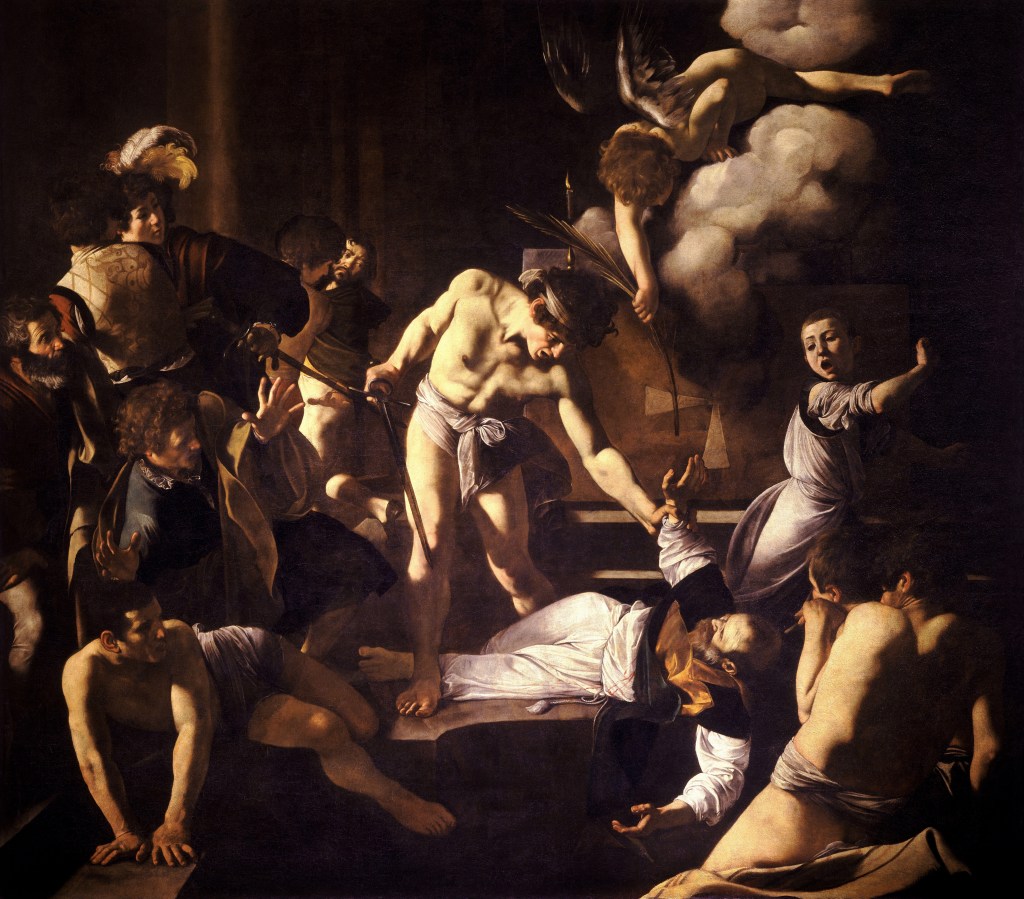
In the Church of San Luigi dei Francesi in Rome, three paintings by the great Italian painter Caravaggio hang in a small chapel near the high altar: The Calling of Saint Matthew, The Inspiration of Saint Matthew, and The Martyrdom of Saint Matthew. I would wager you would recognize them if you saw them, and The Martyrdom of Saint Matthew is the one on the cover of your bulletin.
Matthew lies on the altar steps, and his executioner holds Matthew’s wrist. It appears as though Matthew is holding up his hand, as if trying to ward off another blow, but he is instead reaching out to take the palm branch the angel above the altar is handing him.
The Book of Revelation describes the vision St. John had. At one point, John sees “a great multitude that no one could number… clothed in white robes, with palm branches in their hands.” (Revelation 7:9) When John asks who these people are, he is told, “These are the ones coming out of the great tribulation. They have washed their robes and made them white in the blood of the Lamb.” (Revelation 7:14)
Matthew reaches for the palm branch, the sign of his martyrdom.
Is the whole story true? I’ll let you be the judge, but I suspect that behind the dragons’ wings, there is a good bit of truth about our Patron Saint.
Some may say, “That’s a nice story, Father John, but what’s it got to do with us, with me?” The answer, I see, is not in the story but in the painting.
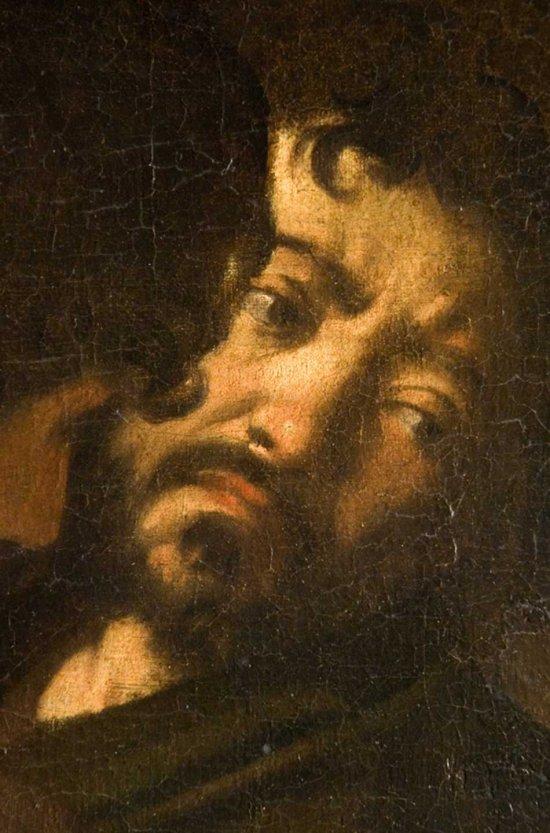
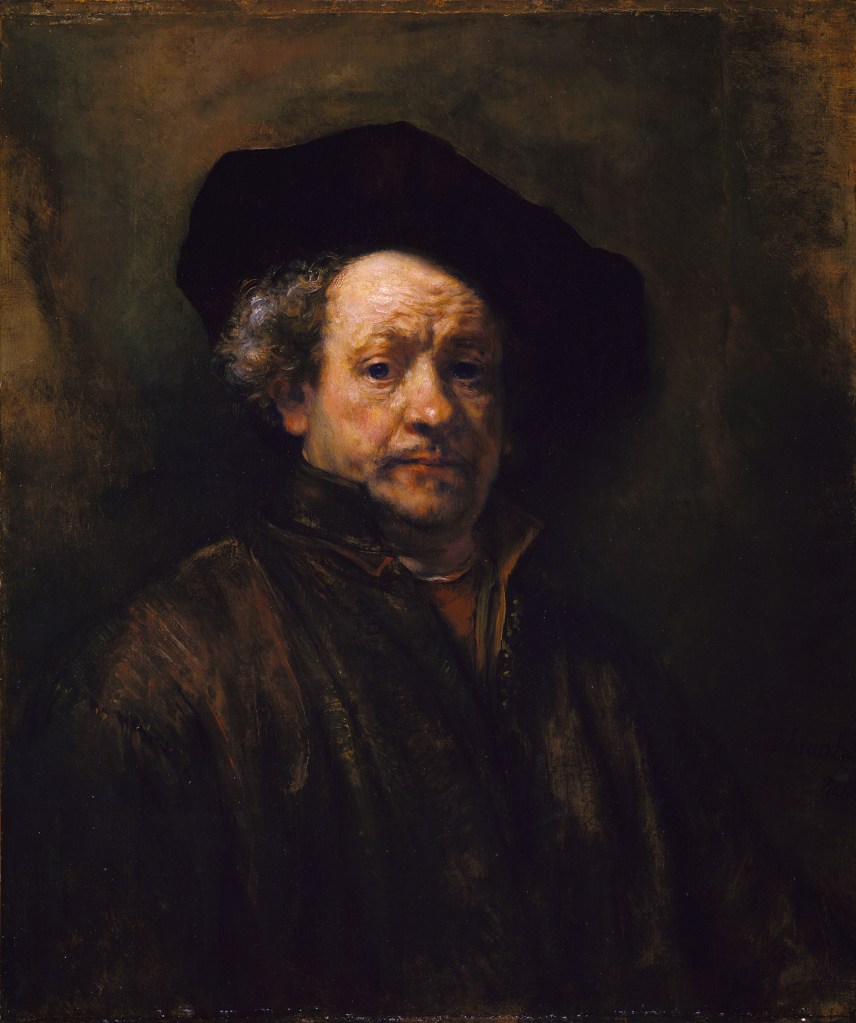
If you were at our Wednesday night study, you may recognize a face in the painting. On Wednesday, we looked at Caravaggio’s painting of David and Goliath. David holds up Goliath’s head, and Goliath’s face is Caravaggio’s self-portrait. Caravaggio also includes a self-portrait in The Martyrdom of St. Matthew.
The executioner is in the center. There is a face just to the left of the executioner’s left shoulder. It is believed to be Caravaggio. He has painted himself looking on this horrific scene while running away.
Now, I don’t know what Caravaggio intended by placing himself in this painting, and I’m not going to pretend that I do. But I wonder what we might learn from this man who is running away while looking back.
He sees the violence. He sees Matthew lying on the steps. He sees the executioner standing over him. And he is leaving.
But he is still looking back.
I wonder how often that is us.
We hear the Gospel. We know what Christ asks of us. We know we are to love God with all our heart, soul, and mind, and our neighbor as ourselves. We know we are to forgive, to show mercy, to care for those in need, and to take up our cross and follow him.
And sometimes we do.
But sometimes we turn away. Sometimes the demands of the Gospel are more than we want to bear. Sometimes the world offers us something that seems a good bit easier than following Christ.
And we walk away.
But we keep looking back.
I wonder if Caravaggio’s self-portrait might tell us something about the grace of God. For even as this man is leaving the scene, he has not entirely turned his back on what is happening. Something still holds his attention.
And perhaps that is where the work of grace begins.
Look again at Matthew. He is reaching toward the palm branch, the promise of victory and eternal life. His earthly journey is coming to an end.
But Caravaggio’s journey is not over.
He is still alive. He still has time to turn around.
And so do we.
I don’t know where you would place yourself in this painting. Perhaps you would be among those fleeing. Perhaps you would be standing helplessly, watching what is happening. Perhaps you would like to imagine yourself beside Matthew, ready to share in his martyrdom.
I know where I would like to place myself.
But I also know that there have been times when I have walked away from what Christ was asking of me.
And yet, I keep looking back.
Maybe that’s the question we should take away from this painting today. Not whether we would have the courage to die as Matthew did, but whether we have the courage to turn around and follow Christ while we are still alive.
Because the man in the painting still has time.
And so do we.
Let us pray:
O blessed Saint Matthew, once a tax collector,
now a beloved apostle of Jesus, pray for us.
You were called from a worldly life to follow the Lord,
and your example inspires us to leave behind
our sins and embrace a life of faith.
Intercede for us that we may
be open to God’s call in our lives.
Help us to recognize His presence
in the ordinary moments of our days.
Grant us the courage to follow Him
wherever He leads.
We ask for your intercession,
that we may be faithful stewards of our talents
and resources, using them for the glory of God
and the good of others.
Amen.