Sermon: Proper 12 RCL A – “The Kingdom of Heaven”

Photo by Tim Huyghe on Unsplash

There is an old legend of a swan and a crane. A beautiful swan alighted by the banks of the water in which a crane was wading about seeking snails. For a moment, the crane viewed the swan in stupid wonder and then asked, “Where do you come from?”

“I come from heaven!” replied the swan.

“And where is heaven?” asked the crane.

“Heaven!” said the swan, “Heaven! Have you never heard of heaven?” And the beautiful bird went on to describe the grandeur of the Eternal City. She told of streets of gold, and the gates and walls made of precious stones, of the river of life, pure as crystal, upon whose banks is the tree whose leaves shall be for the healing of the nations. In eloquent terms, the swan sought to describe the hosts who live in the other world but without arousing the slightest interest on the part of the crane.

Finally, the crane asked, “Are there any snails there?”

“Snails!” repeated the swan. “No! Of course not.”

“Then,” said the crane, as it continued its search along the slimy banks of the pool, “you can have your heaven. I want snails!”

“Jesus put before the crowds another parable: ‘The kingdom of heaven is like…’”… a pond with slimy banks and lots of snails (which, for the record, is snail hell, but that’s another sermon.)

As I thought about these statements of Jesus and the Kingdom of Heaven, I wondered what a first-century Jewish person would have thought. What was their perception of Heaven?

If you go way back to the beginning, it would be easy to see how the Garden of Eden might be the first image of Heaven. “Now the Lord God had planted a garden in the east, in Eden; and there he put the man he had formed. The Lord God made all kinds of trees grow out of the ground—trees that were pleasing to the eye and good for food. In the middle of the garden were the tree of life and the tree of the knowledge of good and evil. A river watering the garden flowed from Eden; from there it was separated into four headwaters.” (Genesis 2:8-10)

It sounds glorious, but early Jews did not have an understanding of Heaven or life after death. It was enough to “sleep with your fathers” and to have your name kindly remembered by others. 

However, as the Israelites began to suffer at the hands of their enemies and be hauled off into exile, the prophets began to point to a time when God would redeem His people, and they would live in peace. The Prophet Daniel wrote, “There will be a time of distress such as has not happened from the beginning of nations until then. But at that time your people—everyone whose name is found written in the book—will be delivered. Multitudes who sleep in the dust of the earth will awake: some to everlasting life, others to shame and everlasting contempt.” (Daniel 12:1b-2)

The people waited, but the persecutions and occupations continued, so around 500 BC, the idea of òlam ha-ba began to take precedence. This world, òlam ha-ze, was understood as an ante-chamber (a narthex or entry room) that leads to the Òlam ha-ba, “the world to come.” This understanding made attaining heaven/“the world to come” a more personal matter. The things you do right and wrong in this world determine whether or not you make it out of the ante-chamber and into the next world or are kicked out altogether. This view brings us back to the beginning because the world to come was known as Gan Eden, the Garden of Eden. Perhaps a bit confusing, but I found it fascinating.

As we know, in the time of Jesus, not everyone was convinced of the resurrection to the world to come. The Pharisees said, “Yes,” but the Sadducees, who were in charge of the Temple and the sacrificial system, were a negative. Ultimately, for those who believed, there was no definite answer. Perhaps the closest came early in the second century.

Rabbi Joshua ben Levi’s son, Joseph, died but was somehow restored.  “His father asked [Joseph], ‘What did you see?’ Joseph replied, ‘I beheld a world the reverse of this one; those who are on top here were below there, and vice versa.’ He [Joshua ben Levi] said to him, ‘My son, you have seen a corrected world.’” You have seen a world turned upside down. A world that is far different from the one we live in now.

It is into this debate on the existence and understanding of Heaven that Jesus walks. Jesus said, “I praise you, Father, Lord of heaven and earth, because you have hidden these things from the wise and learned, and revealed them to little children. Yes, Father, for this is what you were pleased to do.” (Matthew 11:25-26) 

Jesus has just told the parable of the wheat and the tares/weeds and told those listening that the good and evil will grow together. It will not be until the last day when they are separated, but on that day, the Lord will send out the angels to reap the harvest, saying, “First collect the weeds and tie them in bundles to be burned; then gather the wheat and bring it into my barn.” (Matthew 13:30b) 

The scriptures read: “Gather the wheat and bring it into my barn.” And then immediately afterward, we hear our lesson for today, “Jesus put before the crowds another parable: ‘The kingdom of heaven is like….’”

The parable of the wheat and tares spoke of judgment and blessing. Judgment for those who do not believe and blessing, that is, the Kingdom of Heaven, òlam ha-ba, Gad Eden, the world to come, for those who do. But why did Jesus say the Kingdom of Heaven was like so many different things? Mustard seed, leaven, treasure, pearl, and so on? If we go through the list, we learn many things.

With the mustard seed, we learn that the Kingdom will grow from something small and become something that makes room for all the birds of the air—all the peoples of the Earth. The leaven tells us it will be everywhere and a part of everything. The hidden treasure is about how we must work to gain it, and the costly pearl speaks of sacrifice. The separating of the great catch reminds us that not everyone will be allowed entry but will instead be cast out. By telling us all these things, Jesus is telling us that there is a Kingdom that is not of this world and that in that place, our God reigns.

I imagine a rush of words as Jesus spoke about these things, and because of so many parables, he is expressing how incomparable and indescribable.

Have you ever been to the Grand Canyon? The immensity of it is overwhelming. In the movie Grand Canyon, Danny Glover’s character, Simon, talks about sitting on the rim and looking out. “I felt like a gnat that lands on the [backside] of a cow that’s chewing its cud next to the road that you ride by on at 70 miles an hour.” Professor of Psychiatry Mark Goulston said, “I can still remember my first experience standing at the edge of the Grand Canyon and looking into it. It was so awesome. It took a fair amount of restraint to prevent me from jumping into it because I was certain I could fly.”

As Jesus was telling these parables of the Kingdom of Heaven, I can imagine him having this vision of heaven in His mind, much like Simon and Goulston’s vision of the Grand Canyon in theirs as they spoke. It could all be summed up, not in a word, but an expression: “Whoa!” So much more than you could ever imagine. A world turned upside down compared to this one, full of God’s riches. By comparison, this world is insignificant.

Rabbi Hofetz Chaim (d.1933) was very influential. A story tells of how he had an American visitor to his home in Poland. The Rabbi’s home was very austere. A simple room, books, a table, and a bench.

The visitor asked, “Rabbi, where is your furniture?”

“Where is yours?” replied the rabbi.

“Mine?” asked the puzzled American. “But I’m a visitor here. I’m only passing through.”

“So am I,” said the Rabbi.

The people in the time of Jesus had a very limited view of the Kingdom of Heaven. They thought of it in terms of the crane looking for snails along the slimy banks of a pool, but it is so much more. It is worth working for and sacrificing for as we pass through this ante-chamber. Therefore, in the words of St. Augustine (or Ignatius, depending on who you believe said it), “Pray as though everything depended on God. Work as though everything depended on you.” The reward far exceeds any price or sacrifice.

Let us pray (a short prayer that is recited at the end of each decade of the Rosary, known as the Fatima Prayer): O my Jesus, forgive us our sins, save us from the fire of hell, lead all souls to heaven, especially those who are in most need of Thy mercy. Amen.
Sermon: Proper 10 RCL A – “Fate of the Seed”

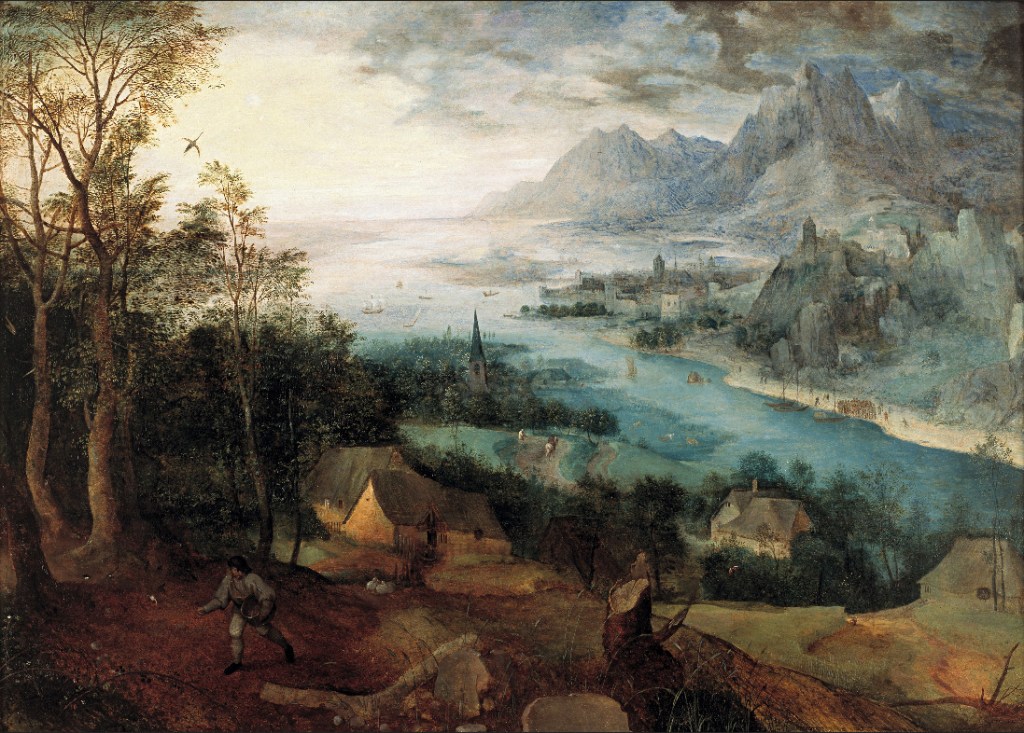
Parable of the Sower by Pieter Brueghel the Elder

The Archbishop of Canterbury was making arrangements to visit the United States. Before his plane landed, one of his advisors recommended that the Archbishop be cautious with the scandal-mongering press. “Be discreet: be very discreet, but with a smile.” 

On arrival, he was hijacked by a bevy of pressmen clamoring for a story. 

One reporter asked, “What do you think of the nightclubs in New York?” Remembering to be discreet, with a smile, the Archbishop ironically responded, “Are there any nightclubs in New York?”  

Headlines next day: Archbishop’s first question on landing, “Are there any nightclubs in New York?”

Near the beginning of our Gospel reading, we read that Jesus “told them many things in parables.” Next Sunday and the following, our Gospel reading will begin, “Jesus put before the crowd another parable.” Three Sundays of parables. Why parables? Jesus answered that question, but we skipped over it.

If you look at your bulletin, you’ll notice that our Gospel for today was Matthew 13:1-9, 18-23. In verses 10-17, Jesus answered the question.

The disciples asked him, “Why do you speak to the people in parables?”

He replied, “Because the knowledge of the secrets of the kingdom of heaven has been given to you, but not to them. Whoever has will be given more, and they will have an abundance. Whoever does not have, even what they have will be taken from them. This is why I speak to them in parables:

“Though seeing, they do not see;
    though hearing, they do not hear or understand.”

Jesus goes on speaking in this same vein, referencing back to the Prophet Isaiah. His answer is almost as confusing as the parables. Jesus is saying that He speaks in parables because some will be receptive to His message, who will understand it, and who will live. At the same time, there will be many others who believe they already know what God is doing and have no need for this message that Jesus is bringing. The parable is a message of mercy and redemption to those who will hear and believe, but it is also a message of judgment on those who refuse Him.

When it comes to the parable we hear today—known as the Parable of the Sower—we benefit from Jesus’ private explanation to his disciples, but all the others who heard it that day did not. What would you have thought had you been one of the others?

You watch as Jesus walks through the crowd and gets into the boat, then after pushing out a way, he sits and faces you and the others. Then, without laying any groundwork, he speaks: “A farmer went out to sow his seed. As he was scattering the seed, some fell along the path, and the birds came and ate it up. Some fell on rocky places, where it did not have much soil. It sprang up quickly, because the soil was shallow. But when the sun came up, the plants were scorched, and they withered because they had no root. Other seed fell among thorns, which grew up and choked the plants. Still other seed fell on good soil, where it produced a crop—a hundred, sixty or thirty times what was sown. Whoever has ears, let them hear.”

After He has given this short message, He rows back in and walks off with his disciples. All you have are those few words. Your mission, should you choose to accept it—without the explanation Jesus provided privately to His disciples—is to interpret what He has said. 

In putting myself in that position, my first thought was to try and understand why Jesus told that parable at that particular time. What prompted it?

From earlier in Matthew’s Gospel, we know that Jesus has already called his disciples and even sent them out to proclaim the message of the Kingdom of God, for “The harvest is plentiful, but the workers are few.” Also, John the Baptist was arrested and sent some followers to ask if Jesus was the Messiah. Shortly before our reading, Jesus demonstrated that he was the Lord of the Sabbath by healing the man, but the religious leaders call him Beelzebub—the devil. Jesus has been rejected by some of the people and has condemned those towns where there was such unbelief. Finally, last week, we heard him say, “No one knows the Son except the Father, and no one knows the Father except the Son and those to whom the Son chooses to reveal him.” (Matthew 11:27) All these things and today, he tells the Parable of the Sower. It began, “That same day Jesus went out of the house and sat by the lake.  Such large crowds gathered around him that he got into a boat and sat in it, while all the people stood on the shore.”

What prompted Jesus to tell the parable? He went in the boat out on the lake and sat. The large crowd stood on the shore. Jesus watches them, and, like any large crowd, He sees the movement of the crowd. At times, the crowd almost appears as a single organism, flowing and moving. We’ve all witnessed the same thing at sporting events or concerts. The crowd shifts and sways, cheers and groans together. I can understand how Jesus may have looked at this crowd and saw their movement as that of a wheat field blowing in the wind. And, considering all that had taken place before—those who believed and followed, but also those who rejected him, who turned away when things became more difficult, who cursed Him… looking out on this wheat field of people and knowing their hearts, He began, “A sower went out to sow. And as he sowed….”

So, back to our original question, you do not have the benefit of Jesus’ private explanation of this parable. All you have are the words he has spoken from the boat. What do you think it means? What would it have meant to you?

The key to our understanding is Jesus’ first statement, “A farmer went out to sow his seed.” A farmer does not walk out on a piece of land and start scattering seeds. No. First, the farmer must clear the land of all that is there: rocks, trees, bushes, and other debris. Then he must prepare the land to receive the seed, plow the field and turn the soil. Then, when it is the right season, he will go out and scatter the seed.

Jesus, through the parable, is telling the listeners that everything has been prepared and that the ground is now ready to receive the seed. The farmer then goes out and scatters the seed. He does so by hand. He tells the crowd where the seed landed, and not all of it landed in the prepared soil, but instead, it fell in unproductive areas: the road and among the rocks and thorns. That does not mean the farmer was careless; it’s just the nature of farming.

In hearing this, it is easy to focus on the farmer and the viability of the soil, but what Jesus is focusing on is the fate of the seed. The farmer has done all he can for the success of the seed. So, did the seed produce good fruit or not? 

“Are there any nightclubs in New York?” Regarding the parables Jesus told, the exact meaning is not always clear. They were intended that way (today’s parable being the exception when Jesus tells the disciples what it means.) So, the parables require a bit of work on our part. We must wrestle with them. They are also timeless because they force us to ask the same questions as those standing by the lake who initially heard this one had to ask themselves. Finally, what makes the parables absolutely brilliant is their ability to speak to everyone and to the individual, each person having to discern for themselves how they fit into this story of God.

Today, we can look at this parable corporately. What does it say about us as a church, the Body of Christ? Have we withered? Have we been snatched away? Have we been choked off by other concerns other than the Gospel? Or are we producing good fruit? These are questions that we should ask ourselves regularly, but they also apply to us as individuals. Is the seed of God’s Word producing good fruit in me? When Jesus looks out over that field of wheat that he has planted, how does He see me? 

The parable does not provide tidy little answers that can be framed and placed on the mantle. Instead, they provide us with questions about who we are in the workings of God. Today’s: God has sown the Word of His Kingdom within you—individually and collectively—how is that seed doing? How do you answer that question?

Within the Church, there are blessings for just about anything, including one for farmers for when the seeds they have sown are beginning to sprout. It seemed appropriate as a prayer. Let us pray: To Thee, O Lord, we cry and pray: bless this sprouting seed, strengthen it in the gentle movement of soft winds, refresh it with the dew of heaven, and let it grow to full maturity for the good of body and soul. Amen.