Sermon: Palm Sunday – “His Most Blessed Mother”


Today, in The Dolorous Passion by Anne Catherine Emmerich, we turn our attention to Jesus’ most Blessed Mother. From Chapter 45:

“What words can, alas, express the deep grief of the Blessed Virgin? Her eyes closed, a death-like tint overspread her countenance; unable to stand, she fell to the ground, but was soon lifted up, and supported by John, Magdalen, and the others. She looked once more upon her beloved Son—that Son whom she had conceived by the Holy Ghost, the flesh of her flesh, the bone of her bone, the heart of her heart—hanging on a cross between two thieves; crucified, dishonoured, condemned by those whom he came on earth to save; and well might she at this moment be termed ‘the queen of martyrs.’”

I wondered about all we have been discussing during this Season of Lent, and then I thought of Jesus’ most blessed Mother. It was thirty-three years ago that she gave birth to him, and she knew Him well. He didn’t have to speak for her to understand how He was feeling. She may have been present when he rode into town on the donkey, the crowds joyful and excited, waving palm branches and shouting, “Blessed is he who comes in the Name of the Lord.” However, one look at Jesus’ face, and she knew something was wrong—terribly wrong. 

Over the course of the next few days, she came to understand the inner torment He was experiencing, but there was nothing she could do. A day later, news arrived through one of Jesus’ terrified disciples that He had been arrested. There was the trial, the long road to Golgotha, the crucifixion, and now… now she sits at the foot of the cross, watching her Son die—the Son who was conceived in her by the Holy Spirit.

She was oblivious to the crowds around her, unconcerned about the danger she was placing herself in. Nothing distracted her from her Son on the cross. Not one thing could make her take her eyes off of God because she knew that if she was going to get through this, it would be only through Him, for He had come to save her as well.

We can learn many things from this most blessed of all women. We can learn love, patience, perseverance. We can learn what it means to hunger for God and to comfort one another. Therefore, I encourage you this Holy Week to take Mary as your companion. Ask her to reveal to you the things she witnessed and to help you experience the true Passion of our Lord. Ask her to guide you beyond your own fears and away from the crowds and the noise. Ask her to allow you to join her at the foot of the Cross, and then ask her to show you perfect love—perfect love that was crucified for her and for you.

Let us pray: O Holy Mary, my most gentle Lady, faithful Advocate of all Christians, in view of the extraordinary merits that were yours and which made you most pleasing to God, and in view of your every comforting gesture you made to your Son, as well as the countless tears you shed during his most bitter Passion, I ask you to have pity on me, poor creature that I am. Take me under your maternal care and include me among the number of your servants, whom you hold dear and embrace with your special love.

O glorious Virgin Mary, my only hope, before my soul should leave this body of mine, come and reveal your face to me. Direct your gentle and beautiful eyes of mercy toward me, the very eyes that had joyfully and so often looked upon the fruit of your womb, Jesus, and were wetted because the many tears shed during his Passion. Most holy Mother of Jesus, come and stand at my side together with your group of attending virgins and the holy assemblage of saints, as you had steadfastly and perseveringly stood unto the end, when your most beloved Son was about to die on the Cross. After my Lord Jesus Christ, your only Son, I find none so generous and eager to console someone in need as you, most amiable Mother of the Afflicted. Amen. (On the Passion of Christ: According to the Four Evangelists, p.117)

Sermon: Palm Sunday – “Romance”

Photo by Tim Mossholder on Unsplash

Most of you are aware that not only do I enjoy reading a good story, but I also like trying to write them. Like with any endeavor, it can be helpful to read how others work, and fortunately, some of my favorite authors have written books on writing. Neil Gaiman, author of Caroline, Good Omens, and other books, in the introduction to his book, Fragile Things: Short Fictions and Wonders, Gaiman talks about stories. He writes,

“Stories, like people and butterflies and songbirds’ eggs and human hearts and dreams, are also fragile things, made up of nothing stronger or more lasting than twenty-six letters and a handful of punctuation marks. Or they are words on the air, composed of sounds and ideas—abstract, invisible, gone once they’ve been spoken—and what could be more frail than that? But some stories, small, simple ones about setting out on adventures or people doing wonders, tales of miracles and monsters, have outlasted all the people who told them, and some of them have outlasted the lands in which they were created.” 

Stories, whether fictitious or factual, hold our attention and mold our perception of the world. Whether a believer or not, the story we hear on this day has long outlasted the people who told it and has been changing peoples’ views for over 2,000 years. No other story has affected the world more. My question for you today is this: What kind of story is it?

Most of us can agree that it is non-fiction, but even in that category, we can classify it as a particular genre. Some might say it is history, while others might categorize it as a thriller or even a horror story. There are good arguments for all these, but the one category that probably would not come to mind when reading the Passion Narrative is romance.

In their definition of a romance novel, the RWA, Romance Writers of America, says, “Two basic elements comprise every romance novel: a central love story and an emotionally satisfying and optimistic ending.” (Source) In the reading of the Passion Narrative, do you hear anything of a love story? Is there an optimistic ending? 

“For God so loved the world that he gave his one and only Son, that whoever believes in him shall not perish but have eternal life.” (John 3:16) 

What we read on this day is the greatest romance, the greatest love story ever written—ever lived out. What we read today is Jesus looking down at you from the Cross and saying, “I love you. I love you and am enduring this so that you may be with me in My Father’s house for all eternity.” The Passion of Our Lord is many things, but at the heart, it is pure romance.

Today, I invite you to experience this romance, this love of God. To not only hear the story but to write yourself into it and become a child of God—the beloved of God. 

Sermon: Palm Sunday – “O Jerusalem, Jerusalem”

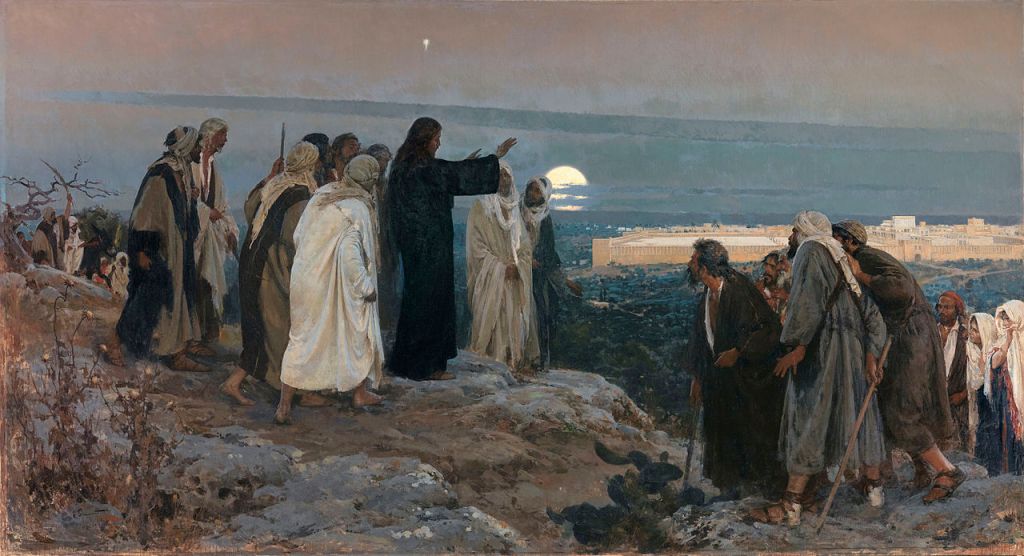
Flevit super illam/He Wept Over It by Enrique Simonet

Five days pass between Jesus’ triumphal entry, which we read about before receiving the palms, and the beginning of the Passion narrative. In those five days, many things happened, including the telling of many great parables, Jesus cursing the fig tree, the institution of the Lord’s Supper, and the washing of the disciples’ feet. Jesus also has several run-ins with the various religious leaders and, at one point, speaks many condemnations to them, saying, “Woe to you scribes and Pharisees, hypocrites.”

Jesus condemns them because of their arrogance in thinking they were better than others, for binding up the people with so many rules and regulations that those who desired to serve God were overwhelmed and disheartened in their faith, for putting faith in things over caring for people, for forgetting to show justice and mercy and to be faithful, for condemning others when they themselves are in error, for hypocrisy and lawlessness, and willful ignorance of their own faults. He then concludes with a lament over Jerusalem,

The lament begins, “O Jerusalem, Jerusalem,”—another way of speaking of the religious leaders and those who have failed to believe—“O Jerusalem, Jerusalem, the city that kills the prophets and stones those who are sent to it! How often would I have gathered your children together as a hen gathers her brood under her wings, and you were not willing! See, your house is left to you desolate. For I tell you, you will not see me again, until you say, ‘Blessed is he who comes in the name of the Lord.’” (Matthew 23:37-39)

With those final words, Jesus repeats to this same group the words proclaimed during the triumphal entry, “Blessed is he who comes in the name of the Lord.” In doing so, He is saying to the religious leaders, “You have not yet believed, but there will come a day when you have no choice but to believe.” As St. Paul said to the Philippians, “God has highly exalted him and bestowed on him the name that is above every name, so that at the name of Jesus every knee should bow, in heaven and on earth and under the earth, and every tongue confess that Jesus Christ is Lord, to the glory of God the Father.” (Philippians 29-11) 

“Woe to you, Jerusalem, Jerusalem, you will bend your knee and confess Jesus Christ as Lord, and you will do so either out of love and obedience or out of fear, trembling, and judgment… but you will confess.”

The error we can make today is wrongly believing that these words do not apply to us. That was then; this is now. Woe to those religious leaders and others who do not believe. We are safe, for we are God’s people, but that is the exact same thing those religious leaders thought. Therefore, we must be on our guard so that we do not become Jerusalem, Jerusalem, and it is an easy trap to fall into. We will do so by making the same mistakes as they made in the past—by putting up barriers to God, by caring for things, by not showing justice, mercy, and faithfulness, by condemning the world around us while thinking we are the holy ones, and by being willfully ignorant and turning a blind eye to our own faults. 

Declare, not only with your lips but also with your heart and soul—your entire being—declare, “Blessed is he—Blessed is Jesus who comes in the Name of the Lord,” and leave behind that old Jerusalem so that you may become citizens of the New Jerusalem. A city, as St. John tells us in his Revelation—that has been adorned as a bride for her husband, the dwelling place of God, where there are no more tears, no more mourning, crying, pain… no more death. (cf. Revelation 21:1-4) Become citizens of that New Jerusalem where all things have been made new and restored to God.

Sermon: Palm Sunday RCL C – “Darkness”

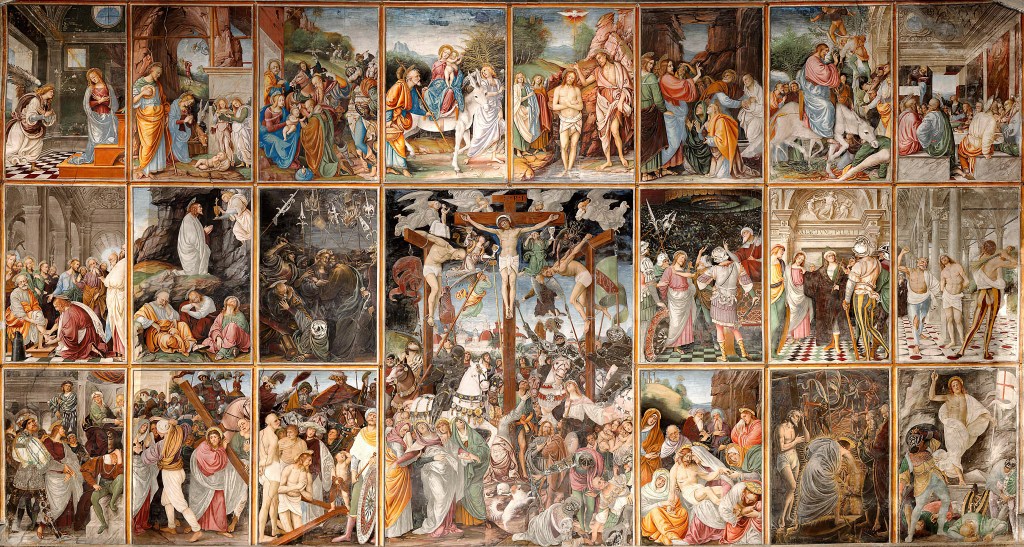
Gaudenzio Ferrari (1475–1546), Stories of The Life and Passion of Christ (1513),
Church of Santa Maria delle Grazie, Varallo Sesia (VC), Italy.

The Gospels are not time-stamped so it is somewhat difficult to calculate the length of Jesus’ public ministry, but given the clues and festivals mentioned, it is estimated to have been three to three and a half years.  With that understanding, we can say that the forty days Jesus spent in the wilderness and the temptation he experienced there took place about three years prior to the events we are reading today.

At the end of those forty days we are told, “When the devil had ended every temptation, he departed from him until an opportune time.”  Following this, Scripture tells us, “Jesus returned in the power of the Spirit to Galilee, and a report about him went out through all the surrounding country. And he taught in their synagogues, being glorified by all.”  The public ministry begins.

Throughout that ministry, we know that there were many encounters with religious leaders, demons that he exorcised, teachings, feedings, miracles, and more.  For three years Jesus poured out his life for the sake of the mission, fighting every battle that came along, so when he arrived in the Garden of Gethsemane on the night before he was crucified—knowing full well what was about to happen—not only was he exhausted, he was also highly stressed.  He sweated drops of blood.  Hematidrosis.  An exceptionally rare medical condition brought on by stress and anxiety that causes a person to sweat blood.  Because of its rarity, the doctors aren’t entirely certain as to what brings it on, but it is postulated that it is related to the fight and/or flight response: “Father, if you are willing, remove this cup from me; yet, not my will but yours be done.”  And then they came to arrest him, Jesus said, “Have you come out with swords and clubs as if I were a bandit? When I was with you day after day in the temple, you did not lay hands on me. But this is your hour, and the power of darkness!”

“But this is your hour, and the power of darkness!”  The word ‘power’ (exousia) in that sentence can be translated in several different ways: power, right, liberty, strength, jurisdiction, authority.

Following the forty days, the devil left Jesus “until an opportune time”.  That opportune time arrived on the night of Jesus’ arrest when he was experiencing the greatest anxiety.  That hour and the hours to come were handed over to the power of darkness… to the jurisdiction / authority of darkness.  This handing over to the darkness was not because Jesus had been defeated, instead, it occurred so that Jesus might be glorified.  The darkness believed it had finally conquered God, but in being given authority for a short while, it was defeated.

What you and I experience of the darkness of this life is nothing more than the death throes of death itself.

“In the beginning was the Word, and the Word was with God, and the Word was God.  He was in the beginning with God.  All things were made through him, and without him was not any thing made that was made.  In him was life, and the life was the light of men.  The light shines in the darkness, and the darkness has not overcome it.”

As we walk with Jesus during this Holy Week, darkness may seem to have conquered, but do not be afraid, it is only the hour before sunrise.