Sermon: Proper 14 RCL C – “O My Jesus…”


A father reports that he used to have trouble getting his son to clean his room. The father would insist that he, “Do it now,” and the son would always agree to do so, but then he wouldn’t follow through—at least not right away. After high school, the son joined the Marine Corps. When he came home for leave after basic training, his father asked him what he had learned.

“Dad,” he said, “I learned what ‘now’ means.”

For me, when it comes to cleaning house, “Now” generally means the day or a few hours before I expect company; otherwise, there’s a good chance that there will be dirty dishes in the sink, dirty socks on the floor, a pile of clean laundry waiting to be folded on the dining room table, and if the cat got sick on my desk, it would be in better shape than it is now. I guess I agree with Phyllis Diller and Erma Bombeck when it comes to housework. Phyllis says, “Housework won’t kill you, but then again, why take the chance?” And Erma writes, “My theory on housework is, if the item doesn’t multiply, smell, catch fire, or block the refrigerator door, let it be. No one else cares. Why should you?” 

I’m guessing they weren’t real keen on the word “Now” when it comes to housework, either. 

The Bureau of Labor Statistics reports that, on average, we spend 2.01 hours per day on household chores, and yes, women spend more time than men—1.67 hours for men and 2.34 for women. (Source) Clearly, they’ve never been to my house. I eventually get everything nice and clean, but it doesn’t last. Give it a few days, and the dishes will start to stack up again, and the dirty socks will be on the floor. Before you know it, the whole place needs a solid napalm strike to clear it all up.

In our Gospel reading, Jesus talks about the servants in a house who remain awake and alert, and the owner of the house who guards against the thief. The servants fulfill their duties for the Master—taking care of his needs and property—and the owner protects against the thief who wishes to break in and steal. In both cases, we understand that the home Jesus is speaking about is our soul—the dwelling place for the Holy Spirit of God. As God’s children, we are to take care of our souls, keeping them pure and free of sin, and we need to guard them so that the devil cannot come in and destroy them. But for me, sometimes the inside of my soul looks a bit like my house—a little messy.

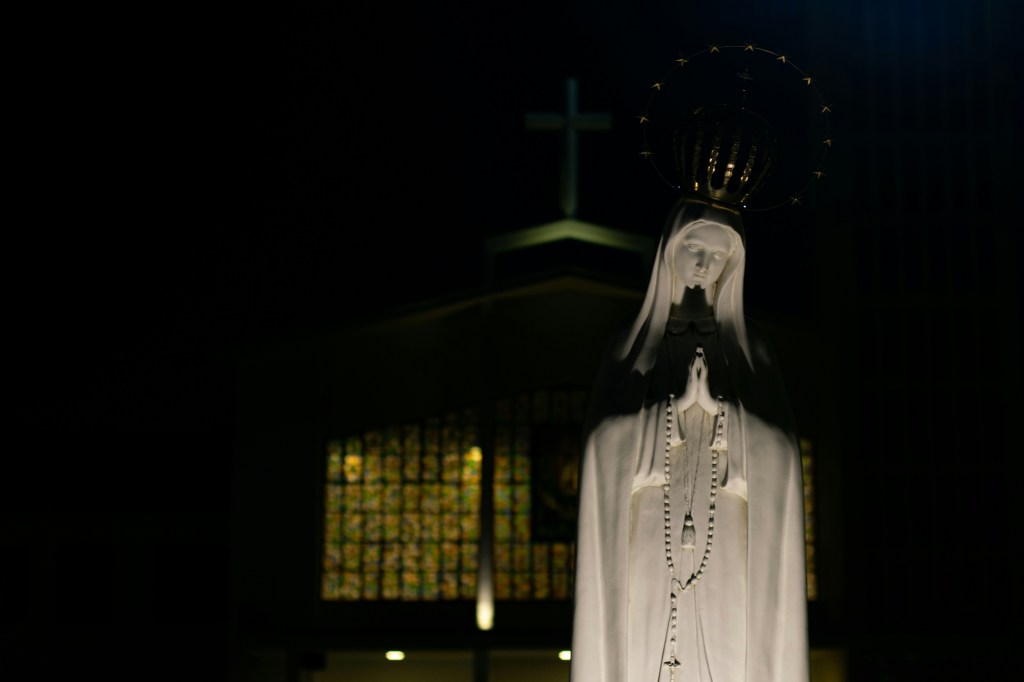
On July 13, 1917, Our Lady of Fatima appeared for the third time to the three children—Lucia dos Santos, Jacinta Marto, and Francisco Marto. During the visitation, she gave them a brief but terrifying vision of hell. Lucia wrote, “She opened Her hands once more, as She had done in the two previous months. The rays of light seemed to penetrate the earth, and we saw as it were a sea of fire. Plunged in this fire were demons and souls in human form.” She then goes on to describe what they saw.

It was so terrifying, she later wrote, “How can we ever be grateful enough to our kind Heavenly Mother, who had already prepared us by promising, in the first Apparition, to take us to Heaven. Otherwise, I think we would have died of fear and terror.” 

During this same visitation, the Virgin Mary gave the children a prayer that we now know as the Fatima Prayer or O My Jesus

“O my Jesus, forgive us our sins, save us from the fires of hell; lead all souls to heaven, especially those most in need of thy mercy.”

Mary asked that the children share with the world her desire for this prayer to be said at the end of each decade of the Rosary. It is also prayed just before starting the first decade—the Our Father and the first ten Hail Marys. 

When I pray my Rosary, it is during those opening prayers that I begin—or at least try—to gain some sort of focus, and on one particular day, it was the same. I recited the Creed, prayed the Our Father, the first three Hail Marys, and the Gloria Patri, and then began the Fatima Prayer, “O my Jesus…” I stopped. The next word, “forgive,” simply would not come out. I tried again. “O my Jesus…” I couldn’t go any further. Why?

There was a story circulating when I was in seminary. It told of a young man who had a vision of himself entering a room. Inside the room were all these small files—row after row of them. The drawers seemed to be large enough to hold a piece of paper no bigger than a note card. As he got closer, he saw that each of the file drawers had labels. These included such things as “Books I Have Read” and “Television Programs I Have Watched.” There were others—“Lies I Have Told” and “Comfort I Have Given.” There was one that read “Things Done in Anger” and one right next to it, “Things I Have Said in Anger.”

He pulled that one out just to see what was inside, and to his horror, he found that written on each card was something he had said in anger. Then he realized he was standing in the record room of his life. Every single event, from the very best to the most sinful, had been recorded and filed. 

As he examined more of the file drawer labels, he became absolutely convinced that no one—not anyone!—should be allowed to see what was written here. But, of course, there was One who would see, and that One, Jesus, was suddenly present, standing before the man. 

Without a word spoken, and instinctively, Jesus went to the drawer that held the cards depicting the most horrible of sins, pulled it out, and began to read each card. The man was horrified and heartbroken. He collapsed in shame, but as he watched, he witnessed the most remarkable thing: on each of the cards, Jesus wrote His Name, covering the sin. 

There I was, trying to pray my Rosary, “O my Jesus…,” but unable to ask for forgiveness. Why? Well, it’s a bit like my house. When my house gets messy, it’s nothing new. It’s always the same mess. Dirty dishes, dirty socks, a messy desk, etc. My soul ends up the same way. When Jesus has to come in and go through the files of my life, it’s not like He pulls out a card and says, “Wow, didn’t see that coming,” or “Hey, that’s original.” No. It’s the same thing each and every time. Entire file drawers dedicated to my life with the same thing written time and time again, and Jesus signing over it again and again… O my Jesus. I found myself—not out of disobedience, but out of shame and frustration—simply unwilling to ask Him once more to forgive me for the same damn thing I asked Him to forgive me for the day or week before. O my Jesus.

I could imagine Him standing there, pen in hand, poised and ready to sign, and there I was… O my Jesus.

In our Gospel reading, Jesus said, “Be dressed for action and have your lamps lit; be like those who are waiting for their master to return from the wedding banquet, so that they may open the door for him as soon as he comes and knocks.” Yet, I’m sitting there in the middle of a very dirty house, knowing I must do something but unable to act.

Joshua said, “Choose you this day whom you will serve.”

Quoting what the Lord said to the Prophet Isaiah, Paul wrote, “In a favorable time I listened to you, and in a day of salvation I have helped you.” Then Paul added, “Behold, now is the favorable time; behold, now is the day of salvation.” (2 Corinthians 6:2)

“Son, what did the Marines teach you?” 

“Dad, I learned what ‘now’ means.”

And I prayed, “O my Jesus, forgive us our sins, save us from the fires of hell; lead all souls to heaven, especially those most in need of thy mercy.”

I’ll share something you might find hard to accept, but it’s true: no matter how much effort you put in, your soul will get dirty. You can’t keep it clean; once it becomes dirty, you won’t be able to clean it with your own strength and power. So, when the Master comes back—when Jesus returns—He will walk into the house of your soul and He will see the mess. Your only recourse is to say to Him today—right now—“O my Jesus, forgive.” And John tells us, “If we confess our sins, he is faithful and just to forgive us our sins and to cleanse us from all unrighteousness.” (1 John 1:9) If we confess our sins, Jesus will sign His name on the card and cover our sins.

The Psalmist writes, “For you, O Lord, are good and forgiving, abounding in steadfast love to all who call upon you.” Jesus stands ready to forgive all those who call on Him. Whatever reasons or excuses you may have—pride, shame, ignorance, stubbornness, or anything else—set it aside and humbly come before your God and King.

Let us pray… would you repeat after me: O my Jesus, forgive us our sins, save us from the fires of hell; lead all souls to heaven, especially those most in need of thy mercy. Amen.


Sermon: “Now”


A few years back, The Netherlandish Proverbs, a painting by Pieter Brueghel, sold for $9M at Christie’s Auction House in London. Painted in 1559, it depicts seventy-six proverbs, many of which we still say today, or at least a version. A man with his hand over his face, peering through his fingers, is “To look through one’s fingers” or to turn a blind eye. Another, “When the gate is open, the pigs run through the wheat,” is for us; when the cat is away, the mice will play. Some are far more obscure, and one of these caught my attention. 

A woman is carrying a bucket of water in her left hand and a set of tongs with a hot coal in the other. The proverb: “She carries fire in one hand and water in the other” means to be two-faced and stir up trouble. It also means to hold two contradictory views. That is not a good thing, and it is a claim that many make about Holy Scripture. It was that issue that I was confronted with this week as I read through the last two verses of our Gospel lesson—“Do not be astonished at this; for the hour is coming when all who are in their graves will hear his voice and will come out—those who have done good, to the resurrection of life, and those who have done evil, to the resurrection of condemnation.” (John 5:28-29) What is the problem?

The last word, “condemnation,” immediately brought to mind our Gospel reading from Sunday. It begins with that most famous of verses, John 3:16, “For God so loved the world that he gave his only Son, so that everyone who believes in him may not perish but may have eternal life.” So far, so good. Jesus continued, “Indeed, God did not send the Son into the world to condemn the world, but in order that the world might be saved through him.” Even more good news, good news that St. Paul will confirm in his letter to the Romans when he writes, “There is therefore now no condemnation for those who are in Christ Jesus.” (Romans 8:1) Everything is coming up roses until you arrive at those verses from today, how some will experience the “resurrection of condemnation.” 

I thought Jesus said we were past all that condemnation bit. Is this a contradiction in Holy Scripture? Not at all. It only requires that we read the passage from John 5 more closely. It is easy to miss, but before speaking of condemnation, Jesus said, “The hour is coming.” Coming. Not yet. John 3 is speaking of Jesus’ first coming. John 5 is speaking of Jesus’ second coming. No contradiction. 

We are now living in the time when “everyone who believes in [Jesus] may not perish but have eternal life.” However, there is an end date—a time when judgment will come, and for those who do not believe, it is a judgment of condemnation; therefore, the time to choose is not then but now.

In the first verse of our reading from Isaiah, the Lord said, “In a favorable time I listened to you, and in a day of salvation I have helped you.” St. Paul quotes this verse in his second letter to the Corinthians: “In a favorable time I listened to you, and in a day of salvation I have helped you.” Then Paul adds, “Behold, now is the favorable time; behold, now is the day of salvation.”

There is no confusion or contradiction; now is the time to come to God. Now is the day. For all of you sitting here, I believe you have, but who do you know that has not? How might you guide them and share your faith with them so that on the last day, they too will be judged and receive the resurrection of life—life eternal with our God?

Sermon: Proper 26 RCL C – “Delays”

Photo by Mael BALLAND on Unsplash

Little Johnny’s mom was working in the kitchen, listening to her young son play with his new electric train in the living room that his father had purchased for his birthday. Mom heard the train stop, and Little Johnny said, “All of you sons of guns who want off, get the heck off now, ’cause this is the last stop! And all of you sons of guns who are getting on, get your behinds in the train ’cause we’re going down the tracks.”

Mom was shocked. “Johnny! We don’t use that kind of language in this house. Now I want you to go to your room and stay there for two hours. You may play with your train when you come out, but I want you to use nice language.”

Two hours later, Little Johnny came out of the bedroom and resumed playing with his train. Soon the train stopped, and mom heard Johnny say, “All passengers who are disembarking from the train, please remember to take all your belongings with you. We thank you for riding with us today and hope your trip was a pleasant one. We hope you will ride with us again soon.” Johnny continues, “For those just boarding, we ask you to stow all your hand luggage under your seat. Remember, there is no smoking on the train. We hope you will have a pleasant and relaxing journey with us today.”

As mom smiled, Johnny added, “For those who are annoyed about the two-hour delay, please see the bossy lady in the kitchen.”

I traveled back and forth to seminary by train: The Empire Builder along the high line, but more recently, my travels have all been by plane, and perhaps, because I don’t travel all that much, I don’t mind the delays. I’ll find a quiet place to read or watch the people, but the delay greatly annoys others. Folks get angry at the airlines, short-tempered with the stewardess, and cranky with traveling companions. If airlines were the only place we encountered delays, I suppose most wouldn’t care, but as we all know, delays are everywhere. Traffic. Doctors office. Rain delays at sporting events. That’s just a few. We see the delay as an infuriating inconvenience and a personal attack on our happiness. But what if we saw this time—not as wasted or an annoyance—but as a blessing? An opportunity?

Zaccheus was a wee, little man, And a wee, little man was he.
He climbed up in a sycamore tree, For the Lord he wanted to see.

“Jesus entered Jericho and was passing through it. A man was there named Zacchaeus; he was a chief tax collector and was rich.” 

At the time of Jesus, Jericho was a significant city. As the Scripture says, Zacchaeus lived there, was a tax collector and was wealthy; therefore, Zacchaeus was a busy little man in a busy little city. And into his busy little life comes Jesus. There is a moment when he thinks he would like to stop and see this Jesus, yet Zacchaeus is on his way to pay a visit to a certain wealthy merchant who owes big, and he can’t afford to waste any time along the way. So instead of stopping, Zacchaeus pushes his way through the crowded street, grumbling over the rabble in his way and angry at this itinerant preacher for the inconvenience he is causing. Finally making his way through the crowd, he finds the wealthy merchant and begins haranguing him for an extra one percent because Zacchaeus just bought a winter home down in the Sinai that needs a new roof.

Meanwhile, Jesus passes on to Jerusalem, and salvation never comes to that wee little man, and he dies wealthy in his winter home in the Sinai, but alone and hated by all. There was a moment when life could have changed so dramatically for him, but he could not be delayed. He was so worried about everything else that he missed the moment altogether. 

A moment changes everything, but unless you are willing to take that moment and to allow it to change you and the course of your life, it is nothing more than a bit of smoke on a breeze. We most likely miss those moments, not by intentionally brushing them away, but by being so trapped in the past or worried by the future that we don’t even see them in the now. 

Blaise Pascal writes, “Let each one examine his thoughts, and he will find them all occupied with the past and the future. We scarcely ever think of the present, and if we think of it, it is only to take light from it to arrange the future. The present is never our end. So we never live, but we hope to live; and, as we are always preparing to be happy, it is inevitable we should never be so.” Why do we not live in the present? Pascal answers: “The present is generally painful to us. We conceal it from our sight, because it troubles us; and if it be delightful to us, we regret to see it pass away.”

We are nearing the end of the church year, which means we will begin the Season of Advent soon. That is the season when we consider Jesus’ first coming—the past—and when we look ahead to the future, anticipating his second coming. It seems that we, as a Christian people, are falling into Pascal’s mistake, being occupied with the past and the future and completely disregarding the present. However, that is not the message of Jesus. A few chapters before our Gospel reading today, we read of an encounter Jesus had with the Pharisees: “Once Jesus was asked by the Pharisees when the kingdom of God was coming, and he answered, ‘The kingdom of God is not coming with things that can be observed; nor will they say, ‘Look, here it is!’ or ‘There it is!’ For, in fact, the kingdom of God is among you… the kingdom of God is within you.’” What does that mean? Jesus came once, and he will come again, but “the kingdom of God is among you” clearly says that the kingdom of God is now, in this very moment. Jesus ushered it in at his first coming, and he will bring it to its eternal and glorious fruition when he comes again, but it is also now. Jesus said, “I am with you always—I am with you now!—even to the end of the age.”

Yes, I do know that sometimes the present moment can be unpleasant, it can be painful, and full of trials, but I also know that God is present even then and that those times contain something good.

A university professor tells of being invited to speak at a military base in the month of December, and while there meets an unforgettable soldier named Ralph. Ralph had been sent to meet him at the airport, and after they had introduced themselves, they headed toward the baggage claim. As they walked down the concourse, Ralph kept disappearing—once to help an older woman whose suitcase had fallen open, once to lift two toddlers up to where they could see Santa Claus, and again to give directions to someone who was lost. Each time he came back with a big smile on his face. “Where did you learn to do that?” The professor asked. “Do what?” Ralph responded. “To be so helpful and considerate to others.” “Oh,” Ralph said, “during the war, I guess.” Then he told the professor about his tour of duty in Vietnam, how it was his job to clear minefields, and how he watched his friends blow up before his eyes, one after another. “I learned to live between steps,” he said. “I never knew whether the next one would be my last, so I learned to get everything I could out of the moment between when I picked up my foot and when I put it down again. Every step I took was a whole new world, and I guess I’ve just been that way ever since.”

Don’t fret over the delays. The Kingdom of God is now. Jesus is coming your way; he may even be sitting in the pew across from you or be your waiter at lunch. It is possible that you will see him in the face of an enemy or a stranger. In all of these instances, it is as though Jesus were saying to Zacchaeus, “Hurry and come down, for I must stay at your house today.” Live between the steps, recognize the gifts and blessings of God that are right here, and be happy to welcome Jesus into your life in all the many forms that he makes his presence known in every moment.

Let us pray:
Most Loving Father, we spend so much time reliving yesterday
or anticipating tomorrow
that we lose sight of the only time that is really ours,
the present moment.
You give today one moment at a time.
That is all we have,
all we ever will have.
Give us the faith which knows that each moment
contains exactly what is best for us.
Give us the hope which trusts You enough
to forget past failings and future trials.
Give us the love which makes each moment
an anticipation of eternity with You.
We ask this in the name of Jesus
Who is the same yesterday, today and forever.
Amen.


Join in the sermon discussion on St. Matthew’s Facebook page.

Click the image below to be directed to it.