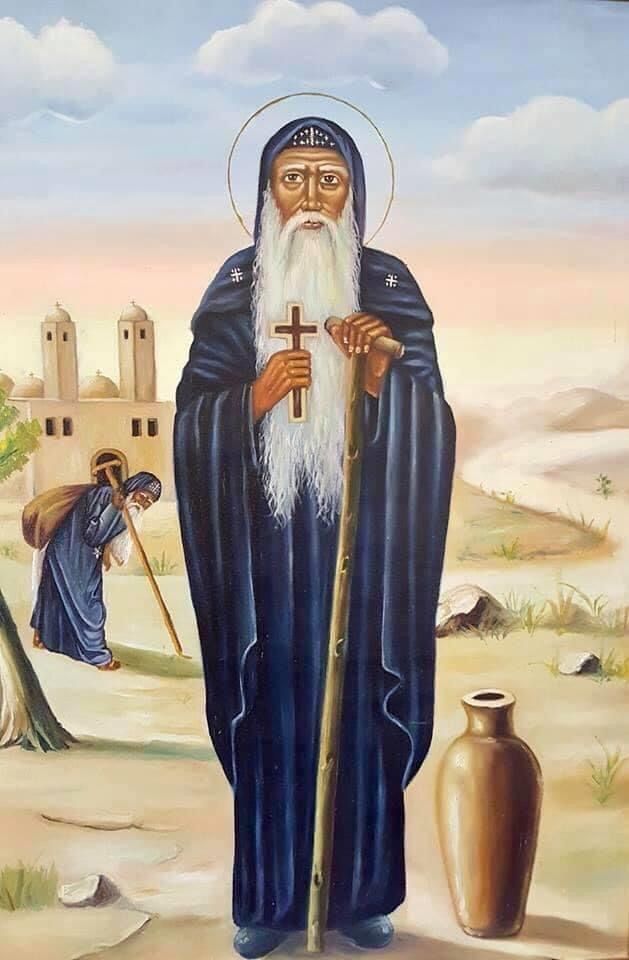
Sermon: Moses the Black

Moses the Black, an Ethiopian living in Egypt during the 4th century, was born a slave and later became a bandit. After years as a feared criminal, he repented and approached the doors of a desert monastery, weeping for his sins. Because of his past, the monks did not allow him entry, even afraid at the mention of his name. However, after some time, they received and accepted him.

Although a member of the monastery, his passions continued to wage a spiritual battle, so he sought the help of the elder Abba Isidore. Moses followed Isidore’s instructions, from eating just enough to sustain himself while remaining hungry at all times, to standing all night in prayer. At night, Moses was led by the ladder to take on the task of fetching water from the well for the other brothers, especially those who were older and lived farthest from the well.

One night, while drawing water, Moses felt a sharp blow to his back and was knocked into the well, where he lay until he was found the next morning when the other brothers discovered him. A year passed before he was fully recovered, and it was then that Isidore declared him to be clean of his demons and ordered him to be ordained a deacon. On the day of his ordination, the bishop clothed Moses in white robes and declared, “Now Abba Moses is entirely white!” Moses replied, “Only outwardly, for God knows that I am still dark within.”

Continuing to protest his worthiness to serve at the altar, the Bishop set out to test him and ordered the other clergy to drive Moses from the altar and the church. Moses accepted this without protest. Witnessing this and being convinced of Moses’ humility, the Bishop ordained him a priest, a role he faithfully served for fifteen years until his martyrdom in 400 AD. 

Moses learned that the monastery would soon be attacked by bandits and encouraged the others to flee. All did, except for seven who remained with Moses. When he was urged to leave, he responded, “For many years already I have awaited the time when the words which my Master, the Lord Jesus Christ, should be fulfilled: “All who take up the sword, shall perish by the sword” (Mt. 26:52). (Source)

The good thief hanging on the cross to the right of Jesus rebuked the other thief, saying, “Do you not fear God, since you are under the same sentence of condemnation? And we indeed have been condemned justly, for we are getting what we deserve for our deeds, but this man has done nothing wrong.” 

I don’t know why Moses chose to remain, knowing that staying would almost certainly be a death sentence. Perhaps he thought he could buy the others more time to escape if he put up a fight. Whatever the case, I wonder if he heard the words of the good thief as he waited, “We indeed have been condemned justly.” I also wonder if he heard the words of St. Paul, “Wretched man that I am! Who will deliver me from this body of death? Thanks be to God through Jesus Christ our Lord!” (Romans 7:24-25a)

We are all rightly condemned for our actions. Thanks be to God through Jesus Christ, our Lord! Through Him, we are saved. He remembers us and, on our last day, brings us into the eternal paradise of His kingdom. 
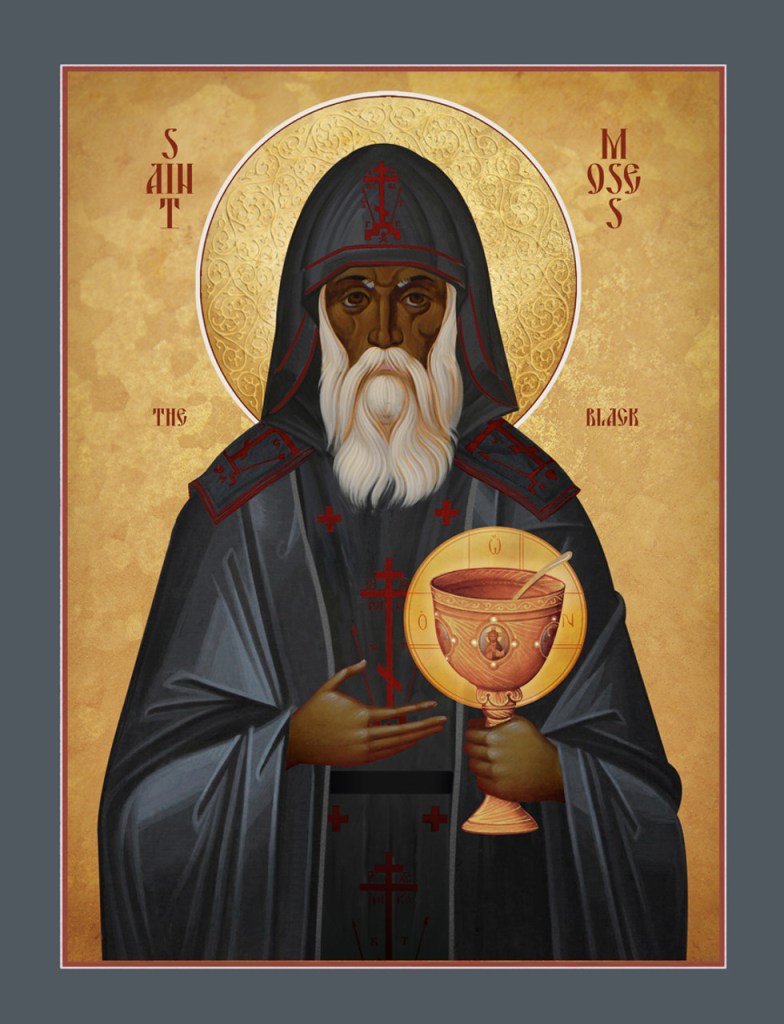
Sermon: Moses the Black


I wouldn’t even consider doing it today, but back in his prime, if someone told me that I was going to have to step into the boxing ring with Mike Tyson, I would have submitted my obituary to the newspaper and made all the necessary prearrangements with the funeral home.  I would not have survived unless I could have somehow outrun him.  I remember going to some friend’s house who had done a pay-for-view of one of Tyson’s fights.  I don’t know how many seconds it lasted, but it was over before I got in from the kitchen.  He was a beast when it came to boxing and apparently not such a great person out of the ring, having spent three years in jail for rape—a seemingly massive brutal, angry man.

John Saraceno interviewed Tyson for the USAToday Newspaper in 2005.  Saraceno writes, “Almost 39, he is anything but at peace. Confused and humiliated after a decadent lifestyle left him with broken relationships, shattered finances, and a reputation in ruin, the fighter cannot hide his insecurities, stacked as high as his legendary knockouts….

“’I’ll never be happy,’ he says. ‘I believe I’ll die alone. I would want it that way. I’ve been a loner all my life with my secrets and my pain. I’m really lost, but I’m trying to find myself. I’m really a sad, pathetic case.’” (Source)

If you understand that ruthless but dejected temperament, you could also very easily be describing Moses the Black or Moses the Ethiopian, one of the Desert Fathers who lived during the 4th century in the deserts of northern Egypt.

Moses began his life as a slave, then became a murderer, an outlaw, and the leader of a vicious gang of some seventy other outlaws; however, after many years, he began to have a change of heart.  

It is reported that he would look up at the sun and say, “O Sun!! if you are God, let me know it.” Then he would say, “And you, O God whom I do not know, let me know you.” On one occasion, he had a response.  A voice said to him, “The monks of Wadi El-Natroun [of northern Egypt] know the real God. Go to them, and they will tell you.”   

He went, but because the monks knew of him and his reputation, they were at first terrified but soon allowed him access to the teachings of the church.  He became one of them, along with several of his former gang, but his battle with his demons continued and was equal to the battles he had fought in real life.  In the end, he had seventy-five followers who, like him, bravely battled against the devil.

One day, it was reported to him that some of the same outlaws that he had run with were coming and that he would surely be killed.  His followers urged him to flee with them, but he responded, “For many years now, I have awaited the time when the words which my Master, the Lord Jesus Christ, should be fulfilled: ‘All who take up the sword, shall perish by the sword.’” (Matthew 26:52)  He died that day, a brutal sinner, redeemed by a loving God.

The good thief that had been crucified along with Jesus said to the other, “Do you not fear God, since you are under the same sentence of condemnation? And we indeed have been condemned justly, for we are getting what we deserve for our deeds, but this man has done nothing wrong.”  Moses the Ethiopian would have agreed fully with this statement; even so, he found true hope in what was said next between Jesus and that good thief.  “Jesus, remember me when you come into your kingdom.” Jesus replied, “Truly I tell you, today you will be with me in Paradise.”

The Kingdom of God was open to Moses the Black and remains so to all, even the hardest and most brutal, who will bend the knee to the King of Kings and seek to follow Him.