
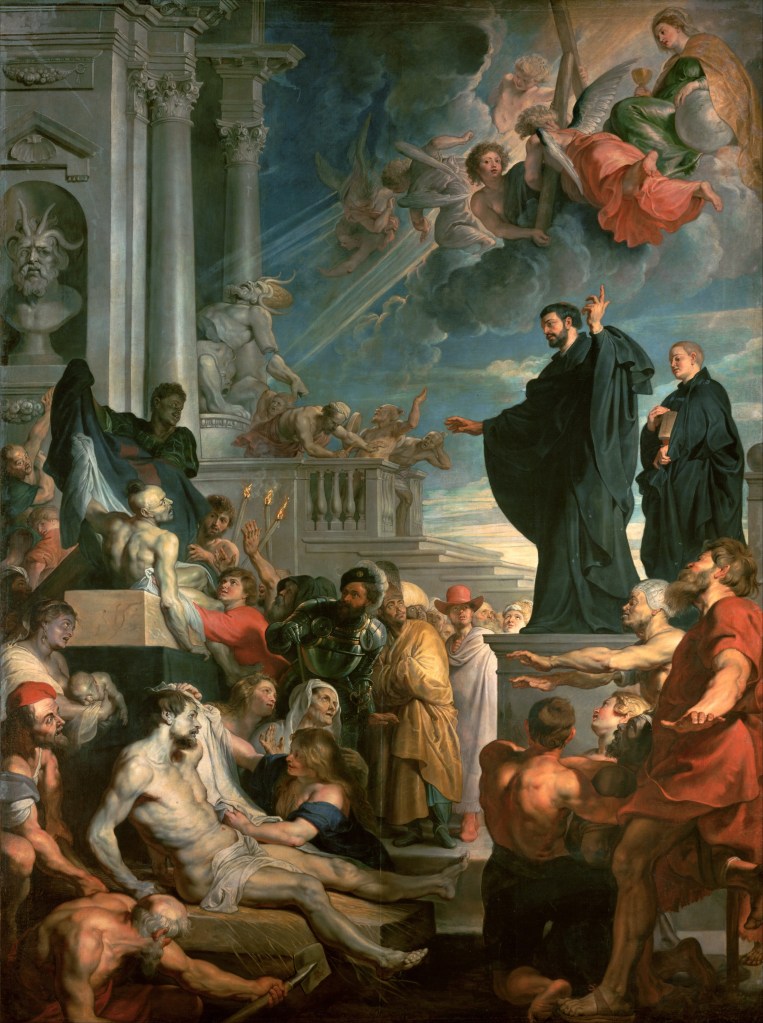
Francis Xavier was born in Navarre, Spain, in 1507. He later moved to Paris, where he studied for the priesthood and there he met St. Ignatius of Loyola. Together, along with four others, they formed the Society of Jesus—The Jesuits—and became renowned missionaries.
Francis would live out this missionary zeal. In 1537, he moved to Lisbon, Portugal, and then traveled on to India. In one of his early letters to Ignatius from India, Francis shared the following:
“We have visited the villages of the new converts who accepted the Christian religion a few years ago. No Portuguese live here—the country is so utterly barren and poor. The native Christians have no priests. They know only that they are Christians. There is nobody to say Mass for them; nobody to teach them the Creed, the Our Father, the Hail Mary and the Commandments of God’s Law.
“I have not stopped since the day I arrived. I conscientiously made the rounds of the villages. I bathed in the sacred waters all the children who had not yet been baptized. This means that I have purified a very large number of children so young that, as the saying goes, they could not tell their right hand from their left. The older children would not let me say my Office or eat or sleep until I taught them one prayer or another. Then I began to understand: “The kingdom of heaven belongs to such as these.”
“I could not refuse so devout a request without failing in devotion myself. I taught them, first the confession of faith in the Father, the Son and the Holy Spirit, then the Apostles’ Creed, the Our Father and Hail Mary. I noticed among them persons of great intelligence. If only someone could educate them in the Christian way of life, I have no doubt that they would make excellent Christians.
“Many, many people hereabouts are not becoming Christians for one reason only: there is nobody to make them Christians. Again and again I have thought of going round the universities of Europe, especially Paris, and everywhere crying out like a madman, riveting the attention of those with more learning than charity: “What a tragedy: how many souls are being shut out of heaven and falling into hell, thanks to you!”
“I wish they would work as hard at this as they do at their books, and so settle their account with God for their learning and the talents entrusted to them.
“This thought would certainly stir most of them to meditate on spiritual realities, to listen actively to what God is saying to them. They would forget their own desires, their human affairs, and give themselves over entirely to God’s will and his choice. They would cry out with all their heart: Lord, I am here! What do you want me to do? Send me anywhere you like—even to India.”
He saw all those priests hanging around Paris just twiddling their thumbs, and thought, if they could see what I see, if they had any passion for souls, “They would cry out with all their heart: Lord, I am here! What do you want me to do? Send me anywhere you like—even to India.”
Even the Apostle Paul teaches us that not all are called to be preachers and teachers, so not all are called to be missionaries; however, each and every Christian can pray the first part of that statement: “Lord, I am here! What do you want me to do?”
It’s a little scary to do this because you never know what God will say or ask, but whatever it is, it is His desire for your life. Pray the prayer—“Lord, I am here! What do you want me to do?”—then, when you hear Him calling, respond like the Prophet Samuel did when the Lord called to him: “Speak, Lord, for your servant is listening.” (1 Samuel 3:9)

 Candle in a Cave