Sermon: Michael and All Angels

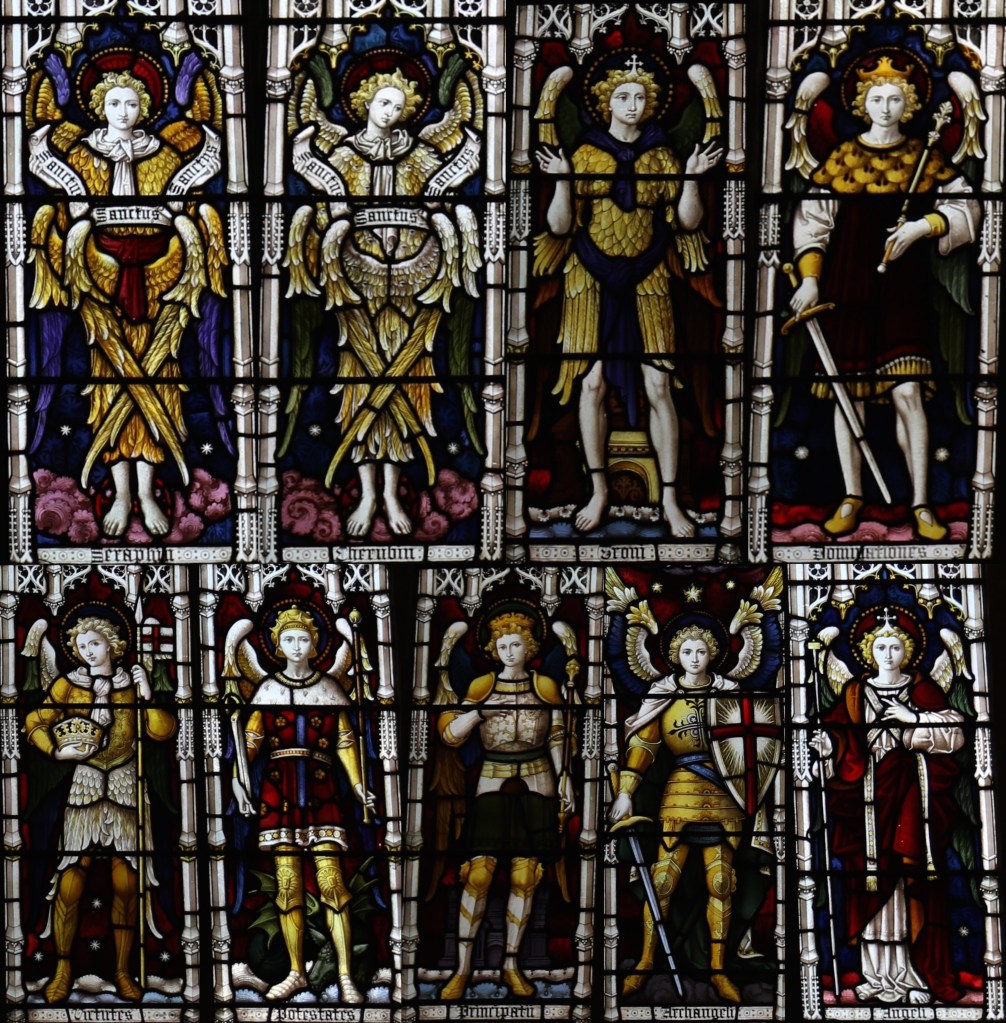
Nine angelic figures depicted on the west window of the Church of St Michael and All Angels in Somerton, which represent the nine ranks of angels. From left to right, first row: Seraphim, Cherubim, Thrones, and Dominions; second row: Virtues, Powers, Principalities, Archangels, and Angels. (License)

The Shepherd of Hermas is a second-century text, sometimes attributed to the brother of Pius, the Bishop of Rome. It is primarily an allegory and contains several visions. For many, it should have been included in the New Testament and was for a time, but eventually fell out of favor. The author’s understanding of Jesus and who He was is quite different from the teachings of the Council of Nicea. Even so, it almost made the cut.

Included in the fifth vision is an explanation of the role of angels. If you’ve ever seen the cartoon of an individual with an angel on one shoulder and a devil on the other, then you get the gist of it. Still, as it is the Feast of St. Michael and All Angels, I wanted to share the text with you. The shepherd begins:

“There are two angels with a man—one of righteousness, and the other of iniquity.” 

And I said to him, “How, sir, am I to know the powers of these, for both angels dwell with me?” 

“Hear,” said he, and “understand them. The angel of righteousness is gentle and modest, meek and peaceful. When, therefore, he ascends into your heart, forthwith he talks to you of righteousness, purity, chastity, contentment, and of every righteous deed and glorious virtue. When all these ascend into your heart, know that the angel of righteousness is with you. 

“These are the deeds of the angel of righteousness. Trust him, then, and his works. Look now at the works of the angel of iniquity. First, he is wrathful, and bitter, and foolish, and his works are evil, and ruin the servants of God. When, then, he ascends into your heart, know him by his works.” 

And I said to him, “How, sir, shall I perceive him, I do not know.” 

“Hear and understand,” said he. “When anger comes upon you, or harshness, know that he is in you; and you will know this to be the case also, when you are attacked by a longing after many transactions, and the richest delicacies, and drunken revels, and divers luxuries, and things improper, and by a hankering after women, and by overreaching, and pride, and blustering, and by whatever is like to these. When these ascend into your heart, know that the angel of iniquity is in you. 

“Now that you know his works, depart from him, and in no respect trust him because his deeds are evil and unprofitable to the servants of God. 

“These, then, are the actions of both angels. Understand them, and trust the angel of righteousness; but depart from the angel of iniquity, because his instruction is bad in every deed. For though a man be most faithful, and the thought of this angel ascend into his heart, that man or woman must sin. 

“On the other hand, be a man or woman ever so bad, yet, if the works of the angel of righteousness ascend into his or her heart, he or she must do something good. You see, therefore, that it is good to follow the angel of righteousness but to bid farewell to the angel of iniquity.”

That may not be exactly our understanding of angels and devils, but perhaps it is a glimpse. The word “angel” is from the Greek angelos (ἄγγελος), which translates messenger. Jacob saw the angels of God ascending and descending the ladder, and Jesus told Nathanael that he would see the angels of God ascending and descending upon the Son of Man. I believe the angels they saw were fulfilling their duties, bringing messages to God’s people. I believe that work continues to this day, so the next time you think about a word or deed, ask yourself, “Is that one of God’s messengers come to bring me a word, or does it come from the other fella?”
Sermon: St. Michael and All Angels


Tomorrow is the Feast of St. Michael and All Angels, and Sunday, October 2nd, is the traditional date for celebrating the Feast of the Guardian Angels. We’ll combine those two days today.

My friend, St. Josemaría Escrivá, had a special devotion to his guardian angel. He would say, “For years I’ve experienced the constant and immediate assistance of my guardian angel, even in the smallest material particulars.” For example, it was his habit to wake at 6 a.m. every morning, so when his alarm clock broke, he turned to his guardian angel and asked for assistance. That angel never failed him, waking him at the correct time every day. Escrivá would refer to him as, “My dear watchmaker.”

At another time, he and friends were playing bocce ball. When it was his turn, Escrivá threw particularly well but immediately declared, “That doesn’t count—I was helped by my guardian angel. I won’t do that anymore.” Later he would confess how ashamed he was for asking his guardian angel to help with such a trivial matter.

And one more: while in seminary, a professor told them how priests, in addition to their guardian angels, have a ministerial archangel that watches over them. This he took to heart. His friend and biographer, Alvaro del Portillo, writes that whenever “[Escrivá] was leaving the room, he would pause, almost imperceptibly, before going through the doorway” to allow his two angels to go before him. Alvaro said, “This was a tiny detail, unnoticed by the others, which showed how he lived in relationship with his guardian angel and ministerial archangel.”

Referring to angels, the Catholic catechism states, “The existence of the spiritual, non-corporeal beings that Sacred Scripture usually calls ‘angels’ is a truth of faith.  The witness of Scripture is as clear as the unanimity of Tradition.” It further states, “From infancy to death human life is surrounded by their (the angels) watchful care and intercession. Beside each believer stands an angel as protector and shepherd leading him to life. Already here on earth the Christian life shares by faith in the blessed company of angels and men united to God,” and St. Thomas Aquinas writes, “The angels work together for the benefit of us all.”

Not only do they watch over and guard, but they are also God’s messengers. The word angel is derived from the Greek word angelos, meaning messenger. Perhaps the most important message being delivered by Gabriel to Mary announcing the Incarnation. Throughout scripture, we hear of their work: the angel that freed Peter from prison, the grand visions of them by Isaiah and John in his Revelation, and how they ministered to Jesus following the forty days in the wilderness.

Like Escrivá, you don’t have to go far to find or hear stories about angels. There are many, many books of accounts and encounters (some of which claim that angels are, in fact, space aliens, but we won’t go down that road.)

We do not worship them. Upon seeing one, John tells us, “I fell down to worship at the feet of the angel…but [the angel] said to me, ‘You must not do that! I am a fellow servant with you and your brothers the prophets, and with those who keep the words of this book. Worship God.’” We do not worship them, but we do honor and celebrate these ‘fellow servants’ of the Lord. We celebrate their unswerving obedience to God and the many kindnesses they show: watching over and protecting us, bringing us God’s messages, and saving our behinds when we do something especially stupid.

Remember that these guardians and messengers are with you, and give them pause to go before you and protect you.

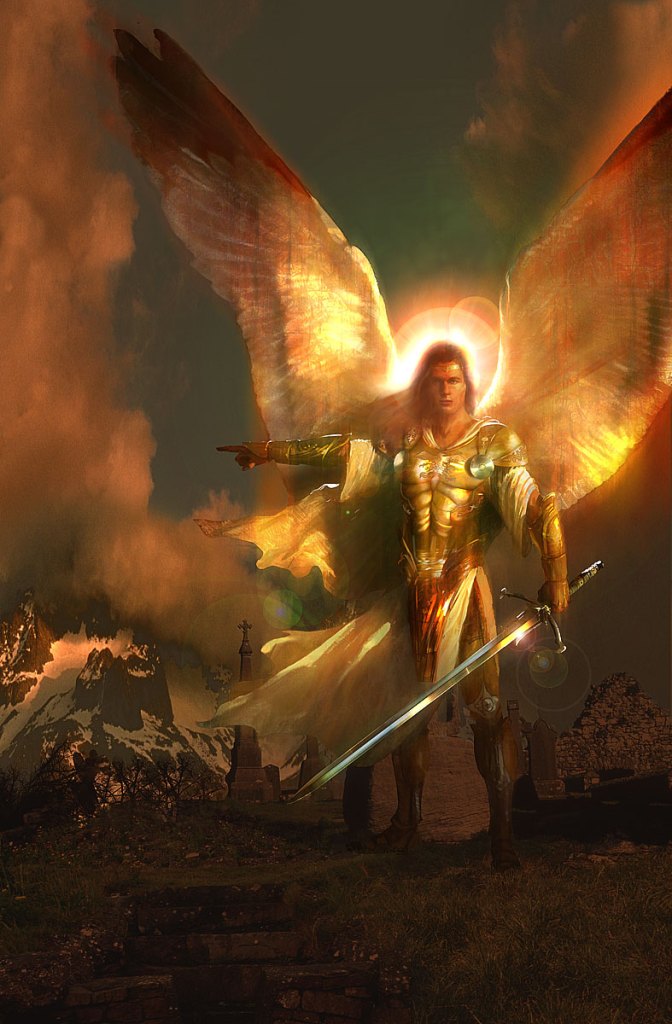
Let us pray: Saint Michael the Archangel, defend us in battle. Be our protection against the wickedness and snares of the devil; May God rebuke him, we humbly pray; And do thou, O Prince of the Heavenly Host, by the power of God, thrust into hell Satan and all evil spirits who wander through the world for the ruin of souls. Amen.