Sermon: Maundy Thursday


From The Dolorous Passion, chapter 7:

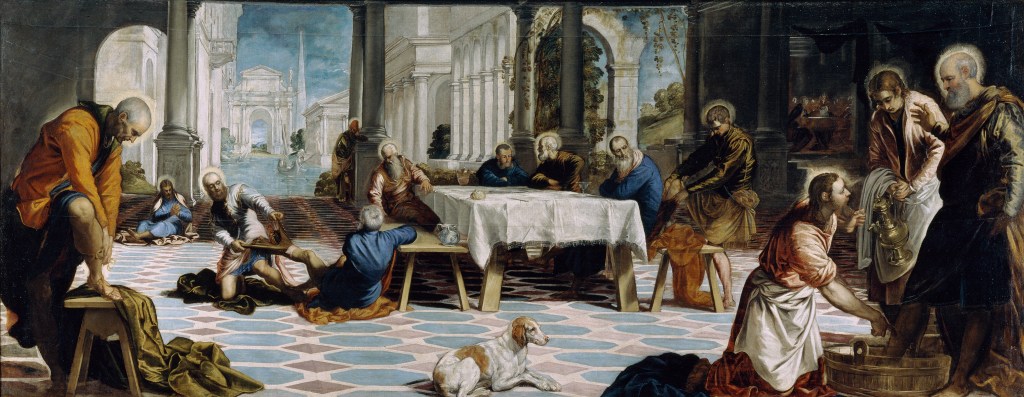
“Jesus, in the vestibule, told John to take a basin, and James a pitcher filled with water, with which they followed him into the room, where the chief steward had placed another empty basin.

“Jesus, on returning to his disciples in so humble a manner, addressed them a few words of reproach on the subject of the dispute which had arisen between them, and said among other things, that he himself was their servant, and that they were to sit down, for him to wash their feet. They sat down, therefore, in the same order as they had sat at table. Jesus went from one to the other, poured water from the basin which John carried on the feet of each, and then, taking the end of the towel wherewith he was girded, wiped them. Most loving and tender was the manner of our Lord while thus humbling himself at the feet of his Apostles.”

And then there was Peter. “‘You will never wash my feet.’ Jesus answered, ‘Unless I wash you, you have no share with me.’ Simon Peter said to him, ‘Lord, not my feet only but also my hands and my head!’”

It is easy to pick on Peter, but would we have acted any differently? Jesus is kneeling before you and says He’s about to wash your feet. What do you do? Yeah. Me too. “Lord, this is so far below You, and I am so unworthy of such an honor.” Yet, as with Peter, this act of washing the disciples’ feet points to something beyond itself.

Jesus says, “Unless I wash you, you have no share with me.” The term “share” can also be interpreted as “heritage” or “inheritance.” In the context of the Old Testament, the Lord speaks to Moses about the Israelites’ inheritance, which is the Land of Canaan, also known as the Promised Land. The Lord declares, “This is the land that shall fall to you for an inheritance, the land of Canaan as defined by its borders.” (Numbers 34:2) In the New Testament, we learn that Jesus will say to the righteous, “Come, you who are blessed by my Father, inherit the kingdom prepared for you from the foundation of the world.” (Matthew 25:34) Unless Jesus washes Peter’s feet, Peter will have no part in the New Promised Land, the very Kingdom of God.

However, remember what Jesus said before he washed their feet. He said, “You do not know now what I am doing, but later you will understand.” This indicates that foot washing is not only about humbly serving one another. It is also pointing to something greater than itself, and the Disciples would not understand until after the Resurrection. St. Paul says it plainly in his letter to the Philippians—“Being found in human form, [Jesus] humbled himself by becoming obedient to the point of death, even death on a cross.” (Philippians 2:8)

The washing of the Disciples’ feet is pointing to the cleansing of sin from their souls, but not just theirs “only but also for the sins of the whole world.” We, like Peter and everyone else who desires the Kingdom of God, must submit to the humility of Jesus and allow Him to wash our feet—allow Him to wash our souls, for “no one comes to the Father except through” Him, and these great acts He performed in the Upper Room and on the hill outside Jerusalem, upon the Cross.

Tonight, I invite you to come forward so that I can learn more about the humility of our Savior by washing your feet. However, remember that these acts serve as an example established by Jesus. Therefore, we are not only witnesses to them but also called to practice them. As Jesus tells us, “Very truly, I tell you, servants are not greater than their master, nor are messengers greater than the one who sent them. If you know these things, you are blessed if you do them.”

Sermon: Maundy Thursday – “Upper Room”


“On the first day of Unleavened Bread, when they sacrificed the Passover lamb, [Jesus’] disciples said to him, “Where will you have us go and prepare for you to eat the Passover?” And he sent two of his disciples and said to them, “Go into the city, and a man carrying a jar of water will meet you. Follow him, and wherever he enters, say to the master of the house, ‘The Teacher says, Where is my guest room, where I may eat the Passover with my disciples?’ And he will show you a large upper room furnished and ready; there prepare for us.” (Mark 14:12-15)

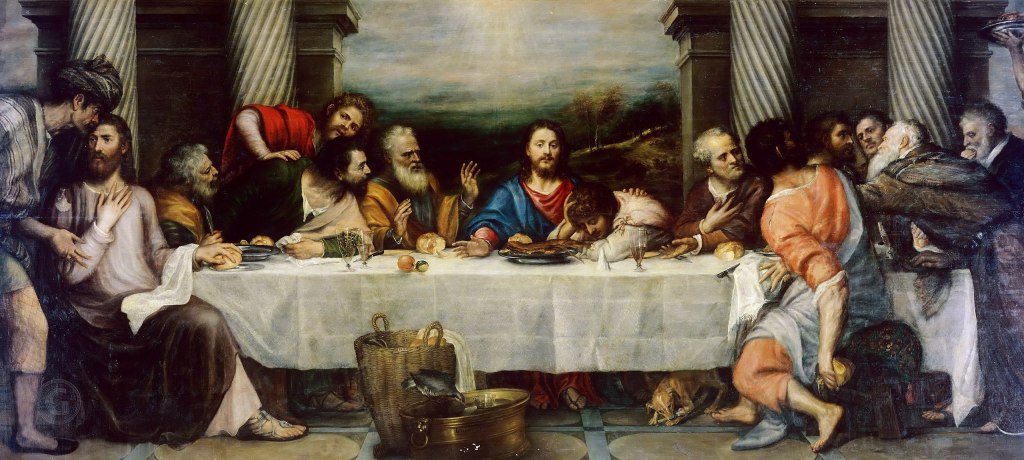
The Last Supper by Leonardo da Vinci is perhaps the most famous, but many others have attempted to capture that scene. The one on the cover of your bulletin was painted by Titian, an Italian artist from the 16th century. If you study it, you will discover many symbols that help identify who each person represents. 

Second, from the left, I believe, is James because of the shell on his shoulder. Second, from the right, I think, is Bartholomew. You see, he is wrapped in a cloak, and the edge hangs over the side of the table. If you look closely, the part that hangs over appears to be an upside-down face. Bartholomew was flayed alive, and he is often pictured holding his skin. And, of course, beside him is Judas, the money bag in his left hand. Behind Jesus and to the right is the tree—a representation of the cross that was near to Jesus since his birth. You can notice all these things as you study the painting, but then you see Jesus’ eyes. Everyone else is distracted, looking here and there and engaged in some conversation (except for John, who is sleeping on our Lord’s breast), but not Jesus. Jesus is looking at you. When you see Jesus’ eyes, everything else becomes a bit blurry. Less important. With his hand, he is gesturing. He is inviting you to pull up a chair and join him, but there are so many years between that meal and today. How could we?

Link to higher resolution image.

in Book 4, Chapter 12 of The Imitation of Christ, my friend, Thomas à Kempis, speaks about Jesus preparing for that last meal with his disciples. Thomas imagines the words of Christ—“I AM the Lover of purity, the Giver of all holiness. I seek a pure heart, and there is the place of My rest. Prepare for Me a large room furnished, and I, with My disciples, will keep the Passover with you. If you wish that I come to you and remain with you, purge out the old leaven and make clean the dwelling of your heart.”

We cannot join Jesus in the upper room that was prepared those years ago, but we can prepare the upper room of our hearts. We, through our confession and devotions, can set the table within. A table covered in fine white linen, adorned with our very best. We can prepare this table of our hearts and say, “Come, Lord Jesus. Dine with me,” and He, with His disciples, will enter in.

Following such a meal, the Lord will get up from the table, take off his outer robe, and tie a towel around himself. Then he will pour water into a basin and wash the feet of all those in the room, including yours, cleansing you of the final remnants of your former self. Making you worthy to enter into His Kingdom.

Look into the eyes of Jesus. He is all that matters. Allow him entry into the banquet you have prepared for Him within your heart.

Sermon: Maundy Thursday – “Two Gardens”

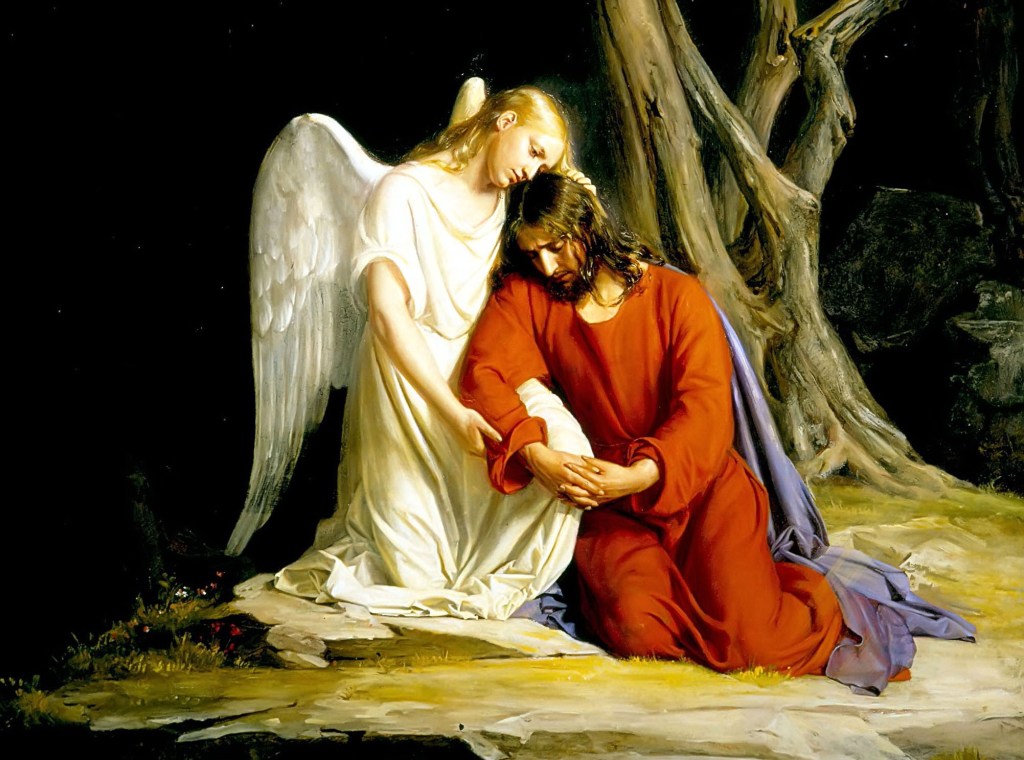
Kristus i Getsemane (1873) by Carl Heinrich Bloch (1834–1890)

Tonight is the night of the foot washing and the institution of the Holy Eucharist.  It is also the night of the Garden of Gethsemane.  When we think of this garden, it should remind us of another: “The Lord God planted a garden in Eden, in the east, and there he put the man whom he had formed.  And out of the ground the Lord God made to spring up every tree that is pleasant to the sight and good for food. The tree of life was in the midst of the garden, and the tree of the knowledge of good and evil.” (Genesis 2:8-9)  But we know how that all worked out: a snake, a lie, a piece of fruit, followed by exile.  God “drove out the man, and at the east of the garden of Eden he placed the cherubim and a flaming sword that turned every way to guard the way to the tree of life.” (Genesis 3:24)

Tonight, following the foot washing and breaking of bread, Jesus taught and prayed for his disciples and for us, and then afterward, “When Jesus had spoken these words, he went out with his disciples across the brook Kidron, where there was a garden, which he and his disciples entered.” (John 18:1)

The Garden of Eden and the Garden of Gethsemane: I’m not suggesting that the two are one and the same, but we are connected to them both.  Archbishop Fulton Sheen also demonstrated that link when we wrote, “As Adam lost the heritage of union with God in a garden, so now Our Blessed Lord ushered in its restoration in a garden. Eden and Gethsemane were the two gardens around which revolved the fate of humanity.” (Source)  

In that first garden, we became burdened by the sin of Adam and Eve’s rebellion and in that second garden, Jesus took that burden upon himself.  In that first garden, we were sent into exile, an angel with a flaming sword preventing our reentry into Paradise, but in that second garden, Jesus accepted the cup of God’s wrath on our behalf and by doing so, the angels rejoice at our return. (cf. Luke 15:10)  In that first garden, there was no atonement for our sin yet in the second garden, there was, Jesus, and he submitted to the Father’s will.

In this world, there are many questions, choices, and options, but the most important question we are asked is which of these two gardens we will choose.  Will we constantly fight against that angel’s flaming sword, seeking to enter a paradise of our creation by the fulfillment of our own will and desires, or will we, like Jesus, come to the other and kneel before the Father and seek his will and desires?  My buddy, Stephen King simplifies the issue, he writes, “There’s really no question.  It always comes down to just two choices. Get busy living, or get busy dying.” (Different Seasons, p.129)  

Enter the Garden with Jesus and get busy living.

Let us pray: “Father… not my will, but yours, be done.”  Amen.