Sermon: Matthew / Heritage Sunday

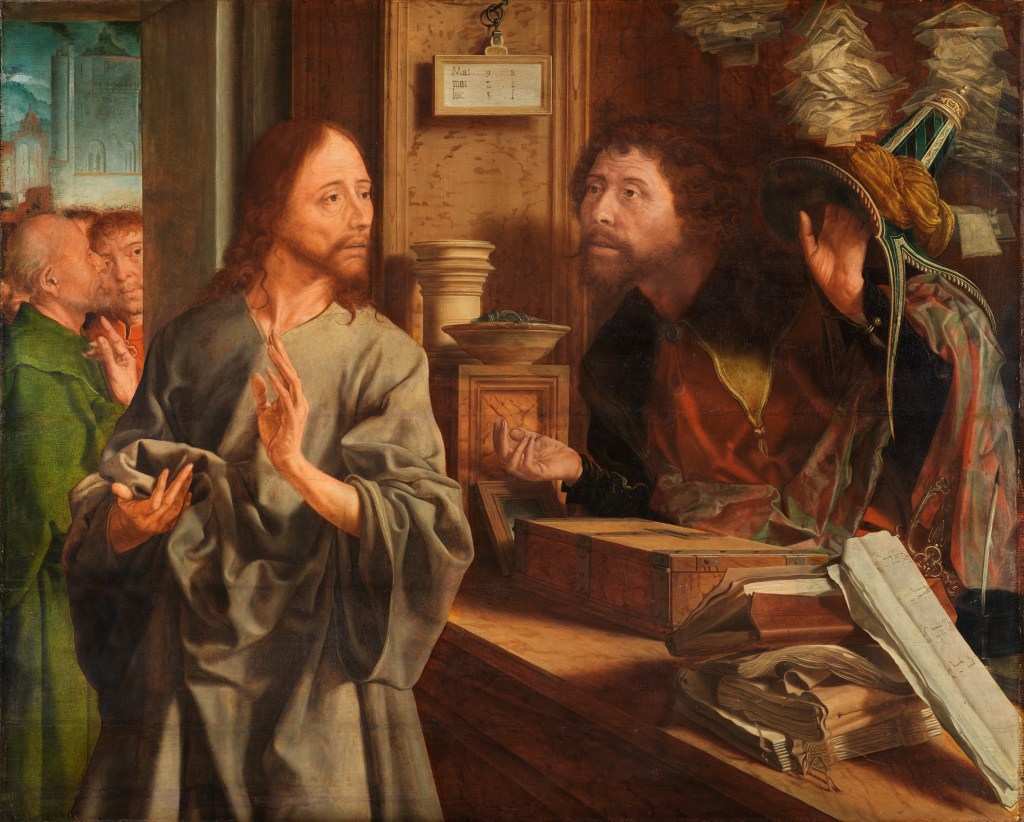
The Calling of Matthew by Marinus van Reymerswale

Things to say to someone you truly dislike:

“I don’t hate you, I’m just not necessarily excited about your existence.”

“I’m not saying I hate you, what I’m saying is that you are literally the Monday of my life.”

“To me, you are like a cloud. When you disappear, it’s a beautiful day.”

“I don’t hate you, but I’d buy you a toaster oven for your bathtub.”

“I’m not saying I hate you, but I would unplug your life support to charge my phone.”

The state of the world these days has stirred up the same level of hatred (and I would say, dysfunction) in many people, so please do not shout anyone’s name—let’s keep things civil here—but I want you to think about the one person you dislike the most. Imagine them like the Grinch as he was looking at the names in the phone book of the citizens of Whooville, saying, “Hate, hate, hate, double hate, LOATHE entirely.” They pretty much just make you angry when you think about them. You would definitely like to give them a piece of your mind. Got it? Now, turn that feeling inward, where you become the target of that intense hatred.

That may seem very unhealthy for many, but for some, it’s how they feel about themselves. If you hate them, try stepping inside their heads for a few minutes, and you’ll realize they hate themselves even more than you ever imagined.

Experts tell us that there are several reasons why someone might not like or even hate themselves. One reason is the illusory truth effect, also known as the illusion of truth effect. A current example of this is what has come to be known as “fake news.” 

Believe it or not, fake news exists. Oy! The trick with fake news is to repeat something enough times, whether it’s true or not, and people will start to believe it. The same idea applies to individuals. If you tell a child enough times that they are stupid, even if they have an IQ off the charts, the child is likely to come to believe they are, in fact, stupid. Tell them or treat them as if they are unloved, and they’ll begin to think that way too. We start to believe what others say about us, whether it’s true or not. What does this have to do with today and our Patron Saint, Matthew? I always imagined Matthew sitting alone at a table while people came up to pay their taxes when they were due. But I was wrong.

As we know, during Jesus’ time, the Romans occupied the Holy Land; therefore, they claimed the right to tax the people. To collect the taxes, the Roman senate appointed wealthy citizens to oversee specific areas of collection. These Roman citizens would then hire managers for those areas, who in turn would hire local individuals fluent in the local language to collect the taxes. These local tax collectors were called publicani.

The rules these tax collectors worked under appears to have been, “Tax everything.” And they were inventive. There were taxes “on axles, wheels, pack animals, pedestrians, roads, highways; on admission to markets; on carriers, bridges, ships, and quays; on crossing rivers, on dams, on licenses—in short, on such a variety of objects that even the research of modern scholars has not been able to identify them all.” Additionally, everyone from the Roman government to the publicani wanted a little piece of the action, so the publicani cheated their own people and charged extra.

Matthew, known in one translation as “The Lord of the Passage,” was in Capernaum, a prime location for collecting taxes. He would have been able to tax people traveling on the roads around the Sea of Galilee, including farmers, fishermen, and those arriving by boat. As a result, he would have been loathed entirely by both Jews and Gentiles. One source states that he would not have even been allowed to enter the Temple, and highly religious Jews would be considered unclean if they so much as touched him.

The building he worked in—think toll booth—was a busy place, with Roman guards and soldiers hanging about (seeing to it that everyone paid and no one tried to rob the place) and a line of folks waiting to pay. The mood: hostile and downcast, and there sits Matthew, not caring what you think about paying taxes or what you think about him. Yell, cry, cuss—whatever you please—you’re going to pay, and he doesn’t care. At the end of the day, he’s going home with a fat wallet. Yet, “As Jesus was walking along, he saw a man called Matthew sitting at the tax booth; and he said to him, ‘Follow me.’ And he got up and followed him.”

Without hesitation, Matthew walked away from it all—the job, the money, everything. He walked away from it all to follow a wandering Rabbi. What would make him do it? On that, the Gospel—even Matthew’s own Gospel—is silent, but I can’t help but wonder.

Some folks can be yelled at and cussed all day long without it affecting them one little bit. Like water off a duck’s back. But for most, it may not impact them much initially, yet over time, it begins to wear on them. Just ask anyone who has ever been in an abusive relationship—they start to believe every word—an illusion of truth effect. So I had to wonder, even with the job and the money, do you think it’s possible that Matthew came to hate himself as much as the people hated him? It wasn’t some pity party, but I wonder if, over time, he started to believe he had no real value, no true friends, no real life. Did he come to believe that he was nothing more than the names people called him?

Perhaps he wasn’t a Biblical whiz kid, but he remembers a few things from his youth, like the words of Psalm 22.

I am a worm and not a man,
    scorned by everyone, despised by the people.

All who see me mock me;
    they hurl insults, shaking their heads. (Psalm 22:6-7)

And, day after day, as he sat there collecting taxes and enduring all the abuse the people dished out, do you think he might have hoped for something better? A life where he could be accepted and valued? A life where he could be loved?

Again, the Gospel is silent, but I have to wonder: when Jesus walked by, did he catch Matthew’s eyes? And in Jesus’ eyes, did Matthew see it all—everything he truly wanted: acceptance and value? And in those two words, “Follow me,” did Matthew hear Love calling out to him?

The Blessed Virgin Mary. In Luke’s Gospel, we learn that when Mary discovered she was with child, she went to visit her cousin Elizabeth. When she entered Elizabeth’s house, Mary greeted her. Scripture says, “When Elizabeth heard Mary’s greeting, the child leaped in her womb. And Elizabeth was filled with the Holy Spirit and exclaimed with a loud cry, ‘Blessed are you among women, and blessed is the fruit of your womb. And why has this happened to me, that the mother of my Lord comes to me? For as soon as I heard the sound of your greeting, the child in my womb leaped for joy.’” Elizabeth’s unborn son, John the Baptist, heard Mary’s greeting and knew that Jesus was near, so he responded with joy by leaping in the womb. I wonder if, in a similar way, when Matthew heard the voice of Jesus, “Follow me,” did his soul leap for joy within him?

Former Presiding Bishop Michael Curry said, “When you look at Jesus, you see one who is loving, one who is liberating, and one who is life-giving.” Matthew was loved by God, he was liberated from those things that bound him, and he was given new life in Jesus. 

I came across a quote this past week attributed to Kahlil Gibran, the Lebanese-American writer and philosopher. After a bit of research, I found that he did not actually say it, but the quote remains quite meaningful—”God said ‘Love Your Enemy,’ and I obeyed him and loved myself.”

Matthew saw, heard, and I believe his soul leapt within him when Jesus called out to him. Matthew no longer hated the enemy; he no longer hated himself but learned to love himself because he finally understood what it meant to be loved. In doing these things and in allowing himself to be loved by Jesus, he became a Saint of God.                                                                       

That is also true when you see Jesus, and it is true when you hear him. If you will look up into the face of Jesus, listen to his voice, and follow Him, He will do the same for you. And not only will he make you a saint, but He will make you a child of God Most High.

Let us pray: O Glorious St. Matthew, in your Gospel you portray Jesus as the longed-for Messiah who fulfilled the Prophets of the Old Covenant and as the new Lawgiver who founded a Church of the New Covenant. Obtain for us the grace to see Jesus living in his Church and to follow his teachings in our lives on earth so that we may live forever with him in heaven. Amen.

Sermon: Heritage Sunday / Feast of St. Matthew


“The most terrifying words in the English language are: I’m from the government, and I’m here to help.” Ronald Reagan

For those of you who are married, I warn you up front not to laugh at this one. “‘I am’ is reportedly the shortest sentence in the English language. Could it be that ‘I do’ is the longest sentence?” George Carlin

The English language—words and grammar. One misspelled word, and you’ll either end up being holy, someone approaching sainthood (such as myself), or being wholly, someone who’s been shot up the OK Coral. One forgotten comma can turn “Let’s eat, gramma,” a call to supper, into “Let’s eat gramma,” an unfortunate act of cannibalism.

After the basics, you get into nouns and verbs, pronouns and adverbs, which brings me to Little Johnny. Johnny was sitting in English class and not paying attention. The teacher, looking to bring him back from wherever his mind was, pointed at him and said, “Name two pronouns.” Johnny replied, “Who, me?” 

Based on those who laughed, we now know who is good with words and grammar.

“Who, me?” 

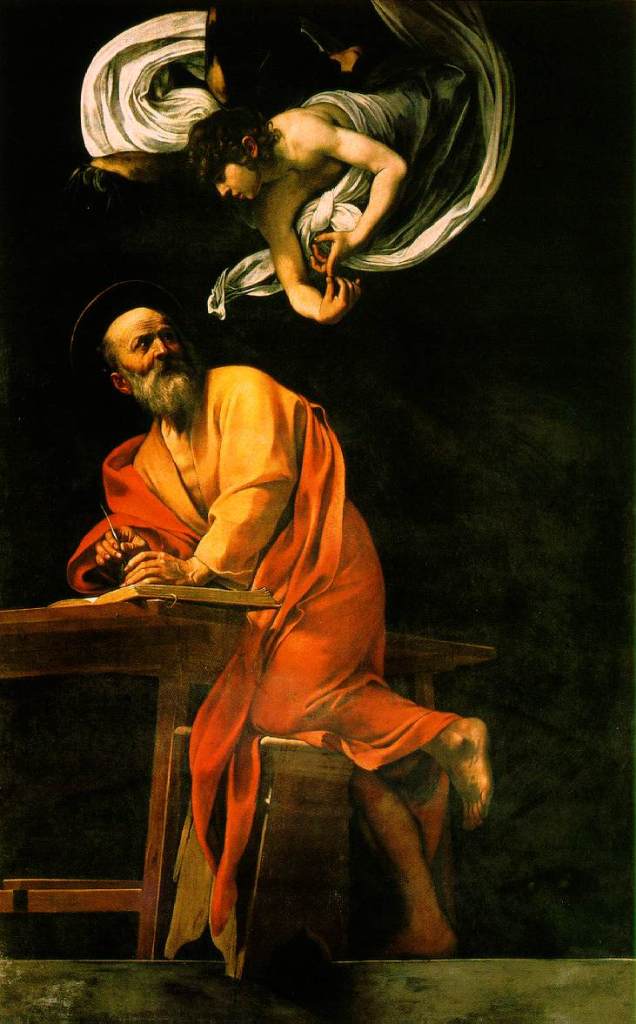
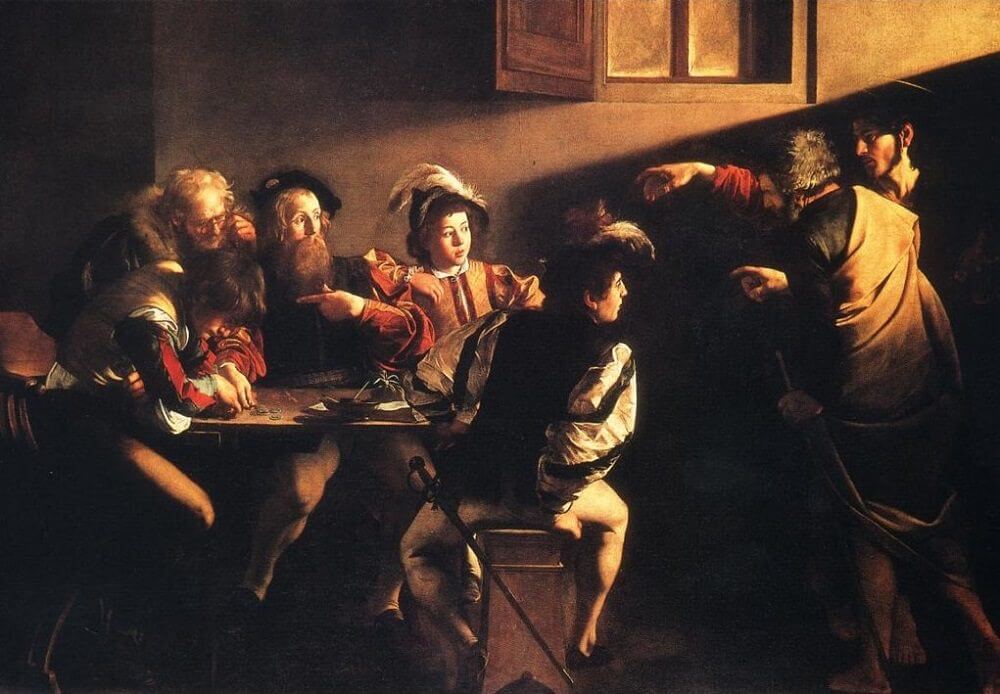
In the Church of San Luigi dei Francesi in Rome, there are three magnificent paintings by the great Italian artist Caravaggio. Each of the paintings portrays a significant moment in the life of our Patron Saint, Matthew. There is the Inspiration of St. Matthew, the angel giving Matthew the words of his Gospel, and the Martyrdom of St. Matthew, depicting his death. However, the one that concerns us today is the Calling of St. Matthew. 

In the painting, Matthew is seated with five other tax collectors who are counting their money. Also in the scene are Jesus and Peter, both of whom are pointing at Matthew.

Matthew’s right hand is stretched out on the table, counting coins, while with his left hand, Matthew is pointing back to himself. The expression on his face—“Who, me?”

I know that feeling. When I first heard God calling me into service, my first response was, “Don’t be stupid.” Yet, God was calling me, and God was calling Matthew. Both of us responded, “Who, me?” And in each case, God responded, “Yes, you.”

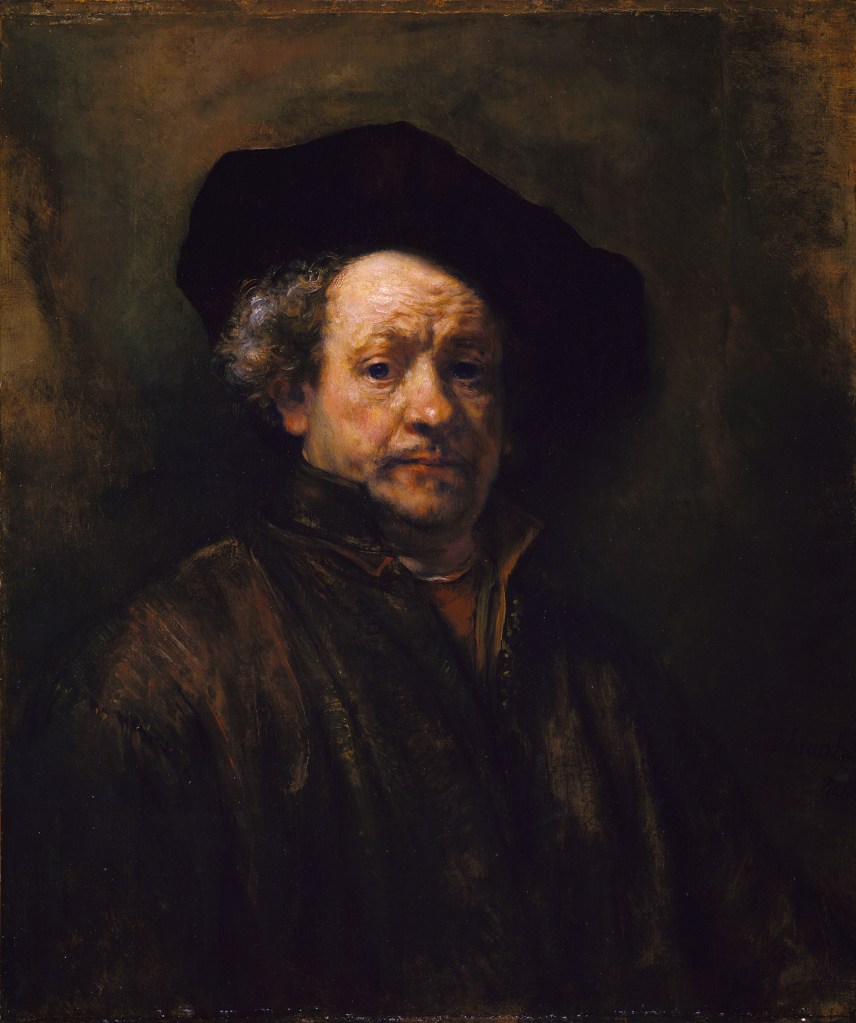
Another of the greatest artists is Rembrandt. In his early career, Rembrandt was wildly successful. Painting and selling portraits, buying the big house, and all the finest art to fill it—living the life. However, all the big spending eventually caught up to him, and he ended up losing it all and dying penniless. Even though he had lost everything, he continued to paint, and the subject he most frequently painted was himself. Rembrandt painted sixty-three self-portraits. This was not an exercise in vanity, nor was it simply to practice his art. He painted himself, year after year, as a “‘search for the spiritual through the channel of his innermost personality.’ Rembrandt felt that he had to enter into his own self, into his dark cellars as well as into his light rooms, if he really wanted to penetrate the mystery of man’s interiority.” (You are the Beloved, Henri Nouwen, June 27) Through those sixty-three self-portraits, Rembrandt was searching for himself. In the process, he understood that as he lived his life, he was also repainting his interior self—a continuous reworking of an interior self-portrait.

Jesus pointed at Matthew, and Matthew pointed at himself and asked, “Who, me?” Jesus responded, “Yes, you.” So, like Rembrandt, Matthew was left with the option of repainting his interior self-portrait or remaining as he was, sitting at a table counting coins, never realizing the life Jesus was calling him to. It is the same for each of us.

We each have an interior self-portrait that is being continuously repainted as we seek to know who we truly are. This interior self-portrait has little or nothing to do with the portrait and all the masks we show to the world. Instead, the interior self-portrait includes all the light and all the darkness that you don’t show to anyone. Sometimes, that interior self-portrait is so fluid it has difficulty maintaining form, and we begin to wonder who we actually are.

During World War II, the great German theologian Dietrich Bonhoeffer was arrested and imprisoned. He would be executed before he could be freed. Although his writing reflects a deep and abiding faith, he, too, had his doubts as to who he truly was. His interior self-portrait was also fluid. During one of those moments, instead of painting an image, Bonhoeffer wrote a poem—Who Am I?

Who am I? They often tell me,
I step out from my cell,
composed, contented and sure,
like a lord from his manor.

Who am I? They often tell me,
I speak with my jailers,
frankly, familiar and firm,
as though I was in command.

Who am I? They also tell me,
I bear the days of hardship,
unconcerned, amused and proud,
like one who usually wins.

Am I really what others tell me?
Or am I only what I myself know of me?
Troubled, homesick, ill, like a bird in a cage,
gasping for breath, as though one strangled me,
hungering for colors, for flowers, for songs of birds…

Am I then, this today and other tomorrow?
Am I both at the same time? In public, a hypocrite
And by myself, a contemptible, whining weakling?

Who am I? Lonely questions mock me.

He then concludes,

Who I really am, you know me, I am thine, O God! (Voices in the Night, p.45)

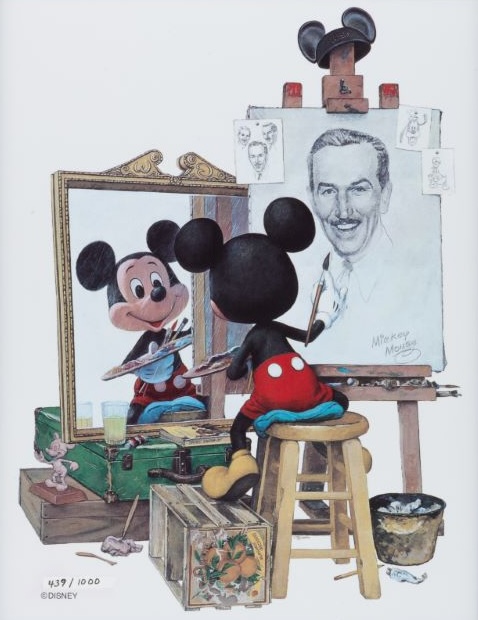
One more artist, perhaps you’ve not heard of—Charles Boyer. Boyer began working for Walt Disney and Disneyland in 1960. In one of his paintings, he has Mickey Mouse painting a self-portrait. Mickey is leaning over, looking in a mirror, and busily painting his portrait. However, the image on the canvas is not that of Mickey Mouse. It is Walt Disney. Mickey Mouse is painting the image of his creator that is within him. 

Bonhoeffer asked, “Who am I?” He concluded, “Who I really am, you know me, I am thine, O God!” Bonhoeffer was painting his interior self-portrait and, in doing so, was attempting to paint the image of his Creator that was within him.

Rembrandt looked in the mirror and painted his sixty-three self-portraits, all along, searching for the image of the Creator Who was within him.

Jesus looked at Matthew and said, “Follow me.” In doing so, Jesus invited Matthew to follow Him and repaint the interior self-portrait. At first, Matthew probably thought, “Who, me?” But then we are told, “he got up and followed” Jesus. Matthew repainted the interior self-portrait, and it revealed the image of his Creator.

St. Paul, writing to the Ephesians, tells them “to put off your old self, which belongs to your former manner of life and is corrupt through deceitful desires, and to be renewed in the spirit of your minds, and to put on the new self, created after the likeness of God in true righteousness and holiness.” (Ephesians 4:22-24) We are called to do the same—to put off the old self and to put on the new self. To repaint the interior self-portrait into the image of our Creator… into the image of Jesus. 

When Jesus points to us, we, along with so many others, likely say, “Who, me?” Jesus smiles and says, “Yes, you. You follow me. Repaint the interior self-portrait in My Image, for I am your loving Creator, and you are Mine.”

Today, Jesus hands you a set of paints, some brushes, and a fresh white canvas. He invites you to follow Him. He invites you to repaint yourself in the Image of your Creator. In His Image. You say, “But I can’t paint!” From Proverbs, we read,

“Trust in the Lord with all your heart,
 and do not rely on your own insight.”
(Proverbs 3:5)

You can’t paint? Trust in the Lord to guide you. Don’t rely on yourself; He will reveal His Image in you.

Let us pray:
God, our Father,
You redeemed us
and made us Your children in Christ.
Through Him You have saved us from death
and given us Your Divine life of grace.
By becoming more like Jesus on earth,
may we come to share His glory in Heaven.
Give us the peace of Your kingdom,
which this world does not give.
By Your loving care protect the good You have given us.
Open our eyes to the wonders of Your Love
that we may serve You with willing hearts.
Amen.

Sermon: Heritage Sunday / Feast of St. Matthew

Photo by Kevin Jackson on Unsplash

An Arab chief tells the story of a spy who was captured and sentenced to death by a general in the Persian army. This general had the strange custom of giving condemned criminals a choice between the firing squad and the big black door. As the moment for execution drew near, the spy was brought to the Persian general, who asked, “What will it be: the firing squad or the big black door?” The spy hesitated for a long time. It was a difficult decision. He chose the firing squad. Moments later, shots rang out, confirming his execution. The general turned to his aide and said, “They always prefer the known way to the unknown. It is characteristic of people to be afraid of the unknown. Yet, we gave him a choice.” The aide said, “What lies beyond the big black door?” “Freedom,” replied the general.

Nicholas Winton’s parents immigrated from Germany to London in 1907, and Nicholas was born in 1909. He attended Stowe School, a boarding school, and then studied banking in France and Germany. He would then go on to become a stockbroker in London. It’s not a bad life if you can live it, but rather ordinary. However, what Nicholas did in his spare time made him extraordinary.

In 1938, the Nazis began their occupation of Czechoslovakia and, which included setting up camps filled with Jews and political prisoners. Learning of this, a friend came to Nicholas and asked if he could help save some. Nicholas was very eager because although he was Christian in name and practice, he was Jewish by blood. Hoping to integrate more smoothly into society, his parents, before Nicholas’ birth, had changed their name from Wertheim to Winton and converted to Christianity.

At the first opportunity, Nicholas traveled to Prague to investigate ways of getting at-risk individuals out. In the process, it was learned that many were working to get the adults out. Still, few were working with the children, so Nicholas and those with him established offices in Prague and London; then, they began rescuing the children by smuggling them out of Czechoslovakia and into England and finding them homes and other resources. Stockbroker by day, superhero by night. After the war, Nicholas took his notes and all and, put them in a box and told no one, saying that what he did was nothing more than a “wartime gesture.” His story would have gone untold if his wife hadn’t stumbled across that box.

That’s Life! was a British TV show that started in 1973 and ran for twenty-one years. The show, with its studio audience, reported on various stories of interest. One episode in 1988 featured Nicholas Winton, who was in the studio audience. He sat and listened to the reporters tell of his “wartime gesture.” When the reporters were done, the camera panned to Nicholas and the woman sitting next to him. Her name was Vera Gissing. The host of the show, Esther Rantzen, said to Vera, “I should tell you that you are actually sitting next to Nicholas Winton.” Nicholas met one of the children he saved. Then the host said, “May I ask, is there anyone in our audience tonight who owes their life to Nicholas Winton? If so, could you stand up, please?” Some twenty to thirty stood. All told, through his efforts, 669 children were saved. They are known as Nicky’s Children

Sir Nicholas Winton died in 2015. He was 106.

We all share common experiences. The one I’m thinking of occurs when you find yourself in a room with several people, with all sorts of conversations taking place and many topics being covered, but your mind is off in its own little world. You might even imagine yourself in a different place with a new life. I love what I do, but even I can wonder, “What if?” But what if your life was just OK? Not bad, only average. So you imagine wanting more—not more stuff, but to be needed. To want to make a difference in the world around you. I’ve no way of knowing, but I can imagine Matthew in just such a place and mindset. 

Matthew, not alone, sitting in the tax booth. He’s got some other workers there with him; maybe a friend or two is hanging around, passing some gossip, other tax collectors also, shooting the breeze and conspiring on more ways to take advantage of the taxpayers. All these people around and all these conversations, yet Matthew, in his mind, is a long way off, fantasizing about a life that might be.

“I sit here and deal with taxes all day. It’s good work. Pays the bills, and the family has what they need, but isn’t there more to life? I would like for my life to be more. I would like for my life to have value. To mean something.” Then, looking up from his thoughts, Matthew says to himself, “Now, who is this fella?”

That fella walks up to the tax booth, points at Matthew, and says, “Follow me.” In that instant, Matthew somehow knew that this man, this Jesus, was the fulfillment his life sought—the very life he had been fantasizing about. He didn’t know what it would be like, but he knew, so he got up, and he followed.

“Matthew? Matthew!” His friends called after him. “Where are you going? You can’t just walk away! You’ve got responsibilities here.” But Matthew keeps walking.

Later that day, after spending time with Jesus, Matthew returns to the tax booth. His friends begin to rib him, “Finally came to your senses, did you? You’re lucky we’re the ones that were here to keep an eye on your cash. Anybody else would have run off with it.” But instead of thanking them, Matthew waves off the money and says, “Hey, would you all like to come to dinner tonight? My treat, my place. I’ve got somebody I would like for you to meet.” Later that night, when they are all gathered at Matthew’s, listening to Jesus, Matthew notices some who had been with Jesus earlier in the day, and they are visiting with the religious leaders. He overhears a snippet of the conversation, as one of the Pharisees said to those other followers, “Why does your teacher eat with tax collectors and sinners?” Matthew quickly looks over to see if his guest, Jesus, has overheard this rudeness. He had, but instead of getting angry, Jesus leaned back from the table and said, “Those who are well have no need of a physician, but those who are sick. Go and learn what this means, ‘I desire mercy, not sacrifice.’ For I have come to call not the righteous but sinners.” Matthew then smiles as Jesus returns to visit with the other tax collectors and sinners, the religious leaders quickly forgotten.

Nicholas Winton was sitting in his stock broker’s office when Jesus said, “Follow me. Help me save these Czechoslovakian children.” Matthew was sitting in the tax collector booth when Jesus said, “Follow me and help me bring salvation to these children of God.” 

The general turned to his aide and said, “They always prefer the known way to the unknown. It is characteristic of people to be afraid of the unknown. Yet, we gave him a choice.” The aide said, “What lies beyond the big black door?” “Freedom,” replied the general.

Both Matthew and Nicholas had the option of choosing. They could have kept it safe and stuck with what they knew. Probably nobody would have blamed them. They were secure in their positions and had all they needed. Yet, if you will, they chose the big black door. They knew the basic trajectory of their lives, but they chose—not the unknown—they chose Jesus, and Jesus gave them freedom. 

St. Paul wrote to the Galatians, “You were called to freedom, brothers. Only do not use your freedom as an opportunity for the flesh, but through love serve one another. For the whole law is fulfilled in one word: “You shall love your neighbor as yourself.” (Galatians 15:13-14)

If our Patron Saint, Matthew, were standing here today, I believe firmly he would say, “Choose the big black door. Above everything you think you know, choose Jesus. It may appear to be the unknown, but it is the life you were created for, the life you sit around fantasizing about, and in living it, you are given freedom. Use this freedom that is a gift from God to love others and love yourself.”

Personally, I can assure you that there is no way of knowing the path that Jesus will lead you down, but wherever it leads, you will never want to be anywhere different. Choose the big black door.

Let us pray: St. Matthew, you became one of Jesus’ closest friends and followers. You continued on the path of holy service to God throughout the rest of your life. Pray for us that we may always be ready and willing to follow Christ wherever He calls us. Pray that we may seek to serve God wholeheartedly each day of our lives. We pray in Jesus’ Name. Amen

Sermon: Heritage Sunday / Feast of St. Matthew

The Inspiration of Saint Matthew by Caravaggio

A farm boy got a white football for his birthday. He played with it a while and then accidentally kicked it over into the neighbor’s yard. The old rooster ran out, looked at it, and called the hens to see it.

“Now look here,” the rooster said, “I don’t want you girls to think I’m complaining, but I just want you to see what they are doing next door.”

If I were a chicken, I don’t know if that would motivate me or get me to cross the road and find a less demanding farm.

When it comes to cats, I don’t believe there is anything that motivates them. They do what they want, when they want, although The Queen is motivated to have a nip of scotch when I pour myself one. On the other hand, dogs can be motivated by all sorts of things: affection, play, food (I would make a good dog), and other games they enjoy. People also have motivators. Food, money, fame, power, love, and such, but we are also motivated by negatives: shame, societal expectations, fear, and more. Whether positive or negative, human or animal, a motivator is an external factor that stimulates a desired response and is something learned. In addition, if the motivator is removed—the reward is no longer given, the fear is no longer present—the person or animal may revert to who they were before. If a person is motivated by money and you cut their pay or their hours, then you’ll likely see their productivity decline. That great motivational speaker, Zig Ziglar, said, “Of course, motivation is not permanent. But then, neither is bathing; but it is something you should do on a regular basis.” Motivation is good.

What is similar to motivation is inspiration, but where motivation is an external force that pushes in hopes of attaining a specific response, inspiration is an internal awakening that draws us and pulls us to something greater. The reward or punishment is not present with inspiration. It is nice if there is a reward, but if you’re inspired, you’ll do whatever it is, regardless. Leonardo Davinci didn’t paint the Mona Lisa because someone offered him a cookie. It was an inspiration, something within him that needed to express itself.

Our life with God is the same. Some are positively motivated—they want the reward of heaven—and some are negatively motivated—they’re afraid of hell. That’s one way to do it. These external factors push us toward the desired response: I want to go to heaven, or I want to avoid hell, so I’ll behave in a certain way. However, to be inspired to follow God and his calling on your life is to be drawn in—not for the reward or avoidance of punishment—but by love, by desire, by passion, by relationship.

The image on the front of your booklet this morning is named, The Inspiration of St. Matthew and is located in the church of San Luigi dei Francesi in Rome. When we study it, we begin to see the inspiration of God at work.

The angel is making several points, ticking them off with his fingers, and Matthew is staring up at him. Although his pen and tablet are on the desk, Matthew only has eyes for the messenger of God. His focus is singular. Matthew is not concerned with himself—you can’t see it all, but he is standing at his desk with one knee propped up on the seat. The seat itself is tilted and about to fall over, yet Matthew is not concerned with his discomfort or the precariousness of his position. His hand is poised for action, ready to write. And notice the background of the painting—it is all black. Nothing else matters other than the angel and the message. Matthew is not motivated—he’s not looking for a reward or in fear of punishment—Matthew is inspired, and he wasn’t only inspired to write a Gospel. He was inspired from the very moment Jesus walked into that tax collection operation and said, “Follow me,” for we are told, “[Matthew] got up and followed him.” Jesus did not promise him heaven or threaten him with hell. Jesus’ words and presence filled Matthew with such a deep inspiration, a deep sense of call, that without hesitation or any concern for self, discomfort, possessions, danger, and everything else that accepting a call from the Savior can produce, he got up and followed Jesus with his entire self. 

Question: why are we not inspired in such a way to follow Jesus so passionately? I can come up with a few answers but I think, for the most part… we simply won’t allow it. We want to follow Jesus with complete abandon, but we will not give ourselves permission to do so. We say, “Yes, Jesus, I will follow you, but… but I’ve got a family. But I’ve got a job. But I’ve got responsibilities. But I’m afraid of what people will think.” That’s a pretty big “but.” But! what we fail to understand is that Jesus is not asking us to abandon family or job or responsibilities, etc. Jesus is asking us to abandon our lives to him so that he can inspire our life with family, our life at work and with our colleagues, and in all those other areas of responsibility. The Lord does not want our day-to-day life to be separate from our life with Him. So often, in following Christ, we think we’ve got our life with him over here and our life in the world over here, with this nice barrier between them keeping them separate. To be inspired by Jesus as St. Matthew was is to remove that barrier and allow Jesus into every aspect of your life. In doing so, you will no longer feel as though there is this conflict between the two but will instead experience peace in knowing that your life is entirely under the kingship of Christ.

It is not in the prayers we have today, but in our Rite II service each Sunday, the last sentence of the Post-Communion prayer is, “Send us now into the world in peace, and grant us strength and courage to love and serve you with gladness and singleness of heart….” It is that peace, that gladness, and that singleness of heart—our daily lives—that enters us when we allow Jesus to inspire the entirety of our lives. 

Jesus says, “Follow me.” Be inspired, be passionate in your walk with Jesus, and follow him in every aspect of your life.

Let us pray: We thank You, heavenly Father, for the witness of Your Apostle and evangelist Matthew to the Gospel of Your Son our Savior; and we pray that, inspired by his example, we may with ready wills and hearts obey the calling of our Lord to follow him; through Jesus Christ our Lord, who lives and reigns with you and the Holy Spirit, one God, now and forever, Amen.

Sermon: Matthew

The Calling of Saint Matthew by Michelangelo Merisi da Caravaggio

A man on vacation was strolling along outside his hotel in Acapulco, enjoying the sunny Mexican weather. Suddenly, he heard the screams of a woman. Rushing to help, he found the woman cradling a young boy.

The man knew enough Spanish to determine that the child had swallowed a coin and was choking. He grabbed the child by the heels, held him up, gave him a few firm swats on the back, and an American quarter dropped to the sidewalk.

“Oh, thank you sir!” cried the woman. “You seemed to know just how to get it out of him. Are you a doctor?”

“No, ma’am,” replied the man. “I’m with the United States Internal Revenue Service.”

I am sure we could find one, but I doubt there are many other individuals who are more universally disliked than the tax man. Even when our tax dollars are spent for good reasons, it just irks us to give them up and a person who’s job it is to collect them… they’re just not all that appreciated. Our Saint for the day and the patron of our congregation, St. Matthew, was one such person.

In the time of Jesus, the tax collectors were known as publicans and the tax organization sounds like a multilevel marketing scheme. You’ve got the guy at the top, then another level below him/her, and each of them has a level below them. In the case of taxes, the ones on the bottom are doing most of the collecting. What they collect is then passed up the food chain to the head person, who then passes it all onto the government. Only catch: everyone in the chain, from the lowest to the highest is going to make sure they get a cut, so instead of simply charging the taxed amount, they charge more to insure they get their piece of the pie. (By the way, we still do things like this: see the $600 hammer.) Our St. Matthew was on the bottom rung, but he was still hated by both Gentiles and Jews.

He was hated by the Gentiles because he was a tax man and they knew he was overtaxing them and he was hated by the Jews for the same reason, but even more so, because he himself was a Jew that was working for the occupying Romans. He had no friends except for other tax collectors. Of all the candidates that could have been selected to proclaim the Kingdom of God, this Matthew was the least likely, yet Jesus did what we have seen God do on a number of occasions. As we’ve been learning in our Sunday morning study, he chose Abraham who wasn’t even a believer to begin with, he chose Jonah who wanted absolutely nothing to do with those apostate Ninevites, he chose David who would be an adulterer and murderer, he chose Mary who was just a young girl. Matthew and all the rest aren’t the odd ones out when it comes to being called into God’s service. They are the norm!

We believe that God can only use those who are holy and righteous, but as Jesus tells us, “Those who are well have no need of a physician, but those who are sick…. For I have come to call not the righteous but sinners.” Why would that be? Because someone who is healthy can give a good testimony, but someone who is sick and is then healed can become a powerful witness, which is why Jesus called a tax collector named Matthew and why he called each of us. Like Matthew and the others, we were all once sick in our sin, but now we are the ones who can give witness to the mercy and healing power of our God.

Like Matthew, live your life as a witness to the Good News and the merciful healing of our God.