Sermon: Mary Magdalene

Giovanni Battista Pittoni – The Penitent Magdalene

Throughout history, there have been some epic searches. Some have searched for the Garden of Eden, and others for the Fountain of Youth. Later, there would be a great quest for the Holy Grail (thankfully, Dan Brown uncovered that one for us). Then there was the Titanic (James Cameron sank it and found it). And, of course, Jimmy Hoffa, who everyone thought was buried under the Giants Stadium in New Jersey, but Hoffa was a no-show following the demolition. Amelia Earhart and the Devil’s Triangle—those two might be connected—Atlantis and Cleopatra’s tomb are all things we’ve searched for and continue to do so.

In our personal lives, we also search. We search for happiness, love, security, and much more. That actually probably depends on the day or even the hour, but we do search. Perhaps the greatest search in our lives is the search for meaning. Physician Viktor Frankl, author of Man’s Search for Meaning, writes: “Man’s search for meaning is the primary motivation in his life and not a ‘secondary rationalization’ of instinctual drives [those being security, food, etc]. The meaning is unique and specific in that it must and can be fulfilled by him alone, only then does it achieve a significance which will satisfy his own will to meaning.” He is postulating that there is a unique meaning to each person’s life, so your meaning of life may not be fulfilling to someone else.

Frankl continues, “It is a peculiarity of man that he can only live by looking to the future—sub specie aeternitatis. And this is his salvation during the most difficult moments of his existence, although he sometimes has to force their mind to the task.” (Source) He points to those who survived the concentration camps in Nazi Germany. Many of the survivors found some meaning in their lives, no matter how small, and that meaning gave them the strength and will to live for something and ultimately survive.

What is the connection between all of this and Mary Magdalene, whom we celebrate today?

Mary Magdalene stood weeping outside the tomb. One of the two angels said to her,“‘Woman, why are you weeping?’ She said to them, ‘They have taken away my Lord, and I do not know where they have laid him.’ When she had said this, she turned around and saw Jesus standing there, but she did not know that it was Jesus. Jesus said to her, ‘Woman, why are you weeping? Whom are you looking for?’”

“Whom are you looking for?” What are you searching for? Mary was searching for meaning and purpose in her life that would bring fulfillment. She believed she had found it in the person of Jesus, but then she saw Him so violently stretched out on the cross, and then she saw Him breathe His last. Her meaning in life had died. Then He called her name, and she saw the Resurrected Lord, at which point, her life took on even greater meaning, for she went and proclaimed to the disciples, “I have seen the Lord.”

The Lord has given us all meaning and purpose in our lives. He has seen fit to allow us to search for and find those things and people that bring us happiness. I believe it brings Him great joy to see us realizing our goals and fulfilling our purposes; however, these meanings and purposes, outside of the Resurrected Jesus, are dead. They are vain searches designed to satisfy our egos, and so, even when fulfilled, they leave us unsatisfied. St. Augustine was correct when, in the first paragraph of his Confessions, he wrote, “To praise you is the desire of man… You stir man to take pleasure in praising you, because you have made us for yourself, and our heart is restless until it rests in you.”

Jesus said, “Seek first the kingdom of God and his righteousness, and all these things will be added to you.” (Matthew 6:33) Search first for Jesus, our Resurrected Lord, and, like Mary Magdalene, in finding Him, you will find fulfillment in Him, and in all your life’s endeavors. 

Sermon: Mary Magdalene

Judith with the Head of Holophernes, by Cristofano Allori, 1613

The Book of Judith can be found in the Apocrypha, which means, according to Article 6 of the 39 Articles, “The Church doth read for example of life and instruction of manners; but yet doth it not apply them to establish any doctrine.”

The book begins, “It was the twelfth year of Nebuchadnezzar who reigned over the Assyrians in the great city of Nineveh,” which rabbinical scholars state is equivalent to saying, “A long time ago in a galaxy far, far away….”  In other words, it is historical fiction but a great read.

Israel is under attack from the Assyrians in the north. On their way to Jerusalem, the Assyrians conquer everyone in their path, finally coming up against the Jewish city of Bethulia.

The general of the Assyrian army, Holofernes, is all for immediately marching in and conquering it. Still, the Edomites, who are with him, convince him to lay siege instead by cutting off the water supply. They do, and they wait.

After thirty-five days, the people of Bethulia are ready to surrender, but the mayor convinces them to wait five more days, saying that if God did not rescue them after 40 days, he would surrender.

It is then that Judith goes into action. She plans to save her people by whatever means necessary, and the plan requires her to get safely into the Assyrian camp. She will need to lie to do this, so she prays that she can lie well.  We heard part of it today, including the words, “King of all your creation, hear my prayer! Make my deceitful words bring wound and bruise on those who have planned cruel things against your covenant.”  

She is very beautiful, so to accentuate that beauty, she dresses seductively. Then, leaving the city with her maidservant, she allows herself to be taken captive. Because of her beauty, they do not harm her, and when she lies, saying she has information on how to defeat the Israelites, she is taken to Holofernes. Beautiful woman encounters lustful general. Care to guess what the general is thinking?  Yahtzee!  

Judith’s plan works, but she keeps the general’s desire at bay for several days. Eventually, she declares that she will give in to his wishes. He is so excited by the prospect that he celebrates. In fact, he celebrates so much with liquor that he passes out. Scripture picks up: “With that, she went up to the bedpost by Holofernes’ head and took down his scimitar; coming closer to the bed, she caught him by the hair and said, ‘Make me strong today, Lord God of Israel!’ Twice she struck at his neck with all her might and cut off his head.” Then, after escaping through the enemy camps, she returned to the city. She said to the people, “Praise God! Praise him! Praise the God who has not withdrawn his mercy from the House of Israel but has shattered our enemies by my hand tonight!” She then had them place the head of the general on the city gate, which struck fear into the hearts of the Assyrians, which led to great chaos. The Israelites used the chaos, attacked, and drove the Assyrians from their land. I think Judith would have made a good Marine.

Interestingly, this story is tied to the feast of St. Mary Magdalene, which we celebrate today. Why? Because they are both declaring a victory. Judith says, “Praise God! Praise him! Praise the God who has not withdrawn his mercy from the House of Israel but has shattered our enemies.” She is declaring salvation from an earthly enemy. Mary Magdalene says, “I have seen the Lord.” She declares salvation for us all—our salvation over sin and death. In essence, Mary is saying, “Praise God!  Praise Him! Praise the God who I have seen, who has conquered death, once and for all, and brought salvation to all God’s children.”

With her, we say, “Praise God for our salvation through Christ Jesus.”

Sermon: Easter Sunday 2024


Doc Pierre decided that he wanted to get into the ranching business, so he went out and purchased himself a bunch of cows and put them out on the pasture. He also knew he would need a bull, so he called up one of his hands, Ol’ Boudreaux, and gave him the plan. 

“Boudreaux,” he says, “I’m going out to find the bull. Once I’ve purchased one, you hook the trailer to that pick ‘em up truck of yours and come fetch it.”

“How will I know?” Bou asks.

Doc Pierre says, “I’ll send a telegram,” and it was all set.

Doc Pierre goes out searching for the bull with $5,000 in his pocket. He finds one for exactly $5,000. Hoping to lower the price, he asks the rancher if that is the best offer. “Well, I suppose I could let it go for $4,999.” Doc Pierre thinks it’s a good deal and takes him up on it. Then, he heads to Western Union to send the telegram to Boudreaux, but it is there that he learns it’ll cost him $1 per word, and all he’s got left is a $1. He thinks on it a moment, then writes out a one-word message to Boudreaux.

The telegraph operator looks at it questioningly, then back up to Doc Pierre. Doc Pierre nods in understanding and explains, “Boudreaux don’t read so good, so he’ll have to sound it out first. He’ll get the message.” The telegraph operator said OK and sent the one-word telegram: “Comfortable.”

About an hour later, Boudreaux showed up with the pick ‘em up truck and trailer.

Doc Pierre sent, “Comfortable,” and Boudreaux had to sound it out, “Come.. for… da… bull.”

Have you heard of response latency? It is defined as “The interval of time elapsing between a stimulus and a response.” (Source) You may not have heard of it, but you may have just experienced it. I told you what I hoped was a good joke, and hopefully, you laughed! However, there was a short period of time between the punch line and you getting the joke and laughing. The time between is the response latency. It is the time when you have all the necessary information, but not quite yet understanding. It is the time leading up to a moment of clarity or an “Aha!” moment or epiphany. Response latency.

Our Gospel reading this morning tells us that Mary Magdalene went to the tomb of Jesus, found the stone rolled away, and ran back and told Peter and John. Hearing this, the two disciples take off. John outruns Peter and arrives first. John stands just outside the tomb, but Peter—never really one for restraint—goes barging in. After gaining his courage, John follows. There, they discover the linen shroud that had covered Jesus’ body and the veil that had been over his face, but the body of Jesus is not there. 

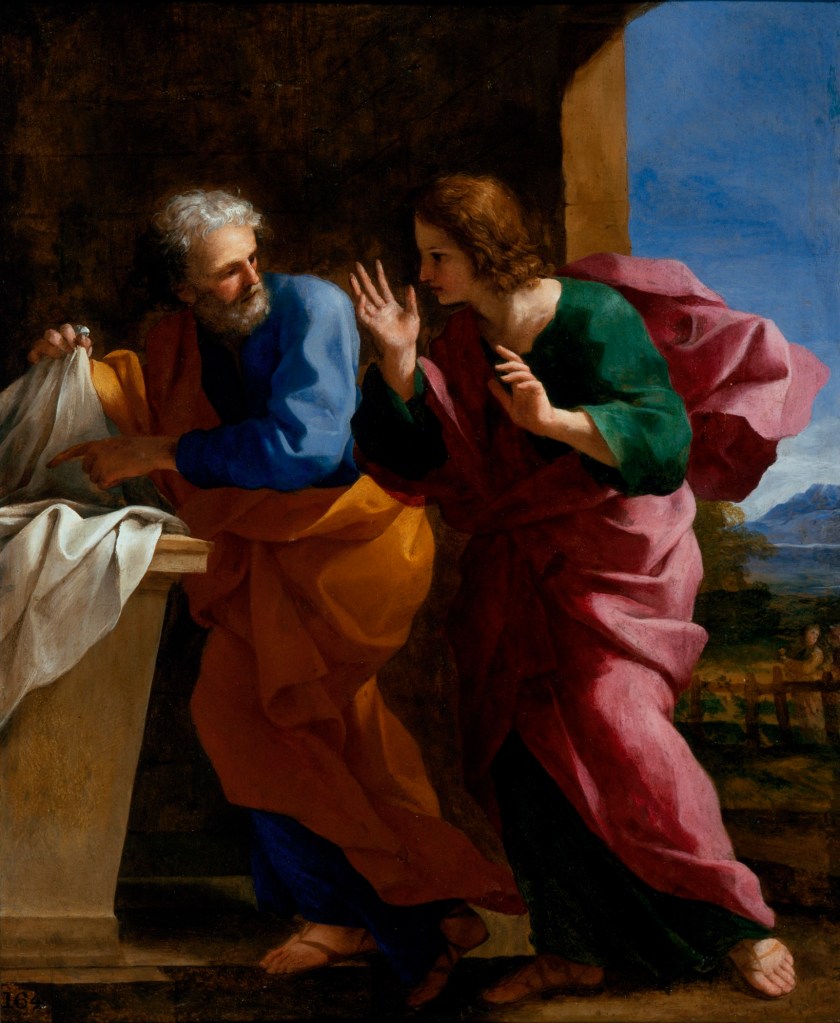
The image on the front of your bulletin depicts the scene. The painting St. John and St. Peter at Christ’s Tomb (c.1640) is by the Italian artist Giovanni Francesco Romanelli. Peter, on the left, is pointing at the shroud and seems to be staring off, trying to understand, but for John,  the response latency is ending. The pieces are falling into place. It is like he is holding up his hands to tell Peter to be quiet so that he can think. The reading tells us that the disciple whom Jesus loved, John, “saw and believed.” Romanelli captured that moment.

The reading then tells us that the two returned home, but Mary, who must have followed behind the footrace, remained. She leaned into the tomb and saw and spoke to the angels, then turning, she saw the gardener, not knowing it was Jesus. 

Now, this is an interpretation on my part, but the gardener was there all along, watching. Maybe he was out of sight, or maybe, in all the excitement and rushing about, all three saw him but more or less dismissed him. Either way, I believe the gardener, Jesus, was there watching this entire scene unfold. And I believe Jesus anxiously anticipated the end of John’s response latency when all the pieces came together. When they did, Jesus smiled and said to Himself, “That’s my boy.” Working behind John’s understanding is God’s grace.

St. John later tells us, “We love because he first loved us” (1 John 4:19), and St. Paul tells us, “For by grace you have been saved through faith. And this is not your own doing; it is the gift of God” (Ephesians 2:8). Believing in Jesus is a grace—a gift from God. Jesus anxiously anticipated all the pieces falling together for John to believe, but the reason this could happen for John was because God first loved John—God’s grace was given to John so that he might believe.

Today, we are the ones standing in the tomb. We are the ones seeing the shroud and other linen. Like John, we have all the teachings of the Prophets and all the words and deeds of Jesus at our disposal. In addition, we have the teachings of the Apostles, the Saints, and the Church. We have all the information. Question: have they fallen into place for you, or are you still in that time of response latency? If yes, if they’ve fallen into place, then have a passion for souls and pray that others may receive the light of the Gospel. If not, then pray for God’s grace, so that He might give you understanding.

“Early on the first day of the week, while it was still dark,” and before Mary Magdalene arrived at the tomb, Jesus rose from the dead—He is “the firstborn from the dead.” (Colossians 1:18) He did this out of His great love for us and accomplished it so that you and I might also be given eternal life with Him. 

This is your first day of the week. The empty tomb is before you. Pray that all the pieces, all the information falls into place and that God’s grace pours out upon you that you might believe and live.

In 1917, the Virgin Mary appeared six times to three young children near Fatima, Portugal. On the second appearance, she gave them a prayer that she asked to be added to the end of each decade of the Rosary. Whether you pray the Rosary or not, it is a prayer worth learning. It is known as the Fatima Prayer.

Let us pray: “Oh, my Jesus, forgive us our sins. Save us from the fires of Hell and lead all souls to Heaven, especially those in most need of Thy mercy. Amen.”

Sermon: Mary Magdalene


I do enjoy reading. I’ve got my theology books that keep me company, but when it comes to relaxing, I’m all about fiction. I particularly like how the authors develop and describe the characters.

J.K. Rowling described Harry Potter: “Harry had a thin face, knobbly knees, black hair, and bright green eyes. He wore round glasses held together with a lot of Scotch tape because of all the times Dudley had punched him on the nose. The only thing Harry liked about his appearance was a very thin scar on his forehead that was shaped like a bolt of lightning.” In The Girl with the Dragon Tattoo (not that I would ever read such a book!), Stieg Larson described Lisbeth Salander as “an information junkie with a delinquent child’s take on morals and ethics.”

If the author is good, when we read these descriptions, we start to get images in our head of what these characters look like and what they are all about, just like when you visit on the phone with someone you’ve never met. You get this idea of what they will look like, even though that often turns out to be completely wrong (I made that mistake on a few blind dates). Even so, we get these images in our heads and will cling to them until proven wrong.

Similarly, the apostles and others who were with Jesus thought they knew who he was. As we’ve discussed, some thought he would be this great king, a military leader come to free them from the oppressive Romans, while others saw him as a prophet or great rabbi. Even though they may occasionally get it right – Peter said, “You are the Christ, the Son of the Living God.” – they still didn’t fully understand; therefore, they had these ideas about who Jesus was that weren’t always correct, so before the Good News could be taken into the world, that image they held had to be corrected.

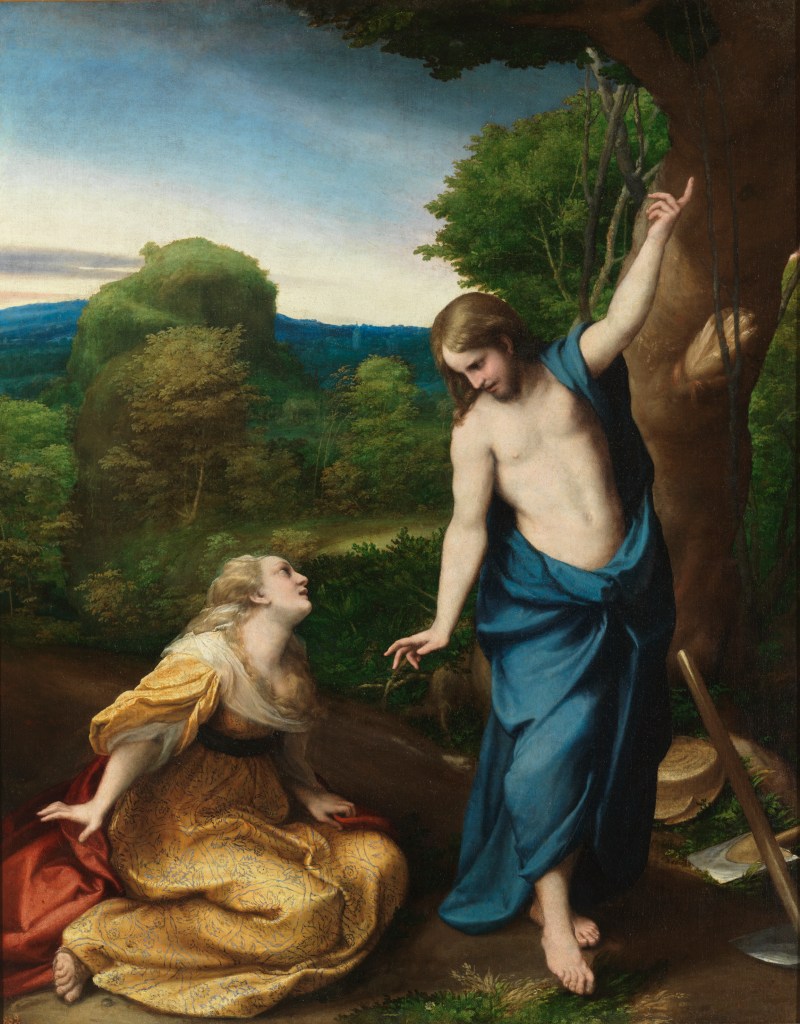
Our Gospel reading begins this process of correction and greater understanding. At the tomb, on the day of the resurrection, Mary Magdalene turned and recognized Jesus, “Rabbouni!” (which means Teacher). Jesus told her, “Do not hold on to me, because I have not yet ascended to the Father.”

“Do not hold on to me” is sometimes seen as Jesus saying, “Do not touch me,” but in the very next chapter, we have Jesus telling Thomas, “Reach your hand out and put it into my side.” So, “Do not touch me” doesn’t fit. Instead, what we see happening is Mary Magdalene projecting onto the Risen Lord the image she has of him in her mind, that of Rabbi and Teacher. And Jesus, by saying, “Do not hold on to me,” is saying, “Do not cling to the limited image you have of me. Things are different now.” As Paul said in our epistle, “If anyone is in Christ, there is a new creation: everything old has passed away; see, everything has become new!”

Mary was clinging to her understanding of Jesus before his death and resurrection. She was holding on to a world where, through sin, humankind was separated from the Father. But through his death and resurrection, that relationship has been made new:

Once you were not a people,
    but now you are God’s people;
once you had not received mercy,
    but now you have received mercy. (1 Peter 2:12)

This is why Jesus was able to say to her and the apostles, “I am ascending to my Father and your Father, to my God and your God.” No longer is it, “In my Father’s house there are many rooms,” but now, “In Our Father’s house.”

You have read about Jesus. You’ve heard preaching about his nature and attributes. Like Mary Magdalene – the Apostle to the Apostles – you have this image of Jesus in your mind. Question: Is that image an accurate portrayal of the Risen Lord, or are you holding onto an image that is – perhaps not wrong – but too small? Limited?

We will never fully understand God, but by asking the Holy Spirit to help us let go of what we think we know, that understanding can be broadened so that we might more fully know the God and Father of us all.

Sermon: Mary Magdalene

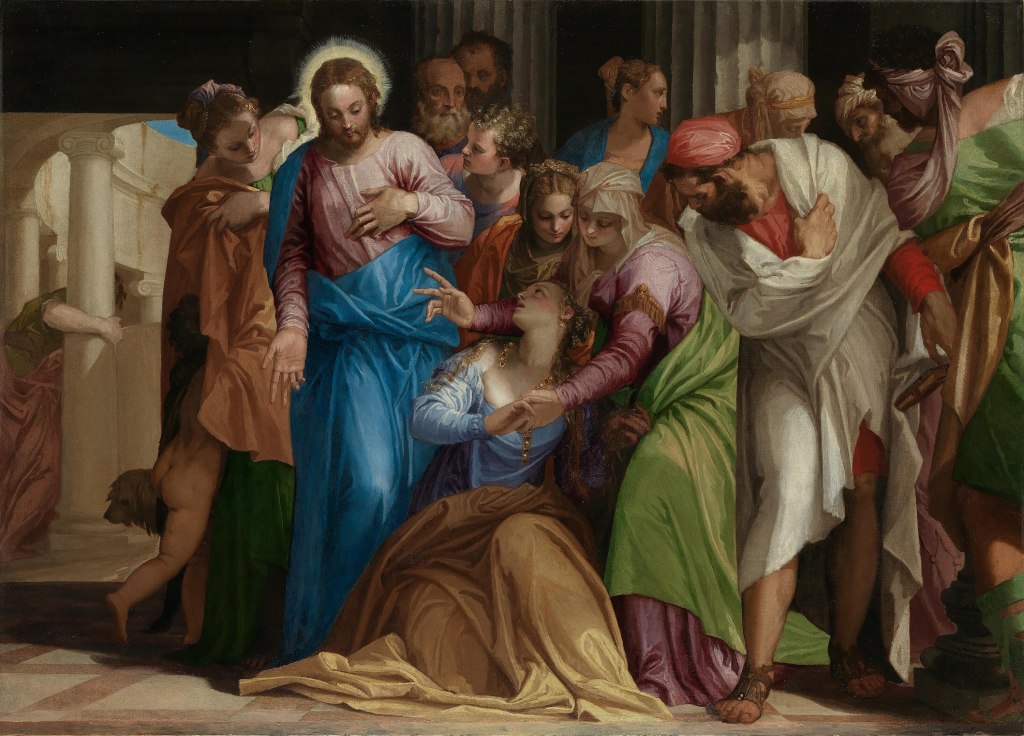
The Conversion of Mary Magdalene (1545-1548) by Paolo Veronese

In the Gospel of John, Jesus says, “If you belonged to the world, it would love you as its own. As it is, you do not belong to the world, but I have chosen you out of the world.”

If you belong to the world, it would love you as its own. There was a time in Mary Magdalene’s life that she belonged to the world and the world loved her as only the world could. It gave her all it had to offer and then some.

How did the world love her and what did it give her? By subjecting her to evil spirits and infirmities. Scripture tells us that Jesus casts seven evil spirits out of her. What were they? We can only imagine: lust, greed, anger, depression… and they all loved her dearly.

There is the movie 300, about the 300 Spartans who took on the entire Persian army. It appeared that the Spartans would be victorious until a traitor went to Xerxes, the Persian King, and betrayed the Spartans. Xerxes makes his case to persuade the traitor to give up the needed information by saying, “Your gods were cruel. The Spartans too were cruel. But I am kind. Everything you could ever desire, every happiness you can imagine, every pleasure your fellow Greeks and your false gods have denied you, I will grant you for I am kind. Embrace me as your king and as your god. Lead my soldiers and your joys will be endless.” The traitor agrees and Xerxes responds, “You will find I am kind. I require only that you kneel.” The traitor knelt and the Spartan army was destroyed.

At a point in her life, the world said to Mary Magdalene, “I am kind. I will grant you every pleasure, every joy. I require only that you kneel.” Like the Spartan traitor, she knelt before the false gods and empty promises, but instead of possessing the world, she was possessed by it. It brought her to a state of utter misery. Yes, the world loved Mary Magdalene with great passion and its sole intent was to keep her from the love of God.

“If you belonged to the world, it would love you as its own.” Yet Jesus went on to say, “As it is, you do not belong to the world, but I have chosen you out of the world.”

At some point early in his ministry, Jesus looked upon this woman Mary Magdalene. He saw her misery and her loneliness, but because of his great love for all of God’s children, he called out of her those seven spirits that possessed her, declaring, “No more. You can’t have her. She is mine. I love her and I have chosen her.”

Today we celebrate Saint Mary Magdalene. We celebrate her for many reasons, but the first of those reasons is the same for each of us. Jesus said, “I choose you.” She responded, “Yes, Lord.” Her actions that followed were in line with anyone’s who had been so clearly touched by God, because she was not only a witness to the death and resurrection of Jesus as attested to in our Gospel today, she was also a witness to the death and resurrection of her own life. Her life demonstrated her thankfulness through a life of service to our Lord and those she witnessed to.

The Apostle Paul wrote, “Since, then, you have been raised with Christ, set your hearts on things above, where Christ is seated at the right hand of God. Set your minds on things above, not on earthly things. For you died, and your life is now hidden with Christ in God.”

Mary Magdalene knew these words in her heart even before Paul had encountered the Risen Lord; by living them out, Saint Mary Magdalene demonstrates for us what it means to be chosen by God.