Sermon: Advent 3 RCL A – “Yes”


When it comes to daily devotional books that you might read as part of a spiritual practice, we most often think of ones that are uplifting and joyful. Something to give a good start to the day. I’ve come across several that I quit pretty quickly, but some I get very involved with. Few are specific for priests, but there are a couple, and one that I discovered several months back is The Dignity and Duties of the Priest, by St. Alphonsus Liguori. 

In the first few pages, I thought it would be inspiring and uplifting. There was a quote by St. John Chrysostom that was setting the tone—“Priests should be so holy that all may look to them as models of sanctity; because God has placed them on earth that they may live like angels, and be luminaries and teachers of virtue to all others.” I read that and began to feel good about my calling, but then it took a turn. A couple of pages later—“In a word, [the priest] that is not holy is unworthy to approach the altar, because by the stains that he brings with him, he contaminates the sanctuary of God. Let him not approach the altar, because he has a blemish, and he must not defile my sanctuary.” On the next page, a quote from Saint Augustine further illumines this: “To the Lord is more pleasing the barking of dogs than the prayer of such priests.”  

It was such a wonderful book—and I mean that—but there were mornings when I would look at it and say, “You’ll get your turn. Give me a minute.” Then I would read and get smacked again—“At present, says the holy church, I am not persecuted by the pagans, for the tyrants have ceased, nor by the heretics, because there are no new heresies; but I am persecuted by the [priest], who by his scandals robs me of many souls.” For such a priest, Liguori tells us, “The end shall be, first, abandonment of God, and then the fire of hell.” 

I kept reading—it actually changed my understanding of the priesthood—but I kept wanting him to throw me a bone. Give me some sign of hope, because there were times I felt convinced I had no chance of heaven.

Now imagine you are Jewish and living during the time leading up to the birth of Jesus. You attend synagogue every Sabbath. You understand the teachings of the Torah and sincerely want to follow them, but you find that every turn, you stumble over one aspect of the Law or another. The only way to enter God’s Kingdom is if you are without sin, but no sooner have you made the appropriate sacrifices at the Temple for the forgiveness of sins, you fall into another pit. You want to be holy, but there seems to be no hope.

Now, imagine you’re living in the small city of Nazareth. One night, after a long, hard day, you’re making your way home. As you walk, you recall all the times you’ve failed God, and you understand the consequences of those failures. Yet, until you can return to the Temple again to make the necessary sacrifices, your salvation remains in question. In your fear and frustration, you stop along the way and lean against a wall just to have a moment of quiet. Then, you see a strange light begin to shine out of the window of the house you’re leaning against. Just as you’re about to move on, you hear the sweetest voice begin to speak, and it stops you in your tracks. You have no choice but to listen.

“Greetings, O favored one, the Lord is with you!” There’s a brief pause, then you hear, “Do not be afraid, Mary, for you have found favor with God. And behold, you will conceive in your womb and bear a son, and you shall call his name Jesus. He will be great and will be called the Son of the Most High. And the Lord God will give to him the throne of his father David, and he will reign over the house of Jacob forever, and of his kingdom there will be no end.”

Another pause, then you hear a young woman’s voice, “How will this be, since I am a virgin?”

The response comes immediately: “The Holy Spirit will come upon you, and the power of the Most High will overshadow you; therefore, the child to be born will be called holy—the Son of God. And behold, your relative Elizabeth in her old age has also conceived a son, and this is the sixth month with her who was called barren. For nothing will be impossible with God.”

Imagine you’re listening outside the window as all this happens. You realize that it is an angel of the Lord speaking to the girl. What he offers is not only salvation for the girl, but for the whole world—yourself included. The angel is offering the hope you are so desperately seeking. You know that through the Son of God, whom the angel is speaking about, you will receive forgiveness of sin, you will be given the freedom to serve and worship God without fear, and that you will be set free from the sting of death. In that moment, you understand all of this, but you also realize that everything depends on one thing—the young woman’s response.

St. Bernard of Clairvaux wrote in a sermon about that moment—a moment when all of creation held its breath, waiting for Mary to speak: “You have heard, O Virgin, that you will conceive and bear a son; you have heard that it will not be by man but by the Holy Spirit. The angel awaits an answer; it is time for him to return to God who sent him. We too are waiting, O Lady, for your word of compassion; the sentence of condemnation weighs heavily upon us…. Tearful Adam with his sorrowing family begs this of you, O loving Virgin, in their exile from Paradise. Abraham begs it, David begs it. All the other holy patriarchs, your ancestors, ask it of you, as they dwell in the country of the shadow of death. This is what the whole earth waits for.”—Mary, what is your answer? On one side is condemnation and death, and on the other is the forgiveness of sins and life eternal.

As I read Liguori’s book, I kept asking, “Is there any hope?” And for you, standing outside the window, listening to the angel’s words, you’ve asked the same question: “Is there any hope?” Yes, there is. The greatest of all hope. Why? Because “Mary said: Behold the handmaid of the Lord; be it done to me according to thy word.” Mary said yes, and Hope Incarnate, the very Word of God, the Son of God, Christ Jesus the Lord, was conceived in the Virgin’s womb.

There is often confusion about why the Blessed Virgin Mary is held in such high esteem, but the answer lies in those few words of hers, for all of salvation—ours, the world’s, all of creation—hinged on her response.

That great Archbishop of Canterbury from the 11th century, St. Anselm, said, “To Mary God gave his only-begotten Son, whom he loved as himself. Through Mary, God made himself a Son, not different but the same, by nature Son of God and Son of Mary. The whole universe was created by God, and God was born of Mary. God created all things, and Mary gave birth to God. The God who made all things gave himself form through Mary, and thus he made his own creation. He who could create all things from nothing would not remake his ruined creation without Mary.”

If I could accomplish one thing today, it would be to increase your devotion to the Blessed Virgin Mary. Our salvation is through Christ Jesus alone—no one comes to the Father except through Him—however, it was through Mary and her yes that Christ took on our flesh and, through that same flesh, was able to give us hope. As I’ve told you before, this hope we possess is not mere wishful thinking. Our hope in Christ Jesus is an unshakable knowledge and expectation of what the Father has promised all along. What is that promise? We read it in the:

“He has shown the strength of his arm,
he has scattered the proud in their conceit.

He has cast down the mighty from their thrones,
and has lifted up the lowly.

He has filled the hungry with good things,
and the rich he has sent away empty.

He has come to the help of his servant Israel,
for he has remembered his promise of mercy,

The promise he made to our fathers,
to Abraham and his children for ever.”

The Father has promised that we will be with Him in His Kingdom, where there will be no end, and it all started with Mary’s “Yes.”

Mary’s life is devoted to guiding us to her Son, our Savior, Jesus Christ. Offer your devotion to her. Respect her as Queen and mother, and through her intercessions, you will be drawn deeper into your relationship with the One True God.

Let us pray: Hail, holy Queen, Mother of mercy, hail, our life, our sweetness and our hope. To thee do we cry, poor banished children of Eve: to thee do we send up our sighs, mourning and weeping in this vale of tears. Turn then, most gracious Advocate, thine eyes of mercy toward us, and after this our exile, show unto us the blessed fruit of thy womb, Jesus, O merciful, O loving, O sweet Virgin Mary! Amen.

Pray for us, O Holy Mother of God, that we may be made worthy of the promises of Christ.

Sermon: Our Lady of Guadalupe


The Feast of the Immaculate Conception of Mary was on Monday, the Feast of Our Lady of Loreto is today, and the Feast of Our Lady of Guadalupe is this coming Friday. We can’t cover them all, so I’ll share with you a report by Don Antonio Valeriano, a Native American author of the sixteenth century.

At daybreak one Saturday morning in 1531, on the very first days of the month of December, an Indian named Juan Diego was going from the village where he lived to Tlatelolco in order to take part in divine worship and listen to God’s commandments. When he came near the hill called Tepeyac, dawn had already come, and Juan Diego heard someone calling him from the very top of the hill: “Juanito, Juan Dieguito.”

He went up the hill and caught sight of a lady of unearthly grandeur whose clothing was as radiant as the sun. She said to him in words both gentle and courteous: “Juanito, the humblest of my children, know and understand that I am the ever virgin Mary, Mother of the true God through whom all things live. It is my ardent desire that a church be erected here so that in it I can show and bestow my love, compassion, help, and protection to all who inhabit this land and to those others who love me, that they might call upon and confide in me. Go to the Bishop of Mexico to make known to him what I greatly desire. Go and put all your efforts into this.”

When Juan Diego arrived in the presence of the Bishop, Fray Juan de Zumarraga, a Franciscan, the latter did not seem to believe Juan Diego and answered: “Come another time, and I will listen at leisure.”

Juan Diego returned to the hilltop where the Heavenly Lady was waiting, and he said to her: “My Lady, my maiden, I presented your message to the Bishop, but it seemed that he did not think it was the truth. For this reason I beg you to entrust your message to someone more illustrious who might convey it in order that they may believe it, for I am only an insignificant man.”

She answered him: “Humblest of my sons, I ask that tomorrow you again go to see the Bishop and tell him that I, the ever virgin holy Mary, Mother of God, am the one who personally sent you.”

The Bishop again did not believe and asked for a sign.

On Monday Juan Diego did not return. His uncle, Juan Bernardino, became very ill, and at night asked Juan to go to Tlatelolco at daybreak to call a priest to hear his confession.

Juan Diego set out on Tuesday, but he went around the hill and passed on the other side, toward the east, so as to arrive quickly in Mexico City and to avoid being detained by the Heavenly Lady. But she came out to meet him on that side of the hill and said to him: “Listen and understand, my humblest son. There is nothing to frighten and distress you. Do not let your heart be troubled, and let nothing upset you. Is it not I, your Mother, who is here? Are you not under my protection? Are you not, fortunately, in my care? Do not let your uncle’s illness distress you. It is certain that he has already been cured. Go up to the hilltop, my son, where you will find flowers of various kinds. Cut them, and bring them into my presence.”

When Juan Diego reached the peak, he was astonished that so many Castilian roses had burst forth at a time when the frost was severe. He carried the roses in the folds of his tilma (mantle) to the Heavenly Lady. She said to him: “My son, this is the proof and the sign which you will bring to the Bishop so that he will see my will in it. You are my ambassador, very worthy of trust.”

Juan Diego set out on his way, now content and sure of succeeding. On arriving in the Bishop’s presence, he told him: “My lord, I did what you asked. The Heavenly Lady complied with your request and fulfilled it. She sent me to the hilltop to cut some Castilian roses and told me to bring them to you in person. And this I am doing, so that you can see in them the sign you seek in order to carry out her will. Here they are; receive them.”

He immediately opened up his white mantle, and as all the different Castilian roses scattered to the ground, there was drawn on the cloak and suddenly appeared the precious image of the ever virgin Mary, Mother of God, in the same manner as it is today and is kept in her shrine of Tepeyac.

The whole city was stirred and came to see and admire her venerable image… they called her by the name that she herself had used: “the ever virgin holy Mary of Guadalupe.”

Sermon: The Annunciation +1

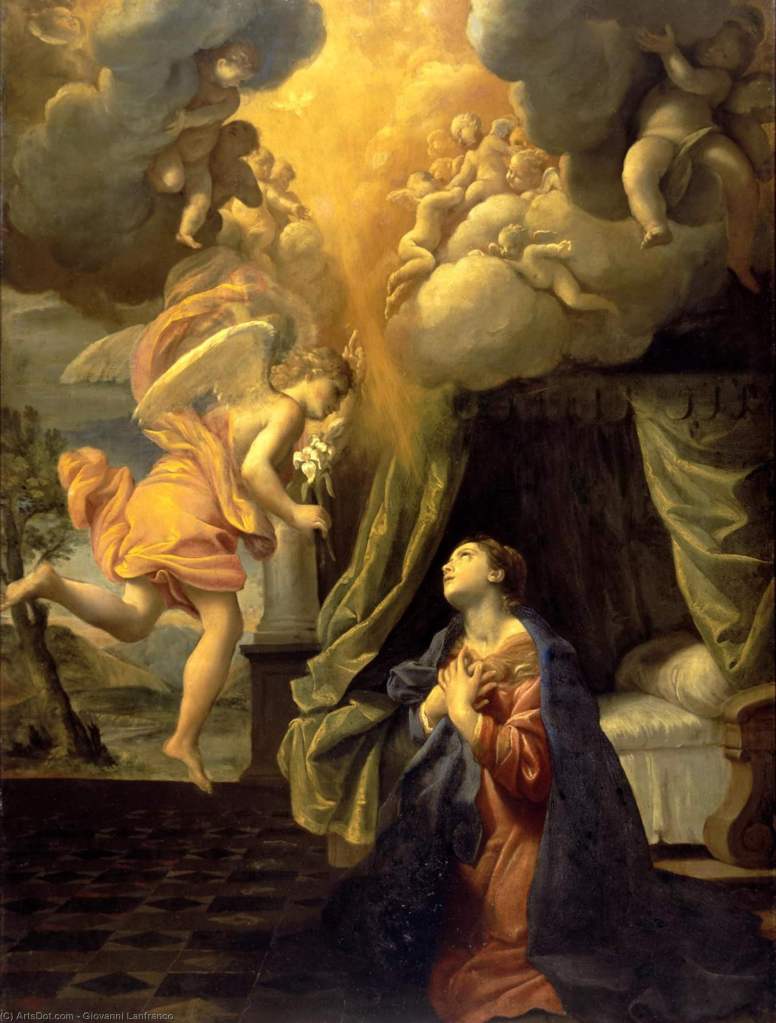
The Annunciation – Giovanni Lanfranco

During the Season of Lent, there are only two significant feast days on our church calendar. One was last Wednesday, the Feast of St. Joseph; the other was yesterday, The Annunciation. Both of these days are fixed, meaning we cannot transfer them from one date to another. St. Joseph’s Day must be celebrated on March 19, and the Annunciation must be celebrated on March 25. Today is March 26, so today we are celebrating the day after the Annunciation when Mary was only a little bit pregnant.

Why must the Annunciation be celebrated on March 26? Math and biology. It is, after all, only 274 days until Christmas—that would be nine months—when we celebrate the birth of Jesus. Therefore, even though we are only days away from Jesus’ death on a cross outside of Jerusalem, we pause to remember the day that the angel of the Lord came to the Blessed Virgin Mary and told her she would conceive in her womb the very Son of God.

The feast of The Annunciation is a pivotal event in God’s plan of salvation for His people.

For centuries, the prophets had been speaking of the coming of a Savior. Perhaps the prophet whose voice we are most familiar with regarding the Savior’s birth is Isaiah.

The people walking in darkness
    have seen a great light;
on those living in the land of deep darkness
    a light has dawned….

For to us a child is born,
    to us a son is given,
    and the government will be on his shoulders.
And he will be called
    Wonderful Counselor, Mighty God,
    Everlasting Father, Prince of Peace.

The world looked for this child, this Savior, because as St. Paul wrote in his letter to the Romans: “The creation was subjected to frustration, not by its own choice, but by the will of the one who subjected it, in hope that the creation itself will be liberated from its bondage to decay and brought into the freedom and glory of the children of God. We know that the whole creation has been groaning as in the pains of childbirth right up to the present time.”

The world is groaning under bondage and decay, but for the child to be born, Jesus can save it. However, all of this depends on the response of a young teenage girl.

The angel tells Mary, “You will conceive in your womb and bear a son, and you will name him Jesus.” He goes on to tell her about her cousin Elizabeth and then waits for Mary’s response. In the moment before Mary spoke, a deacon observed, “It was the moment when all creation held its collective breath.” (Source) St. Bernard of Clairvaux also wrote in his homily for this day, “You have heard, O Virgin, that you will conceive and bear a son; you have heard that it will not be by man but by the Holy Spirit. The angel awaits an answer; it is time for him to return to God who sent him. We too are waiting, O Lady, for your word of compassion.” (Source)

We know her response, but had we been present, we would also have held our breath. Will she say “Yes” or “No?” Will we be saved, or are we condemned forever?

Mary speaks. ”Here am I, the servant of the Lord; let it be with me according to your word.” And all creation wept for joy.

How does that short prayer begin: “Hail Mary, full of grace.
 The Lord is with thee.
 Blessed art thou among women…”

Our Mother Mary is truly blessed. Her “Yes” to God allowed the birth of our salvation.

I wonder, what would your “yes” to God accomplish?

Sermon: Joseph


In our study of the Gospels, certain characters beyond Jesus always capture our attention. There is, of course, Jesus’ mother, Mary, the disciples, John the Baptist, and even some antagonists—Pilate, Herod, the religious leaders. However, it seems to me that one character often fades into the background: Joseph, Jesus’ earthly “step-father.” Perhaps that is where he prefers to be, in the background, but as the head of the Holy Family, he should be regarded as one of the primary figures in the life of our Savior.

What do we know about him? He was of the lineage of King David, which was quite special. He worked as a carpenter, an honest trade. He was older than Mary and likely respected in the community. I don’t think he was wealthy, but given his profession, he was comfortable. It seems that his life was probably uncomplicated right up until he discovered that Mary was pregnant. Since they were not yet married, everyone, including Joseph, assumed Mary had committed adultery; therefore, Joseph could have accused her, and she would have faced stoning. Instead, he decided to walk away quietly. However, the angel of the Lord appeared to him in a dream, saying, “Joseph, son of David, do not be afraid to take Mary as your wife, for the child conceived in her is from the Holy Spirit. She will bear a son, and you are to name him Jesus, for he will save his people from their sins.” So, instead of walking away, Joseph followed the angel’s instructions.

It required a great deal of faith, but what Joseph did was truly sacrificial. He would have been justified in accusing her, but he chose not to. He would have had to swallow a bit of pride, yet it would have been even more convenient to just walk away; however, he looked upon Mary and took her as his wife. He regarded her with love. How much did he love her? He loved her enough to say that he would give up everything. He would sacrifice all he had for her. 

The love Joseph demonstrates is a sacrificial love. It is completely about and for another, regardless of whether there is any benefit for the one who loves; in fact, it may cost them a great deal. The purpose of such sacrificial love is to see Christ born in another. This is the sacrificial love that Joseph showed to Mary, and it serves as an example for us. We seek to follow Joseph’s example so that we, too, can see Christ born in another.

It’s not an easy question to answer, but what part of yourself would you sacrifice to witness God being born in another?  What is so important in you that you couldn’t sacrifice it? If that’s not enough, who would you be willing to sacrifice it for? Who wouldn’t you?

St. Josemaria Escriva writes, “This is the truth of a Christian’s life: self-giving and love—love of God and, for God’s sake, love of one’s neighbor—founded on sacrifice.” The life of St. Joseph exemplified both, as seen in his life of sacrifice. He may prefer to remain in the background, but in our Christian walk, we can look to him as a model for how we are to live and love.

Sermon: Our Lady of Guadalupe


On December 9, 1531, fifty-seven-year-old Juan Diego was walking to Mass. He is a convert to the faith and a widower. As he walks, he begins to hear the most beautiful music. Following the sound, he climbs Tepeyac Hill, located in what is now Mexico City.

When Juan Diego arrives at the top, he sees a beautiful apparition of the Blessed Virgin Mary. She speaks to Juan Diego, calming him, then telling him that she would like a church to be built on that spot for the people of Mexico. It is to be a place where they can come for healing and worship. She instructs him to go to the local bishop and give him this message, adding, “Now go and put forth your best effort.” 

Juan Diego does as he is told, but the bishop is highly skeptical, thinking this peasant is either mad or a trickster. So, he sends him away. 

Juan Diego returns to Tepeyac Hill, where he sees the Virgin again. He tells her what she already knew—he had failed. Mary tells him that he is to go again on the following morning and try again. Juan Diego is obedient, but the result is essentially the same; however, the bishop tells him if the visions are real, he is to bring some sign the following day. Juan Diego agrees, but when he returns home, he finds his uncle, who he lives with, very ill—near death. He cannot return to the bishop but must stay and care for him. 

Two days later, Juan Diego is convinced that his uncle will die, so he goes in search of a priest. Along the way, he again encounters Our Lady. He explains everything that has happened, yet she says, “Am I not your mother? Are you not in the crossing of my arms?” In other words, she says, “Don’t you trust that I will care for you?” He says that he will believe, and she gives him additional instructions.

Juan Diego is to go that moment and again climb Tepeyac Hill. There, he will find flowers that he has never seen before. He is to gather the flowers in his tunic and take them to the bishop as a sign. It is the middle of December when all this is happening, so he doesn’t know how flowers could bloom, but he does as he is told. Arriving, he finds a beautiful field of flowers. Gathering them quickly in his tunic, he rushes to see the bishop.

The bishop is still skeptical, but Juan Diego drops the flowers, thinking they are the sign, but there is much more. On his tunic, in great detail, is the image of the Blessed Virgin. The image is the sign.

While Juan Diego is with the bishop, the Blessed Virgin appears to his uncle, whom he was caring for. The uncle is healed, and the Virgin tells him of Juan Diego’s mission and that she will be called “Santa Maria, de Guadalupe.” 

The bishop believed, and the church was built on Tepeyac Hill, the former site of an Aztec Temple—The Basilica of Our Lady of Guadalupe. Millions have come to faith in Christ Jesus through these events.

The tunic that Juan Diego was wearing was made of cactus fiber. It should have fallen to pieces within thirty years. After more than 500 years, it is miraculously preserved.

What started it all was the message that Our Lady gave to Juan Diego on their first meeting. “Know for certain, least of my sons, that I am the perfect and perpetual Virgin Mary, Mother of the True God through whom everything lives, the Lord of all things near and far, the Master of heaven and earth. It is my earnest wish that a temple be built here to my honor. Here, I will demonstrate, I will exhibit, I will give all my love, my compassion, my help, and my protection to the people. I am your merciful mother, the merciful mother of all of you who live united in this land, and of all mankind, of all those who love me, of those who cry to me, of those who seek me, of those who have confidence in me. Here, I will hear their weeping, their sorrow, and will remedy and alleviate all their multiple sufferings, necessities, and misfortunes.”

God used a simple peasant farmer, Juan Diego, to bring this all about. How might God use you?

Sermon: Saint Mary the Virgin

Photo by Luca Tosoni on Unsplash

I don’t remember telling you about this before… I know of a man who, while praying the Rosary, had a vision of the Blessed Virgin Mary.

He had been walking along a country road. On one side of the road was a piney forest and on the other was a field and a pond. As he was walking, he had been searching for the Virgin, but unable to find her, then in the distance, he saw her walking toward him down the road. He quickly turned and ran to meet her, but—and this is probably funny—the closer she got, the bigger she got so that when they finally met, she was able to reach down and pick him up and put him in her pocket.

He tried to see through the weave in the fabric of her dress to see the outside world and determine where she was taking him, but was unable to. Not only that, but the further they went, the darker it became until all was dark. Yet as the light had lessened, he had been able to detect something new: a sound. At first, it sounded like the soft beating of a drum, but a short distance on, the sound was unmistakable: it was the beating of a heart. He began to not only hear the heartbeat, but to also feel it in his entire body. Each beat was like a loving embrace. It was then the man realized that Mary had done what she had always done: she had brought him to Jesus. You see, it was not her pocket that she had placed the man into. No. Mary had placed the man in the wound in Jesus’ side so that the man could be near the beating loving heart of the Risen Lord where he had learned even more of the great love of Jesus. He had been allowed to remain there for a short time and then was sent on his way to try and fulfill the Lord’s will.

There is always much confusion surrounding the role of Mary in the Church and in the life of God’s people, but that confusion only arrises when people fail to understand her purpose. Her purpose is to draw people in so that she can lead them or even take them to her Son… so that she can place them near His heart that they might know of His great salvific love for them.

I encourage you all to take her by the hand and to walk with her. When that walk ends, you will find that you have been brought to Jesus.

Eternal Father,
you inspired the Virgin Mary, mother of your son,
to visit Elizabeth and assist her in her need.
Keep us open to the working of your Spirit,
and with Mary may we praise you for ever.

We ask this through our Lord Jesus Christ, your Son,
who lives and reigns with you and the Holy Spirit,
one God, for ever and ever. Amen

May the Lord bless us,
protect us from evil
and bring us to everlasting life.
Amen