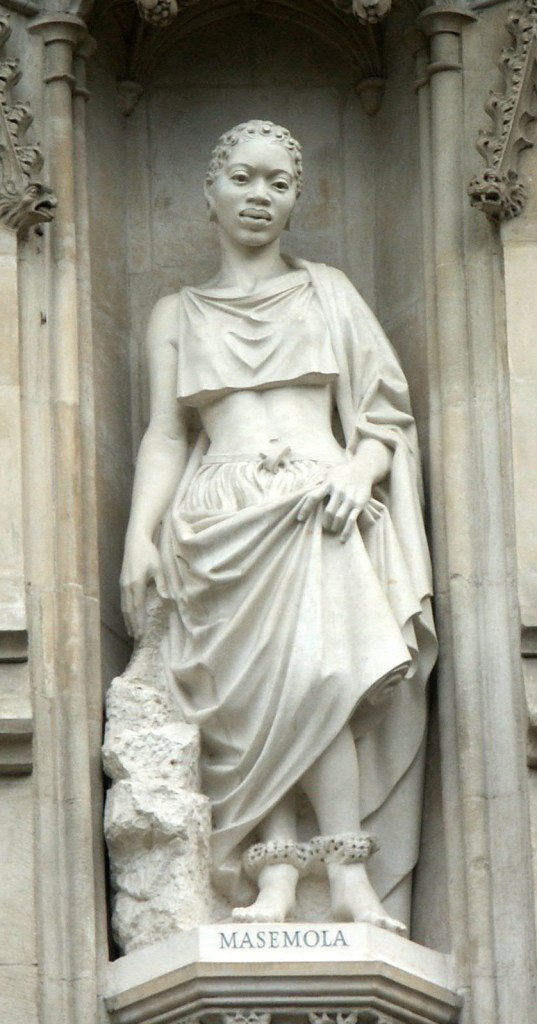
Sermon: Manche Masemola and Other Martyrs


Today, Thursday, and Friday, we celebrate three martyrs. Today, we remember Manche Masemola, an Anglican woman from South Africa who, in 1928, was put to death by her parents at age 15 for converting to Christianity and refusing to renounce her faith. She was unbaptized, but she declared she would be baptized in her own blood. Tomorrow is the Feast Day of St. Agatha, who, in 251 AD, was put to death at age 19 for refusing to renounce her faith and marry a Roman prefect. Shortly before her death, she prayed, “You Lord, who have created and guarded me from my childhood, and made me to act with manly strength, have taken from me the love of the passing world, who kept my body from contamination, who made me overcome the torments of the executioner, the iron, the fire, and the chains, who gave me in torment the virtue of patience! Please accept my spirit now, for it is already time that I should leave this world by your command and reach your mercy.” She is the patron saint of breast cancer patients, which points to some of the torture she endured. And, finally, Friday is the Feast Day of St. Paul Miki and his companions, who were missionaries in Japan in the 1500s and were put to death for proclaiming the Good News. Before he died, he said, “The only reason for my being killed is that I have taught the doctrine of Christ. I certainly did teach the doctrine of Christ. I thank God it is for this reason I die.”

Those are three of the estimated 70 million Christian martyrs since the time of Christ. Even today, 5,000 to 10,000 people are estimated to be martyred each year—people who died for the same cause as Manche, Agatha, and Paul Miki.

On her feast day, Saint Methodius of Sicily spoke of Agatha. The words he shared are true for Agatha and for all who have stood upon the solid rock of their faith in Christ Jesus. Methodius writes, “The woman who invites us to this banquet is both a wife and virgin. To use the analogy of Paul, she is the bride who has been betrothed to one husband, Christ. A true virgin, she wore the glow of pure conscience and the crimson of the Lamb’s blood for her cosmetics. Again and again she meditated on the death of her eager lover. For her, Christ’s death was recent, his blood was still moist. Her robe is the mark of her faithful witness to Christ. It bears the indelible marks of his crimson blood and the shining threads of her eloquence. She offers to all who come after her these treasures of her eloquent confession.

“Agatha, the name of our saint, means “good.” She was truly good, for she lived as a child of God. She was also given as the gift of God, the source of all goodness to her bridegroom, Christ, and to us. For she grants us a share in her goodness.

“Agatha, her goodness coincides with her name and way of life. She won a good name by her noble deeds, and by her name she points to the nobility of those deeds. Agatha, her mere name wins all men over to her company. She teaches them by her example to hasten with her to the true Good. God alone.”

My prayer is that none of us ever has to experience what these and so many others have gone through. My prayer is that if we do, we can stand as firmly in our faith as they did. My prayer is that we can look to their lives and their deaths and find the courage to live our faith in the smallest of details. As St. Josemaría Escrivá tells us, “‘Great’ holiness consists in carrying out the ‘little duties’ of each moment.” (The Way, #817)
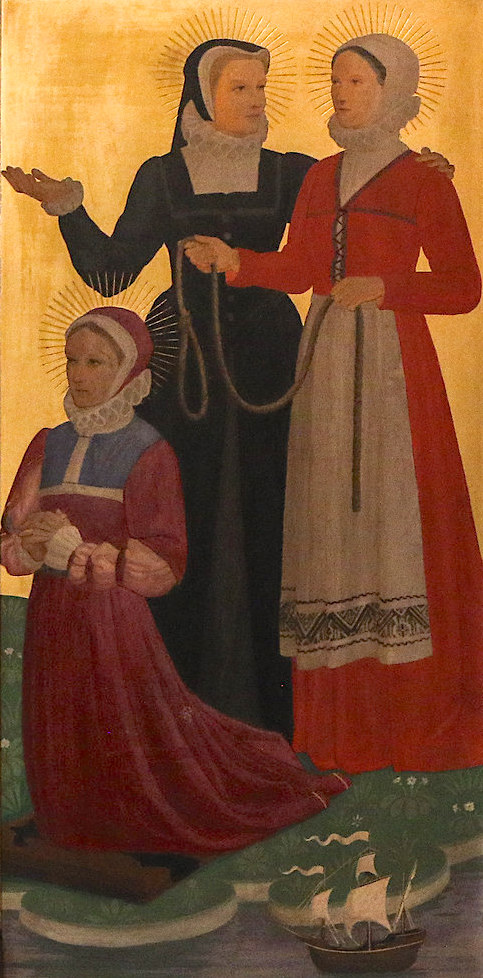
Sermon: Margaret Ward, Margaret Clitherow, and Anne Line


I have shared a quote from Archbishop of Canterbury Michael Ramsey with you in the past: “The Church is not the society of those labeled virtuous.  It is the mixed community of sinners called to be saints.” Unfortunately, the Church can sometimes be more sinner than saint.

The Reformation in the English Church was more political before it was theological, and the issues between the monarch and the Pope were going on long before Henry VIII, but it very much came to a head during Henry’s reign. 

The theological issues had to do with Luther and the protestant message, but the political had to do with who gets to be boss. Would it be the monarch or some guy in a pointy had a thousand miles away? The issue would not resolve itself for years to come, so it was still at play when Elizabeth I ascended the throne in 1558. 

There was no love lost between Rome and Queen Elizabeth I, and finally, in 1570, Elizabeth was excommunicated by Pope Pius V. I don’t think it bothered Elizabeth; however, what did bother her was the fact that the Pope said that Roman Catholics living in England no longer had to be obedient to her. What exacerbated the problem was that Mary, Queen of Scots, was in Scotland, and she was a Catholic stalwart and beacon to all those disgruntled Catholics who were no longer required to be obedient. Therefore, Elizabeth feared Mary might raise an army and come against her. We know that Elizabeth would eventually sign Mary’s death warrant, but in the meantime, she enacted several measures attempting to reign in the Catholics. 

The first measure was the 1581 Act of Persuasion against the recusants. (A recusant is one who is disobedient.) The act stated that if you were disobedient to the monarch, you would face steep fines (this got the attention of the rich) and imprisonment. However, it did not affect the changes Elizabeth had hoped for, so in 1585, she signed the Act against Priest.

This act stated that any priest ordained abroad since 1559 was automatically deemed a traitor and given forty days to leave the country or face arrest and execution. Furthermore, anyone attempting to harbor a Roman priest was also to be arrested and executed. This is where the three women we remember today enter: Margaret Ward, Margaret Clitherow, and Anne Line.

All three of these women were martyrs, and Margaret Clitherow was the first. Her home was searched, and a young boy who was afraid revealed the priest hole (where priests were hidden). Although pregnant with her fourth child, she was executed. 

Next was Margaret Ward. She helped a priest escape prison by smuggling in small pieces of rope, which he wove together and made a proper rope. The priest managed to escape, but Ward’s actions were discovered. Before her execution, she rejoiced, for, as she said, “Having delivered an innocent lamb from the hands of those bloody wolves.”

Finally, a raid on Anne Line’s home resulted in her arrest for the same crime as the others. The priest she was harboring also managed to escape (it bothers me a bit to think of them escaping while these women were dying). She told her accusers she was only grieved because she “could not receive a thousand more” priests to save.

St. Paul tells us in his letter to the Romans, “For one will scarcely die for a righteous person—though perhaps for a good person one would dare even to die.” (Romans 5:7) Jesus tells us, “Greater love has no one than this, that someone lay down his life for his friends.” (John 15:13)

Were the priests that were being saved, good people? I don’t know—not my department—but I do know that these three ladies showed the “greater love” that Jesus spoke of. We may never be called on to give our lives in such a way, but we are all called to demonstrate “greater love” to the world by making sacrifices so that the word of God may be proclaimed.