Two brothers went to an elder monk who lived alone in Scete. The first one said, “Father, I have learned all of the Old and New Testaments by heart.” The elder replied, “You have filled the air with words.” The other brother said, “I have copied out the Old and New Testaments and have them in my hut.” To this, the elder responded, “You have filled your window with parchment, but do you not know Him who said, ‘The kingdom of God is not in words, but in power?’ and again, ‘Not those who hear the law will be justified before God, but those who carry it out.’”
As holy as scripture is and as life-giving as the sacred texts are, they remain limiting, for if we find Jesus only in the words, He is confined to our intellectual ability to understand that which cannot truly be understood. But, as we know, Jesus is not just a figure in a book, nor a distant memory of ancient events; He is a living presence. Therefore, we are not only called to know about Jesus, but more importantly, we are called to know Jesus. We do this not only by listening to the voices of others, but also by hearing the voice of Jesus for ourselves.
My favorite monk, Thomas a Kempis, wrote, “O God, You Who are the truth, make me one with You in love everlasting. I am often wearied by the many things I hear and read, but in You is all that I long for. Let the learned be still, let all creatures be silent before You. You alone speak to me.”
Unless the Lord speaks to us and writes the words of scripture on our hearts, we are merely engaging in an academic exercise.
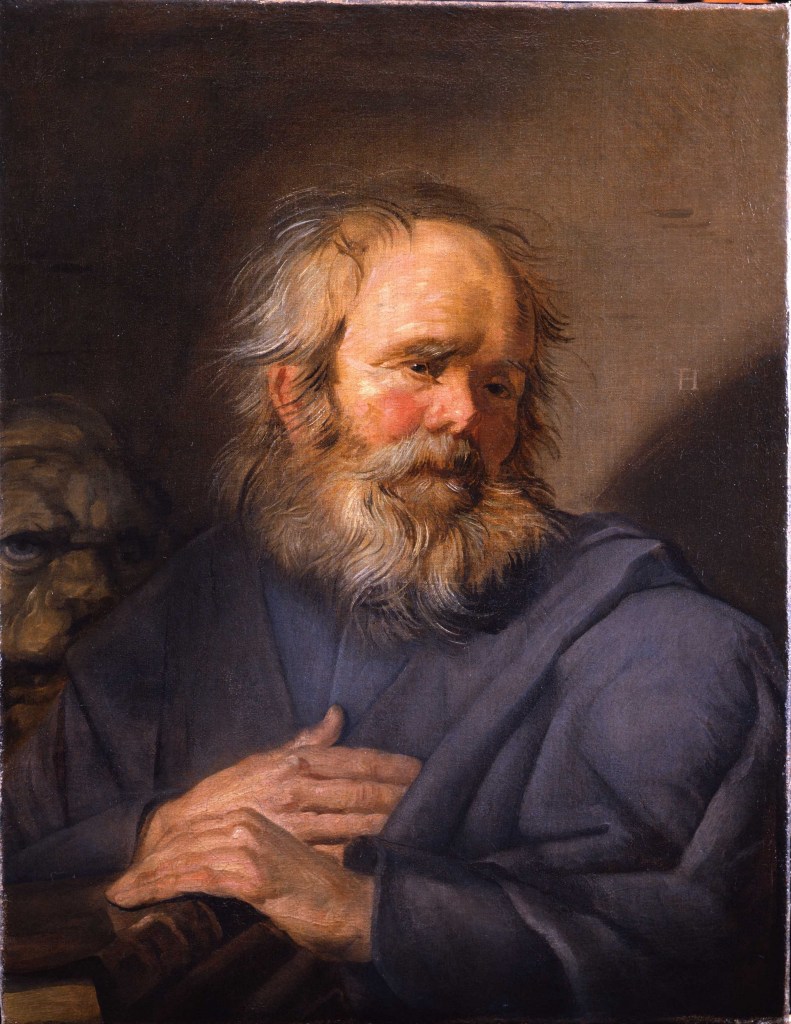
Holy Scripture does not say it specifically, but I feel as though St. Mark was someone who met Jesus, talked with Him, and so on. Scripture also indicates that he went on missions with Paul and Barnabas, and that he sat at the feet of the great Apostle Peter, learning much from him. Yet, even with all this, there had to come a day in his life when he set aside the writings and said, “Lord, You alone speak to me.” There must have been a day when he encountered and witnessed the crucified and resurrected Lord for himself, because his Gospel is a testimony to that encounter and a desire for you to have a similar experience.
The first words of his Gospel are, “The beginning of the good news of Jesus Christ, the Son of God.” From there, he narrates the story of Jesus in very succinct language.
In his Gospel, Mark tells the story of the Good News of Jesus Christ. After the apostles had encountered Jesus for themselves, they went out and proclaimed salvation so that others might experience Jesus—so that you and I might experience Jesus, not just in the words of the text but in our lives.
I encourage you, in your times of prayer and study, to set aside the scriptures and the prayer book—to set aside all those other voices, including your own—and say, “Lord, You alone speak to me,” allowing the One who has been handed down to us in the texts to speak to you personally.
There was a frog that absolutely knew his destiny was to turn into a handsome young prince. But for confirmation, he decided to visit a fortuneteller. The fortuneteller brought the frog in and gazed into her crystal ball. She said, “Oh, I see something. You are going to meet a beautiful young woman.”
The frog gets very antsy, “Yes, I knew it. I’m going to become a prince.”
The fortuneteller continues, “From the moment she sets eyes on you, she will have an insatiable desire to know all about you. She will be compelled to get close to you—you’ll fascinate her.”
The frog is very excited. It is everything he has ever desired. He asks, “Where am I? At a party? A restaurant? A palace?”
The fortuneteller gazes even deeper into her crystal ball, then, looking up, answers, “No, Biology class.”
The things we desire. Author Jackson Brown, Jr. said, “I’ve learned that if you give a pig and a boy everything they want, you’ll get a good pig and a bad boy.” (Live and Learn and Pass it On) There’s a good bit of wisdom in that. Wisdom that Herod could have benefited from.
Today’s Gospel reading is one of the few in our lectionary that does not include the words of Jesus. Instead, we have an incident from the life of Herod and his dealings with John the Baptist.
John the Baptist had condemned Herod for marrying his brother’s wife, Herodias. Was John correct in this condemnation? Yes. From the Law of Moses, “If a man takes his brother’s wife, it is impurity.” Herod may not have minded so much, but Herodias, his wife, took it personally and held a grudge against John. So, when the opportunity arose, it was probably she who convinced Herod to arrest John.
One day, while John is in prison, Herod throws himself a great birthday party and invites all his little minions to tell him how great he is. To impress them, we are told that he asked his “daughter Herodias” to come in and dance. This is a case of Daryl, his brother Daryl, and their brother Daryl. Herod’s wife is Herodias, and his stepdaughter is Princess Herodias, also known as Salome. Salome comes in and dances. Herod is so impressed with the dance that he makes an outlandish offer to the girl, “Ask me for whatever you wish, and I will give it. Whatever you ask me, I will give you, even half of my kingdom.” Salome is a child and has no idea what to ask for, so she runs to Momma and asks her. Having her grudge against John the Baptist, Momma asked for John’s head, probably because she feared her husband would eventually release John because he liked him. Having made the outlandish offer to the girl in front of all those guests, Herod had to make good on his promise to give her whatever she asked or lose face. Bottom line: John was beheaded.
There’s much we can learn from this, but one of my questions was, why did Herod promise up to half his kingdom to Salome? The answer, or at least part of it, is desire. The girl was young and beautiful, and the dance was provocative. Herod saw something he desired, and that desire drove him to lust for the girl, make outlandish promises, experience pride in his unwillingness to reverse course, go against his conscience, and ultimately to even greater sin in ordering the death of John. All of that because of desire.
There is a healthy desire for something. Such a desire leads to motivation, imagination, hope, and more. But so often, the things we desire are either of no consequence in the larger picture or, like with Herod, sinful.
Think of something you desire or want that falls outside the healthy category. Sometimes, the object of our desire is so elusive or outside the realm of possibility we know we will never be able to obtain it—perfect example: Scarlett Johansson. Never going to happen. You know it, and I know it, and if she knew I even existed, she would know it, but what if I didn’t? What if I became one of those weird, obsessive stalkers? What would that lead to other than a lengthy prison sentence? I would covet what others could have, and in that, I would become disappointed, angry, and frustrated. My actions would probably resemble something of Herod’s or the frog pinned down in a biology class.
At other times, we have the means to obtain those things we desire. Lucky you. However, how many times have you desired something in an unhealthy way, actually ended up getting it, but then being less than 100% happy with it, even disappointed? Sometimes, that’s a bit like reading a good book and hearing they’re making a movie out of the book. You get all excited, await the release date, watch the previews with anticipation, and then… eh. In other cases, when you finally obtain the object of your desire, you ask, “Now what?” “What is there to look forward to?” “What am I supposed to do?” “Is this all there is?” In those cases, instead of being happy, we start wanting something else, and the cycle repeats itself time and time again.
In all of these cases, what did it cost you? Time? Energy? Money? Joy? Peace? Happiness? What did it cost the people around you? Did you even consider them? Was it worth it? In seeking it out, how did you sin? Who did you hurt or neglect? How many blessings did you overlook or ignore because you were so singularly focused on this one desire? At that stage, perhaps we didn’t order anyone’s death, but we are no better than Herod, who desired a dancing girl.
So, again, think of something you desire, even those healthy desires, and replace it. Replace it with God. What if your desire for God was as great as your desire for things of this world? What if you were one of those weird obsessive stalkers, but the object of your obsession, of your desire, is God? Is that an unreasonable or unobtainable desire? No. The Lord says, “You will seek me and find me when you seek me with all your heart.” (Jeremiah 29:13) The Psalmist writes, “The Lord is near to all who call on him, to all who call on him in truth.” (Psalm 145:18) Once you have come into the presence of God will you say, “Now what? Is this all there is?” No.
“‘Oh, the depth of the riches and wisdom and knowledge of God! How unsearchable are his judgments and how inscrutable his ways!
‘For who has known the mind of the Lord, or who has been his counselor?’
‘Or who has given a gift to him that he might be repaid?’
For from him and through him and to him are all things.’” (Romans 11:33-36)
The knowledge, wisdom, love, and person of God and His Son Jesus Christ are inexhaustible. You will never delve the depths of God. There is always more, but unlike desiring more of this world, when you desire God, it never gets old or frustrating or boring. It only becomes richer and more exciting.
St. Augustine wrote his autobiography, Confessions, around the year 400. In the first chapter, he states, “Thou hast formed us for Thyself, and our hearts are restless till they find rest in Thee.” Then he asks, “Oh! how shall I find rest in Thee? Who will send Thee into my heart to inebriate it, so that I may forget my woes, and embrace Thee my only good?”
Like the things of this world, desiring God will cost you time and energy, but as Augustine says, God is the only one—the only desire—that will give you rest, where peace and joy are in such measure that the cup of your soul is overflowing. It might mean that I don’t end up on a date with Scarlett Johansson, but hopefully, I won’t end up splayed out with my hands and feet pinned down in some biology class, either.
King David wrote, “Whom have I in heaven but you? And there is nothing on earth that I desire besides you.” (Psalm 73:25) What of all the rest? Allow God to work these things out according to His good purposes, for as Jesus tells us, “Seek first—desire first—the kingdom of God and his righteousness, and all these things will be added to you.” (Matthew 6:33)
Let us pray: Father in heaven, our hearts desire the warmth of your love, and our minds are searching for the light of your Word. Increase our longing for Christ our Savior and give us the strength to grow in love, that the dawn of his coming may find us rejoicing in his presence and welcoming the light of his truth. We ask this in the name of Jesus the Lord. Amen.


 Candle in a Cave