Sermon: Christmas Day RCL A


The first words of the Bible are “In the beginning God created the heavens and the earth,” and then, in very poetic language, the account of creation follows: light and darkness, the sun, moon, and stars, earth, land and sea, plants, animals, and finally humankind. This is God’s creation.

The Gospel of John begins with a similar phrase: “In the beginning…” However, it is not the creation account that follows, but what was before even that — “In the beginning was the Word.” Then comes another poetic passage about who the Word is and what he does.

But why do we hear these verses today? It becomes clear when we read, “And the Word became flesh and dwelt among us.” These words point to the child in the manger. They reveal who this newborn child truly is—a human child, but not only that. His origins go back further and deeper than ours. We are people begotten of men, but Jesus is “God from God, Light from Light,” as the Nicene Creed states. He is God’s own Son, who has become man, taken on flesh, our mortal humanity, and become one of us.

God became man; this is what we say about the Christ Child in the manger. That is the focus of today’s Gospel. When God became man, He brought with Him the divine light that shines in the darkness—a light that brightens every shadow and dark corner as brightly as the noonday sun.

Why? Because He knows that we often wander in darkness—darkness of sin, death, sickness, war, and much more. We can become lost in a harsh world we don’t understand. We seek answers even when we don’t know the questions. That is why the Word became flesh, why God became man. So He could shine His divine light into the darkness of this world and our hearts, so that we might know joy and so that we all might find our way home to Him.

History records for us an interesting footnote. It was during the dark winter of 1864 at Petersburg, Virginia, where Robert E. Lee’s Confederate army faced the Union divisions led by General Ulysses S. Grant. The war, now three and a half years old, had transitioned from glorious charges to the muddy realities of trench warfare. Late one evening, Major General George Pickett, one of Lee’s generals, received news that his wife had given birth to a healthy baby boy. Throughout the line, Southerners lit large bonfires to celebrate the event. These fires did not go unnoticed in the Northern camps, prompting a cautious Grant to send a reconnaissance patrol to investigate. The scouts returned with news that Pickett had a son, and that the fires were celebratory. Interestingly, Grant and Pickett had been classmates at West Point and knew each other well. To mark the occasion, Grant also ordered bonfires to be built. 

What a strange night it was. Fires blazed on both sides of the lines for miles. No gunshots, no shouts, no fighting. Just light celebrating the birth of a child. But that didn’t last long. Soon, the fires died out, and darkness took over again—both of the night and of the war. 

The good news of Christmas is that in the midst of great darkness, there came a light, and the darkness was not able to overcome the light. It was not just a temporary flicker; it was an eternal flame. We need to remember that. There are times, in both world events and our personal lives, when we feel the light of the world will be snuffed out. But the Christmas story affirms that no matter what happens, the light still shines.

The theologian Robert Alden wrote, “There is not enough darkness in all the world to put out the light of even one small candle.” That being true, then the divine light born in a manger in Bethlehem is more than adequate to dispel the darkness of this world eternally.

Sermon: Transfiguration


St. Leo the Great said that the Transfiguration revealed to the disciples “the excellence of [Jesus’] hidden dignity.” That is, it revealed Jesus’ true nature. St. Paul mentioned in his first letter to the Corinthians, “For now we see in a mirror, dimly, but then we will see face to face.” Seeing Jesus outside of the Transfiguration, it was as if the disciples saw Him dimly, but in that moment, they saw Him fully; however, He is not the only one called to be transfigured, because when the Lord says, “You shall be holy, for I am holy,” He is calling for all of us to be transfigured into His likeness.

Anglican Bishop, Brook Westcott writes, “The Transfiguration is the revelation of the potential spirituality of the earthly life in the highest outward form. Such an event, distinct in its teaching from the resurrection, and yet closely akin to it, calls for more religious recognition than it receives. Here the Lord, as Son of Man, gives the measure of the capacity of humanity, and shows that to which he leads all those who are united with him.”

The Transfiguration revealed to us our potential and our fullest capacity as children of God. Achieving this potential, at least in part, makes the saints we study on Wednesdays so extraordinary. They become light to us, radiating Christ. What is the outcome?

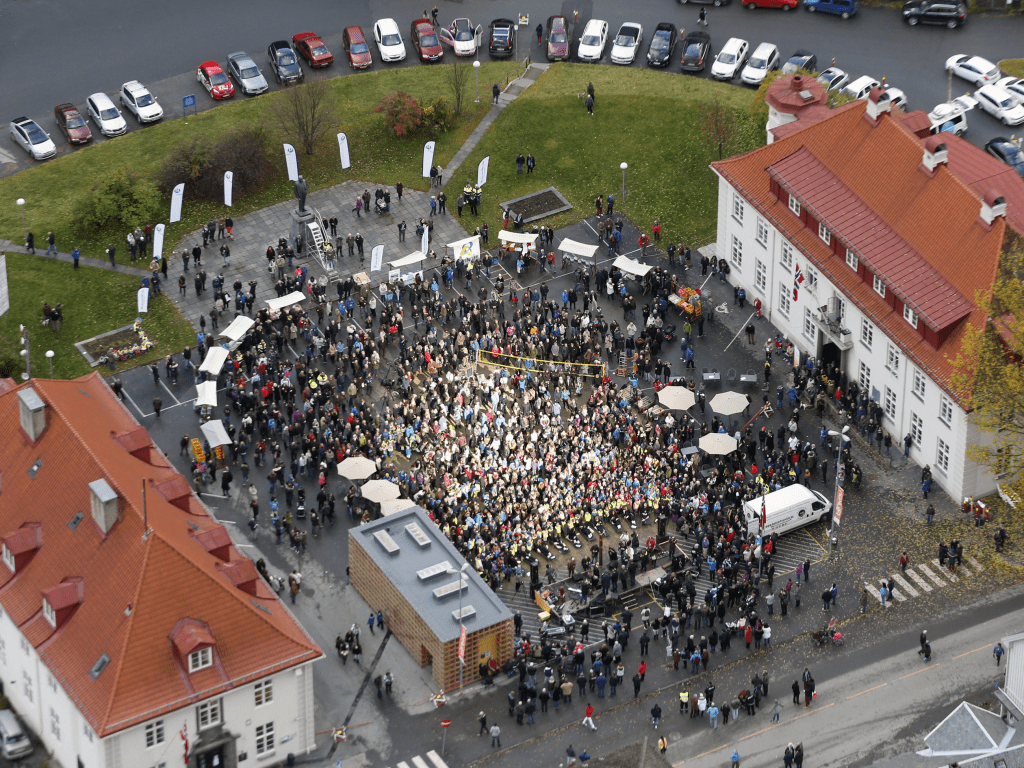
In south-central Norway, nestled in a mountain range (the name I won’t even attempt to pronounce), is the small community of Rjukan. The valley where the town is located is so narrow and the mountains so tall that, for six months each year, the town receives no direct sunlight; however, that changed in November 2013. Large mirrors were installed on one of the mountain peaks, and a computer tracks the sun’s movement and adjusts the mirrors’ angles so that a concentrated beam of light shines into the town square, creating a 6,500-square-foot patch of sunlight.

On the day the light started shining, one resident said, “People have been sitting there and standing there and taking pictures of each other. The town square was totally full. We are not that big of a town, so I think almost all the people in the town were on the town square.” She added, “It’s not very big, but it is enough when we are sharing.” (Source)

The saints we study are like mirrors, radiating—not their own light—but the light of Christ into the darkness of the world. As we say in the preface during the Eucharist on certain saints’ days, we give thanks to the Father, “For the wonderful grace and virtue declared in all your saints, who have been the chosen vessels of your grace, and the lights of the world in their generations.”  

It is this same light that we also seek to reflect. We accomplish this by setting ourselves aside and putting on Christ, working on our salvation with “fear and trembling,” and striving for sanctification in our daily lives. Like all the capital “S” Saints, there will be days and seasons of failure, but each day we start fresh until we are clothed in the robes of white and standing eternally before our Father in Heaven, fully transfigured into his glory.

Sermon: Christmas 1 RCL C – “Being Light”


A young girl once consulted with her priest. “I cannot stick it out any longer. I am the only Christian in the factory where I work. I get nothing but taunts and sneers. It is more than I can stand. I am going to resign.”

“Will you tell me,” asked the priest, “where lights are placed?”

“What has that to do with it?” the young Christian asked him rather bluntly.

“Never mind,” the priest replied. “Answer my question: Where are lights placed?”

“I suppose in dark places,” she replied.

Speaking of Jesus, John wrote in the Prologue of his Gospel, “What has come into being in him was life, and the life was the light of all people. The light shines in the darkness, and the darkness did not overcome it…. The true light, which enlightens everyone, was coming into the world.”

It speaks of Jesus, but it also speaks of the illuminating light of Jesus. A light that seeks out others and enlightens them in the ways of God. Jesus says toward the beginning of the Sermon on the Mount: “You are the light of the world. A city set on a hill cannot be hidden. Nor do people light a lamp and put it under a basket, but on a stand, and it gives light to all in the house. In the same way, let your light shine before others, so that they may see your good works and give glory to your Father who is in heaven.”

Jesus is the light, but he has shared His light with us so that we might also become beacons of hope and love in the darkness.

What does such light look like? 

Desmond Tutu was born in 1931, and he died on December 26, 2021. He was also one of ours—a South African Anglican bishop and theologian known for his work against apartheid and for human rights.

In 1940, Desmond’s mother worked as a cook in a hospital for women. The story tells that Desmond—he was nine years old at the time—and his mother were walking down the street, and a white man in a dark suit was walking toward them. The rules of apartheid dictated that Desmond and his mother step into the gutter, bow their heads, and allow the white man to pass. However, before they had the opportunity to do so, the white man stepped off the street first and, as they passed, tipped his hat to Desmond’s mother. After a time, Desmond asked his mother why the white man would do that, to which his mother replied, “He is a man of God.” The white man was Trevor Huddleston, Bishop in the Anglican Church.

Bishop Huddleston not only could have but should have ignored them; instead, he ignored the societal expectations and norms and honored the Image of God that was within them. He became a light in a dark world.

Tutu said much later, “I couldn’t believe my eyes, a White man who greeted a Black working-class woman.”  This one event was a great deal of the inspiration for Desmond becoming an Anglican priest.

What does it look like to be the light in the darkness? It is not necessarily something big and grand. Sometimes, it is nothing more than a tip of the hat, but that tip of the hat can speak volumes of the work of God.

Later, Bishop Tutu would say, “So often when people hear about the suffering in our world, they feel guilty, but rarely does guilt actually motivate action like empathy or compassion. Guilt paralyzes and causes us to deny and avoid what makes us feel guilty. The goal is to replace our guilt with generosity. We all have a natural desire to help and to care, and we simply need to allow ourselves to give from our love without self-reproach. We each must do what we can. This is all that God asks of us.” 

How will you be the light? You don’t have to look far, and you don’t have to come up with some grand scheme. All that is required is that you be faithful to God’s calling to love one another as He has loved us.

Let us pray (a prayer from Blessed John Henry Cardinal Newman that we can each make our own):  Dear Jesus, help me to spread Your fragrance everywhere I go. Flood my soul with Your spirit and life. Penetrate and possess my whole being so utterly that my life may only be a radiance of Yours. Shine through me, and be so in me that every soul I come in contact with may feel Your presence in my soul. Let them look up and see no longer me but only Jesus! Stay with me, and then I shall begin to shine as You shine, so to shine as to be a light to others; the light, O Jesus, will be all from You; none of it will be mine; it will be you, shining on others through me. Amen.

Sermon: Wednesday in Holy Week

Photo by David Werbrouck on Unsplash

The deadline for completing the construction of a skyscraper was near, so the crews worked around the clock. The night crew was hard at work on the twenty-first floor when unknown to the others, one of the welders went over the edge. 

Dropping everything, he flung his hands into the pitch-black and grabbed an edge. Hanging there, he yelled, screamed, and prayed that someone would come, but because of all the other construction noise, no one heard, and his grip began to slip. 

He let out a scream and fell… three feet, and landed on the scaffolding that was below him. Scaffolding he had not been able to see in the dark. 

There is a physical darkness, but we also know that there is a spiritual darkness, and it is this spiritual darkness Paul tells us we do battle against it. “Our struggle is not against enemies of blood and flesh, but against the rulers, against the authorities, against the cosmic powers of this present darkness, against the spiritual forces of evil in the heavenly places.” (Ephesians 6:12)  Therefore, Jesus tells us, “The light (He is the way, the truth, and the light)… the light is with you for a little longer.  Walk while you have the light, so that the darkness may not overtake you.  If you walk in the darkness, you do not know where you are going.  While you have the light, believe in the light, so that you may become children of light.” (John 12:35-36a)  And it is through Jesus, as Paul teaches us again, that we “are all children of light and children of the day.” (1 Thessalonians 5:5a)

Our Gospel tells us, “When Jesus had dipped the piece of bread, he gave it to Judas son of Simon Iscariot.  After he received the piece of bread, Satan entered into him.  Jesus said to him, ‘Do quickly what you are going to do.’” (John 13:26b-27) Then, “after receiving the piece of bread, Judas immediately went out.  And it was night.” (John 13:30)  As he turned from Jesus and left, Judas entered the darkness, both physically and spiritually.

Later that evening, “Judas brought a detachment of soldiers together with police from the chief priests and the Pharisees, and they came there with lanterns and torches and weapons.” (John 18:3) “They came there with lanterns and torches”—they came there in the dark and carried out the works of darkness, the works of the “spiritual forces of evil.”

For Judas, there was a threshold, both literally and spiritually, that he crossed when he went out. He intentionally stepped out of the light of the room where Jesus and the others were gathered—the Light of Christ—and, in a similar manner, he intentionally stepped into the spiritual darkness and was lost.

For Judas and for us, the threshold between the light and the dark is the place of testing. It is the place of free will, where we choose light or dark. The biggest mistake we can make is to think there can be a compromise.  “I won’t go so far into the night that I can’t see the threshold leading back into the light.”  That’s like a woman saying she’s only a little bit pregnant.  There is not a little bit of darkness. We either walk in the dark or we walk in the light. Therefore, walk in the light and believe in the light so that you may remain children of light.  This is God’s plan for us; through the guidance and strength of his Holy Spirit, we can be obedient.

Sermon: Lent 4 RCL B – “Into the Light”

Photo by Matthew Henry on Unsplash

Ol’ Boudreaux had been out carousing all night, so he decided it might be best to go to confession before going home to Clotile. It had been many years since his last confession, so he was a bit surprised when he stepped into the confessional. On one wall was a fully stocked bar with Guinness on tap. A dazzling array of the finest cigars and chocolates was on the other wall. Boudreaux here’s the priest come in on the other side and says, “Father, forgive me, for it’s been a very long time since I’ve been to confession, but I must admit that the confessional box is much more inviting than it used to be.”

The priest responds, “Get out! You’re on my side.”

The Israelites had been set free from their bondage in Egypt, and they passed through the parted waters of the Red Sea, but through their sin, they ended up wandering around for forty years. At one point, they came to Mount Hor, about forty miles south of the Dead Sea. As it was difficult in the land, they again complained against the Lord, so the Lord sent the serpents to punish them. Many died from being bitten by the poisonous snakes. When the people came to their senses, they confessed to Moses—“We have sinned by speaking against the Lord and against you; pray to the Lord to take away the serpents from us.” The Lord heard their cries for mercy, so He said to Moses, “‘Make a poisonous serpent, and set it on a pole; and everyone who is bitten shall look at it and live.’” So Moses made a serpent of bronze, and put it upon a pole; and whenever a serpent bit someone, that person would look at the serpent of bronze and live.” They named the bronze snake Nehushtan, and later in Israel’s history, they’ll turn it into a god and worship it, but that’s for another day. In today’s lesson, the people sinned, and death entered in the form of the serpents. When the people confessed their sins, the Lord provided a way for them to live—look upon the serpent that has been raised up, and you will live.

In our Gospel reading this morning, Jesus said, “Just as Moses lifted up the serpent in the wilderness, so must the Son of Man be lifted up, that whoever believes in him may have eternal life.”

In the time of Moses, the people sinned, and death came upon them. So they confessed their sin, and if they looked up at the bronze snake, they would live.

Today, we know that “all have sinned and fall short of the glory of God” (Romans 3:23) and that “the wages of sin is death.” (Romans 6:23) However, we also know that “If we confess our sins, [God] is faithful and just to forgive us our sins and to cleanse us from all unrighteousness.” (1 John 1:9) In confessing and repenting, we are not looking up at a bronze snake, but within our souls, we are looking up to our crucified Lord, and by doing so, by believing in the sacrifice He made on our behalf, we have eternal life.

Within the teachings of the Old Testament and the New, we know that there is sin and death, as well as forgiveness and life. However, between those two paths lies confession. 

There is the general/private confession we make almost every time we gather, and there is auricular confession. Auricular relates to the ear, meaning to be heard, so it is our confession to a priest.

Is the general/private confession just as good as auricular confession? Yes, in that forgiveness of sin is assured. No, in that sometimes, you need to confront and speak a sin—you need to make it real—not for God’s sake, but for yours, so that, as we say in The Exhortation, “you may receive the benefit of absolution, and spiritual counsel and advice; to the removal of scruple and doubt, the assurance of pardon, and the strengthening of your faith.” And there’s one more reason to speak your sins to another that the Prayer Book will not mention—it is humbling, and there are times when we need to be humbled. It is not a pleasant experience, far from it, but it is a cleansing one. 

Think of what Jesus said, “All who do evil hate the light and do not come to the light, so that their deeds may not be exposed. But those who do what is true come to the light, so that it may be clearly seen that their deeds have been done in God.” The confession of sin is the hauling out into the light those things we would prefer to keep hidden. It is the recognition that as much as we would like to think otherwise, we are not always good little boys and girls. In my heart, I can speak to God about my unrighteousness, and God says, “Yeah, I know.” However, when I speak to the image of Christ in another person, when I make my sin real, then I also genuinely know of my fallenness. No longer can I deceive myself into thinking that I’ve confessed when I come before another. In Life Together, Dietrich Bonhoeffer writes, “Our brother breaks the circle of self-deception. A man who confesses his sins in the presence of a brother knows that he is no longer alone with himself; he experiences the presence of God in the reality of the other person.” (p. 116) When we confess, we come into the light with all that is dark within us and allow God’s Light to reveal and cleanse us of that darkness.

I know that we always have fun when the topic of confession comes up, but I do believe in its ability to heal, so, all fun aside, I want you to know about it. Do I expect there to be a line on Wednesday for those of you seeking to make confession? Nope. But I do ask you to consider it, and if nothing else, the next time you make a general confession, don’t just say the words. Instead, bring the burden of your sins before God, and seek to make amendment of life, not just with words, but in actions as well. And then—and this is the other half and perhaps the more difficult aspect of confession—receive the absolution. Know in your soul, without hesitation or doubt, that you have been forgiven. You don’t have to carry the weight of your sins. As St. John tells us, “If we walk in the light, as he is in the light, we have fellowship with one another, and the blood of Jesus his Son cleanses us from all sin.” (1 John 1:7) Jesus was lifted up on the cross that you might receive forgiveness of sin. Receive that forgiveness and know that you have been made acceptable to God. From the Book of the Prophet Isaiah,

“Come now, let us reason together, says the Lord:
though your sins are like scarlet,
    they shall be as white as snow;
though they are red like crimson,
    they shall become like wool.”

(Isaiah 1:18)

Today, I’ll close with a portion of Psalm 32,

Blessed is the one whose transgression is forgiven,
whose sin is covered.
Blessed is the man against whom the Lord counts no iniquity, and in
whose spirit there is no deceit.
For when I kept silent, my bones wasted away
through my groaning all day long.
For day and night your hand was heavy upon me;
my strength was dried up as by the heat of summer.
I acknowledged my sin to you,
and I did not cover my iniquity;
I said, “I will confess my transgressions to the Lord,”
and you forgave the iniquity of my sin. (Psalm 32:1-5)

The Word of the Lord.

Thanks be to God.

Sermon: Advent 4 RCL A – “Perspective”

Photo by Philip Myrtorp on Unsplash

A new soldier was on sentry duty at the main gate of a military installation. His orders were clear. No car was to enter unless it had a special sticker on the windshield. A big Army car came up with a general seated in the back. The sentry said, “Halt, who goes there?”

The chauffeur, a corporal, said, “General Wheeler.”

“I’m sorry, I can’t let you through. You’ve got to have a sticker on the windshield.”

The general said to the chauffeur, “Drive on!”

The sentry said, “Hold it! You really can’t come through. If anyone attempts to drive in without a sticker, I have orders to shoot.”

The general barked at the chauffeur, “I’m telling you, son, drive on!”

The sentry walked up to the driver’s window and said quietly to the chauffeur, “I’m new at this. Do I shoot you or the general?”

One article states, “We each have a uniquely valuable perspective on life—a lens through which we interpret our lives. Through our perspective, we define what makes sense to us, which is differentiated from how others see and experience life.” (Source) From the general’s perspective, the world was at his command, and he could do what he wanted regardless of the rule. However, the chauffeur’s perspective was likely considerably different at that moment. The lens through which he was interpreting the situation was the barrel of a gun. 

The perspectives we hold are formed by many factors—environment, age, situation, knowledge, etc.—so our perspective is a combination of all these things and is something that is learned over time—according to the article—“Our perspective is arguably the single greatest aspect of our uniqueness.” Our fingerprints are as unique as each individual snowflake, and so are our perspectives. 

What’s interesting is when our perspective—the lens through which we view the world—encounters faith. For example, consider St. Peter.

The disciples are crossing the sea in their boat when they see Jesus walking on the water. At first, they are terrified, but then Jesus identifies himself, “Take heart; it is I. Do not be afraid.” Hearing this, Peter says, “Lord, if it is you, command me to come to you on the water.” And Jesus said, “Come.” And we know that Peter had faith, got out of the boat, and walked on the water, but then his perspective changed: “when he saw the wind, he was afraid, and beginning to sink he cried out, ‘Lord, save me.’” I firmly believe that Jesus laughed heartily when he said to soaking-wet Peter, “O you of little faith, why did you doubt?”

From his perspective, Peter, a fisherman who grew up working on the water, walking on water was impossible, yet through faith—at least for a few steps—Peter held a different perspective. Through faith, what he perceived to be impossible, was suddenly possible. When he reverted to his original perspective—doubt—he sank, but for those few steps, there was faith.

If it was night and all the lights were out, and these four candles were all the light in the room, some’s perspectives would still only show them darkness even though there was light.  They would see shadows in the corners and blackness under and behind objects. Yet others would see the hope of light. Even if the darkness were vast around them, they would see the light as a way forward. And many others would see both. Fear of the dark, but thankful there is at least a little light to keep some of the darkness at bay. You and I are somewhere on that spectrum. It depends on our perspective, but more importantly, it depends on our faith.

We read of Joseph in our Gospel lesson. Mary was found to be with child before they were married. He had not been with her, so he assumed another man had, so he planned to call off the wedding. Joseph was a kind man, but even so, he was not prepared to be with someone who had been unfaithful. Joseph looked around him and saw the dark and the shadows, and then the angel of the Lord came to him in a dream and said, “Joseph, son of David, do not be afraid to take Mary as your wife.” Joseph was shown the light but was his perspective going to change, or would he remain afraid of the dark—what will others say? How can I ever trust her? Was I really only dreaming and so many more shadows? Yet, another variable came to bear when he woke from his sleep: faith. Through faith, his perspective changed, and “he did as the angel of the Lord commanded him; he took her as his wife.”

There is a story about a train traveling through the night in a violent rainstorm. 

The lightning flashes were almost blinding, the rain hitting the windows was deafening, and the strong gust winds rocked the train from side to side. 

The passengers could see the rising water along the tracks when the lightning flashed and lit up the darkness. 

The engineer—the driver of the train— was unaware, but the storm and rising water created great terror in the minds of the passengers, so the engineer just kept going.

Several passengers noticed that through all the noise, lightning, and wind, one of the passengers, a little girl, seemed to be at perfect peace. 

The adult passengers couldn’t figure out why she was so calm. Finally, one passenger asked her, “How can you be so calm when all the rest of us are so worried about what might happen?”

The girl smiled and said, “My father is the engineer.”

Storms. Lightning. Rising waters. Darkness. Shadows. Death. Fear. “My father is the engineer.” Faith.

Joseph experienced those same fears, that darkness, but when he awoke, he had faith and said in his heart, “My father is the engineer.” Faith changed his perspective.

In the opening verses of his Gospel, St. John wrote, “The true light, which gives light to everyone, was coming into the world. He—Jesus—was in the world, and the world was made through him, yet the world did not know him. He came to his own, and his own people did not receive him. But to all who did receive him, who believed in his name, he gave the right to become children of God, who were born, not of blood nor of the will of the flesh nor of the will of man, but of God.”

Jesus, the true Light, came into the world, but many—even though they saw this light—continued to see shadows and darkness all around them. Those with faith received him and became children of God.

I’m not Pollyanna. I am very much aware of the shadows and darkness around us, but we cannot spend our lives dwelling in it. We must, through faith, change our perspective and see this light that has come into the world. It will not eradicate the darkness, but it will show us the way through the dark valley unto the Kingdom of our God… but not just that. It will also show us the way to the Kingdom of our God that is made manifest today, for his name is Emmanuel, which does not mean “God will be with us.” No. His name is Emmanuel, which means “God is with us.” And His Father is the Engineer.

Let us pray: Father in heaven, our hearts desire the warmth of your love, and our minds are searching for the light of your Word. Increase our longing for Christ our Savior and give us the strength to grow in love, that the dawn of his coming may find us rejoicing in his presence and welcoming the light of his truth. We ask this in the name of Jesus the Lord. Amen.


Click the image below to join the conversation on St. Matthew’s Facebook page.

Sermon: Advent 1 RCL A – “Separating the Darkness”

Michelangelo is painting the Sistine Chapel’s ceiling when he sees a woman praying the rosary. He decides to take a break and lies back on the scaffolding so the woman can’t see him and says in a loud voice, “I am Jesus Christ. Listen to me, and I will perform miracles.”

The woman is intent on her beads and prayers and does not look up.

Michelangelo figures that she is hard of hearing, so he shouts, “I am Jesus Christ! Listen to me, and I will perform miracles!”

With head bent, the woman continues praying, so Michelangelo shouts, “I AM JESUS CHRIST! LISTEN TO ME!”

The woman yells back, “Would you shut up? I’m talking to your mother.”

As you know, last Sunday, a group of us went down to the city and saw the Sistine Chapel Exhibit. Being together and seeing the images close up was a treat. 

The construction of the Sistine Chapel was completed in 1483 and consecrated by Pope Sixtus IV, but Michelangelo’s work did not begin until 1508. When it started, it took him four years. That is remarkable in itself, but when you consider a few more details, it seems impossible. The chapel is 132 feet long, 44 feet wide, and 68 feet high. With the arch, the ceiling—Michelangelo’s canvas—is over 12,000 square feet. 

Ten years after it was complete, not everyone got it. For example, a visiting bishop wrote, “Among the most important figures is that of an old man, in the middle of the ceiling, who is represented in the act of flying through the air.” That old man flying through the air is supposed to be God.

Finally, due to a mistranslated word, it was long believed that Michelangelo painted the ceiling while lying on his back. As it turns out, he did it standing and even wrote a short poem about how uncomfortable it was.

I’ve already grown a goiter from this torture,
hunched up here like a cat in Lombardy
(or anywhere else where the stagnant water’s poison).
My stomach’s squashed under my chin, my beard’s pointing at heaven,
my brain’s crushed in a casket, my breast twists like a harpy’s.
My brush, above me all the time, dribbles paint so my face makes a fine floor for droppings!
My haunches are grinding into my guts, my poor [back side] strains to work as a counterweight…
my spine’s all knotted from folding over itself.
I’m bent taut as a Syrian bow.

On our way home from the exhibit, Marianne asked us each which was our favorite image. For me, it is the one on the front of your bulletin, inspired by Genesis 1:1-4— “In the beginning, God created the heavens and the earth. “The earth was without form and void, and darkness was over the face of the deep. And the Spirit of God was hovering over the face of the waters. And God said, ‘Let there be light,’ and there was light. And God saw that the light was good. And God separated the light from the darkness.” In the picture, God is looking up and separating the light from the dark. It is as if he were pushing the darkness asides so that the light could be revealed. 

How is this relevant for us today? Because the bringing of light into the darkness is what the Season of Advent is all about. 

[Light first Advent candle]

As we light the first candle, it does not provide much light, but it is only the beginning.

You all know I’m a Stephen King fan and my favorite Stephen King book (I won’t scare you by telling you how many times I’ve read it) is The Stand. The setting is a world where 99.99% of all human beings have died—very uplifting. At one point, two individuals, Larry and Rita, must find their way out of New York City, and they choose to walk through one of the tunnels. There is no electricity, so the tunnel is dark and jammed up with cars, and… let’s just say it is a scary place. They’ve lost their lights (naturally) and are blindly stumbling through the pitch-black tunnel. Rita suddenly stops, and Larry asks her what is wrong.

Rita says, “‘I can see, Larry! It’s the end of the tunnel!’

“[Larry] blinked and realized that he could see, too. The glow was dim and it had come so gradually that he hadn’t been aware of it until Rita had spoken. He could make out a faint shine on the tiles, and the pale blur of Rita’s face closer by. Looking over to the left he could see the dead river of automobiles.”

St. Matthew tells us:

“The people dwelling in darkness
    have seen a great light,
and for those dwelling in the region and shadow of death,
    on them a light has dawned.” (Matthew 4:16)

Like Rita and Larry, the people had been in darkness so long that they may not have even noticed that light was coming into the world. Like the dawn that comes slowly, almost imperceptibly at first, but the light is there. The people only needed to recognize it. And recognizing the light is not always easy, especially when our souls are in a dark place.

For many individuals, the holiday season is not a happy season. They can put on a smile at the office party or be cheery while around others, but inside… they are not so good. Instead of being a time of joy, it is a time of regrets or loneliness. It is a time for missing those we’ve lost: spouses, other family members, and friends. It is also a time when we may experience the loss of ourselves and all the what-ifs. At such times, our souls can begin to feel like Michelangelo’s body as he painted the Sistine Chapel: tortured, hunched, crushed, unbalanced, bent out of shape, and worse. As a result, just as this time of year has greater darkness, a darkness of a spiritual nature can seep into our souls and spirits. Like walking through that tunnel, our souls stumble along, unable to see what is around us. For some in that place, even if the light does begin to shine, like Larry, who had spent so much time in that dark tunnel, they aren’t able to recognize that the light has started to shine. 

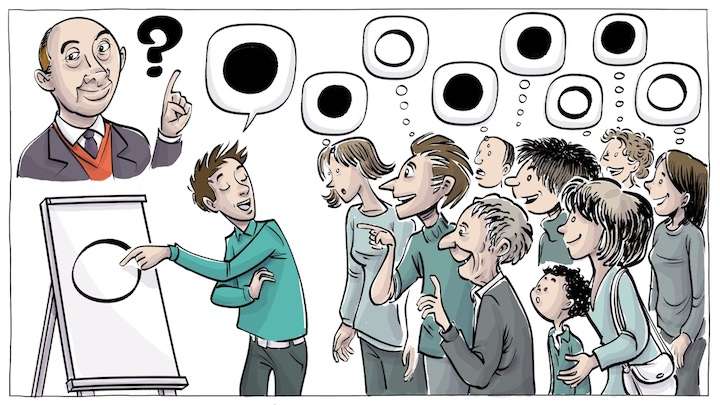
We know that Jesus said, “I am the light of the world. Whoever follows me will not walk in darkness, but will have the light of life.” So, when we encounter someone in that spiritually dark place, we can quote that off to them, thinking that should be enough, but the last thing a person in a spiritually dark place needs from you is for you to start preaching to them. No. What they need from you, more than anything is for you to be that candle. Don’t tell them about the light, be the light. You can’t simply “fix” them so, it may be that you can only sit in that dark place with them, but you can be a sign of hope. Your presence will tell them what Rita said to Larry: “I can see, Larry! It’s the end of the tunnel!” 

If you are a person who is in that dark place, then I encourage you to look around you here because I see many candles burning brightly who would share their light with you. You are loved by God and by God’s people. Your soul may be in a dark place, but you do not have to be alone. I read, “Hope is faith holding out its hand in the dark.” You do not have to be alone in the dark. Perform one small act of hope: reach out.

God is still separating the light from the darkness, and he invites us all to participate in this great work. When the work begins, it may be only a dim glow, one small candle’s worth, but it will be there—a sign of hope—and we can know that it is only the beginning of all that Our Father longs to give us.

Let us pray: Father in heaven, our hearts desire the warmth of your love, and our minds search for the light of your Word. Increase our longing for Christ our Savior and give us the strength to grow in love, that the dawn of his coming may find us rejoicing in his presence and welcoming the light of his truth. We ask this in the name of Jesus the Lord. Amen.