Sermon: Lent 4 – The Nails in His Feet


On the first Sunday of Lent, I shared that the movie The Passion of the Christ was heavily inspired by the text we’ve been meditating on for the past three weeks—The Dolorous Passion of Our Lord Jesus Christ by Anne Catherine Emmerich. One of the scenes in the movie, which is not found in Scripture, originates from Chapter 39.

I apologize in advance for reading too much to you today.

In the movie, the cross lies on the ground while Jesus is nailed to it. A hole has been dug at the base of the cross to allow it to stand upright. Now, with ropes tied to it, the soldiers are lifting the cross so that it will settle into the hole. When the cross is finally vertical, it drops violently a few feet into the prepared hole.

In chapter 39, Catherine speaks of this sudden violent dropping, the sound of it, and the result.

The cross was “raised up in the midst of the vast concourse of persons who were assembled all around…. The air resounded with acclamations and derisive cries when they beheld it towering on high, and after vibrating for a moment in the air, fall with a heavy crash into the hole cut for it in the rock. … When the solemn sound of the fall of the cross into the hole prepared for it in the rock was heard, a dead silence ensued, every heart was filled with an undefinable feeling of awe—a feeling never before experienced, and for which no one could account, even to himself; all the inmates of hell shook with terror, and vented their rage by endeavouring to stimulate the enemies of Jesus to still greater fury and brutality; the souls in Limbo were filled with joy and hope, for the sound was to them a harbinger of happiness, the prelude to the appearance of their Deliverer. Thus was the blessed cross of our Lord planted for the first time on the earth; and well might it be compared to the tree of life in Paradise, for the wounds of Jesus were as sacred fountains, from which flowed four rivers destined both to purify the world from the curse of sin, and to give it fertility, so as to produce fruit unto salvation.

The eminence on which the cross was planted was about two feet higher than the surrounding parts; the feet of Jesus were sufficiently near the ground for his friends to be able to reach to kiss them.”

In the New Testament, the Simon we are most familiar with is Simon Peter; however, there is another Simon, Simon the Pharisee, who we hear about in Luke’s Gospel.

Simon invites Jesus to dinner. While there, “A woman in that town, who lived a sinful life, learned that Jesus was eating at the Pharisee’s house, so she came there with an alabaster jar of perfume. As she stood behind him at his feet, weeping, she began to wet his feet with her tears. Then she wiped them with her hair, kissed them, and poured perfume on them.”

Simon, aware of this woman’s reputation, believes that if Jesus truly is who he claims to be, He would recognize that this woman is wicked. Understanding Simon’s thoughts, Jesus then told a parable. 

“Two people owed money to a certain moneylender. One owed him five hundred denarii, and the other fifty. Neither of them had the money to pay him back, so he forgave the debts of both. Now which of them will love him more?”

Simon replied, “I suppose the one who had the bigger debt forgiven.”

Simon receives the gold star. Jesus then says, “Do you see this woman? I came into your house. You did not give me any water for my feet, but she wet my feet with her tears and wiped them with her hair. You did not give me a kiss, but this woman, from the time I entered, has not stopped kissing my feet. You did not put oil on my head, but she has poured perfume on my feet. Therefore, I tell you, her many sins have been forgiven—as her great love has shown. But whoever has been forgiven little loves little.”

To the woman, Jesus says, “Your sins are forgiven…. Your faith has saved you; go in peace.” (Luke 7:36-50)

Gathered around Jesus as He hung upon His Cross were soldiers, religious leaders, gawkers, and followers. However, Catherine tells us that others were present—demons who cheered on those committing these evil acts and souls in Limbo, witnessing the coming of their salvation. Heaven, Hell, and all of creation witnessed the King upon the Cross, which we can break down into their respective categories. However, in the end, there are really only two categories, and Jesus identified them earlier in His ministry. He stated, “Whoever is not with me is against me, and whoever does not gather with me scatters.” (Matthew 12:30)

Gathered around the Cross were those who were either with Jesus or against Him. Present were those whose sins were forgiven and those who stood condemned. There is no gray area. Those who were forgiven, out of the deepest gratitude and adoration, came forward and, like the woman in Simon’s house, kissed the feet of Jesus. Like the Prodigal Son, they were the ones who knew they had been lost but also understood that they had been found, forgiven, and would be received into the Kingdom of God as sons and daughters. 

What is particularly interesting is the fact that in the past 2,000 years, nothing has changed. There is our crucified Savior upon His Cross, and gathered around Him are Heaven, Hell, and all Creation. As before, we can categorize them into their respective groups—white/black, Republican/Democrat, male/female, rich/poor, Asian/European, etc., etc., etc. However, as before, there are only two categories—those who are with Jesus or those who are against Him. Sons and daughters of God Most High or condemned. Some will time and time again nail Jesus’ feet to the cross, while others will, out of the deepest sense of gratitude and adoration, come forward and kiss His bloodied feet. There are those who will hear Jesus say, “I never knew you; depart from me” (Matthew 7:21), and there are those who will hear Jesus say, “Your sins are forgiven…. Your faith has saved you” (Luke 7:50).

Have faith. Within your soul, come and kneel before the Cross of Jesus, and kiss the nail-pierced feet. He is the only One who can forgive and save, and He endured all of this for you. He is waiting for you.

Let us pray… Lord Jesus Christ, author of our salvation and most gracious Dispenser of pardon, and most patient in tolerating man’s wickedness, I bless and thank you for the great pain, the many stripes, and the bloody wounds inflicted on your tender and noble body. From the soles of your feet to the crown of your head there was no area without its injury or lesion.

O precious wounds, supreme signs of incomparable love, abounding with divine sweetness, it is from you that the sinner learns abiding trust.. otherwise his guilty conscience would cause him to despair. In these wounds we find the medicine for life, abundant grace, full forgiveness, unstinting mercy, and the gateway to promised glory. Whatever defilement I incur or whatever sins of the flesh I commit, it is in these fountains that I wash myself clean, and am purified, and again made new. 

Lord Jesus Christ, fountain of holiness and sweetness, I bless and thank you for your abundant love… Instill in my flesh a fear of you, lest I yield to carnal appetites; pierce my hands, lest I yield to sloth; transfix my feet that I may remain firm and courageously endure toil and sorrows. May your nails enter my heart’s center and there inflict a saving wound, as a consequence of which and because of my overwhelming contrition, may I shed tears and be lost in love of you. Fill me with wonder and increase my devotion, until nothing will be more pleasant or dearer to my heart than Christ Jesus and him crucified. Amen.

Sermon: Ash Wednesday RCL C – “Sphragis”

Photo by Ilya Chunin on Unsplash

A man opened a zoo filled with the most amazing animals the world had ever seen, charging $300 per person for admission. However, nobody came, so he reduced the price to $200 per person. Still, there were no takers. This continued until he lowered the price to $10 per person, and when no one showed up, even then, he made entry free. On that day, the zoo was jammed with people. The man then locked the gates, let loose the lions, and charged a $500 exit fee. Everyone paid.

As I read that story, I thought, “That’s the way of the darker side of the world—placing all these temptations out there, enticing us with all sorts of tricks, and then locking us in with all the evil we’ve so often brought upon ourselves.” As St. Peter said in his First Epistle, “Your adversary the devil prowls around like a roaring lion, seeking someone to devour.” (1 Peter 5:8) 

How are we to fight such a formidable adversary?

In the ancient world, a shepherd would place a sphragis, a mark or brand, on his sheep. This sphragis was a sign to all that not only was a sheep that was marked the property of the shepherd but also one who was under the shepherd’s protection.

The early Church Fathers took this understanding of the sphragis and applied it to our Baptism and the sealing we receive when we are Chrismated at either Baptism or Confirmation. Chrismation is the signing of the cross on the forehead with the holy oil, and whether the words are said or not, the result is the same: “You are sealed by the Holy Spirit in Baptism and marked as Christ’s own for ever.” 

You have received the sphragis of Christ. You are His, but like a shepherd and the sheep, this does not imply you are His, as though you were a slave. It means you are His, and He will watch over you and care for you. He will lead you to green pastures and still waters. He will revive your soul. In short, it means He loves you.

Writing in the 4th century, St. Gregory Nazianzen says, “If you fortify yourself with the sphragis, and secure yourself for the future with the best and strongest of all aids, being signed both in body and in soul with the anointing… what then can happen to you and what has been worked out for you? … This, even while you live, will greatly contribute to your sense of safety. For a sheep that is sealed is not easily snared, but that which is unmarked is an easy prey to thieves.” (The Sign of the Cross: Recovering the Power of the Ancient Prayer, p.47)

We have been sealed as one of Christ’s own forever, so when the darker side of the world locks the gates and sets loose the lions, we have One, the Good Shepherd, who will be with us. However, even though Christ’s sphragis is placed upon us, we still have a responsibility. St. Paul tells us, “God’s firm foundation stands, bearing [this sphragis]/this seal: ‘The Lord knows those who are his,’ and, ‘Let everyone who names the name of the Lord depart from iniquity.’” 

We are under the Lord’s protection, but let us avoid putting ourselves deliberately in the lion’s mouth.

The ashes you receive today are a sign of penance and a reminder of where we are all headed—“Ashes to ashes, dust to dust.” The ashes remind us that we have sinned and that the penalty for sin is death. However, through our faith in Jesus, the ashes and what they represent wash away, and all that remains is Christ’s sphragis, His seal upon our bodies and souls.

During this Season of Lent, set yourself aside and submit to the Shepherd of your soul. Allow Him the opportunity to lead you into the safety of His pastures.

Sermon: “Spiritual Disciplines”


How easy is it for you to maintain your focus on any given thought or practice? For most of us, our minds wander. We get sidetracked by the demands of the world, by our ever-dinging and chiming devices, and by the random thoughts that ceaselessly stream through our minds. It is true for our life in the world, and it is true for our life with God. Because of this, learning to clearly focus on a single task is a practiced skill. If you’ve ever tried to sit down and pray, you know how this works. You are attempting to focus on God, then, without even the awareness of it occurring, you’re thinking about having curly fries for lunch.

My all-time favorite novel is The Stand by Stephen King. The publishers said it was too long, so they made him cut 150,000 words (500 pages) to make it more manageable. It would later be printed in its entirety, which made me a thrilled reader. It is now a hefty doorstop with 1,440 pages. How does someone write so much? 

In his own words, Sai King says, “I used to tell interviewers that I wrote every day except for Christmas, the Fourth of July, and my birthday. That was a lie. I told them that because if you agree to an interview you have to say something, and it plays better if it’s something at least half-clever. Also, I didn’t want to sound like a workaholic dweeb (just a workaholic, I guess). The truth is that when I’m writing, I write every day, workaholic dweeb or not. That includes Christmas, the Fourth, and my birthday (at my age you try to ignore your … birthday anyway). And when I’m not working, I’m not working at all, although during those periods of full stop I usually feel at loose ends with myself and have trouble sleeping. For me, not working is the real work. When I’m writing, it’s all the playground, and the worst three hours I ever spent there were still pretty… good.” (On Writing, p.153)

King has learned the art of focus—approaching the task with unwavering attention and has become one of the most prolific writers ever. Can I focus like that? Nope. I’ve thought about what’s for lunch at least twice since we’ve been here. What’s this got to do with today?

“While Jesus was going up to Jerusalem, he took the twelve disciples aside by themselves and said to them on the way, ‘See, we are going up to Jerusalem, and the Son of Man will be handed over to the chief priests and scribes, and they will condemn him to death; then they will hand him over to the Gentiles to be mocked and flogged and crucified; and on the third day he will be raised.’” This is followed by James and John jockeying for positions.

Jesus said, “We are headed to Jerusalem, where I will be brutally murdered.” The disciples said, “Cool. Can we have a pony?” Like us, their minds could not focus on what Jesus was saying. It wandered here and there with all sorts of concerns.

The Season of Lent is marked by certain practices—“self-examination and repentance; by prayer, fasting, and self-denial; and by reading and meditating on God’s holy Word.” (BCP 265) Although we should, these are not always things that we practice, so it’s likely that we’re not very good at it. When we should be reading God’s holy Word, we get distracted by the latest Stephen King novel to come out or whatever. Therefore, we must be very intentional in our time with God. Disciplining our minds to focus on spiritual practices. At first, it is easy to become frustrated—“I just can’t seem to sit with Jesus for an hour!”—but over time, we will learn, and we will then say, “I just can’t seem to not sit with Jesus.” 

“For everything there is a season, and a time for every matter under heaven.” That is true when it comes to thinking about getting a pony, and it is true when it is about spending time with God.

Sermon: Lent 1 RCL A – “Gift from the Devil”


Hattie May Wiatt lived in Philadelphia in the late 19th century and died as a little girl. She must have known how sick she was because she left her life savings to Grace Baptist Church so they could build a bigger building for the children’s Sunday school. Her gift: $0.57.  Accepting this gift, the church contributed toward her vision and bought a piece of property. This went on to become Temple College, which later became Temple University and the Temple University Hospital.

No matter how small, a good gift can make a significant difference. A bad gift can also accomplish much. Take, for example, this one. [Holding up a small box.]

It doesn’t weigh much, the box is attractive enough, it doesn’t rattle when you shake it, and I know what it is. How? I’ve received it countless times throughout my life. I’ve received it and opened it more times than I care to remember. This is a gift from the Devil. As the Devil holds this gift out to me, it is a temptation. When I take it from him, I’m on a slide that can lead to sin.

You see, when the Devil holds it out to me, I still have the opportunity to say, “Away with you, Satan!” But when I take it, I concede to the possibility—perhaps even the inevitability—of sin. 

Once in my possession, I may place it on a shelf somewhere, but in my heart, I know I’ve likely already lost the battle. I didn’t renounce it outright, so it has power over me. Remember St. Augustine’s prayer? “Lord, Grant me chastity and continence, but not yet.” He wanted what he prayed for, but it still had power over him.

After a time, I may take this gift off the shelf and nonchalantly fiddle with it a bit. “Oh, Lord, I didn’t know I even picked this silly thing up. I’ll just put it right back up here on the shelf. I’m in control.”

Then comes the day when I make a poor decision to open the box. “Lord, I’m just looking to see what’s in here. Nothing more. I’m proving to myself that it has no control over me,” but even as I am assuring the Lord of my conviction, I look down in the box and say in my heart, “Isn’t it so pretty.” From there, it is only a matter of time, which is actually the case from the moment I accepted it from the Devil’s hands.

If we examine our lives, I’m confident that we will discover that the ground around us is littered with opened little boxes like this and that the shelves are overflowing with others that are unopened, just waiting for a more opportune time to remind us of their presence. If we are honest with ourselves, we can say with certainty what sin each of those boxes contains. And, if we look with a sincere and discerning heart, we will likely discover that the gifts in each box may differ from one to the other but are also remarkably similar—slight variations on a common theme. Finally, in completing such an exercise, we may learn that all those boxes fall into three main categories: lust, greed, anger or pride, gluttony, despair, and so on. That may sound odd, but it is what happened to Jesus.

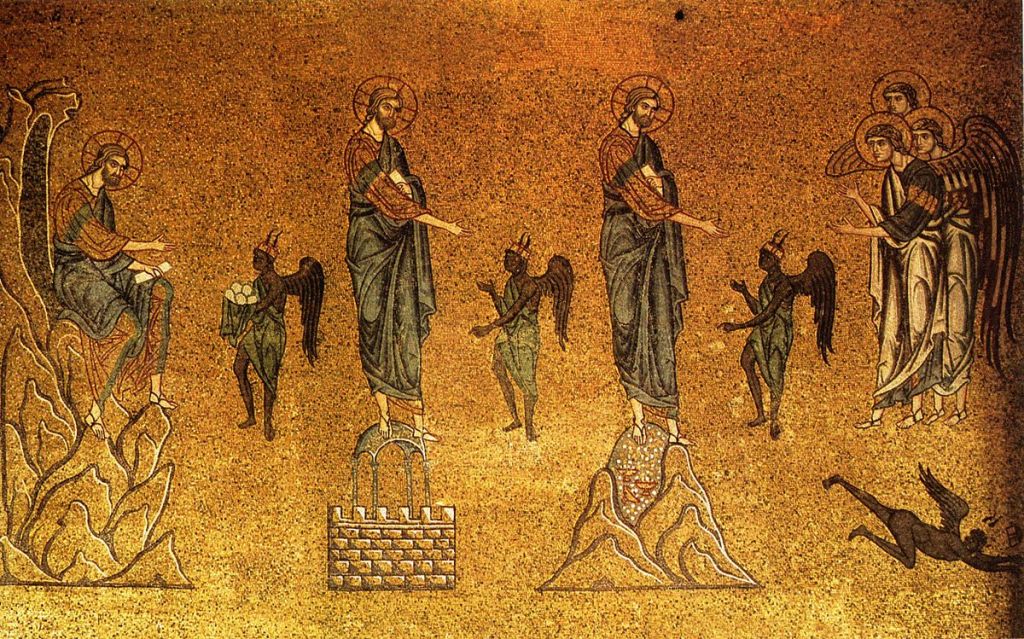
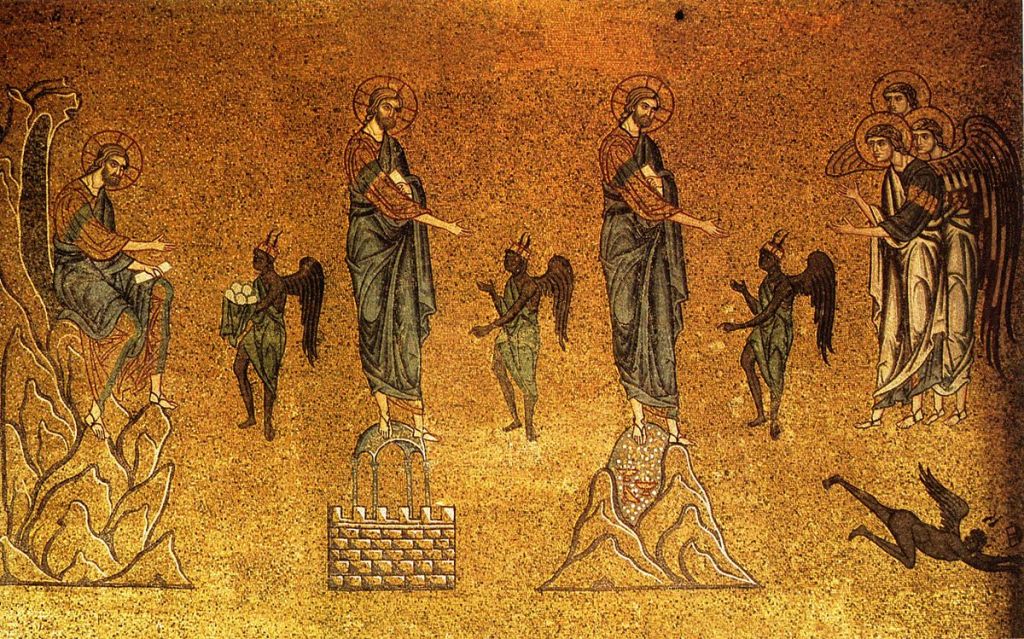
In the first temptation, Jesus was tempted to satisfy his flesh, his physical needs, and his wants. In the second, it was a temptation of pride—taking advantage of his status as the Son of God. Finally, Jesus was tempted to have the world at his command instead of the Father’s. If you want to simplify those, you could say that Jesus was tempted with lust, pride, and greed. Yet, Jesus never accepted the gift from the Devil’s hands. He never even glanced at it except to rebuke it, and He remained without sin.

If the Devil, in his arrogance, would go after Jesus, the very Son of God, in such a way, don’t you think he’ll try the same tactics on you as well? Nod your head, ‘Yes.’ So, spend some time discovering what gifts the Devil gives you, then as a disciple of Jesus, one who wants to be like him, learn from Him and be prepared so that when the gift is offered, you know how you will rebuke it—“Away with you, Satan!”

“‘God opposes the proud but gives grace to the humble.’ Submit yourselves therefore to God. Resist the devil, and he will flee from you. Draw near to God, and he will draw near to you…. Humble yourselves before the Lord, and he will exalt you.” (James 4:6b-8a, 10)

Let us pray: Holy Michael, the Archangel, defend us in battle. Be our safeguard against the wickedness and snares of the devil. May God rebuke him, we humbly pray; and do you, O Prince of the heavenly host, by the power of God, cast into hell Satan and all the evil spirits who wander through the world seeking the ruin of souls. Amen.

Sermon: Lent 3 RCL C – “Colon or Period?”

http://www.metmuseum.org/art/collection/search/436205

In about 512 B.C., as Darius I of Persia led his armies north of the Black Sea, the Scythians sent him a message comprised of a mouse, a frog, a bird, and five arrows. Darius summoned his captains. “Our victory is assured,” he announced. “These arrows signify that the Scythians will lay down their arms; the mouse means the land of the Scythians will be surrendered to us; the frog means that their rivers and lakes will also be ours; and the Scythian army will fly like a bird from our forces.” But an adviser to Darius provided a different interpretation: “The Scythians mean by these things that unless you turn into mice and burrow for safety in the ground or into frogs and hide in the waters or into birds and fly away, you will all be slain by the Scythian archers.” Darius took counsel and made a hasty retreat!

According to the International Bible Society, “As of 2020, the full Bible has been translated into 704 languages. The New Testament has been translated into 1,551 languages and parts of the Bible have been translated into 1,160 additional languages.” (Source) Within the English language alone, there are over 100 complete translations: ESV, NIV, KJV, NKJV, RSV, NLT, and an E I E I O. Deciding on which translation is right for you can prove to be challenging, but what we must understand about them all is that while each is seeking to convey the truth, they are all interpretations of the original. The original Old Testament was written in Hebrew and the original New Testament was written in Greek. The correct translation of these ancient languages is difficult enough, but what makes them even more so is that neither of these original languages uses punctuation when writing (no commas, periods, question marks, etc), and the Hebrew texts did not even use vowels. Bottom line: to read the original Bible texts, you are going to have to be an amazing linguistic scholar and even then, you will not likely be able to translate the text perfectly. So we pray that the Holy Spirit has guided each person who has undertaken such a task so that what is given to us is as God intended. All that to ask you one question about our Old Testament lesson: should it be a colon or a period? I’ve highlighted for you the sentence in question.

“I will be with you; and this shall be the sign for you that it is I who sent you [colon] when you have brought the people out of Egypt, you shall worship God on this mountain.”

The colon right there in about the middle is what caught my interest. Is it correctly punctuated or should it be a period?

As we read, Moses saw the burning bush and went up on the mountain to behold this marvelous sight. There, the Lord told him that he has heard the cry of his people Israel and that he is sending Moses to call them out of captivity. The Lord said to Moses, “So come, I will send you to Pharaoh to bring my people, the Israelites, out of Egypt.” But Moses said to God, “Who am I that I should go to Pharaoh, and bring the Israelites out of Egypt?” And then our sentence: “I will be with you; and this shall be the sign for you that it is I who sent you: when you have brought the people out of Egypt, you shall worship God on this mountain.”

“… this shall be the sign…” If in the sentence it is a colon, then the sign to be given is Moses bringing the people out of Egypt and worshipping on the mountain, but… if that colon is supposed to be a period, then the sign is, “I will be with you.” And everyone says, “Fr. John, you’re splitting hairs this morning,” but not really, because you see, if it is a colon, it is about what Moses will do, but if it is a period, it is all about what God will do.

We know that Moses had been a prince of Egypt, but now he is a shepherd. Not only that, he is a murderer, a runaway, and as he will soon confess that he don’t talk so good. Is that the kind of person that can free an entire nation? Not likely. We also know that in the next chapter, God will have Moses cast down his staff and it will turn into a snake. When God tells him to pick up the snake by the tail, it reverts to a staff. Then God tells Moses to place his hand inside his cloak and when he pulls it out it is covered in leprosy. When he repeats the process his hand is healed. Question: what part did Moses play in either of those two events? Other than doing what he was told: nothing. It wasn’t about what Moses could do, it was about what God could do through him: a weak sinful man.

I’m not a biblical language scholar. I got through Greek and Hebrew, but we all get lucky on occasion. That said, I believe that the verse should actually be two sentences… no colon because all that Moses said and did was to reflect what God was doing through him. God being with him was the sign. What happens later only confirms this.

It was when all the Israelites were at Meribah. They were complaining to Moses that there was no water, so the Lord said to Moses, “Take the staff, and you and your brother Aaron gather the assembly together. Speak to that rock before their eyes and it will pour out its water.” However, instead of speaking to the rock, “Moses raised his arm and struck the rock twice with his staff.” By speaking to the rock, it would have been a clear sign that God was working through Moses, but by striking the rock with his staff, Moses made it appear that it was he who had accomplished the miracle. For this, the Lord counted it against him and Moses was not allowed to enter the promised land.

The Lord told Moses to get down to Egypt land and tell old Pharoah, “Let my people go.” Moses responded, “But who am I. I’m a shepherd, a murderer, and my tongue gets tied.” God said to Moses, “Yes you are and yes it does, but I will be with you, and me being with, doing such marvelous works through you, will be a sign to everyone that I AM is with you. That the God of Abraham, Isaac, and Jacob, the God of your forefathers, is with you.”

We see Moses as this giant of a man. A man who talks to God. A savior of Israel, the one who parts the waters, but all that Moses ever did was only accomplished because of his willingness as a weak and sinful man to allow God to work through him.

Question: what does that tell you about yourself? In his weakness, the Apostle Paul cried out to the Lord and the Lord responded, “‘My grace is sufficient for you, for my power is made perfect in weakness.’ Therefore [Paul says] I will boast all the more gladly of my weaknesses, so that the power of Christ may rest upon me.  For the sake of Christ, then, I am content with weaknesses, insults, hardships, persecutions, and calamities. For when I am weak, then I am strong.”

My friend, St. Josemaría Escrivá says, “You realize you are weak. And so indeed you are. In spite of that — rather, Just because of that — God has chosen you. He always uses inadequate instruments, so that the ‘work’ will be seen to be his.” (The Way #475)

Gather up all your weaknesses and place them at God’s disposal then witness—not how weak you are—but how mighty He is.

Let us pray: (in honor of St. Patrick, part of an old Irish prayer that you can make your own)
As I arise today,
may the strength of God pilot me,
the power of God uphold me,
the wisdom of God guide me.
May the eye of God look before me,
the ear of God hear me,
the word of God speak for me.
May the hand of God protect me,
the way of God lie before me,
the shield of God defend me,
and the host of God save me.
Amen.

Sermon: Lent 1 RCL C – “Temptation”


A fella and his wife were shopping a kiosk in mall when a shapely young woman in a short, form-fitting dress strolled by.  The man couldn’t help himself and followed her with his eyes.

Without looking up from the item she was examining, his wife asked, “Was it worth the trouble you’re in?”

Temptation and sin: every preachers favorite topic.

I feel quite certain that most of us have at one time or another gone out looking for trouble, but I doubt any of us go out looking for temptation.  In most cases, temptation is something that arrives on your spiritual doorstep uninvited, but the temptation is not a sin.  What you do with that temptation will determine whether or not you’ve sinned.  Man sees a pretty girl, he can a) recognize her as pretty—there’s absolutely nothing wrong with that or b) let his mind loose with all kinds of desires and fall into sin.  Not all temptations are as simple as that, but in the end, most come down to that type of decision.  You can “Resist the devil [and the temptation], and he will flee from you.” (James 4:7b) or you can give in to its Siren like calling and sin.  Again, the temptation is not a sin.  It is what you do with the temptation that is the determining factor.

Another aspect of our temptations is that they are tailor made.  They suit our weaknesses and passions perfectly.  Some people like fast cars and they can’t help but be tempted to speed.  Others like to gossip and they can’t help but chat away when they’re around others.  Everything from shopping to alcohol to anger to… we don’t have time to include them all, but if you’ve shown a weakness to something in the past, then you know the devil is going to bring it your way again.  As my friend always said, the devil isn’t all that smart because he’s only got a few tricks, only trouble is we keep falling for them.  What’s a person to do?  In the words of Severus Snape (Harry Potter reference for all you muggles): “Control your emotions! Discipline your mind!”  And that really is the answer.

Our temptations are also referred to as “occasions of sin.”  If someone is a recovering alcoholic, then an occasion of sin or temptation would be for someone to unwittingly offer them an alcoholic drink.  There was no malice on the part of the person offering.  They were not some agent of the devil trying to bring the other person down, they were simply being friendly, but it has put the recovering alcoholic in an occasion of sin.  What is the person to do with the temptation?  “Control your emotions! Discipline your mind!”  The controlling of the emotions is something that occurs when the drink is offered, but the disciplining of the mind is something that takes practice over time, before the temptation is presented.  For whatever trick of the devil’s that you find yourself falling for time and time again, you have to know beforehand how you will respond or you stand a good chance of falling.  So, for the recovering alcoholic, they must mentally walk themselves through various scenarios and determine how it is they’re going to react.  “Ok.  If someone offers me a drink, I’m going to say, ‘Thank you, but I don’t drink.’”  And they have to repeat that to themselves over and over again, so that it is ingrained in their minds.  So that their minds are disciplined.  

When we talk about temptation and sin, we are talking about the battle for our souls, so this sounds like a rather dry / clinical approach, but ask yourself, “How’s my current method working out?”  Then look at the example of our Gospel lesson today: the temptation of Jesus in the wilderness.

Jesus did not go off into the wilderness to be tempted by the devil.  We are told that he was “led by the Spirit in the wilderness, where for forty days he was tempted by the devil.”  I don’t believe he went out there looking for trouble, but it did arrive on his spiritual doorstep.  Did he wring his hands and fret: “What do I do?  What do I do?”  Nope.  He answered the devil’s every temptation with Holy Scripture (specifically from the Book of Deuteronomy.)  He had control of his emotions and he had disciplined his mind.  He had prepared for just such an occasion of sin in advance.  Perhaps he did not know what the temptation would be, but he was not foolish to think that they wouldn’t come at all.

“Resist the devil, and he will flee from you.”  But you’re going to want a game plan for the resisting bit.  Abraham Lincoln said, “Give me six hours to chop down a tree and I will spend the first four sharpening the axe.”  Approach your spiritual battles in the same manner and you will be far more successful in defeating the temptations that wander up to your spiritual doorstep.

Above all your preparations, pray.  Pray for God’s strength to defeat your enemies from whatever direction they may come.  St. Paul tells us, “No temptation has overtaken you that is not common to all. God is faithful, and he will not let you be tempted beyond your ability, but with the temptation he will also provide the way of escape, that you may be able to endure it.”  That way of escape will be made clear to you through your prayer and your preparation.

One final note: if you fall into sin, learn from your mistakes, repent, confess, and get back in the fight.  You are a child of God.  You have work to do.

Let us pray: Saint Michael the Archangel, defend us in battle. Be our protection against the wickedness and snares of the devil; May God rebuke him, we humbly pray; And do thou, O Prince of the Heavenly Host, by the power of God, thrust into hell Satan and all evil spirits who wander through the world for the ruin of souls. Amen.

Sermon: Lent III RCL A – “Forgiveness, Pt. 3 – Obedience, Guilt, Imitate”

images-19The new priest is nervous about hearing confessions, so he asks an older priest to sit in on his sessions. The new priest hears several confessions, then the old priest asks him to step out of the confessional for a few suggestions… The old priest suggests, “Cross your arms over your chest and rub your chin with one hand.”… The new priest tries this. The old priest suggests, “Try saying things like, ‘I see, yes, go on, and I understand, how did you feel about that?”  The new priest says those things, trying them out. The old priest says, “Now, don’t you think that’s a little better than slapping your knee and saying, ‘No way! What happened next?'” – I’m not sure if this would be a good time to encourage you all to go to confession during Lent or not.

It is in the fifth chapter of James that we hear specific instructions on healing: “Is anyone among you sick? Let them call the elders of the church to pray over them and anoint them with oil.”   A few verses later, “Therefore confess your sins to each other and pray for each other so that you may be healed.”  James is showing us that there is often a link between sin and sickness, therefore he encourages us to confess our sins to each other.  Often, when we hear these instructions we think of the confession between a penitent and a priest, but James is also talking about Christian speaking to Christian as a means of accountability.  For example – if you have a problem with ___, then you can confess this to a trusted friend or even a group of trusted friends who will in turn hold you accountable.  They do this not so they can beat you over the head when you slip and fail, but so that they can support you in your time of weakness and give you encouragement when you hold strong.

So we confess our sins to God and to a priest for absolution.  We confess to one another for accountability and encouragement, and finally we confess so that we might receive forgiveness from the person who we injured.

Back in the day before I was the saint that you see standing before you today, I had a favorite expression for someone who had injured me in someway when asked if I would forgive them.  I heartily responded, “I wouldn’t spit on them if they were on fire.”  That left very little room for reconciliation and Jesus was not amused.  Yet finally I heard that call from St. Paul’s letter to the Colossians, “Therefore, as God’s chosen people, holy and dearly loved, clothe yourselves with compassion, kindness, humility, gentleness and patience.  Bear with each other and forgive one another if any of you has a grievance against someone.  Forgive as the Lord forgave you.”  I understood that I must learn to forgive as I have been forgiven.  For me, I also discovered that there were three main reasons that compelled me to forgive: obedience, guilt and imitation.

Take obedience.  Some folks choose to go to work out of obedience, which can sometimes be closely linked to fear.  Obedience in that they know what is expected of them and fear that they will be fired if they don’t.  The same line of thought applies to forgiveness.  Consider Jesus’ parable of the unforgiving servant: a servant owed a great debt to his master and yet was unable to pay when his master called in the debt.  He therefore begged his master for forgiveness and the master forgave the debt and let him go; however, when that servant went out he encountered someone who owed him a debt and demanded that it be paid.  When the man said he couldn’t pay the servant had him thrown into prison until he could.  When the other servants saw what had happened they went to the master and reported it.  The master recalled the servant and said to him, “‘You wicked servant; I canceled all that debt of yours because you begged me to.  Shouldn’t you have had mercy on your fellow servant just as I had on you?’  In anger his master handed him over to the jailers to be tortured, until he should pay back all he owed.”   Jesus concludes by saying, “This is how my heavenly Father will treat each of you unless you forgive your brother or sister from your heart.”  There are times when we may also forgive someone out of obedience to the command to forgive and out of fear of the repercussions of not forgiving.  Is that forgiveness?  Yes, as long as it is from the heart.  As long as we truly forgive.

Second, we may choose to forgive out of guilt.  Take for example the parable of the father who had two sons.  The father went to the first and said, “‘Son, go and work today in the vineyard.’  ‘I will not,’ he answered, but later he changed his mind and went.  Then the father went to the other son and said the same thing. He answered, ‘I will, sir,’ but he did not go.”  Jesus asked those who were listening to him, “Which of the two did what his father wanted?”  “The first,” they answered, but the question for us is: what turned the first son’s heart?  Probably a number of things, but I suspect it started with guilt.  “Dad asked me to do this [grumble.  grumble.]”, yet off he went.  In a similar manner – because of guilt – we may choose to forgive.  If I am being hard hearted and not wanting to forgive, but then look at an image of our crucified Lord and recognize the price he paid for my sins that I might be forgiven… guilt.  Plain and simple.  The guilt of my own sin and understanding the price paid by Jesus for those sins, will compel me toward forgiveness.  Is that forgiveness.  Again, yes, as long as it is from the heart.

So we can forgive out of obedience and guilt, but I would suggest to you there is an even better way: imitation.  Why do you do something in a particular way?  Oh, that’s how my dad always did it.  Why are you a dentist?  Oh, my mother was a dentist.  We imitate the behavior we see from others.  In the first paragraph of the first chapter of the Imitation of Christ by Thomas a Kempis, “‘He who follows Me, walks not in darkness,’ says the Lord.  By these words of Christ we are advised to imitate His life and habits, if we wish to be truly enlightened and free from all blindness of heart. Let our chief effort, therefore, be to study the life of Jesus Christ.”

Ephesians 5:12 (NIV), “Follow God’s example, therefore, as dearly loved children and walk in the way of love, just as Christ loved us and gave himself up for us as a fragrant offering and sacrifice to God.”  “Follow God’s example” is also translated in other versions as “Be ye therefore imitators of God.”  That word “followers” / “imitators” is translated from the Greek word “mimEtai” (μιμηταὶ)  It is where we get the word “mimic.”  What is it we are to imitate / mimic as dearly loved children of God?  “When they came to the place called the Skull, they crucified him there, along with the criminals—one on his right, the other on his left.  Jesus said, ‘Father, forgive them, for they do not know what they are doing.’”  That is what we are to imitate.  We forgive, because Jesus forgives.

If you forgive from your heart out of obedience or guilt, then you have done as Christ commanded.  You have forgiven because you have been told to forgive and know that you must, and there is absolutely nothing wrong with that; however, in being a follower / imitator / mimic of Jesus you will forgive – not because you have been told to do it – but because you want to be like Jesus.

Is that asking too much?  Is it to hard to want to be like Jesus?  If so, then to paraphrase George Herbert, set it up there as a mark, something to aim for “since he shoots higher that threatens the moon, than he that aims at a tree.”  Forgive by any means you can summon, but seek the higher way of imitating Christ.

Sermon: Lent I RCL A – “Forgiveness, Pt. 1 – Where to Begin?”

forgive-tumblr

The Beatitudes.  Blessed are the poor, those who mourn, the meek, those who hunger for righteousness, the merciful, the pure in heart, peacemakers, and the persecuted.  Have you ever read those and thought to yourself, “I am so going to hell!”  There are days when I think that my ticket is already stamped.  This notion  of going to hell is only confirmed when I consider the seven deadly sins.

Pride.  How could I possibly be prideful when I’m the humblest person I know?  Greed?  Yeah.  Here’s a good one, lust.  You know what I think of when I think of being lustful?  Roy Orbison.  No.  Not Roy himself, but that song of his, “There she was just walking down the street, singing do wah diddy diddy dum diddy do.  She looked good, she looked fine, and I nearly lost my mind”  What is wrong with me?  Sloth?  Wrath?  Gluttony?  Please!  Just look at me.  I couldn’t come close to measuring up to a single one of the Beatitudes, but give me the seven deadly sins and I’m batting 1,000.  I am most certainly going to hell and my only consolation is that I can look around the congregation and know that I’ll at least have several friends with me!

In our Gospel today Jesus was able to overcome all the temptations that the Devil threw at him – worldly pleasures, fame, power, everything – but if you were to set a double beef cheeseburger, large fries and an ice cold Coca-Cola down in front of me, I’m fairly certain that I would commit at least half of the seven deadly sins.  If you set that same double beef cheeseburger, large fries, and ice cold Coca-Cola down in front of somebody else, I would probably break the other half.

I know it is Lent and we aren’t suppose to be having any fun in Church, but I’m sure you see the point as it would apply to a wide range of sinful activity that’s a bit more serious than a double cheeseburger.

St. Peter implores us, “Dear friends, I urge you, as foreigners and exiles, to abstain from sinful desires, which wage war against your soul.  Live such good lives among the pagans that, though they accuse you of doing wrong, they may see your good deeds and glorify God on the day he visits us.”  As a Christian people, that is the goal, but so often we end up in the same boat as St. Paul, “I do not understand what I do.  For what I want to do I do not do, but what I hate I do.”

Pride is at the top of the list of the seven deadly sins, because it takes a great deal of humility to admit that we have sinned.  Think how difficult it is to go to confession, how much humility it takes to confess your sins to another –  many can’t even make themselves practice this sacrament, but if we do humble ourselves, we can recognize that we have sinned, that we have damaged our relationship with God.

But the committing of the sin is not the saddest part?  We can discuss the fact that we have sinned.  We can identify times in our lives that we committed horrible acts.  We can identify times in our lives when someone committed horrible acts against us.  We will gladly beat ourselves up time and time again for something we did wrong even if it was years ago.  I can stand up here, point you out, and say, “You are a sinner.”  With the exception of the very proud, most, in humility will hang their head in agreement and defeat.

During the Ash Wednesday service we recited the 51st Psalm and we can agree with the words David wrote, “For I know my transgressions, and my sin is ever before me.  Against you only have I sinned and done what is evil in your sight.  Indeed, I have been wicked from my birth, a sinner from my mother’s womb.”

But you know what?  That’s not the sad part.  The sad part is that in the next sentence after I have said you are a sinner – in the very next sentence – I can tell you that you are forgiven – you are forgiven – and the sad part is… you won’t believe me.

Jesus said, “Take heart, son; your sins are forgiven.”  Again “Jesus said, ‘Your sins are forgiven.’” And again, “This is my blood of the covenant, which is poured out for many for the forgiveness of sins.”  Peter declares, “Repent and be baptized, every one of you, in the name of Jesus Christ for the forgiveness of your sins.”  St. Paul writes, “Blessed are those whose transgressions are forgiven, whose sins are covered.”  St. John confirms, “I am writing to you, dear children, because your sins have been forgiven on account of Jesus’ name.”  All that and many still won’t believe those words, “You are forgiven.”

Not only that, but believing that we are forgiven is almost as difficult as it is for us to forgive others.  That whole bit about “forgive, that you may be forgiven.”  “Forgive us our trespasses as we forgive others.”  Yeah, there are days when I definitely don’t want to pray that!  Do you really always forgive others?

Forgiveness, in every form, is key to the teachings of Holy Scripture.  We know that it is a large part of our Christian identity, but what does it really mean?  I should probably spend Lent beating you over the head with your sins, but most of us don’t need any help with that.  So I’ve decided that during this Holy Lent we are going to look at the various aspects of this rather illusive topic.

To begin with, you have an assignment for this week: think about forgiveness.  No.  Not about who you should forgive or anything like that, but consider your ideas about forgiveness.  What do you think Jesus means when he says we should forgive?  How can we forgive ourselves?  Next week we will begin with many of the myths out there about what true Christian forgiveness is all about and see if what we believe is right or wrong.

In the meantime, consider these words Mahatma Gandhi: “The weak can never forgive.  Forgiveness is the attribute of the strong.”


Sermon: Ash Wednesday

8m

The Bureau of Labor came out with some statistics on how we spend our time.  It breaks down like this:

Working and related activities:  8.7 hours

Sleep:  7.7 hours

Leisure and sports:  2.6 hours

Household activities:  1.1 hours

Eating and drinking:  1.1 hours

Caring for Others: 1.3 hours

Other: 1.5 hours

This means that over half the day is gone, with over 12 hours a day devoted to working, eating, household and caring activities.  Then there is the time for sleeping, 7.7 hours, which leaves only a few hours remaining for anything else.  The majority of that extra time would seem to be assigned to the La-z-boy and the TV.  However, of that “other” category, 16 minutes are given to “organizational, civic, and religious” activities.  If we were being generous with the religious aspect and gave it 50% of that time, we would have 8 minutes per day or 56 minutes per week that we give to God.

Now, the unaware and self-righteous side of me would like to rail against those statistics, start telling folks that they need to get their priorities straight and all that.  Truth is, if I weren’t a priest – receiving a stipend so that I could spend time with God on behalf of the people – if I had a job in the secular world, children to care for, school and family functions, if I had all these things and more, then I’m fairly certain that my minutes per day that I spend with God would be less than eight.  Heck, even as a priest there are days when 8 minutes with God seems like a lot!   But that doesn’t make it right.

Much of our life with Christ is about sacrifice, the giving up of who we are and replacing it with who God is.  It is about a relationship and with any relationship it requires time, nurturing, giving, and sacrifice.

In the time leading up to Lent there are always discussion about what we will be “giving up,” that which we abstain from.  However, this giving up is not about an act of will power: “I’m giving up coffee for Lent or smoking or whatever.”  Heck, I gave up beer one Lent and really learned to enjoy red wine.  The point of abstaining from something is so that you will be able to give that time, those resources, etc. to God.  I’ll give up half an hour of TV a day so that I can spend that time with God.  See how it works?

I read our Gospel today and it speaks of doing certain things for God: giving alms, serving Him, praying, and fasting.  It talks about how we rightly do these things, not in public and not for show, but with a world that is constantly demanding more and more of our time, before we can do these things properly we must first learn to simply DO them.  We discover how to give God more than 8 minutes per day, to sacrifice something of ourselves so that we can enter more deeply into that relationship with Him.  This time with God is not just one more thing that we have to accomplish, as a Christian people, time with God, serving Him is our joy!  Thomas a Kempis understood these things.  In his Imitation of Christ, he writes, “I WILL hear what the Lord God will speak in me… Blessed is the soul who hears the Lord speaking within her, who receives the word of consolation from His lips.  Blessed are the ears that catch the accents of divine whispering, and pay no heed to the murmurings of this world.  Blessed indeed are the ears that listen, not to the voice which sounds without, but to the truth which teaches within.  Blessed are the eyes which are closed to exterior things and are fixed upon those which are interior.  Blessed are they who penetrate inwardly, who try daily to prepare themselves more and more to understand mysteries.  Blessed are they who long to give their time to God, and who cut themselves off from the hindrances of the world…. Consider these things, my soul, and close the door of your senses, so that you can hear what the Lord your God speaks within you, ‘I am your salvation,’ says your Beloved. ‘I am your peace and your life.’”

The Lord is your joy.  Your salvation.  Your peace.  Your life.  During this Holy Lent make the sacrifice, take the time, and hear what the Lord your God will speak in you.