Sermon: Wednesday in Holy Week

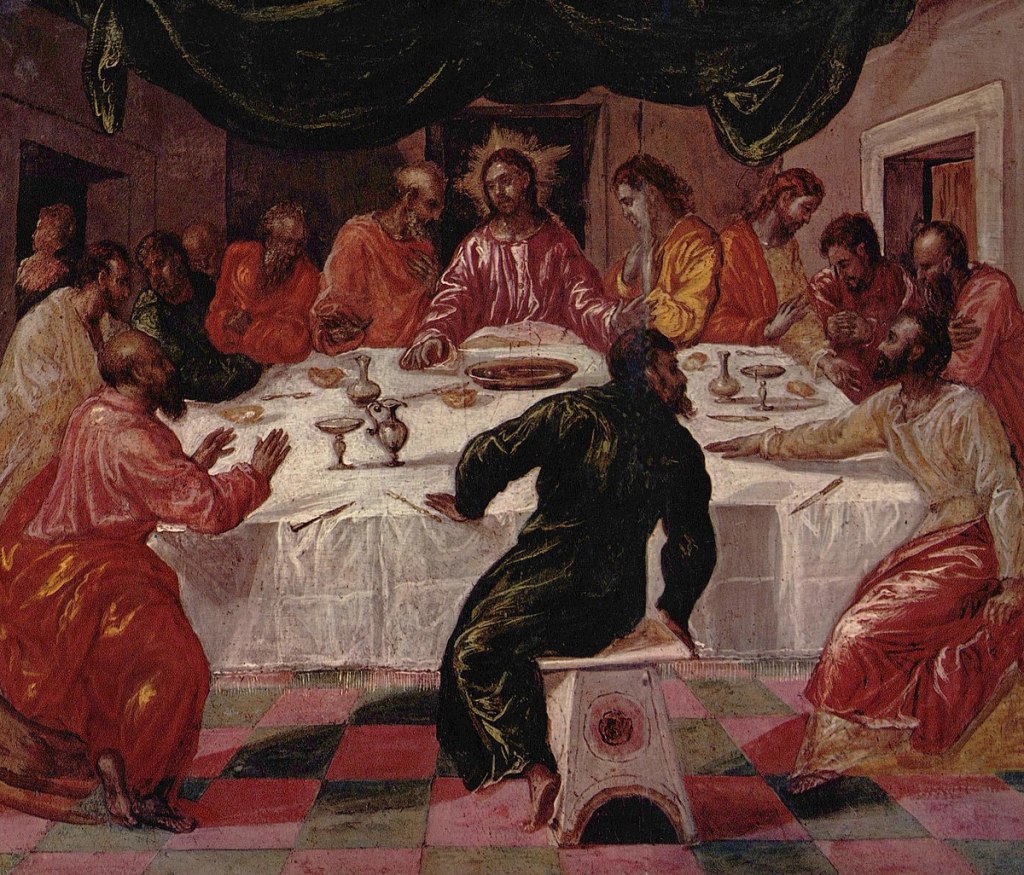
The Last Supper by El Greco

Throughout the Gospels, the disciples struggled to grasp who Jesus truly was, along with the significance of his actions and words. 

The disciples and Jesus are out on the sea when a storm rolls in, and the disciples fear they will drown. Jesus calms the storm, yet the disciples are even more afraid. He asks them, “Why are you so afraid? Do you still have no faith?”

Jesus had fed the 5,000, and he and the disciples were out on the boat, but the disciples had forgotten to bring anything to eat. Jesus said to them, “Watch out—beware of the yeast of the Pharisees and the yeast of Herod.” How did the disciples respond? They said to one another, “It is because we have no bread.” Jesus then asked them, “Why are you talking about having no bread? [Ya nitwits! — Fr. John’s commentary] Do you still not perceive or understand? Are your hearts hardened?  Do you have eyes and fail to see? Do you have ears and fail to hear?”

Jesus tells the disciples that he must die, leading to that unfortunate scene with Peter and the “Get behind me, Satan!” business. And then there is today. 

They are gathered in the upper room for their last supper together. Jesus says, “Very truly, I tell you, one of you will betray me.” Peter wants to know what he means, but seems afraid to ask, so he tells John to ask Jesus, “Who is it that will betray you?” John asks, and Jesus responds, “It is the one to whom I give this piece of bread when I have dipped it in the dish.” Jesus then dips a piece of bread into the dish and hands it to Judas Iscariot, saying to him, “Do quickly what you are going to do.” Scripture then states, “Now no one at the table knew why he said this to him. Some thought that, because Judas had the common purse, Jesus was telling him, ‘Buy what we need for the festival’; or that he should give something to the poor. So, after receiving the piece of bread, he immediately went out.”

Jesus just said, whoever I give this piece of bread to will be the one who betrays me! He dips the bread into the dish and hands it to Judas. Why then do the disciples not understand? Why, instead of saying that Judas went out to do the deed, does scripture not say, “The disciples understood that it was Judas who would betray Jesus, so they pounced on him and beat the living daylights out of him!” Come on, fellas! Seriously? 

Why did the disciples fail to grasp who Jesus truly was, the things He did, and what He said? Answer: for the same reason we don’t fully comprehend who Jesus truly is, the things He does, and the things He says. “For now we see in a mirror, dimly, but then we will see face to face. Now I know only in part; then I will know fully, even as I have been fully known.”

Much of who Jesus—God—is was hidden from the disciples, just as He is hidden from us. Coming into the full knowledge of God would be like walking into the core of the sun. It is beyond our current condition to fathom.

Such knowledge is too wonderful for me;
    it is so high that I cannot attain it.

Instead of understanding everything, God tells us, “Understand this,” and He stretches out His arms upon the hardwood of the cross. You don’t need to understand how it works, what happened, the nature of sin, the Holy Trinity, or why the disciples allowed Judas to walk out and betray Him. You only need to understand the “Why?” behind it all. What is the answer to “Why?” You. 

Sermon: Wednesday in Holy Week – “Cognitive Dissonance”

Judas by Edward Okuń

Psychology Today defines cognitive dissonance as “the state of discomfort felt when two or more modes of thought contradict each other. The clashing cognitions may include ideas, beliefs, or the knowledge that one has behaved in a certain way.” (Source)  So, you believe A to be true but then through study or enlightenment, you come to believe the exact opposite, Z, to be true.  However, you’ve invested so much time and energy into A that regardless of how much you believe Z to be true, you won’t give in, so you now have this tension/guilt between the two or maybe a deep sense of confusion.  That said it seems I tell you this story during Holy Week at least every other year.  It involves Bishop Jack Nicholls, the Bishop of Sheffield, who once asked a sixth-grade girl where she thought Jesus was between Good Friday and Easter. 

As a church, we understand the answer to be related to the Harrowing of Hell.  The Harrowing of Hell is understood from two passages of scripture: 1) Ephesians 4:7-9 — “But each of us was given grace according to the measure of Christ’s gift.  Therefore it is said, ‘When he ascended on high he made captivity itself a captive; he gave gifts to his people.’ (When it says, ‘He ascended,’ what does it mean but that he had also descended into the lower parts of the earth?” and 2)  1 Peter 4:6 — “For the gospel has for this purpose been preached even to those who are dead, that though they are judged in the flesh as people, they may live in the spirit according to the will of God.”  Combined, we understand the Harrowing of Hell as Jesus descending into hell and proclaiming the Good News to those who had died before his first coming giving them the option to also accept him as Lord and Savior.  Those who do are allowed to rise in glory.  The iconography shows Jesus pulling people up out of the depths.

When Bishop Nicholls asked the child what Jesus was doing between his death and resurrection, the answer he was looking for was likely associated with this Harrowing of Hell, but instead of answering the question in general terms, the little girl answered it in very specific terms.  After she had thought a little, she replied, “I think he was in deepest hell looking for his friend Judas.”

For me, this is where the cognitive dissonance kicks in.  We are told, “Satan entered Judas, the one called Iscariot.” (Luke 22:3)  In speaking to the Father about the twelve and referring to Judas, Jesus says, “I guarded them, and not one of them perished except the son of destruction.” (John 17:12)  He was a thief, traitor, betrayer, and more.  Yes, he did try and return the silver, but by then it was too late.  So, could the little girl have been right?  Would Jesus have gone looking for his “friend” Judas?  Answer: No!  Absolutely not!  Let him burn.  Answer: Yes!  “God is love.” (1 John 4:8)  God “desires all people to be saved and to come to the knowledge of the truth.” (1 Timothy 2:4)  Jesus said, “What man among you, if he has a hundred sheep and has lost one of them, does not leave the other ninety-nine in the open pasture and go after the one that is lost, until he finds it?” (Luke 15:4)

Dante placed Judas in the lowest level of hell and I think that is where he belongs, but… I also want Jesus to go looking for him and maybe even find him.  Why?  Because I want Jesus to come looking for and find me.  

Cognitive dissonance.