Sermon: Advent 2 RCL A – “Prophet’s Call”


The American Film Institute has several “Top 100” lists: 100 best movies, 100 best musicals, 100 best heroes and villains, and so on. They also have the “100 top movie quotes.” Way down in the 80s, we have lines like, “Yo, Adrian,” and “My Precious.” Moving up into the 40s, there is “Shane. Shane. Come back,” and “Stella! Hey, Stella!” Then breaking into the top ten, there are “Go ahead, make my day,” and “I’m gonna make him an offer he can’t refuse.” Number one on the list, you’ve got to love Rhett Butler—“Frankly, my dear, I don’t give a….” However, the one I’m thinking of today comes in at number ten, spoken by Travis Bickle, played by Robert De Niro, in Taxi Driver. The line: “You talkin’ to me? You talkin’ to me!?” (Source)

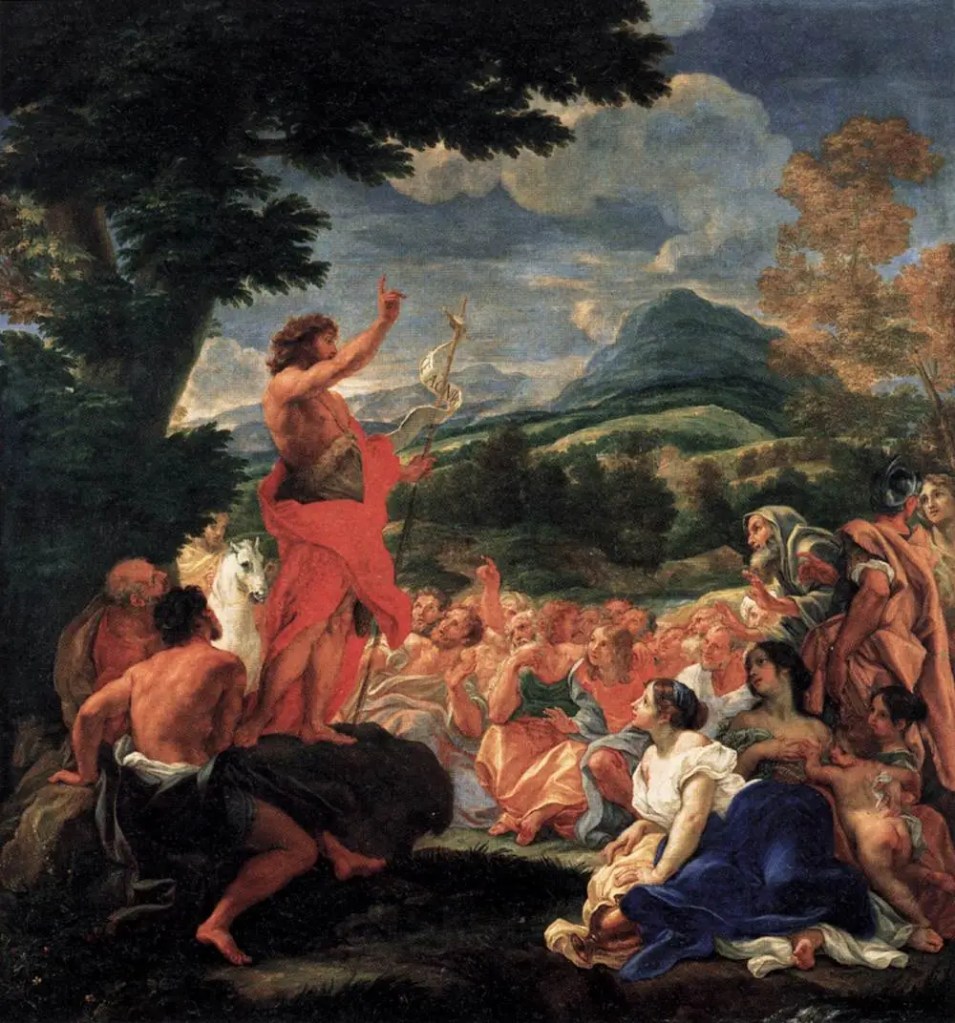
In our Gospel reading, when John the Baptist confronts the Pharisees and Sadducees, I can picture them glancing at each other, then at John, and in their best Robert De Niro impression, asking, “You talkin’ to me?!” And then John firing back with number forty-four on the AFI list, “I see dead people.” Okay. Enough of that. 

As we know, John’s criticism didn’t stop with the religious leaders. He was an equal-opportunity rebuker, and later, he would criticize Herod for marrying his brother’s sister, which landed him in jail and eventually led to his beheading. Yet for the prophets, including John the Baptist, they were almost always upsetting someone and finding themselves in danger.

In the Acts of the Apostles, the first deacon was Stephen. He said to the religious leaders, “You stiff-necked people, uncircumcised in heart and ears, you always resist the Holy Spirit. As your fathers did, so do you. Which of the prophets did your fathers not persecute? And they killed those who announced beforehand the coming of the Righteous One.” (Acts 7:51-52) They then proceeded to stone him to death.

Despite the dangers of the job, the prophet’s role is to stir up the people and point out their errors, hoping they will return to God. In fact, they are responsible for the souls of the people before God. Speaking to Ezekiel, the Lord said, “So you, son of man, I have made a watchman for the house of Israel. Whenever you hear a word from my mouth, you shall give them warning from me. If I say to the wicked, O wicked one, you shall surely die, and you do not speak to warn the wicked to turn from his way, that wicked person shall die in his iniquity, but his blood I will require at your hand. But if you warn the wicked to turn from his way, and he does not turn from his way, that person shall die in his iniquity, but you will have delivered your soul.” (Ezekiel 33:7-9)

Prophet: a dangerous job before the people and before God, yet God calls those He chooses. The Prophet Jeremiah said, “The Lord put out his hand and touched my mouth. And the Lord said to me,
‘Behold, I have put my words in your mouth.
See, I have set you this day over nations and over kingdoms,
to pluck up and to break down,
to destroy and to overthrow,
to build and to plant.’”
(Jeremiah 1:9-10)

The Lord chooses and sends His prophets to speak His words, not their own. Knowing this, you might think they—dare I say, “We”?—would respond accordingly, but it was said, “The Lord, the God of their fathers, sent persistently to them by his messengers, because he had compassion on his people and on his dwelling place. But they kept mocking the messengers of God, despising his words, and scoffing at his prophets, until the wrath of the Lord rose against his people, until there was no remedy.” (2 Chronicles 36:15-16)

The same was true with John the Baptist. The people heard what was said, but they did not respond according to the will of God. Instead, they became angry with these messengers and persecuted them, often putting them to death. Thank goodness we are not like them. We accept criticism and correction very well. When someone offers Godly corrections to us, we don’t get angry. No, sir. We might get even, but we don’t get angry! Right?

Let me ask you this: you hear John the Baptist crying out, “Repent, for the kingdom of heaven has come near.” How do you respond? The human thing to do is to look at everyone around you and say, “Darn tooting! Y’all need to repent! Get right with the Lord!” The whole time, thinking John the Baptist couldn’t possibly be talking to you. Or what about this: Christian groups love to quote this one from 2nd Chronicles: “If my people who are called by my name humble themselves, and pray and seek my face and turn from their wicked ways, then I will hear from heaven and will forgive their sin and heal their land.” (2 Chronicles 7:15) What’s the first thing to go through your head? “If those left-wingers or the fascist right (I too am an equal opportunity rebuker) would just learn to pray and follow Jesus, then this whole thing could be sorted out overnight!” Can I get an “Amen”? Why do we think this way? Isn’t it obvious? This call to turn from wicked ways is about them, and has nothing to do with me! 

However, the prophet confronts us and says, “Oh, yes, it is. It is all about you. You are the one who needs to get right with God.” Like everyone else, we don’t much like hearing it, but we must be willing to listen to the words of John the Baptist—“Repent, for the kingdom of heaven has come near.”—and allow those words to be spoken to us personally and as the Church. We must let God correct us so we are not the ones provoking His wrath. Through this process of correction, we are allowing him to perfect us. As the Lord told the church in Laodicea, “Those whom I love, I reprove and discipline, so be zealous and repent.” (Revelation 3:19)

How can we let the prophets’ words speak to us and correct us? There is a powerful phrase from Martin Luther: “The Cross tests everything.”  

If we test our thoughts, actions, and deeds the same way the Pharisees and Sadducees evaluated theirs, we respond like they did—“You talking to me?” However, if we test those same thoughts, actions, and deeds by the Cross, we may discover a different outcome. It might not be what we want to hear, but it will be God’s truth.

I wonder, if we are willing and brave enough to look closely, which part of ourselves, our lives, our being would we hesitate to put to the test of the Cross? I suspect there are aspects of all our lives that are much safer tucked away in their own personal niches, their own special places of worship within our souls, even illuminated with one of those little votive candles—areas that are far too cherished by the Great “I” to be put to such a test. Yet, if we did, if we nailed those silly notions to that most sacred tree, the Cross, well, they would likely scream out in protest and blasphemy, just like the wicked thief did who was crucified with Jesus. But in the end, we would be set free from those things that bind us.

The prophets deliver messages to a world that is broken, but their messages are also for us. Jesus says, “He who has ears, let him hear.” (Matthew 13:9) I pray that if you hear in your soul John the Baptist calling you to repentance, don’t be like those who become proud and angry. Instead, submit to the call of repentance and accept the forgiveness of sins; for as St. John tells us, “If we confess our sins, [God] is faithful and just to forgive us our sins and to cleanse us from all unrighteousness.” (1 John 1:9)

Let us pray: 

O God,
You raised up St. John the Baptist
to prepare a perfect person for Christ.
We call upon St. John’s intercession
to properly prepare us with a true
sense of repentance to receive Your
grace and salvation.
Make us faithful to Truth and justice,
as You did Your servant,
John the Baptist, herald of Your Son’s
birth and death. Lord, may You increase
Your life within us.
Amen.


Sermon: Advent 3 RCL C – “Expression of Love”


Lucy approaches Charlie Brown and says, “Merry Christmas, Charlie Brown. ’Tis the season of peace on earth and good will toward men. Therefore, I suggest we forget all our differences and love one another.”

Charlie Brown is totally taken aback by this change of spirit. His face lights up, and he replies, “That’s wonderful, Lucy. I’m so glad you said that. But tell me, do we have to love each other only at this season of the year? Why can’t we love each other all year long?”

Lucy retorts, “What are you, a fanatic or something?”

In an interview, C.S. Lewis states, “Love is not affectionate feeling, but a steady wish for the loved person’s ultimate good as far as it can be obtained.” (God in the Dock, p.37) Bishop Robert Barron is always reminding us that to love is to “consistently will and choose the good of the other.” It would seem that both of these are taking their understanding of love from St. Thomas Aquinas, who said, “To love is to will the good of the other.” 

So, love is partly about the funny feeling you get in your stomach, but more importantly, it is sacrificial. It is giving yourself, without regard for yourself, to another. What makes love so colorful and broad is how this, willing the good of the other, is expressed. That expression of love can take many forms, even some that seem to be any and everything other than love.

One of my favorite books is The Stand by Stephen King. In the beginning, one of the characters, Larry Underwood, finds himself in a bit of trouble out in California, so he heads to New York, where he spends some time with his mom. 

The relationship between these two has some interesting dynamics. His mom, Alice, is quite reserved and stoic, and Larry is a bit selfish. The day after he arrived, he slept in while his mother got up and went to work, but before she did, she took care of a few things for Larry and left a note. 

She had gone out and purchased all the foods he liked—canned ham, roast beef, Coke, peach ice cream. In the bathroom, there’s a new toothbrush, disposable razors, shaving cream, and even a bottle of Old Spice cologne. Of the cologne, he remembers her saying, “Not fancy but smelly enough for the money.” 

Larry saw all these things but then reflected on the note she had left. At the beginning, there was no “Dear Larry,” at the end, there was no “Love, Mom.” “Just a new toothbrush, new tube of toothpaste, new bottle of cologne. Sometimes, [Larry] thought, real love is silent as well as blind.” (p.104)

However, there are times when love looks even more different than what we expect.

As I sat in my office at home, reading the lessons for this week, I startled the cat because the sequence and the contrast of the lessons made me laugh.

Our first reading from Zephaniah began,

“Sing aloud, O daughter Zion;
shout, O Israel!

Rejoice and exult with all your heart,
O daughter Jerusalem!”

Our canticle, The First Song of Isaiah, concluded with the words, 

“Cry aloud, inhabitants of Zion, ring out your joy,
for the great one in the midst of you is the Holy One of Israel.”

Paul told the Philippians, “Rejoice in the Lord always; again I will say, Rejoice.”

And then we get to the Gospel lesson. “John [the Baptist] said to the crowds that came out to be baptized by him, ‘You brood of vipers! Who warned you to flee from the wrath to come?’”

Sing aloud! Rejoice and exult! Rejoice! You brood of vipers!

I laughed, but then I wondered why. Why was John so angry?

Within our psyche, some emotions are categorized as primary. These can include fear, anger, joy, sadness, disgust, contempt, and surprise. However, anger can also be categorized as a secondary emotion—a mask for a true emotion. In some cases, anger is the mind’s way of hiding fear. One specialist notes, “The brain moves us very quickly from these primary emotions to anger. It can happen so fast that we hardly even notice the switch.” (Source)

Parents probably often experience this. Think of a time when you thought your child was in danger or doing something stupid. At first, you experience fear and concern, but as soon as the incident is resolved, you might say, “Now, I’m gonna kill ‘em.” In such circumstances, fear led to anger, but why did you fear for them in the first place? For the same reason John the Baptist called those coming to him a brood of vipers—love. 

You were afraid and angry because you love your children. John was also afraid for those coming to him, and his fear made him angry. John loved those coming to him because he loved them as God loved them. He feared what would happen to them if they did not turn from evil. He would have been like Jonah if he hadn’t cared about them. Remember him?

The Lord told Jonah, “Arise, go to Nineveh, that great city, and call out against it, for their evil has come up before me.” Jonah is to tell the people to repent, but instead of obeying, he flees in the opposite direction, which ends with him being swallowed by the great fish. After three days, he is spit back out on the dry land and again told by the Lord to go to Nineveh. This time, he obeys. He cries out against Nineveh, telling them the Lord will destroy them unless they repent. Miracles of miracles, the people repent, and the Lord does not destroy them. What was Jonah’s response? Jonah said, “O Lord, is not this what I said when I was yet in my country? That is why I made haste to flee to Tarshish; for I knew that you are a gracious God and merciful, slow to anger and abounding in steadfast love, and relenting from disaster. Therefore now, O Lord, please take my life from me, for it is better for me to die than to live.” 

Kill me now, Lord, because I’m so angry. Not angry because I feared for Nineveh, but angry because I don’t like them. They deserved to be wiped out, but no, you’ve got to be all sweet and lovey-dovey and save them.

Jonah did not want the people to be saved, but John did. John’s anger was not a sign of his contempt for the people. John’s anger was a sign of his love for them—the steady wish for their ultimate good, a willing for their good and salvation.

There are many ways love is expressed. “Love is patient and kind; love does not envy or boast; it is not arrogant or rude. It does not insist on its own way; it is not irritable or resentful; it does not rejoice at wrongdoing, but rejoices with the truth. Love bears all things, believes all things, hopes all things, endures all things.” Love can be blind and revealed in silent acts, but it can, at times, be revealed even in anger. However it is manifested, “Love never ends,” and “God is love.”

Charlie Brown said, “Why can’t we love each other all year long?” Lucy responded, “What are you, a fanatic or something?” When it comes to love, God is a fanatic. 

So, here’s a question: How much do you love those around you? Do you wish for and work toward their ultimate good? Is your love for them like a sappy Hallmark card, or is your love for them a John the Baptist kind of love—a fanatic kind of love? And if you say it is fanatic love, does that extend to their soul? Like John the Baptist, do you love them enough to share your faith and call them to God? Do you love them enough to care about their life today, but also their eternal life? 

Sing aloud! Rejoice and exult! Rejoice! You brood of vipers! God loves you. Don’t keep it a secret. Go out and share God’s fanatic love with others.

Let us pray: Stir up your power, O Lord, and with great might come among us; and, because we are sorely hindered by our sins, let your bountiful grace and mercy speedily help and deliver us; through Jesus Christ our Lord, to whom, with you and the Holy Spirit, be honor and glory, now and for ever. Amen.

Sermon: Advent 2 RCL C – “Song of the Soul”


A violinist noticed that his playing had a hypnotic effect on his audience. They sat motionless as though they were in a trance. He found he had the same impact on his friends’ pets. Dogs and cats would sit spellbound while he played. Wondering if he could cast the same spell over wild beasts, he went to a jungle clearing in Africa, took out his violin, and began to play. A lion, an elephant, and a gorilla charged into the clearing stopped to listen, and sat mesmerized by the music. Soon, the clearing was filled with every kind of ferocious animal, each one listening intently. Suddenly, another lion charged out of the jungle pounced on the violinist, and killed him instantly.

The first lion, bewildered, asked, “Why did you do that?”

The second lion cupped his paw behind his ear. “What?”

If you ask the experts, they will tell you that a digital recording produces better sound quality than a vinyl record. If you ask me, I’ll tell you vinyl produces better quality. Why? For whatever reason, I can hear it better, and for someone who does not hear so well, that is reason enough to spend a few more dollars on the music I genuinely enjoy. 

When you look at a record, you can see it has grooves/lines that the needle settles into. However, when you put a vinyl record under a microscope, it looks like a mountain range: ridges, valleys, bumps, wiggles, and all. When you play a CD, it is reading a digital code made up of ones and zeroes. When you play a vinyl record, the needle (stylus for all you aficionados) reads all those ridges, valleys, bumps, and wiggles, converting them into electrical signals that are then played through the speakers. If all goes well… beautiful music, but you have to take care of records.

A scratch on a CD may or may not damage the sound quality, but even minor scratches on a vinyl record will produce a popping sound. Why? You’ve added a new element to the ridges and valleys, and the needle reads it. It may pop, but if the scratch is bad enough, the needle may jump out of the groove and skip part of the song.

Today, our Gospel reading begins with a list of who’s who. Luke, by providing all these details, isn’t dropping names. Instead, he is setting the timeframe for those who would read his Gospel. So, with the info provided, we know it is about 29/30 AD. (FYI: many believe that AD means “after death,” referring to the death of Jesus. However, it is an abbreviation for Anno Domini, meaning “the year of our Lord.”) What is Luke setting the timeframe for? The ministry of John the Baptist.

John, we are told, went about the region surrounding the Jordan River “proclaiming a baptism of repentance for the forgiveness of sins.” Luke then states, “as it is written in the book of the words of the prophet Isaiah.” In other words, Luke tells us that John’s ministry is a fulfillment of prophecy. 

“The voice of one crying out in the wilderness:

‘Prepare the way of the Lord,
make his paths straight.’”

That is Isaiah 4:3, but who is speaking those words? To learn this, we have to read the first two verses of Isaiah 40.

“Comfort, comfort my people, says your God.

Speak tenderly to Jerusalem,
    and cry to her
that her warfare is ended,
    that her iniquity is pardoned,
that she has received from the Lord’s hand
    double for all her sins.”

“Comfort, comfort my people, says your God.” Isaiah records the words, but it is as though he is sitting in the room with God, for it is God Himself speaking. God is calling for the comfort of His people. Why? 

You’ll remember from last week, we discussed the Babylonian Captivity—when the Israelites were taken slaves in Babylon following the sacking of Jerusalem. God is speaking comfort because that captivity is nearing its end. The people will soon be set free and allowed to return home, and it is God who will lead them. A few verses on, the Lord says,

“He will tend his flock like a shepherd;
    he will gather the lambs in his arms;
he will carry them in his bosom,
    and gently lead those that are with young.”

(Isaiah 40:11)

So, putting that all together, the Lord says that He will lead his people out of captivity and that the way ahead shall be made ready and made easy. As though calling on His Holy Angels, the Lord says to them, 

“Prepare the way of the Lord,
make his paths straight.
Every valley shall be filled,
and every mountain and hill shall be made low,
and the crooked shall be made straight,
and the rough ways made smooth.”

So, if Isaiah was talking about the release of captivity from Babylon, why then was Luke applying this passage to the ministry of John? Answer: the people are still being held captive. However, this time, it is not by some foreign adversary (although the Romans occupy the land); instead, they are being held captive by their sins.

John  came “proclaiming a baptism of repentance for the forgiveness of sins.” The call to “Prepare the way of the Lord” is not about preparing smoother roads. It is about preparing the soul. 

You were created in the Image of God, an image that is perfection. An image that was never meant to decay or even know death. People will say that “death is natural.” No, it is not. It is the most unnatural thing we do. We were created for life eternal, but through sin, death entered in—the Image of God that is within us became distorted.

Our bodies and souls were created to play the most beautiful music. Music that was in perfect harmony with our Creator. Yet, through the sin of Adam and Eve, we received our first “scratch.” Over time, and through our disobedience, we became even more damaged so that the music we now play contains discord—pops, skips, and missing pieces; therefore, John’s proclamation for repentance is still valid. Luke’s call to fill in the valleys and smooth the rough ways is a way of saying we need to repair the scratches so that we may again play beautiful music. How do we do this? 

Isaiah told those in captivity that God would lead them. Remember his words: “He will tend his flock like a shepherd.” God will also lead us. God, the Good Shepherd—Jesus—will lead us. It is He who leads us out of the captivity of our sins and restores the Image of God within us. In the next chapter of Luke, we hear Jesus also quote Isaiah.

“The Spirit of the Lord is upon me,
    because he has anointed me
    to proclaim good news to the poor.
He has sent me to proclaim liberty to the captives
    and recovering of sight to the blind,
    to set at liberty those who are oppressed,

to proclaim the year of the Lord’s favor.

And he rolled up the scroll and gave it back to the attendant and sat down. And the eyes of all in the synagogue were fixed on him. And he began to say to them, ‘Today this Scripture has been fulfilled in your hearing.’” (Luke 4:18-21)

Jesus will restore the image of God within, but just as we must protect and care for a vinyl record, we must also protect and care for our souls. This is not because Jesus will get tired and just quit repairing the scratches. Through grace, He never will, but to sin is to willingly place ourselves back into the captivity we were set free from. St. Paul also asked this same question.

“What shall we say, then? Shall we go on sinning so that grace may increase? By no means! We are those who have died to sin; how can we live in it any longer?” A few verses on, he says, “Sin shall no longer be your master, because you are not under the law, but under grace… Thanks be to God that, though you used to be slaves to sin, you have come to obey from your heart the pattern of teaching that has now claimed your allegiance. You have been set free from sin and have become slaves to righteousness.” (Romans 6:1-2, 14, 17-18) 

We are not those who willingly submit ourselves to captivity and the slavery of sin. Sin shall not be our master and defile the beautiful song of our souls. Instead, we submit ourselves to God and allow His ways to rule in our lives so that the song of our souls may once again be in harmony with the Lover of our souls.

St. James tells us, “Submit yourselves, then, to God. Resist the devil, and he will flee from you. Come near to God and he will come near to you…. Humble yourselves before the Lord, and he will lift you up.” (James 4:7, 10)

Submit yourself to God so that the Image of God within you may be restored.

Let us pray: Merciful God, who sent your messengers the prophets to preach repentance and prepare the way for our salvation: Give us grace to heed their warnings and forsake our sins, that we may greet with joy the coming of Jesus Christ our Redeemer; who lives and reigns with you and the Holy Spirit, one God, now and for ever. Amen.

Sermon: Proper 15 RCL B – “Desires”


There was a frog that absolutely knew his destiny was to turn into a handsome young prince. But for confirmation, he decided to visit a fortuneteller. The fortuneteller brought the frog in and gazed into her crystal ball. She said, “Oh, I see something. You are going to meet a beautiful young woman.”

The frog gets very antsy, “Yes, I knew it. I’m going to become a prince.”

The fortuneteller continues, “From the moment she sets eyes on you, she will have an insatiable desire to know all about you. She will be compelled to get close to you—you’ll fascinate her.”

The frog is very excited. It is everything he has ever desired. He asks, “Where am I? At a party? A restaurant? A palace?”

The fortuneteller gazes even deeper into her crystal ball, then, looking up, answers, “No, Biology class.”

The things we desire. Author Jackson Brown, Jr. said, “I’ve learned that if you give a pig and a boy everything they want, you’ll get a good pig and a bad boy.” (Live and Learn and Pass it On) There’s a good bit of wisdom in that. Wisdom that Herod could have benefited from.

Today’s Gospel reading is one of the few in our lectionary that does not include the words of Jesus. Instead, we have an incident from the life of Herod and his dealings with John the Baptist.

John the Baptist had condemned Herod for marrying his brother’s wife, Herodias. Was John correct in this condemnation? Yes. From the Law of Moses, “If a man takes his brother’s wife, it is impurity.” Herod may not have minded so much, but Herodias, his wife, took it personally and held a grudge against John. So, when the opportunity arose, it was probably she who convinced Herod to arrest John. 

One day, while John is in prison, Herod throws himself a great birthday party and invites all his little minions to tell him how great he is. To impress them, we are told that he asked his “daughter Herodias” to come in and dance. This is a case of Daryl, his brother Daryl, and their brother Daryl. Herod’s wife is Herodias, and his stepdaughter is Princess Herodias, also known as Salome. Salome comes in and dances. Herod is so impressed with the dance that he makes an outlandish offer to the girl, “Ask me for whatever you wish, and I will give it. Whatever you ask me, I will give you, even half of my kingdom.” Salome is a child and has no idea what to ask for, so she runs to Momma and asks her. Having her grudge against John the Baptist, Momma asked for John’s head, probably because she feared her husband would eventually release John because he liked him. Having made the outlandish offer to the girl in front of all those guests, Herod had to make good on his promise to give her whatever she asked or lose face. Bottom line: John was beheaded.

There’s much we can learn from this, but one of my questions was, why did Herod promise up to half his kingdom to Salome? The answer, or at least part of it, is desire. The girl was young and beautiful, and the dance was provocative. Herod saw something he desired, and that desire drove him to lust for the girl, make outlandish promises, experience pride in his unwillingness to reverse course, go against his conscience, and ultimately to even greater sin in ordering the death of John. All of that because of desire.

There is a healthy desire for something. Such a desire leads to motivation, imagination, hope, and more. But so often, the things we desire are either of no consequence in the larger picture or, like with Herod, sinful.

Think of something you desire or want that falls outside the healthy category. Sometimes, the object of our desire is so elusive or outside the realm of possibility we know we will never be able to obtain it—perfect example: Scarlett Johansson. Never going to happen. You know it, and I know it, and if she knew I even existed, she would know it, but what if I didn’t? What if I became one of those weird, obsessive stalkers? What would that lead to other than a lengthy prison sentence? I would covet what others could have, and in that, I would become disappointed, angry, and frustrated. My actions would probably resemble something of Herod’s or the frog pinned down in a biology class.

At other times, we have the means to obtain those things we desire. Lucky you. However, how many times have you desired something in an unhealthy way, actually ended up getting it, but then being less than 100% happy with it, even disappointed? Sometimes, that’s a bit like reading a good book and hearing they’re making a movie out of the book. You get all excited, await the release date, watch the previews with anticipation, and then… eh. In other cases, when you finally obtain the object of your desire, you ask, “Now what?” “What is there to look forward to?” “What am I supposed to do?” “Is this all there is?” In those cases, instead of being happy, we start wanting something else, and the cycle repeats itself time and time again.

In all of these cases, what did it cost you? Time? Energy? Money? Joy? Peace? Happiness? What did it cost the people around you? Did you even consider them? Was it worth it? In seeking it out, how did you sin? Who did you hurt or neglect? How many blessings did you overlook or ignore because you were so singularly focused on this one desire? At that stage, perhaps we didn’t order anyone’s death, but we are no better than Herod, who desired a dancing girl.

So, again, think of something you desire, even those healthy desires, and replace it. Replace it with God. What if your desire for God was as great as your desire for things of this world? What if you were one of those weird obsessive stalkers, but the object of your obsession, of your desire, is God? Is that an unreasonable or unobtainable desire? No. The Lord says, “You will seek me and find me when you seek me with all your heart.” (Jeremiah 29:13) The Psalmist writes, “The Lord is near to all who call on him, to all who call on him in truth.” (Psalm 145:18) Once you have come into the presence of God will you say, “Now what? Is this all there is?” No. 

“‘Oh, the depth of the riches and wisdom and knowledge of God! How unsearchable are his judgments and how inscrutable his ways!

‘For who has known the mind of the Lord,
    or who has been his counselor?’

‘Or who has given a gift to him
    that he might be repaid?’

For from him and through him and to him are all things.’” (Romans 11:33-36)

The knowledge, wisdom, love, and person of God and His Son Jesus Christ are inexhaustible. You will never delve the depths of God. There is always more, but unlike desiring more of this world, when you desire God, it never gets old or frustrating or boring. It only becomes richer and more exciting. 

St. Augustine wrote his autobiography, Confessions, around the year 400. In the first chapter, he states, “Thou hast formed us for Thyself, and our hearts are restless till they find rest in Thee.” Then he asks, “Oh! how shall I find rest in Thee? Who will send Thee into my heart to inebriate it, so that I may forget my woes, and embrace Thee my only good?”

Like the things of this world, desiring God will cost you time and energy, but as Augustine says, God is the only one—the only desire—that will give you rest, where peace and joy are in such measure that the cup of your soul is overflowing. It might mean that I don’t end up on a date with Scarlett Johansson, but hopefully, I won’t end up splayed out with my hands and feet pinned down in some biology class, either. 

King David wrote, “Whom have I in heaven but you? And there is nothing on earth that I desire besides you.” (Psalm 73:25) What of all the rest? Allow God to work these things out according to His good purposes, for as Jesus tells us, “Seek first—desire first—the kingdom of God and his righteousness, and all these things will be added to you.” (Matthew 6:33) 

Let us pray: Father in heaven, our hearts desire the warmth of your love, and our minds are searching for the light of your Word. Increase our longing for Christ our Savior and give us the strength to grow in love, that the dawn of his coming may find us rejoicing in his presence and welcoming the light of his truth. We ask this in the name of Jesus the Lord. Amen.

Sermon: Nativity of John the Baptist

John the Baptist (right) with the Christ Child, in The Holy Children with a Shell by Bartolomé Esteban Murillo

Today we celebrate the nativity of John the Baptist, and I confess that I like his style. The first recorded words of his that we have: “You brood of vipers!” He announced the coming of the Savior and told the people to prepare for what was to come. “Who warned you to flee from the wrath to come? Bear fruits worthy of repentance. Do not begin to say to yourselves, ‘We have Abraham as our ancestor’; for I tell you, God is able from these stones to raise up children to Abraham. Even now the ax is lying at the root of the trees; every tree therefore that does not bear good fruit is cut down and thrown into the fire.”

For some, this message of John’s only made them angry, but for others, it was what they had been waiting for, so instead of fighting him, they asked, “What should we do?” In other words, if being the children of Abraham—the recipients of the First Covenant with God—won’t save us, then what must we do to be saved?

How did John respond?: “Self-flagellation all around. Minimum of 50 lashes each!” “Walk in the desert like me, eating only wild honey and locusts.” “Sit in the scorching sun and read all the Psalms every day.” Was this how John responded?  No. Was anything John said for them to do really all that difficult?  Not even close.

If you have extra clothes and see someone in need, give them some of yours. If you see someone who is hungry and you can help them, then do so. Let me ask you this: at what age did you learn you were supposed to share? Two? Three? That is all John asked the people to do. To share. To love and care for one another. To the tax collectors, he said, “Do your job fairly. The government needs taxes to provide services, so collect the taxes that are called for, but don’t abuse your position and steal extra from the people.”  To the soldiers, he said, “Be the ones who protect the people and not the ones who exploit them.”  It sounds like something Jesus said, “Do to others as you would have them do to you.” John the Baptist said to those children of Abraham, “Act like decent human beings.”

Through Christ and the New Covenant that he established, we now have been grafted into the family. We are also the children of Abraham. So the question comes to us: Would John the Baptist stand before us and, in a loud and angry voice, address us as a brood of vipers? Children of snakes, instead of children of Abraham? Are we making the same mistakes that the people made then?

We are children of Abraham, not of snakes. We are sons and daughters of God Most High, made perfect through the everlasting Covenant established by Jesus. But we must never lose sight of the fact that we are also called to live like Jesus. St. Paul wrote to the church in Ephesus, “Be imitators of God, as beloved children, and live in love, as Christ loved us and gave himself up for us, a fragrant offering and sacrifice to God.”  In imitation of Christ, we are called to sacrifice ourselves through radical generosity, not for our benefit but for the benefit of others. In this, we will “Bear fruits worthy of repentance.”

Sermon: Epiphany 2 RCL B – “Lost and Anxious”


Mark Twain wrote, “I have found out that there ain’t no surer way to find out whether you like people or hate them than to travel with them.” I think this is probably true and, as most of you know, the day after Christmas, I went traveling again, but this time I went by myself and discovered that I’m not a bad travel companion.

I went to Portugal on this trip and spent most of my time in Lisbon. However, I was able to travel to several nearby locations, including Fatima, the site of perhaps the most significant Marian apparitions.

I left Monday morning and arrived in Lisbon three flights and roughly twenty-six hours later. I want to be able to sleep on planes, especially flights that long, but that is not the case. In addition, the host of the VRBO that I would be staying in gave me a great restaurant to have lunch in when I arrived, so I passed on the last meal offered on the flight. Bottom line: when I got to Lisbon, I hadn’t slept or had anything to eat in quite some time. From there, the situation began to decline.

I had purchased an international data plan for my phone so that I would have access to Google maps and the like, yet, when I arrived, it would not connect, even after I spent half an hour on the phone with the provider. It was at this point that no sleep and no food gave me my first stupid idea: “I can do this. No problem.” 

My host told me the subway to take and what stop to get off at. How hard could that be? The only piece of information I forgot was that, at one point, I needed to switch trains. I rode that train and rode that train, and when it finally came to a stop, and everyone was getting off, a little older lady leaned down to me—and I must have been looking baffled at this point—and said, “This is the end of the line.” I said, “Thank you,” but what I thought was, “No…. kidding.” I then proceeded to make my second mistake: I got off the subway and rode the elevator to street level, the entire time thinking, “Surely I’ll be able to recognize something.” The problem: no Google maps or any map for that matter. In The Fellowship of the Rings by J.R.R. Tolkien, Gandalf writes a letter to Frodo and the letter includes a poem. A line from that poem reads, “All that is gold does not glitter, not all those who wander are lost.” I got off that train, and I was one who was not only wandering but also terribly lost and—no sleep, no food—did not have the sense to figure it out, so I found a spot in the shade and just stood there, staring blankly into a city I knew nothing about.

A wristwatch used to have only one function: tell the time. After a while, they added the date, then Seiko and the others added calculators, etc., and now, we have the Apple Watch and other similar devices that have more computing power than the first rocket to the moon. This little watch can do all sorts of things, but for the most, it is tied to your phone, so if your phone has no signal, your watch isn’t going to do much. If it is connected, then you’ll be able to get notifications on your watch. 

As I stood there in the shade, staring blankly into that unknown city, my watch vibrated and dinged, and I was suddenly elated. That notification could mean only one thing: I had data services and could find my way out of this mess. However, specific functions on the watch work without data, one of which is the healthcare monitoring functions. Specifically, in this case, it was the heart rate monitor. 

I raised my wrist, hoping to have a data-related message, but what I read was this: “High Heart Rate: your heart rate rose above 120 BPM while you seemed to be inactive for ten minutes.” You know you’re a little stressed when your watch tells you to chill out.

I took a deep breath and slowly walked around until I spotted a police officer. He didn’t speak a lick of English, but we were able to mime communicate enough that I could tell him where I was trying to get; when he realized where it was, I didn’t understand what he said, but it meant, “How in blue blazes did you get all the way over here?”

I asked, “How do I get there? Can I walk?” “No,” he said, wide-eyed. He then indicated he would get me to the train station; I said, “No. Taxi.” He then gently took me by the arm and led me to the street. Standing there with me, he flagged me a cab. He had a conversation with the taxi driver and told him where I needed to go. There was more to the conversation than this, but I didn’t understand any of it other than the grin, and the eye roll exchanged between them. 

I don’t know either of these two individuals’ names, but the police officer I named Angel because, following a fifteen-minute taxi ride, I was deposited in the exact spot I needed to be. 

For the duration of the trip, when I was out and about, I had no data services, but André, my VRBO host, was brilliant and helped me learn how to get around. After a thirteen-hour nap and some tasty food the following day, I set off into that remarkable city and had a brilliant time. I got lost a few more times and occasionally missed a train stop, but I really had no problem getting around after that first day.

St. Augustine of Hippo (d.430) was one of the greatest theologians the Church has known. One of his books is the City of God. In it, he writes of the City of Man and the City of God, where “the earthly city glories in itself, the Heavenly City glories in the Lord.” There are many other comparisons: “The earthly city was created by self-love reaching the point of contempt of God, the Heavenly City by the love of God carried as far contempt of self.” Although there are two cities, they are intertwined, just as in the parable of the wheat and the weeds that grow in the field together. 

Augustine says that it is in this intertwined city that we live, and it is a place where, for the most part, “the strongest oppress the others because all follow after their own interests and lusts.” It is a city where it is easy to become lost, bouncing from one thing to another, never settled, anxious, and not truly knowing where you are going.

It was in such a city, such a time, that Jesus was born and lived. People wandered in the city, lost with no means of finding their way. Anxious, with no knowledge of how to calm their hearts and their souls. But then, like my angel in Lisbon, along came John the Baptist, who took them by the arm and directed them to the one… the only one, who could bring peace to their souls and get them to where they needed to be: “Here is the Lamb of God who takes away the sin of the world!” So, coming to Jesus, they asked, “Rabbi—teacher—where are you staying?” “Where are you staying? We are lost. How do we get there?” And Jesus responds, “Come and see.” Jesus says, “Come with me, and I will show you the way through this city. I will show you the path that leads to God, for not only can I show you the way, but I Am The Way.” 

If you are anxious and lost in the city, there are many here who can help show you to the one who is the Way. If you know of someone who is lost, be a John the Baptist to them, be an Angel to them, and point them to the Lamb of God, who will give them safe passage through this City of Man to the Eternal City, the City of Our God.

While in Portugal, I had the opportunity to visit Fatima, the site of the great Marian Apparition. During one of the apparitions, the Virgin Mary gave the children a prayer she asked to be prayed at the end of each decade of the Rosary. It is brief but addresses our most profound need while we walk the streets of this City of Man. Let us pray: “O my Jesus, forgive us our sins, save us from the fires of hell, lead all souls to Heaven, especially those most in need of Thy mercy. Amen.”

Advent Devotion: His Name is John?

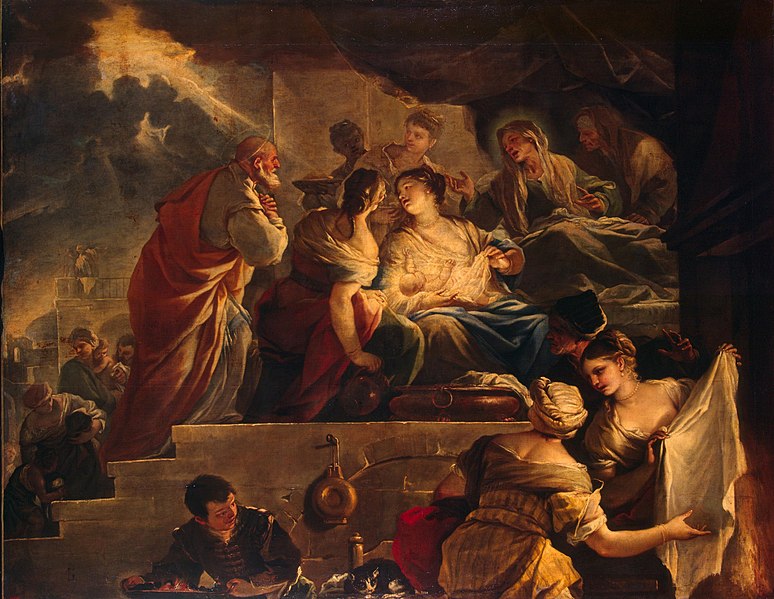
Luca GiordanoBirth of St John the Baptist

Each year my friend, The Rev. Sean Ekberg, gathers laity and clergy to write a daily Advent reflection. Today (December 23) was mine. You can read it below or visit The Episcopal Church the Resurrection and read there along with some of the other reflections.

Luke 1:57-66

57 Now the time came for Elizabeth to give birth, and she bore a son. 58 Her neighbors and relatives heard that the Lord had shown his great mercy to her, and they rejoiced with her.

59 On the eighth day they came to circumcise the child, and they were going to name him Zechariah after his father. 60 But his mother said, “No; he is to be called John.” 61 They said to her, “None of your relatives has this name.” 62 Then they began motioning to his father to find out what name he wanted to give him. 63 He asked for a writing tablet and wrote, “His name is John.” And all of them were amazed. 64 Immediately his mouth was opened and his tongue freed, and he began to speak, praising God. 65 Fear came over all their neighbors, and all these things were talked about throughout the entire hill country of Judea. 66 All who heard them pondered them and said, “What then will this child become?” For, indeed, the hand of the Lord was with him.

His Name is John?

Holden Caulfield loves his sister, Phoebe, and her innocence. He desires that her innocence go unchanged, yet he knows that every experience will change her to one degree or another. Reflecting on her many trips to the museum to view the same paintings that he has enjoyed, he thinks, “I thought how she’d see the same stuff I used to see, and how she’d be different every time she saw it. It didn’t exactly depress me to think about it, but it didn’t make me feel gay as hell, either. Certain things they should stay the way they are. You ought to be able to stick them in one of those big glass cases and just leave them alone.” (The Catcher in the Rye, J.D. Salinger)

In many respects, the Church had come to see itself as one of those items that should be curated in a big glass case. It should occasionally be brought out to remove the fine layer of dust that had accumulated, along with any unwelcomed spider’s web, and the glass it set upon also properly dusted. But then it should be set back unhindered in its proper place in that big glass cabinet.

Close to two years ago, something came along and smashed the cabinet.

When it hit, we all lunged forward from our comfortable seats and dashed to catch the Church before it struck the ground and burst into thousands of unrecognizable shards. By the grace of God, we caught it, but then what were we to do? Build another glass museum case? Set it out of reach on some high pinnacle? Place it on the nearest flat surface and quietly walk away? No. None of the above. Besides, this is God’s Church and if we were not to care for it, then He would raise up from the stones those who would.

The Bishop, clergy and people of the Diocese of Oklahoma took their Church and began taking a much closer look at it. They peered into stained glass windows and found the wonders of God and signs of a life that they had not anticipated, but one they would embrace. This was something new. In a sense, within the Church, the events of the last few years are like Zechariah giving his newborn son a name that none of his family had ever received, and it was God saying, “Behold I make all things new.” And truthfully, we were all amazed. We were perhaps afraid in trying, but we were doing things that we had not ever imagined. We were speaking to the world in new ways, being creative in how we fulfilled the Great Commission. Sometimes those new ways worked and sometimes the internet signal was not strong enough; but we have persevered and will continue to do so, for we believe that the hand of the Lord is with us.

At the naming of John, Zechariah’s neighbors asked, “What then will this child become?” We can ask the same of the Church in this new era. What will we become? The answer: exactly the Church of which God desires for us to become. Let’s just not go and put ourselves back in another big glass cabinet. Let’s continue to seek new and innovative ways to proclaim the Gospel of Jesus Christ to a world that has also changed. Let’s follow John out into the wilderness and be witness to Love.

The Rev. Dr. John Toles

Rector, St. Matthew’s Enid

Episcopal Diocese of Oklahoma

Sermon: Proper 10 RCL B – “Silencing God”

Saint Jean Baptiste prêchant devant Hérode Antipas by Pieter de Grebber

Hibbard “Hib” Johnson was an associate of Thomas Edison and was a partner in the organization that is now General Electric. He is also the Father of the Electric Christmas Tree Light. Given all that, he was fairly well off, being worth about $30M in today’s dollars, which means he could have what he wanted and he wanted a house built by Frank Lloyd Wright and… he got it. Only problem, the roof leaked, and one evening when Johnson was entertaining distinguished guests for dinner, and after several attempts to repair, it leaked again, dripping steadily onto Hibbard’s head. It is reported that Hib, irate, called Wright in Phoenix, Arizona. “Frank,” he said, “you built this beautiful house for me and we enjoy it very much. But I have told you the roof leaks, and right now I am with some friends and distinguished guests and it is leaking right on top of my head.” Wright’s reply, supposedly heard by all: “Well, Hib, why don’t you move your chair?”

I’m sure I can be stubborn at times, but not so pig-headed as to not move the chair. However, when we get our minds set on something, we can get a bit stubborn, whether we know we are right or wrong. Why? Because we want to get our way. We want what we want. After thinking on our Gospel lesson, I believe that was what was behind Herodias’ desire to have John put to death.

A little background, which is the story of three Herods. There was Herod the Great. He was the Herod that the three wisemen came to visit and that had all the young children in Bethlehem put to death. Then there was Herod II, son of Herod the Great. Herod II was heir apparent to the throne and married to Herodias; however, just days prior to Herod the Great’s death, Herod II fell out of favor with dad and it was Herod Antipas (we’ll call him Antipas) who was Herod II’s brother by another mother, that became king. Clear as mud? So, Herod II is married to Herodias and Antipas is married to a foreign princess. Herod II loses the throne to Antipas, and this is where things get really complicated. Antipas and Herodias, have a little thing on the side and both end up divorcing their spouses and marrying one another. Some might say they fell in love, but it would seem to me that Herodias just wanted to be queen, no matter what. She got it and was determined to remain so, but then, along comes John the Baptist, calling them out on their sin: you can’t marry your brother’s wife.

That would certainly be enough to get John in trouble, but as Herod was king and Herodias queen, they would have received criticism from many, and if those critics get too loud, you get rid of them, but there was something about John that was different from those other critics. Our reading said, “Herodias had a grudge against him, and wanted to kill him. But she could not, for Herod feared John, knowing that he was a righteous and holy man, and he protected him. When he heard him, he was greatly perplexed; and yet he liked to listen to him.”

Enter the dancing daughter. Must have been a fine dance, because Herod offers her half the kingdom. Being the devoted daughter, she asks momma: “Momma, we can have half the kingdom. What should I ask for?” She could have had so much, but instead she asked for John’s death. Why? I think part of the answer lies in the fact that Herod “liked to listen to” John. And what if, in all his talking that Herod like to listen to, one day, John was able to finally convince Herod that he shouldn’t be married to Herodias? Herodias understood that. Herod could as easily divorce her as he did his first wife. She could have had anything she wanted, but she could have lost what she so stubbornly went after: being queen. So, she had eliminated the one that might bring about her demise. “Well, Hib, why don’t you move your chair?” “Well, Herodias, why don’t you stop being so pig-headed and listen to God?”

This incident tells us about the lives of the king and queen and the death of John, is a microcosm of the world that Jesus entered into. A world where those who rule, both civilly and religiously, are corrupt and sinful. A world that does whatever it wants in order to get whatever it wants, whether it be right or wrong. A world that will put to death those who try to speak the word of God into the sinfulness. It is a story about how the world goes about silencing God. The entire incident, therefore, is a foreshadowing of what is to happen with Jesus, for like John, Jesus is going to call them all out on their sinfulness and as we know, they will silence him as well.

Today… today we also silence God. From taking prayer out of schools to perverting God’s word to suit our purposes, whether using it as a weapon against those who are different or by reinterpreting the difficult bits so that we no longer call sin sin. These and in so many other ways we silence God. But not only do we see the silencing of God in the world around us, but we silence him in our own lives as well.

Think of Herod and Herodias and John calling them to repentance. John was performing the same function that the Holy Spirit performs in our lives. With the king and queen, he spoke to them, showing them the errors they were making, and then showing them the path of righteousness. The same is true with the workings of the Holy Spirit in our own lives, and like Herod and Herodias, when that voice in the wilderness speaks to us, pointing out our errors and showing us the path of righteousness, we can become stubborn in our sin and effectively tune out and silence the Spirit. If we persist, then we put ourselves in danger of no longer even recognizing that voice, and then we really are in trouble, but we are not lost. Our God is one that seeks out the lost.

They brought to Jesus “a man who was deaf and had a speech impediment, and they begged him to lay his hand on him.  And taking him aside from the crowd privately, he put his fingers into his ears, and after spitting touched his tongue. And looking up to heaven, he sighed and said to him, ‘Ephphatha,’ that is, ‘Be opened.’ And his ears were opened, his tongue was released, and he spoke plainly.” (Mark 7:32-35)

We can silence God to the point where we become deaf to God, but if we will allow it by not being stubborn in our sin, if we will accept his corrections, then he can once again open our ears and our spirits to the voice of the Spirit of God, that we might walk in paths of righteousness. Consider the first verse of our Psalm:

“I will listen to what the Lord God is saying,
for he is speaking peace to his faithful people
and to those who turn their hearts to him.”
(Psalm 85:8)

Don’t be the one who is too stubborn to move your chair when the water is pouring on you. Don’t be the one who silences God when God is trying to correct you. Pray that the ears of your heart will be opened, then turn your heart to him and listen to what the Lord God is saying and he will be faithful to you and lead you along the path of righteousness.

Let us pray: Come Holy Spirit, fill the hearts of your faithful and kindle in them the fire of your love. Send forth your Spirit and they shall be created. And You shall renew the face of the earth. Amen.