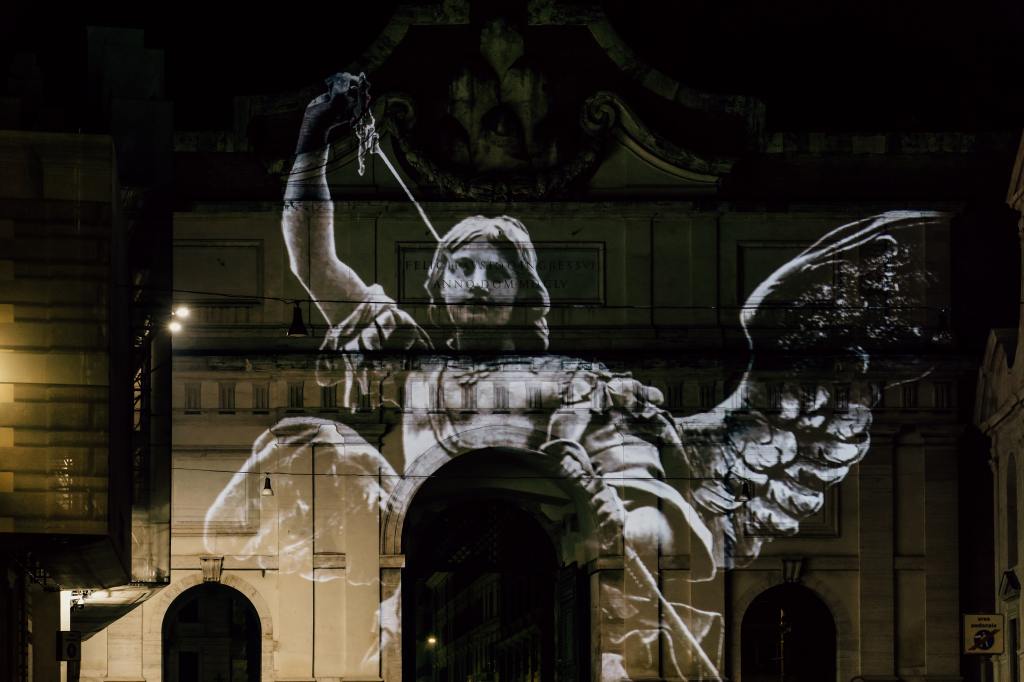
On the Feast of Michael and all Angels, also known as Michaelmas, we give thanks for the many ways in which God’s loving care watches over us, both directly and indirectly, and we are reminded that the richness and variety of God’s creation far exceeds our knowledge of it.
The Holy Scriptures often speak of created intelligences other than humans who worship God in heaven and act as His messengers and agents on earth. We are not told much about them, but Jesus speaks of them rejoicing over penitent sinners and elsewhere in a statement that has been variously understood, He warns against misleading a child, because their angels behold the face of God.
In the Hebrew Scriptures, it is occasionally reported that someone saw a man who spoke to them with authority, and who they then realized was no mere man, but a messenger of God. All this leads us to understand that there are super-human rational created beings, either resembling men in appearance or taking on human countenance when they are to communicate with us and are referred to as “messengers of God,” or simply as “messengers.” The word for a messenger in Hebrew is malach and in Greek, angelos, which is where we get the word “angel.”
By the time of Jesus, Jewish popular belief included many specifics about angels, with names for many of them, including the seven archangels: Gabriel, Michael, Raphael, Uriel, Raguel, Remiel and Saraqael.
What is the value to us in remembering the Holy Angels? They are the ones who fight the unseen battles and wars. From the Book of Revelation, “War broke out in heaven; Michael and his angels fought against the dragon. The dragon and his angels fought back, but they were defeated, and there was no longer any place for them in heaven. The great dragon was thrown down, that ancient serpent, who is called the Devil and Satan, the deceiver of the whole world– he was thrown down to the earth, and his angels were thrown down with him.”
Michael and his angels fought against the dragon and the other rebellious angels and they were defeated and cast out.
You only need to turn on the TV to see images of war and it seems that we are now constantly at war with someone. Bombing here. Invasions there. They will mount a camera on a missile so that you can watch it as it leaves the plane to when it hits it’s target. Spend anytime on the internet and you will come across images of war that are so horrible that they seer themselves onto your brain. In the midst of all this, it is easy to forget that there is another war taking place around you. And it is Michael and his angels, those that fought that great rebellion in Heaven, that continue the fight in this war. However, this war is not over control or real-estate. This war is for your soul. Therefore, we celebrate Michael and the angels for their constant vigilance in the spiritual realm protecting us against those enemies we cannot see and for assisting us in those times of trouble. They are the messengers of God and the play a very active, though unseen, role in our lives.
I’ll close with a prayer that we should all know and frequently pray:
St. Michael the Archangel, defend us in battle. Be our defense against the wickedness and snares of the Devil. May God rebuke him, we humbly pray, and do thou, O Prince of the heavenly hosts, by the power of God, thrust into hell Satan, and all the evil spirits, who prowl about the world seeking the ruin of souls. Amen.
There was once a king who was very sick and whose wise men told him that if he covered himself with the shirt of a contented man, he would be healed. He sent his emissaries throughout the length and breadth of the country looking for a contented man. At last, several months later, they returned empty-handed. “Was there no-one in my realm who is contented?” asked the king. “Yes, Your Majesty,” they replied. “Then where is the shirt?” asked the king. “Your Majesty, he had no shirt.”
The human body is about 60% water, which is why we often hear the importance of drinking enough water. We must stay hydrated, because dehydration can cause all sorts of problems within our physical systems. But our bodies are smart and most of the time, when our bodies need more water, we will become thirsty; however, by the time this sensation kicks in, we are already entering the stages of dehydration. You see, there are sensors within our body that tell our brains when the salt level in our blood is too high, which is an indicator of dehydration, so it sends a signal to the brain that the water levels have dropped and the brain initiates the sensation of thirst that we experience. What’s even more amazing is that the brain can detect and determine how much fluid we’ve consumed so that the thirst sensation can be turned off almost immediately. The brain is literally regulating the level of water in our system to keep the body physically satisfied or contented. Not too much and not too little. Amazing. If only the brain could work that way in other areas of our lives.
Last week I read South of the Border, West of the Sun by Haruki Murakami. It is an interesting little story, but toward the end, one of the characters describes the west of the sun part of the title and it has to do with farmers in the Siberian tundra. She tells about how the farmer gets up everyday and goes out into the fields and plows the gardens. As the farmer plows, he can see nothing in either direction as far as the horizon. Just the fields. His day consists of getting up each morning, having his breakfast, plows until noon, has lunch, then back to plowing until the sun sets in the west. It happens day after day except in the winter when he works on indoor jobs. However, one day as he is plowing, something breaks and dies inside the farmer’s spirit. At that point, the farmer tosses the plow to the side and starts walking toward the west. Headed to the land west of the sun, thinking there must be something more out thee. Like someone possessed, the farmer walks day after day, not eating or drinking until he collapses on the ground and dies.
We can lead such lives as this. Lives that are never contented, causing us to always be searching for something west of the sun. Never satisfied. Always thirsty. It can occur in so many areas of our life. Relationships: having a solid and loving relationship, but always looking for something that might be better. Being invited to the prom by someone known to be good and kind, but waiting to give them an answer to see if someone better might ask. Having a job that provides for every need, but thinking there are others that provide more prestige. This is a terrible state to be in, but it is not limited to our worldly pursuits. It occurs in our faith as well. We experience a dryness in our faith. We don’t believe that God hears our prayers. We become discontent in our relationship with Him. Like the Psalmist, we call out:
O God, you are my God; earnestly I seek you; my soul thirsts for you; my flesh faints for you, as in a dry and weary land where there is no water.
But instead of realizing that he is the source of all our souls desires, we stop what we’ve been doing and we start searching for what is west of the sun. Something we believe will be more fulfilling or entertaining or less challenging. We go in search of something that does not involve the cross that we are called to carry or the sacrifices that must be made. In that search for more, our souls become dehydrated and we become disoriented and confused, we lose our strength and our vision becomes cloudy, we can no longer walk or even stand. Left in such a state, we will die, but in such a state, we can no longer care for ourselves. We are in desperate need of someone giving us a cup of water for our souls.
John said to Jesus, “Teacher, we saw someone casting out demons in your name, and we tried to stop him, because he was not following us.” But Jesus said, “Do not stop him; for no one who does a deed of power in my name will be able soon afterward to speak evil of me. Whoever is not against us is for us. For truly I tell you, whoever gives you a cup of water to drink because you bear the name of Christ will by no means lose the reward.”
What does that cup of water look like? Is it an attempt to solve the issue for them, by telling them what to do? “You need to drink more water. You need to do this or that.” No. That’s not what they need. Do they need a piece of your mind? “If I’ve told you once I’ve told you a thousand times… etc.” That’s not what they need either. If their soul is thirsty, do they need you to quote scripture to them? “You know, Jesus says, ‘If anyone thirsts, let him come to me and drink. Whoever believes in me, as the Scripture has said, ‘Out of his heart will flow rivers of living water.’ So, what you need is Jesus. That’ll solve your issue.” Truth is, that’s not it either. What they need, in most cases, is for someone to simply bring them a glass of cool water; and what we are saying is… they need—more than anything else—is to be loved and to know they are loved and to be shown they are loved.
I believe that people go searching west of the sun in search of fulfillment because they are dying of a spiritual thirst. They are dying because they do not feel loved and we can be the ones who give that love to them.
Let us pray: Dear Jesus, help us to spread the fragrance of your love everywhere we go. Flood our souls with Your spirit and life. Penetrate and possess our whole being so utterly that all our life may only be a radiance of Yours. Shine through us and be so in us that every soul we come in contact with may feel Your presence in our souls. Let them look up and see no longer us but only You! Amen.
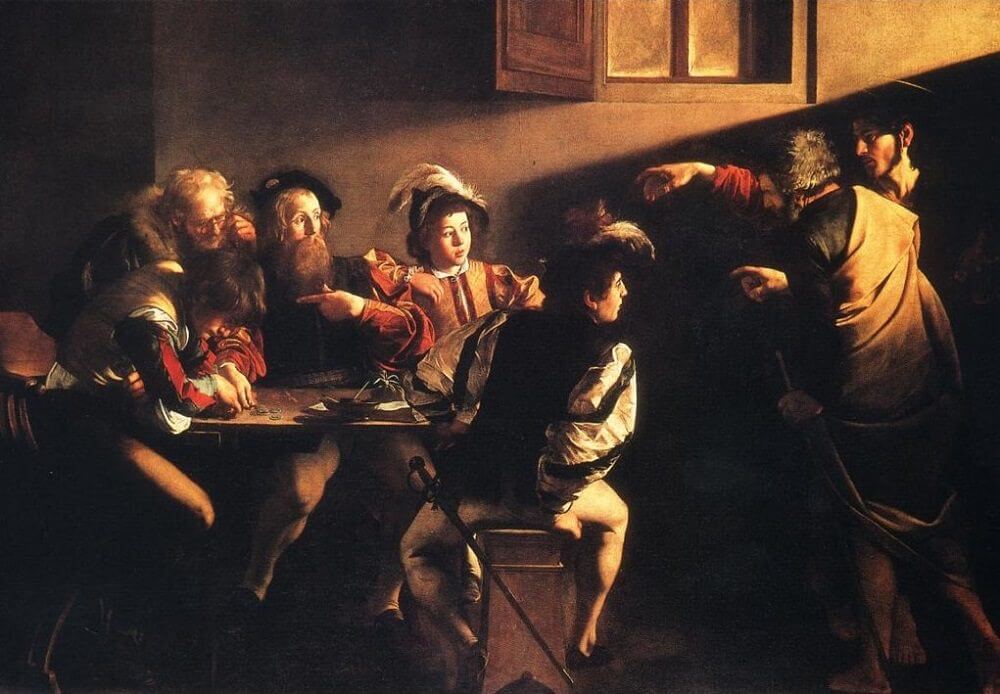
The Calling of Saint Matthew by Michelangelo Merisi da Caravaggio
A man on vacation was strolling along outside his hotel in Acapulco, enjoying the sunny Mexican weather. Suddenly, he heard the screams of a woman. Rushing to help, he found the woman cradling a young boy.
The man knew enough Spanish to determine that the child had swallowed a coin and was choking. He grabbed the child by the heels, held him up, gave him a few firm swats on the back, and an American quarter dropped to the sidewalk.
“Oh, thank you sir!” cried the woman. “You seemed to know just how to get it out of him. Are you a doctor?”
“No, ma’am,” replied the man. “I’m with the United States Internal Revenue Service.”
I am sure we could find one, but I doubt there are many other individuals who are more universally disliked than the tax man. Even when our tax dollars are spent for good reasons, it just irks us to give them up and a person who’s job it is to collect them… they’re just not all that appreciated. Our Saint for the day and the patron of our congregation, St. Matthew, was one such person.
In the time of Jesus, the tax collectors were known as publicans and the tax organization sounds like a multilevel marketing scheme. You’ve got the guy at the top, then another level below him/her, and each of them has a level below them. In the case of taxes, the ones on the bottom are doing most of the collecting. What they collect is then passed up the food chain to the head person, who then passes it all onto the government. Only catch: everyone in the chain, from the lowest to the highest is going to make sure they get a cut, so instead of simply charging the taxed amount, they charge more to insure they get their piece of the pie. (By the way, we still do things like this: see the $600 hammer.) Our St. Matthew was on the bottom rung, but he was still hated by both Gentiles and Jews.
He was hated by the Gentiles because he was a tax man and they knew he was overtaxing them and he was hated by the Jews for the same reason, but even more so, because he himself was a Jew that was working for the occupying Romans. He had no friends except for other tax collectors. Of all the candidates that could have been selected to proclaim the Kingdom of God, this Matthew was the least likely, yet Jesus did what we have seen God do on a number of occasions. As we’ve been learning in our Sunday morning study, he chose Abraham who wasn’t even a believer to begin with, he chose Jonah who wanted absolutely nothing to do with those apostate Ninevites, he chose David who would be an adulterer and murderer, he chose Mary who was just a young girl. Matthew and all the rest aren’t the odd ones out when it comes to being called into God’s service. They are the norm!
We believe that God can only use those who are holy and righteous, but as Jesus tells us, “Those who are well have no need of a physician, but those who are sick…. For I have come to call not the righteous but sinners.” Why would that be? Because someone who is healthy can give a good testimony, but someone who is sick and is then healed can become a powerful witness, which is why Jesus called a tax collector named Matthew and why he called each of us. Like Matthew and the others, we were all once sick in our sin, but now we are the ones who can give witness to the mercy and healing power of our God.
Like Matthew, live your life as a witness to the Good News and the merciful healing of our God.
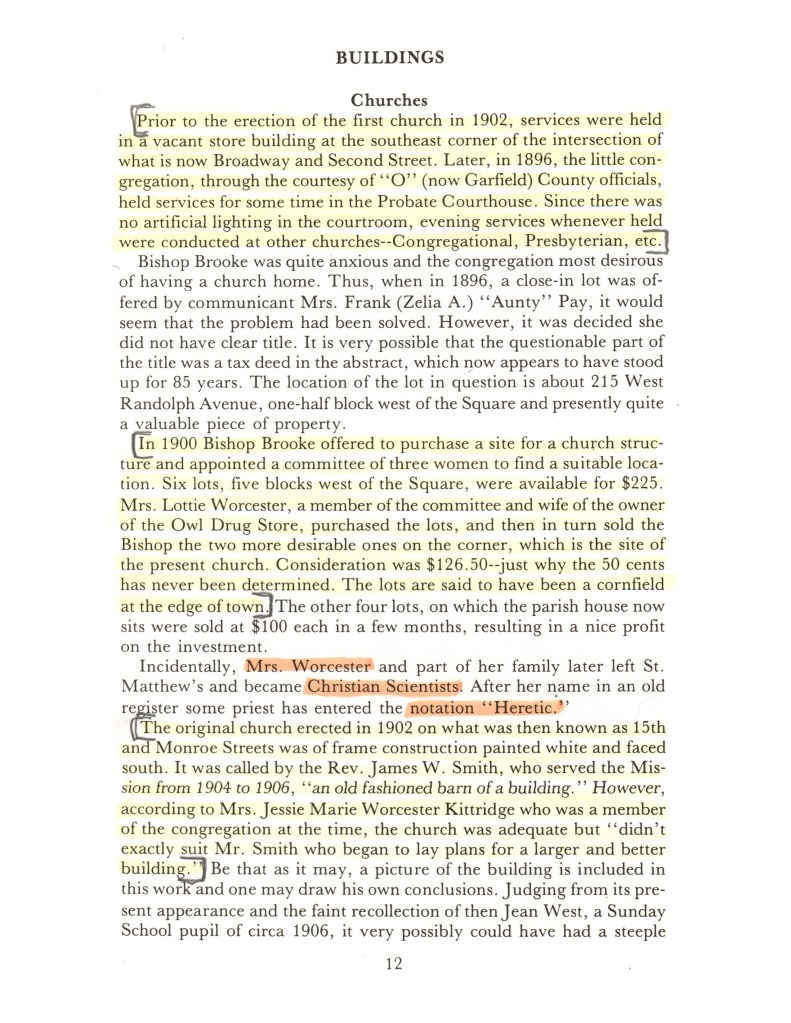
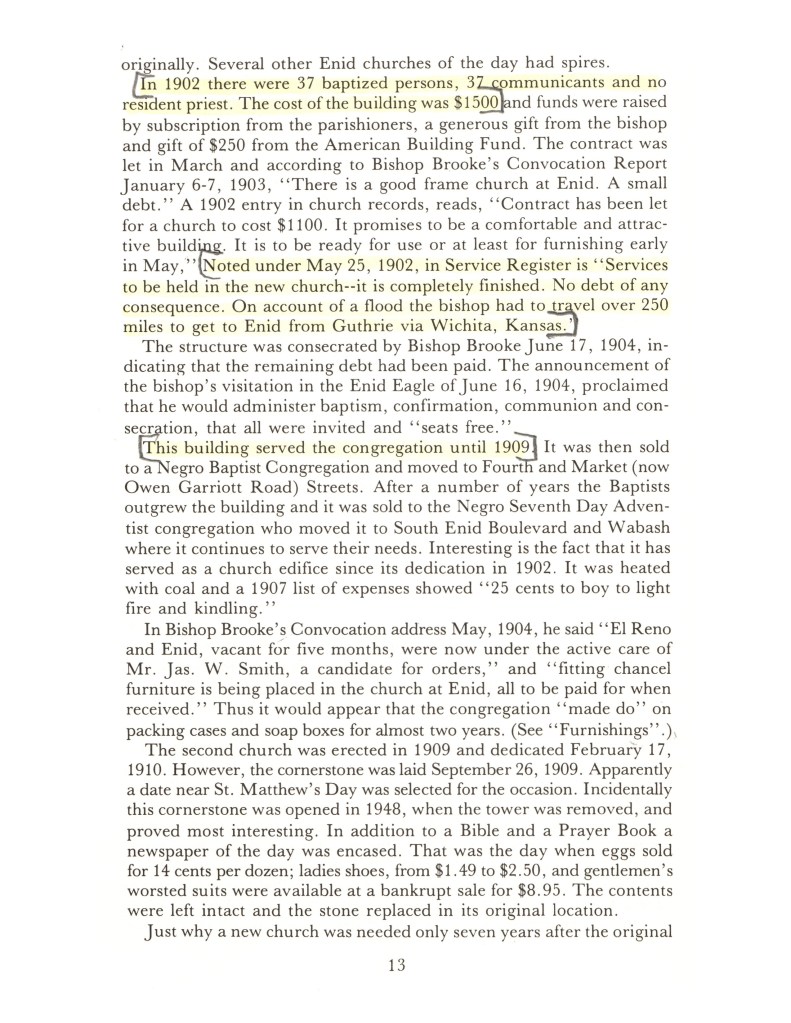
Then they came to Capernaum; and when he was in the house he asked them, “What were you arguing about on the way?” After I read this and some of the other history of our church, I read the Gospel for today and had myself a little laugh… Then they came to Enid; and when he was in the house he asked them, “What were you arguing about on the way?”
The interesting thing about a church’s history is that you can really only talk about the buildings and the clergy, the people and who served, the money or the lack there of, and so on. What you can’t really tell in the history of a church is how God moved in the people. How the power of the Holy Spirit transformed lives. How Jesus truly entered this house and began the work of the Kingdom of God in this place. The buildings, the people, and all are only a part of our heritage, because it is these workings of God in our lives and the lives of those around us that are reflects our true heritage, and that really is the most important thing.
Jesus “took a little child and put it among them; and taking it in his arms, he said to them, ‘Whoever welcomes one such child in my name welcomes me, and whoever welcomes me welcomes not me but the one who sent me.’” Our heritage is about welcoming the child, welcoming Jesus into our midst and loving him and loving one another, for what other sign can we show that God is present than by our love for Him and our love for one another? Does the height of a steeple prove that love? Or the size of our endowment? Or even the number of cars in the parking lot? Do any of these things demonstrate the love of God and the love of one another? Not really. They do demonstrate commitment and courage. They also show a desire to honor God in visible ways. None of this is bad or wrong, but what they can’t show is love, because love is an action of the heart. True love is that which seeks the good of the other without regard for self and that is what it means to welcome the little child, but that is not something that can necessarily be documented. Instead, it is a feeling, almost a presence.
This past week, we had our Saints Book Club. We’ve just finished reading In This House of Brede. A beautiful story about the lives of the nuns living in a convent. The main character, Philippa, had come to the point when the older nuns would decide if she would be allowed to stay and become a fully professed sister. She was afraid they would not allow it, so she went to the sanctuary to pray, asking God to allow her to stay. The scene is set: “The light flickering by the tabernacle was warm, alive, and as if they were still there, she heard what the nuns had sung last night at Benediction: ‘Christus vincit, Christus regnat, Christus imperat.’” Christ conquers, Christ reigns, Christ commands. In that place, she could “feel” the prayers from the night before, because as was stated, “If a place has been filled with prayer, though it is empty, something remains; a quiet, a steadiness.” Our sanctuary is the same. You can “feel” the presence of the prayers that have been said there over the last century, but it’s not just that… and it is the reason I’m so happy to be serving in this place, because, I can see the heritage in buildings and the books and the art, but more importantly, I can “feel” that more important heritage—that heritage of God’s work and transforming power—I can feel that you have always performed the work that Christ called on his disciples to perform. That is, in the name of Jesus, the child has always been welcomed here. In the name of Jesus, you have always loved and there really is no greater heritage than this.
This year… your church is 128 years old. May the love you have shown in those years be a source of inspiration to continue in this great work of the kingdom for the years to come, until the great day of the Lord’s return.
Let us pray: We thank you, heavenly Father, for the witness of your apostle and evangelist Matthew to the Gospel of your Son our Savior; and we pray that, after his example, we may with ready wills and hearts obey the calling of our Lord to follow him; through Jesus Christ our Lord, who lives and reigns with you and the Holy Spirit, one God, now and for ever. Amen.
Jane Austen is the author of Pride and Prejudice. Mark Twain was not a fan of Jane Austen and is reported to have said, “Everytime I read Pride and Prejudice I want to dig Jane Austen up and beat her over the skull with her own shin-bone.”
The American academic and Shakespearean scholar, Duncan Spaeth, stated, “I know why the sun never sets on the British Empire: God wouldn’t trust an Englishman in the dark.”
Someone once asked Ghandi: “What do you think of Western civilization?” Ghandi replied, “I think it would be a good idea.”
A young Hollywood wannabe was once bragging to the the great actress Miriam Hopkins. The wannabe said, “You know, my dear, I insured my voice for fifty thousand dollars.” Hopkins responded, “That’s wonderful. And what did you do with the money?”
Bessie Braddock served in the English Parliament for twenty-five years. Encountering a somewhat intoxicated Winston Churchill, she said to him, “Winston, you’re drunk.” Not thinking much of Bessie Braddock, Winston replied, “Bessie, you’re ugly, and tomorrow morning I’ll be sober.”
It seems that insulting someone has been around for a as long as there has been language and I’m guessing even the caveman new a thing or two about putting one another down. Growing up, I would have to say that my ability to insult someone was limited to that witty comeback, “Yo mama!” I may have improved since then. Many have and some even make a living at insulting others. For example, if it weren’t for the insults, the twenty-four hour news stations would run out of something to say within the first five minutes.
At times, the insult is just folks who give each other a hard time, and if they ever cross the line, an apology will follow, but it seems the insult has grown into a way of life. Not the sign of some quick witted response, but an assault to tear down and destroy. And when the words are no longer sufficient, threats and violence will ensue.
I remember years ago reading Ray Bradbury’s great dystopian novel, Fahrenheit 451. Seems it was one of those required readings, so I just muscled my way through it without much thought, but I reread it again just a few weeks ago and was amazed. A bit too close to reality. Neil Gaiman (sci-fi and horror author) wrote the introduction to the edition I ordered and although I don’t normally read the introductions to books—don’t necessarily want someone telling me what I’m supposed to think about a book I’m about to read—I did read this one, because of who wrote it. In it, Gaiman wrote, “When I reread it as a teenager, Fahrenheit 451 had become about treasuring books and the dissent inside the covers of books. It was about how we has humans begin by burning books and end by burning people.” I had to underline that, because it is so true. As the story goes, those who would read were first insulted, then persecuted, then… burned. As I read the story, I came to a line that made me stop reading. I had to get up and walk around for a bit before continuing: “Those who don’t build must burn.” We see a lot of burning these days. The events of twenty years ago that we remembered yesterday provide the perfect example, but in truth, we do the same thing everyday when we decide to burn instead of build.
We burn others by cruelly insulting them from our hearts. By speaking or even thinking of how to bring them lower. By raising our voices in angry confrontation. By dismantling the works of others for our own perceived benefit, in order to exert and promote our own opinion, or simply for the heck of it; but our ability to do so is not a sign of our strength. It simply shows our capacity to burn. Why? “Those who don’t build must burn.” Those who don’t want to take the time and find the courage to build and create, those who become jealous and feel threatened by others’ successes, those who are simply too lazy to create, and so on… those are the ones who will burn, because it is much much easier to burn than it is to build.
Jesus has been going from town to town. He has been teaching, healing, feeding, and loving. Jesus has been building up the Kingdom of God. He asked the disciples, “Who do people say that I am?” In doing so, Jesus is not fishing for compliments. He is secure in the knowledge of who he is, but he is evaluating the work. Are the people… are you beginning to understand who I am and what we are building? It sounds positive. The disciples answer, some say you are “John the Baptist; and others, Elijah; and still others, one of the prophets.” That is good, but Jesus wants to know what those who have been closest to him think. Are they grasping even more of the truth than the crowds, so he asked them specifically, “But who do you say that I am?” Peter answered him, “You are the Messiah.” Yes! The work is being accomplished and we are building something here, but don’t tell anyone about what you know of me. Why? Because there are those who aren’t building anything and if they discover too soon, they will try and burn it all down before the time has come; and Jesus knew who those were that would burn: the elders, the chief priests, and the scribes. He also knew that they would eventually succeed, so he tells his disciples, you are not to be like them. You are not to follow their example of burning. Instead, you are to follow my example, by building: “If any want to become my followers, let them deny themselves and take up their cross and follow me.” You as my disciples are to follow me in building up the kingdom of God, because we’re not building something that moths and rust can destroy or something that thieves can break in and steal. No. We are building something eternal. What did Jesus say, “Destroy this temple, and in three days I will raise it up.” Destroy this temple, burn it to the ground, and I will build a temple that not even death can destroy. He did and we are to follow, taking our cross, being crucified with him and being raised to a new and eternal life that not even death can touch. And we not only build up ourselves, but we are to build up one another.
1 Thessalonians 5:11—“Encourage one another and build one another up.”
Ephesians 4:29—“Let no corrupting talk come out of your mouths, but only such as is good for building up.”
Romans 14:19—“So then let us pursue what makes for peace and for mutual upbuilding.”
1 Corinthians 14:26—“Let all things be done for building up.”
Not only does this apply to those we know and love, but Jesus also makes it clear that this applies to those that hate us: “Love your enemies and pray for those who persecute you, so that you may be children of your Father who is in heaven.” (Matthew 5:44-45)
Am I preaching on this today because I know of a problem within this body of Christ? Absolutely not. I see nothing but love and compassion among you, but what I do see is an increased desire within society to insult and to burn. It is like an infection that is going unchecked and unless we are aware of it and the symptoms, then we become susceptible, and then we become those who burn, no longer building up as Christ has called us to. As St. Paul teaches, “Do not be overcome by evil, but overcome evil with good.”
From the poem, Ulysses, by Alfred, Lord Tennyson, “Come my friends, tis not too late to seek a newer world.” Let us be the ones that build and in the process, join with Jesus in the great work of making all things new.
Let us pray: Lord, make us instruments of Your peace. Where there is hatred, let us sow love; where there is injury, pardon; where there is doubt, faith; where there is despair, hope; where there is darkness, light; where there is sadness, joy. O, Divine Master, grant that we may not so much seek to be consoled as to console; to be understood as to understand; to be loved as to love; For it is in giving that we receive; it is in pardoning that we are pardoned; it is in dying that we are born again to eternal life. Amen.F
It is a rather obscure feast day for Episcopalians, but it is on our calendar: The Nativity of the Blessed Virgin Mary. It is a fixed day, always occurring on September 8, which is exactly nine months after a feast day occurring on December 8 that is not on our calendar: The Conception of the Blessed Virgin Mary. None of the information we have for either of these feasts comes to us from Holy Scripture, but rather from tradition and other non-biblical text, such as the Protoevangelium of James, also known as the Gospel of James, which is one of the infancy Gospels of Jesus, covering the time of Mary’s conception through Jesus’ birth.
The narrative tells about Joachim and Anne, the parents of Mary, who like Abraham and Sarah could not conceive a child, but instead of giving up, they prayed all the more fervently. Because of their faithfulness, an angel of the Lord appeared to Anne and told her, “The Lord has heard your prayer, and you shall conceive, and shall bring forth, and your seed shall be spoken of in all the world.”
Hearing the news, they created a sanctuary in their home for the child so that she might remain pure. Following Mary’s birth, she was given to God. James tells us, “And Joachim brought the child to the priests and they blessed her, saying: ‘O God of our fathers, bless this child, and give her an everlasting name to be named in all generations’ . . . And he brought her to the chief priests, and they blessed her, saying: ‘O God most high, look upon this child, and bless her with the utmost blessing, which shall be for ever.’”
Reflecting on these great events, St. Augustine, writing in the fifth century said, “[Mary] is the flower of the field from whom bloomed the precious lily of the valley. Through her birth the nature inherited from our first parents is changed.” Through her, the Messiah was given, and through him, we receive new birth. If nothing else is as it truly happened, that much is. Through Mary’s fiat, her “Yes” to God, our Salvation entered the world.
Did any or all of what James tells us occur? I don’t know, but… I feel that there is some truth behind it, because there had to of been something special about Mary for God to have chosen her, out of all the women to ever be born, to give birth to his one and only Son.
So today is a birthday celebration. The birth of our Savior’s mother, which reminds us of Jesus’ birth, but also ours. They were both born for a reason and so were we… so were you. It is also a reminder and a demonstration of God’s faithfulness to those whom He calls and to those who turn their lives over to God’s will. Mary said, “Behold, I am the servant of the Lord; let it be to me according to your word,” and Jesus declared, “Not my will, but yours, be done.” Both gave themselves fully to God. They did not hold back. Our calling as God’s children is to do the same.
Let us pray: O Most Blessed Virgin Mary, Mother of Christ and Mother of the Church, with joy and wonder we seek to make our own your Magnificat, joining you in your hymn of thankfulness and love. Guide and sustain us so that we might always live as true sons and daughters of the Church of your son. Enable us to do our part in helping to establish on earth the civilization of truth and love, as God wills it, for his glory. Amen.
A man made an appointment with the famous psychologist Carl Jung to get help for chronic depression. Jung told him to reduce his fourteen-hour workday to eight, go directly home, and spend the evenings in his study, quiet and all alone. The depressed man went to his study each night, shut the door, read a little Hermann Hesse or Thomas Mann, played a few Chopin études or some Mozart.
After weeks of this, he returned to Jung, complaining that he could see no improvement. On learning how the man had spent his time, Jung said, “But you didn’t understand. I didn’t want you to be with Hesse or Mann or Chopin or Mozart. I wanted you to be completely alone.” The man looked terrified and exclaimed, “I can’t think of any worse company.” Jung replied, “Yet this is the self you inflict on other people fourteen hours a day”
For several weeks, we talked about the Holy Eucharist and Communion. The benefits, the mystery and also the way in which it binds us together as a community. When we spoke of the community, I shared with you the statement from the Archbishop of Canterbury, Michael Ramsey: “Individualism therefore has no place in Christianity, and Christianity verily means its extinction. The individual Christian exists only because the body exists already. In the body the self is found, and within the individual experience the body is present.” However, without further investigation, we could come to believe that we can only practice our faith when gathered together as a community, but with all things, we must seek the proper balance, because there are also times, in practicing our faith, that we must be alone with Jesus. There are so many fine lessons in our Gospel reading this morning, but that was what I kept thinking on.
First there was the encounter with the Gentile woman, of Syrophoenician origin and the tongue-in-cheek bantering between her and Jesus. Then, in a different town, the people bring Jesus a deaf/mute and asked Jesus to heal him. It is here that we read, Jesus “took him aside in private, away from the crowd, and put his fingers into his ears, and he spat and touched his tongue. Then looking up to heaven, he sighed and said to him, ‘Ephphatha,’ that is, ‘Be opened.’ And immediately his ears were opened, his tongue was released, and he spoke plainly.” Jesus healed him. The man could hear and speak, but in order to do this great work in his life, Jesus brought him to a private place, away from everyone else.
Christianity cannot exist outside of the community of the faithful, but the individual needs private time with Jesus, so that Jesus can do great work within them. However, like the fella who went to visit Carl Jung, so many of us, when we have time alone, will fill the air with all sorts of noise, because the idea of being alone or even alone with Jesus, is terrifying. Yet the truth remains: we must have community and we must have this time alone with Jesus. Dietrich Bonhoeffer said it best in Life Together: “One who wants fellowship without solitude plunges into the void of words and feelings, and one who seeks solitude without fellowship perishes in the abyss of vanity, self-infatuation, and despair.” His conclusion, “Let him who cannot be alone beware of community. Let him who is not in community beware of being alone.” His reasoning for time alone with God: “Alone you stood before God when he called you; alone you had to answer that call; alone you had to struggle and pray; and alone you will die and give an account to God. You cannot escape from yourself; for God has singled you out.” (p.77f) Therefore we need community, but we need the alone time as well.
What does this alone with Jesus while at the same time being in community look like? It is about like this very moment we have now. We are gathered here as a community, but there is also this reverence, awe, (and when the preacher shuts up) silence. A time of being together, but also a time to listen to ourselves and to God. A place of encounter between the Creator and the created. A time to be alone with Jesus so that he might perform a great work within us. It sounds easy—sit quietly with Jesus—but it is actually hard work and requires practice. Why? Because we don’t know how to stop. To stop doing, talking, digesting every form of media… we simply do not know how to do what our parents and everyone else tried to get us to do the entire time we were growing up: we do not know how to sit still and be quiet, but… we can learn. If there were two pieces of advice I would give you on how to sit still and quiet with God, it would be these 1) be intentional and 2) have a pen and paper handy.
First, intentionality. I have one of those brains that’s always traveling somewhere, but if I’m focused on one particular task, I can stick with it. However, if I’m going to be focused on a task, I have to schedule that time. I make an intentional “appointment” to accomplish a certain work. I think that the same is true with our private time with Jesus. Yes, we can have those moments throughout the day, but in order for that greater work to be accomplished, we need to intentionally schedule time to meet with God. That might sound ridiculous to some, “Excuse me God, but tomorrow I have the 9 a.m. hour free. Would that work for you to meet?” Sounds silly, but if you don’t schedule that 9 a.m. hour with God, then I guarantee you something else will fill it and it won’t be God.
Second, pen and paper. Best friends. I love the post-it note. I’ve scheduled my appointment to complete a particular task. I’m focused and in the groove. Yet, even though I’m focused, some random piece of information pops into my head, “I need to write that message to the Bishop.” At that point, I have a couple of options: I can stop what I’m doing and write the message or I can go on with what I’m doing, but afraid I’ll forget to do it or… I can pop off a post-it note and jot it down: “Write message to Bp.” I can confidently stay focused on what I’m doing, knowing I won’t forget the other bit. The same is true with that scheduled time with God. All sorts of things are going to come up during it. If I let a thought or concern persist, then my time with God is a wash, but if I’ll take just a moment to write down that thought, then I know it is safely dealt with for the time and I can get back to God.
Again, this may all sound a bit too pragmatic in our relationship with God and spending time with him, but let me ask you this: how’s your current system working out for you?
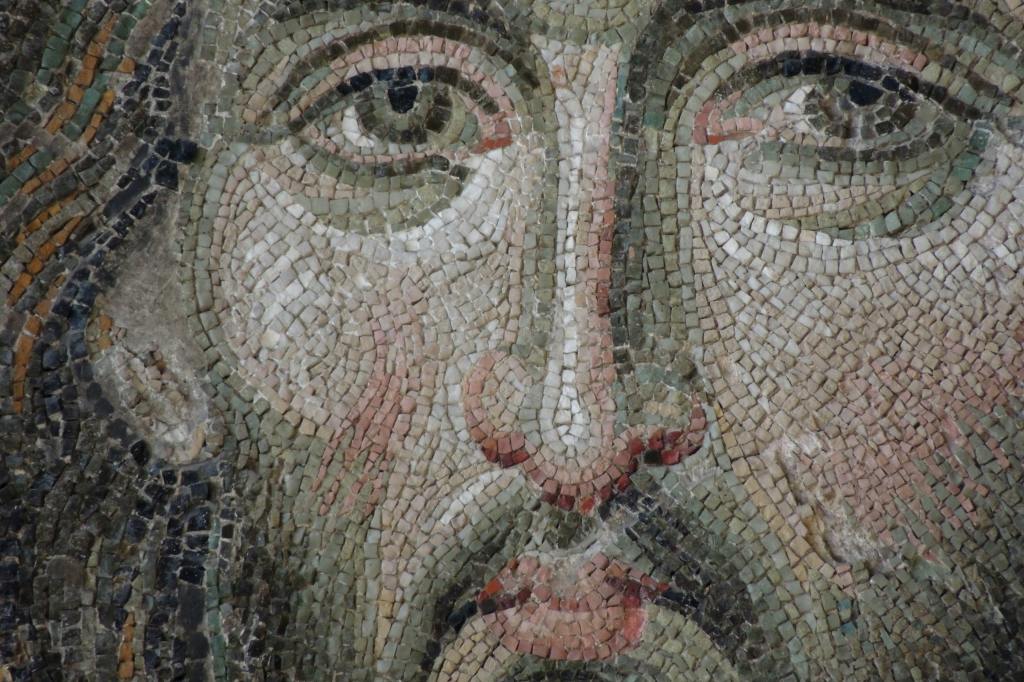
Just as we were intentional in coming here today to spend time with God in the family of the faithful, we must also do the same in our private time with Jesus, because we need both: community and time alone with our God. The two are inseparable. What is the end result? Henri Nouwen, in Can You Drink this Cup?, described it best: “Community is like a large mosaic. Each little piece seems so insignificant. One piece is bright red, another cold blue or dull green, another warm purple, another sharp yellow, another shining gold. Some look precious, others ordinary. Some look valuable, others worthless. Some look gaudy, others delicate. We can do little with them as individual stones except compare them and judge their beauty and value. When, however, all these little stones are brought together in one big mosaic, portraying the face of Christ, who would ever question the importance of any one of them? If one of them, even the least spectacular one, is missing, the face is incomplete. Together in the one mosaic, each little stone is indispensable and makes a unique contribution to the glory of God. That’s community, a fellowship of little people who together make God visible in the world.”
Let us pray: Heavenly Father, author and inspirer of all things holy, hear our prayers for our Church. Send forth Your Spirit that we may humbly be guided by your Divine Will. Touch our hearts with true generosity to raise up a house of God for the inspiration and renewal of all your faithful. We ask this in Jesus’ Name. Amen.
Two Jewish boys were trying to outdo each other on how far back they could trace their family lineage. The first said, “My family can trace our ancestry back almost two thousand years to the great Rabbi Akiva. So how far back does your family go,” he asked the second.
Without missing a beat, the second boy says, “I don’t know. My father told me that all of our records were lost in the flood.”
Family trees. Family reunions. Family photos. Families that are happy, dysfunctional, dysfunctionally happy, extended, small and so much more. No matter what type of family you have—good, bad, or indifferent—you did not become a member by choice and you’re stuck with the one you’ve got.
The word “family” describes our biological family, but is also good to describe a group of individuals who have a common thread, so it is often used as a way of describing the Church. You are my Church family and the comedian Les Dawson describes you well: “Families are like fudge – mostly sweet, with a few nuts.” And you know who you are.
Not only family, the Church is also described as the Body of Christ, describing our unity and how we need one another. In his first letter to the Corinthians, Paul writes, “The eye cannot say to the hand, ‘I have no need of you,’ nor again the head to the feet, ‘I have no need of you.’” And a little further on, “There may be no division in the body, but that the members may have the same care for one another. If one member suffers, all suffer together; if one member is honored, all rejoice together. Now you are the body of Christ and individually members of it.” We do not exist for ourselves, we exist for the Body. Archbishop of Canterbury, Michael Ramsey, was quite emphatic on this: “Individualism therefore has no place in Christianity, and Christianity verily means its extinction. The individual Christian exists only because the body exists already. In the body the self is found, and within the individual experience the body is present.” This unity is the fulfillment of Jesus’ great priestly prayer recorded in John’s Gospel: “The glory that you have given me I have given to them, that they may be one even as we are one, I in them and you in me, that they may become perfectly one, so that the world may know that you sent me and loved them even as you loved me.”
We have this unity, but it is a unity that can exist at different levels, that is why when Paul speaks of the Body of Christ, he speaks of the body of all believers, but also about the Body of Christ as the local church; so we can say that contained within this church of St. Matthew’s, we are the Body of Christ, while still being a part of a greater body. As that body of St. Matthew’s, we gather as any family gathers, but in this family, there is a true dependence on one another, which means this body of St. Matthew’s has all that it needs to be the church in this place, but it cannot be that church without you. We have a dependence on one another, therefore we have a responsibility to one another. As St. Paul teaches, “Let each of you look not only to his own interests, but also to the interests of others.”
However, in order for this body to be real, something more than just nice words, then we must have a common thread running through us all, and we do, Jesus. We have him, not just in our profession of faith, but as we said last week, we have his real presence in his body and blood that we receive in the Eucharist, and it is this Eucharist that provides a real and tangible common thread, binding us together.
In our Gospel reading, Jesus said, “Those who eat my flesh and drink my blood abide in me, and I in them.” We abide in him and he abides in us, therefore, we abide in one another. St. Francis de Sales preached, “We are all nourished by the same bread, that heavenly bread of the divine Eucharist, the reception which is called communion, and which symbolizes that unity that we should have one with another, without which we could not be called children of God.” This has been the belief of the Church since the very beginning. The Didache is a first century liturgical book and at the celebration of the Holy Eucharist, while holding the bread, the priest would say, “As this piece of bread was scattered over the hills and then was brought together and made one, so let your Church be brought together from the ends of the earth into your Kingdom.” God’s Kingdom in heaven and God’s Kingdom here on earth.
Have you ever been to a wedding where, toward the end of the ceremony, the couple lights a unity candle? They’ve got a large candle in the middle and smaller ones on each side. The two smaller ones are burning and the bride and groom each take one the smaller ones and together they light the candle in the center. The interesting bit is what comes next: do they place the smaller candles back in their stands still burning or do they blow them out first. Did they light a flame together, but maintain their own separate flames, or do they extinguish their individual flames and truly only exist as one. (I once heard that the couple left the smaller ones burning, but after moment, the bride leaned over and blew out the grooms. To that, someone said, “During the marriage ceremony two become one — on the honeymoon they discover which one.”) Seriously, in the end, there should only be one flame and the same is true for us as the family and body of Christ, made one through Jesus who gave himself for us all.
Today, as you come forward to receive the body and blood of Christ, remember that we are the family of God, the Body of Christ, and recognize that we truly need one another. Without you, each of you, we are diminished. With you… with you we become a flame that can set the world on fire with the love of God.
Let us pray: Lord God, you have built in heaven and on earth a single Church of truth and love and Holy Spirit; one family and communion, whose temple is the Lamb, One body indivisible, here and beyond: the body of Your dear Son. The unity of holy Church, its might, its Gospel, proceeding from Your unalterable will, is truth and love and Holy Spirit. Its ministries stream from your heart. We pray Lord that we might become this Church in this place: a beacon to the lost, a salve for the wounded, and a family for all. Jesus, in your name. Amen.
I don’t remember telling you about this before… I know of a man who, while praying the Rosary, had a vision of the Blessed Virgin Mary.
He had been walking along a country road. On one side of the road was a piney forest and on the other was a field and a pond. As he was walking, he had been searching for the Virgin, but unable to find her, then in the distance, he saw her walking toward him down the road. He quickly turned and ran to meet her, but—and this is probably funny—the closer she got, the bigger she got so that when they finally met, she was able to reach down and pick him up and put him in her pocket.
He tried to see through the weave in the fabric of her dress to see the outside world and determine where she was taking him, but was unable to. Not only that, but the further they went, the darker it became until all was dark. Yet as the light had lessened, he had been able to detect something new: a sound. At first, it sounded like the soft beating of a drum, but a short distance on, the sound was unmistakable: it was the beating of a heart. He began to not only hear the heartbeat, but to also feel it in his entire body. Each beat was like a loving embrace. It was then the man realized that Mary had done what she had always done: she had brought him to Jesus. You see, it was not her pocket that she had placed the man into. No. Mary had placed the man in the wound in Jesus’ side so that the man could be near the beating loving heart of the Risen Lord where he had learned even more of the great love of Jesus. He had been allowed to remain there for a short time and then was sent on his way to try and fulfill the Lord’s will.
There is always much confusion surrounding the role of Mary in the Church and in the life of God’s people, but that confusion only arrises when people fail to understand her purpose. Her purpose is to draw people in so that she can lead them or even take them to her Son… so that she can place them near His heart that they might know of His great salvific love for them.
I encourage you all to take her by the hand and to walk with her. When that walk ends, you will find that you have been brought to Jesus.
Eternal Father, you inspired the Virgin Mary, mother of your son, to visit Elizabeth and assist her in her need. Keep us open to the working of your Spirit, and with Mary may we praise you for ever.
We ask this through our Lord Jesus Christ, your Son, who lives and reigns with you and the Holy Spirit, one God, for ever and ever. Amen
May the Lord bless us, protect us from evil and bring us to everlasting life. Amen