Sermon: Christ the King Sunday RCL B – “What have you done?”

Photo by Pro Church Media on Unsplash

Boudreaux’s entire family was gathered and looking over his momma’s shoulder as she flipped through an old photo album. She eventually came across a picture of her holding baby Boudreaux in one hand and a coconut cream pie with a mile high meringue in the other.

“My pride and joy,” momma said, smiling.

Boudreaux almost got weepy until his momma said, “Won the blue ribbon at the state fair pie cook-off.”

I suppose when some folks remember us, we’ll always be in second place in their life—if not further back—to a blue ribbon pie or something less, but hopefully there will be a few that remember us a bit more fondly. But have you ever wondered what your younger self would remember and think of you today? One person who did was Elie Wiesel.

Elie died in 2016 at age eighty-seven, having as a boy survived the Nazi concentration camps. His parents and one of his sisters did not survive. He would emigrate to the United States and become a writer and professor, promoting human rights and was a great advocate for the Jewish people. In 2003, the Los Angeles Times declared him, “the most important Jew in America”. Earlier, in 1986 he won the Nobel Peace Prize. During his acceptance speech, he made the following remarks about those early days in Germany.

I remember: it happened yesterday or eternities ago. A young Jewish boy discovered the kingdom of night. I remember his bewilderment, I remember his anguish. It all happened so fast. The ghetto. The deportation. The sealed cattle car. The fiery altar upon which the history of our people and the future of mankind were meant to be sacrificed.

I remember: he asked his father: “Can this be true?” This is the twentieth century, not the Middle Ages. Who would allow such crimes to be committed? How could the world remain silent?

And then he wondered what his younger self would ask. He said, And now the boy is turning to me: “Tell me,” he asks. “What have you done with my future? What have you done with your life?”

Although our own lives may not have been as hard and difficult as Elie’s, we can speak of the events of our lives in a similar way. I remember when difficult things happened in my life, but I also remember the good: from the day I was ordained a priest to the day I gave last rites to a four year old little girl. So many different events in between, good and bad. And I know that you all can tell of similar events. I also know, as with Elie, the young boy or girl within us turns to us and says, “Tell me. What have you done with my future? What have you done with your life?”

As for Jesus, think of the things he could remember. I remember calling the first of the disciples and the beheading of John the Baptist. I remember the temptations in the wilderness and I remember the look on the people’s faces as they were fed with a few loaves of bread and a couple of fish. I remember how I was arrested in the garden and I remember the blind man seeing for the first time in his life. But for Jesus, it was not the little boy within him who asked, What have you done with your life. Instead, it was Pilate.

As we read in our Gospel: Pilate asked Jesus, “Are you the King of the Jews?” Jesus answered, “Do you ask this on your own, or did others tell you about me?” Pilate replied, “I am not a Jew, am I? Your own nation and the chief priests have handed you over to me.” And then Pilate asks, “What have you done?” What have you done with your life that has brought you to this point?

How any of us answer those types of questions communicates our legacy. How we will be remembered by our friends and family.

Elie Wiesel, says that he answers the little boy in himself by telling him, “I have tried. That I have tried to keep memory alive, that I have tried to fight those who would forget. Because if we forget, we are guilty, we are accomplices.”

As for myself, it depends on the day. On some days I tell my younger self that I have tried to make a difference. That I tried to follow God to the best of my abilities. That I tried to be true to my calling. Other days, the devil shouts me down.

As for Jesus, Pilate went onto say to him, “So you are a king?” Jesus answered, “You say that I am a king. For this I was born, and for this I came into the world, to testify to the truth. Everyone who belongs to the truth listens to my voice.”

Jesus, what have you done with your life that has brought you to this point? And Jesus answers, “I came into this world and I have testified to the truth. For I am the way and the truth and the life. I came into this world that God’s people might have life and have it abundantly.”

Today is Christ the King Sunday. It is the last Sunday of the Church year. Next Sunday, The First Sunday of Advent, we begin the story again. Over the last twelve months, we have added another year to how we can answer the young child in us: what have you done with my future? What have you done with your life? For each of us, there will be moments that we are proud of and moments we regret, successes and failures, but each of us, through our faith in our One True King, can report to our younger selves that if nothing else, we have secured our eternal future in the Kingdom of our God. A Kingdom where our remembered lives are redeemed and our past sins are forgiven. A Kingdom where we are allowed entry, not because of what we have done, but because of what Jesus has done.

Today, I invite you to take a deep breath and to let it out slowly and begin again. As we learned a few weeks ago in our Wednesday night study: for the Christian person, each new day is the Genesis story being written anew. The first words of that history are, “In the beginning God created…” and today God is creating, re-creating you better than you were yesterday. This day is a new Genesis, so—now that I think about it—those questions our younger selves ask should’t be asked in the past tense: “What have you done with my future? What have you done with your life?” Those questions from our younger selves should be asked in the future tense: “What will you do with my future? What will you do with your life?”

Would you please turn to page 93 in your Book of Common Prayer. To close today, I would like for us to say together canticle 19, The Song of the Redeemed, would you please stand:

O ruler of the universe, Lord God,
great deeds are they that you have done, *
surpassing human understanding.
Your ways are ways of righteousness and truth, *

O King of all the ages.
Who can fail to do you homage, Lord
and sing the praises of your Name
for you only are the Holy One.
All nations will draw near and fall down before you
because your just and holy works have been revealed.

Glory to the Father, and to the Son, and to the Holy Spirit
as it was in the beginning, is now, and will be for ever. Amen.

Sermon: Hugh of Lincoln

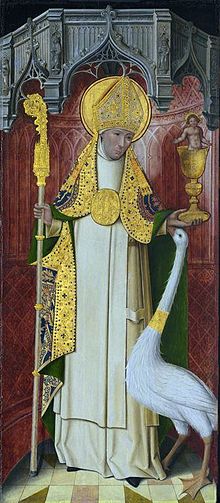
We know that within the icons and paintings of Saints, there are always clues as to who is being represented. Matthew is often depicted holding or writing in a book (his Gospel) and a winged man is generally seen with him. When it comes to our saint for the day, Hugh of Lincoln, you will often see him with a goose and holding up a chalice with the child Jesus inside.

It is told that on the day of his consecration, a wild goose arrived at his home and killed all the other geese on the lake. When anyone tried to approach, the goose would attack, but when Hugh arrived the following day, the goose went immediately up to him and followed him all over, even remaining in Hugh’s room at night to fight off any intruders. When Hugh was away, the goose would return to the lake, but a day or so before Hugh would return, the goose would fly around in great circles, joyously honking. When Hugh died, the goose refused to eat and would die a short time later.

The chalice with the child Jesus appeared to a man who was a critic of Hugh who had come to Lincoln to chastise the bishop, however, while attending a Mass that Hugh was celebrating, the man saw the child Jesus in the chalice when Hugh elevated it. Needless to say, the man was no longer a critic of Hugh.

The life of the saint began when he, at the age of fifteen, moved into a religious house. There he received his training and four years later was ordained a deacon. At the age of twenty-three, he visited a Carthusian monastery and was immediately taken by the way of life. Receiving permission from his superiors, he joined the order, being ordained a priest a few years later. In June of 1186, unbeknownst to him that he was even being considered, Hugh was elected Bishop of Lincoln. He said, no thank you. They held another election and he was elected again. He again said, no thank you, but he was eventually persuaded to accept the position, but in doing so, he did not renounce his vows as a Carthusian and maintained his simple life.

At the time, the Diocese of Lincoln was the largest in the Roman Catholic Church, so there was a great deal of responsibility to the people and the crown, who he got along with at times, but at other times clashed. He was a great defender of the Jews who lived in his diocese, of the poor, children, and of women (he once said, “No man was ever allowed to be called the father of God, but a woman was granted the privilege of being God’s mother.”)

His funeral procession had three archbishops, fourteen bishops, one hundred abbots of the surrounding monasteries, and the Prince of Wales. The kings of England and the King of Scotland were among those who carried his casket.

An early biographer writes, “A more self-denying, earnest, energetic, and fearless Bishop has seldom, if ever, ruled the diocese of Lincoln, or any other diocese whatever…. Hugh was the rare man, who was a match, and more than a match for them all (the monarchs and archbishops). Once sure of the straight path of duty, no earthly influence, or fear, or power, could stop him: he never bated an inch even to such opponents; and while fighting and beating them, still, all the while, won and retained their admiration and reverence.” (The Life of St. Hugh of Lincoln, p.xx-xxi.)

Hugh of Lincoln: he died on this day in the year 1200.

Sermon: Proper 28 RCL B – “The Steeple”

Photo by Ernest Brillo on Unsplash

You Know You’re in a Cajun Church if the finance committee refuses to provide funds for the purchase of a chandelier because none of the members knows how to cook it.

You Know You’re in a Cajun Church if when people learn that Jesus fed the 5000, they want to know whether the two fish bass or catfish.

You Know You’re in a Cajun Church if when the pastor says, “I’d like to ask Boudreaux to help take up the offering,” four guys and one gal stand up.

You Know You’re in a Cajun Church if on the opening day of gator season the church is closed.

You Know You’re in a Cajun Church if the choir robes were donated by and embroidered with the logo for, Thibideaux’s Fine Dining and Bait Shop.

Finally, you Know You’re in a Cajun Church if instead of sanctus bells, you hear a duck call.

There’s more, but I’ll stop there.

It doesn’t matter if it is within the same denomination, every church has its own distinctive characteristics. Like the Episcopal Church, there’ll be the same basic liturgy—even protestant churches have liturgies, whether they admit it or not—but they’ll all have certain nuances one to the next. And all denominations essentially believe the same basic tenants of the faith, although they’ll argue about the details. But when it comes to the mainline denominations—Episcopal, Methodist, Presbyterian, Lutherans, and the likes—we also have one other thing in common, which is a bit disconcerting: decline in members and attendance. A study that came out recently surveyed 15,000 churches across all denominations. In the year 2000, the average attendance in those churches on a Sunday was 137. In the year 2020, that number had dropped by more than 50% to 65. Why would it drop so dramatically?

It is still mostly true in towns like ours, but no longer in the cities: the steeple of the church used to be the tallest structure in any community. It was a sign to the faithful and a beacon to the lost. But as things progressed and the buildings got taller, the church—literally—became less visible, until eventually it was completely dwarfed and even hidden in the mass of ever growing commerce and skyscrapers. The only trouble, not only did this happen with the church building, but it happened with the people as well. As more and more opportunities were presented, more and more people were drawn away. Some blame the people for this. “They need to get their priorities straight!” “Jesus is the reason for the season!”, and so on, but the truth is, the circumstances are far more complex than platitudes and the pandemic only accelerated and exacerbated the situation.

As for us at St. Matthew’s, prior to the pandemic, we were bucking the trends and growing, but the pandemic did a bit more than knock the wind out of that. When we were once again able to open our doors, I thought that everyone would be back. That has not been the case. This has been very upsetting to me. At first I was even a bit angry, but then I just became more and more anxious. What had happened to our church? When I got past the initial panic, I started looking for an answer. In my opinion, knowledge is power and over the last couple of months, I have been talking to our bishop and my colleagues and reading and I’ve come to understand that we are not alone in this at St. Matthew’s. As a matter of fact, it is basically across the board in almost every church and every denomination. What I’ve also realized is that if I was feeling anxious about it, then so are you.

Most of you have been here a lot longer than I have and this is your church. So today, I thought I would share with you some of the things that I’ve learned and hope to show a vision of a path forward that I’ve been working on with the Bishop, the diocese, Dora (our Sr. Warden) and the vestry. And I’ll start by saying, I am very excited about the future of St. Matthew’s. So, what did I learn?

One of the hardest hitting and honest articles I came across and shared with colleagues summarized what we know about the low attendance that we’re all experiencing. It was simply titled: They’re Not Coming Back. My initial reaction was like being punched in the gut, but after a bit, it cleared the fog of my anxiousness and allowed me to understand what is taking place.

Three main takeaways from the article and confirmed in many conversations and observations here: 1) people who were eager to volunteer in the past and showed up for everything are being more selective and only choosing a few things to participate in, 2) individuals and families who were once regular attenders are becoming semi-regular, and 3) individuals and families that were on the periphery are fading away all together. If we ask ourselves, “Do I fall into one of those categories?” I think we would probably say, yes. The “why” behind it is a bit more difficult to understand, but the way forward is to understand and acknowledge that the last two years have presented every human being on the planet with a shared trauma. We did not simply ease into the pandemic. There was a day when we were all hearing about a new variety of flu and the very next day we collectively slammed into a brick wall. Everything stopped and closed. If you’ve ever been in a bad accident or known someone that has, you don’t just walk away from it without feeling some effects. Whether you were injured or not—and with the pandemic we all were in one way or another—whether you were injured or not, the world and each individual has been traumatized to one degree or another and at the moment, we’re all just trying to figure out if it’s safe to get back in a car.

That’s the first bit. Understanding and acknowledging the trauma we’ve been through, so that we can see through the fog of our anxiousness, which then allows us to recognize the one thing we truly need: the healing that comes from God that will restore us to health.

The second piece is this (and to continue using the analogy of a car hitting a brick wall): when you’ve walked away from that accident, my guess is your number one priority will be safety. In other words, you’re going to probably make some changes in what you drive and how you drive. Following the crash of the pandemic, the Church is going to have to make some changes as well. Don’t worry, I won’t be adding big screens and rock bands in the sanctuary or wearing skinny jeans (Lord, help us all!) It does however mean that we need to truly define who we are and then, with that in mind, actively engage in the mission of the church. What is the mission of the Church? From the Book of Common Prayer: “The mission of the Church is to restore all people to unity with God and each other in Christ.” How do we pursue this mission? “The Church pursues its mission as it prays and worships, proclaims the Gospel, and promotes justice, peace, and love.” And who in the Church carries out this mission? “The Church carries out its mission through the ministry of all its members.” That is our mission, how we accomplish it, and who takes part in it. It is truly the fulfillment of the Great Commission as given to us by Christ Jesus. This is the goal of the second part, of going forward and so, everything we do—from the music we select to sing on a Sunday morning, to the annual budget, to the programs we offer, to who we are in the community as disciples of Jesus, and everything else—should reflect the mission.

At times like this, it can seem the right thing to do would be to circle the wagons, hold what we’ve, got and wait for things to settle out, but that is not who we are as a Christian people. The Lord said to Joshua, “Be strong and courageous. Do not be frightened, and do not be dismayed, for the Lord your God is with you wherever you go.” That’s who we are.

We—the world—has been knocked around pretty good the last couple of years, but through our faith and courage, in the process of asking for and realizing our own healing, we as a congregation are going to seek to bring that same healing to others. I said I was excited about the future of St. Matthew’s and that is why, because as I’ve told you, I firmly believe that the Lord is about to do some amazing work through you and I’m delighted to be a part of it and to be able to watch and participate as it unfolds.

Let us pray: Heavenly Father, look upon our community of faith which is the Church of your Son, Jesus Christ. Help us to witness to his love by loving all our fellow creatures without exception. Under the leadership of our Bishop keep us faithful to Christ’s mission of calling all men and women to your service so that there may be “one fold and one shepherd.” We ask this through Christ, our Lord. Amen.

Sermon: Proper 27 RCL B – “Desperation to Hope”

Photo by Siora Photography on Unsplash

A fisherman was at sea with his heathen buddies when a huge storm came out of nowhere and was close to destroying their small ship. His friends begged him to do anything, even pray, but he said to his buddies, “It’s been a long time since I’ve done that or even gone to church.” Finally they were desperate for anything, so he said O.K. and prayed, “O Lord, I haven’t asked anything for you for fifteen years, and if you help us now and bring us to safety, I promise I won’t bother you for another fifteen years!”

Merriam-Webster defines desperation as “1) loss of hope and surrender to despair and 2) a state of hopelessness leading to rashness.” The Latin origin word defines itself: de spes / no hope.

As we are all aware, desperation can lead to all sorts of poor choices and wrong behavior. Everything from oversharing in attempts to gain some sort of attention, to acts of violence: the cornered animal can no longer run, so it will turn and fight or attack. As Winston Churchill said, “Beware of driving men to desperation. Even a cornered rat is dangerous.” When we become desperate, our rational selves duck under the covers, leaving us vulnerable to our own emotions. However, just as the word defined itself—de spes / no hope— it also defines the solution.

You have all probably heard the Greek myth of Pandora and her box. According to the mythology, Pandora was created by Zeus as punishment for Prometheus stealing fire from the gods and bringing it down. Pandora was the first mortal created and was gifted with beauty, elegance, life. She was very desirable, but she was also given her box that she was told by Zeus to never open. Curiosity got the cat and it got Pandora as well. She opened it to take a peak and all the evils of the world flew out before she could slam it closed again. Here, there are a couple of different endings, but it seems that there was only one thing that did not escape: hope. All the evils ever created (anger, lust, greed, gluttony, etc) were released into the world to inflict harm on all mortals who would be weighed down in their grief, because there was no hope: it was still trapped in Pandora’s box.

Holy Scripture tells us of similar events: “Now war arose in heaven, Michael and his angels fighting against the dragon. And the dragon and his angels fought back, but he was defeated, and there was no longer any place for them in heaven.  And the great dragon was thrown down, that ancient serpent, who is called the devil and Satan, the deceiver of the whole world—he was thrown down to the earth, and his angels were thrown down with him.” And a little further on, “Therefore, rejoice, O heavens and you who dwell in them! But woe to you, O earth and sea, for the devil has come down to you in great wrath, because he knows that his time is short!” (Revelation 12:7-9, 12) All the evils set loose in the Devil’s great wrath, but where is the hope?

I know I’ve shared it with you before, but it is the poem, The Coming, by R.S. Thomas that just never seems to leave me alone:

And God held in his hand a small globe.
Look, he said.
The son looked.
Far off, as through water, he saw a scorched land of fierce color.
The light burned there, crusted buildings cast their shadows
a bright serpent, a river uncoiled itself, radiant with slime.
On a bare hill a bare tree saddened the sky.
Many people held out their thin arms to it,
as though waiting for a vanished April to return to its crossed boughs.
The son watched them.
Let me go there, he said.

The Devil, that serpent radiant in slime pours out his great wrath, stripping us of hope, but the Son said, “Let me go there,” and in doing so, hope is freed from Pandora’s box, it is released into the world through Jesus. St. Paul teaches us: “Remember that you were at that time without Christ, being aliens from the commonwealth of Israel, and strangers to the covenants of promise, having no hope and without God in the world. But now in Christ Jesus you who once were far off have been brought near by the blood of Christ.” (Ephesians 2:12-13) We have been given the hope of God, but do you know what’s funny? Remember those heathen fishermen caught in the storm? Story tells us that in their desperation they tried everything to save themselves and it was only then that they decided to place their hope in God and pray. Isn’t that odd… and we do the same thing.

Have you ever been in some desperate situation and done all you know and can think to do and only then say, “Well, as a last resort, might as well try God.” God gave himself that we might have hope, but we so often only look to him when things become desperate. As crazy as this might seem, why not go to him first? Seeking his will and his guidance before the situation becomes desperate and even if the circumstances continue to deteriorate, you will still not enter into that sense of desperation, because you know that he is with you, bringing you peace even in the midst of the chaos. How do we get there? How do we enter into that peace and that place of hope?

Jesus “sat down opposite the treasury, and watched the crowd putting money into the treasury. Many rich people put in large sums. A poor widow came and put in two small copper coins, which are worth a penny. Then he called his disciples and said to them, ‘Truly I tell you, this poor widow has put in more than all those who are contributing to the treasury. For all of them have contributed out of their abundance; but she out of her poverty has put in everything she had, all she had to live on.’”

How do we enter into that peace and hope of God? We take our two copper coins, all that we have, and place them into God’s hands. We do this, not when everything is falling down around us, but at the very beginning, even when life is grand and we’re walking on sunshine. We give him our two copper coins, so that come rain or shine, we are confident and even courageous in knowing that our God, “who neither slumbers nor sleeps,” is watching over us.

“Today we read in our Psalm:
Put not your trust in rulers, nor in any child of earth,
for there is no help in them.
When they breathe their last, they return to earth,
and in that day their thoughts perish.
Happy are they who have the God of Jacob for their help!
whose hope is in the Lord their God.”

Put your two copper coins in the treasury that is God and discover the peace and hope that your soul is… desperate for.

Let us pray: O God, our Creator, you are our hope and light. We are your people, a people of hope. Bless us, O Lord, and send your Spirit upon us. It is through our love and caring, that you give us hope, and we bring light to each other. Help us, O Lord, to keep our hope centered on you and may we bring light to each other. May your love inspire us, and your light sustain us. May a future full of hope bring us closer to you. We ask this through Christ our Lord. Amen.

Sermon: Richard Hooker


The 1549 Book of Common Prayer was the first Book of Common Prayer. There are many significances to its publication, but primarily, it established a uniformity of worship within the English Church, now separated from the Church of Rome. When it was published, Edward VI was king and he had some very protestant leanings. Three years later, in 1552, we have the second Book of Common Prayer, Edward was still king, but those protestant leanings took a wild swing towards Calvinism, so the revisions were quite severe.

In 1553, at the age of fifteen, Edward VI died. Lady Jane Grey ruled England for nine days and was then executed. She was seventeen. At this point the Book of Common Prayer went out the window as Queen “Bloody” Mary, a staunch Roman Catholic ascended to the throne. She lasted about five and a half years, then died and was followed by Elizabeth I—our beloved “Bess”, who became Queen in 1558. Elizabeth’s inheritance was a kingdom on the brink of civil war between the protestants and the Catholics. What was such a Queen to do?

To begin, as part of the Elizabethan Settlement, Elizabeth issued the 1559 Book of Common Prayer, which sought a middle ground between these two warring factions. For example: in the 1549 English Book of Common Prayer, when the priest distributes communion, he says to the communicant: “The body of our Lorde Jesus Christe whiche was geven for thee, preserve thy bodye and soule unto everlasting lyfe.” This is a very Catholic statement in that it points to the real presence of Jesus in the bread and the wine. In the 1552 English Book of Common Prayer, the priest says, “Take and eate this, in remembraunce that Christ dyed for thee, and feede on him in thy hearte by faythe, with thankesgeving.” This is a protestant view of the sacrament, in that the bread and wine are only a memorialization. Elizabeth, in the 1559 Book of Common Prayer, had the priest say: “The bodie of our lord Jesu Christ, which was geven for the, preserve thy body and soule into everlastinge life: and take and eate this in remembraunce that Christ died for thee, feede on him in thine heart by faith, with thankesgevynge.” It was a combination of the two views. This type of compromise can be found throughout the 1559.

Calvin once got into an argument with his tiger, Hobbes, which resulted in a compromise. Calvin’s opinion on the result: “A good compromise leaves everybody mad.” (May 1, 1993) Elizabeth’s solution basically accomplished the same result, but it was a beginning. This way of seeking the compromise is known in the Anglican Church (Episcopalians included) as the via media / the middle way. It is very much what defines our church. We are neither Catholic or protestant. We are—and I agree—the best of both worlds.

According to the Episcopal Dictionary, “Via media is often misunderstood in a negative way to mean compromise or unwillingness to take a firm position. However, for Aristotle and those Anglicans who have used it, the term refers to the ‘golden mean’ which is recognized as a more adequate expression of truth between the weaknesses of extreme positions.”

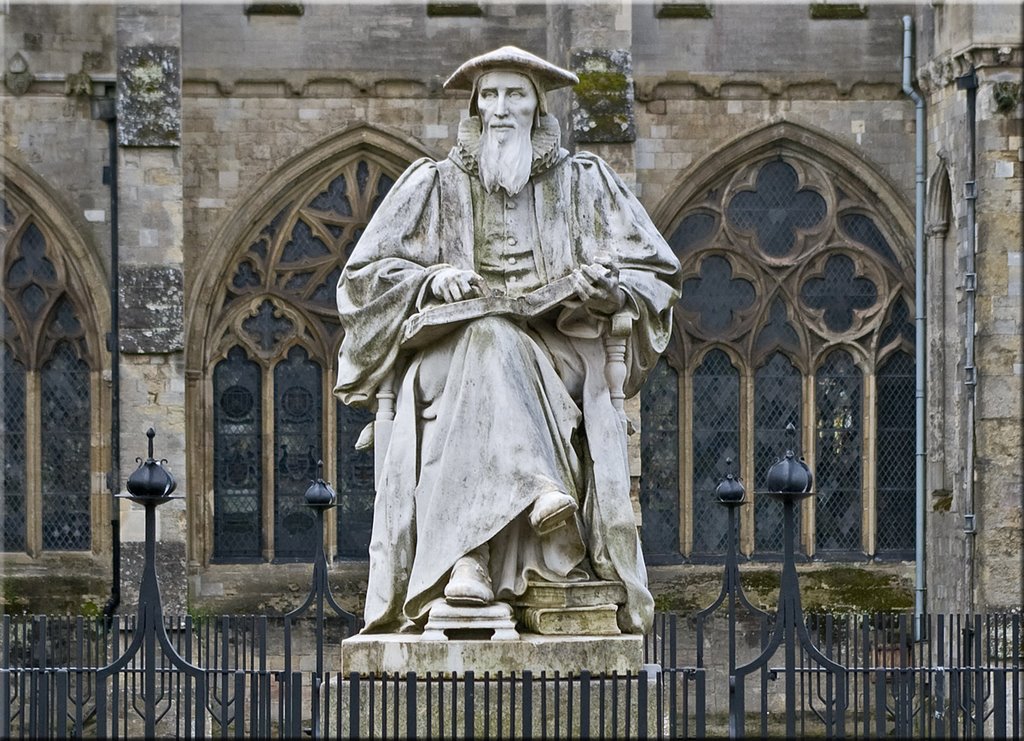
Why all this talk of the development of the Book of Common Prayer and the via media? It was our saint for the day, Richard Hooker, who was the great apologist/defender of this Anglican Way. In his great work, Of the Lawes of Ecclesiastical Polity, he puts forth the arguments that allowed the Elizabethan Settlement to be more fully realized and to continue to this day. Even Pope Clement VIII (died 1605) declared: “It [the book] has in it such seeds of eternity that it will abide until the last fire shall consume all learning.”

The via media today tends to get hijacked by whichever side is in power, but in the end, the prayer is that it will come back to that “golden mean”, where there are no sides, but only the truth.

Sermon: All Saints Day

Photo by Gianni Scognamiglio on Unsplash

A doctor was lecturing on the subject of nutrition. He said, “What we put into our stomachs is enough to have killed most of us sitting here, years ago. Red meat is terrible. Soft drinks eat away at your stomach lining. Chinese cooking is loaded with MSG. High-fat diets can be very risky. But there’s one thing that’s more dangerous than all of these, and we’ve all eaten it, or will eat it. Would anyone like to guess what food causes the most grief and suffering for years after eating it?” After a few seconds of silence, a small, hunched 80-year-old man in the front row raised his hand timidly and said: “Wedding cake.”

Today’s service is a combination of Halloween—which was originally known as All Saints Eve—All Saints Day and All Souls Day. Just to make it interesting, we’ve also decided to throw in a wedding. Remember that song from Sesame Street: “One of these things is not like the other….” Well, it may seem like it, but as it turns out, these events are all closely related. Let’s start with the wedding.

Since we are combining the wedding with our Sunday service, we’re doing things just a bit differently, but during the normal wedding liturgy, the bride and groom would stand down here. While here the bride and groom give and receive consent from one another, agreeing to be husband and wife. They also receive the consent and assurances of the congregation that they will be supported in their life together. It is also the time when they hear the reading of the word and a teaching or sermon, expanding on their life together. This first part then, which takes place down here, is about their common life and ours and instruction. Once this portion of the liturgy is completed, the bride and groom take a step up.

It is here that they make their vows to one another. Vows that bind them together as one. Here we also have the giving and the receiving of rings: a symbol of those vows they have taken. A symbol, not only to one another, but to the world. A symbol that states, I have given myself to another and no other. Next, it is here that the couple also receives the blessing of the Church and the pronouncement that they are now husband and wife (but Nick, you don’t get to kiss her yet!), because these vows are followed by a time of prayer for the life together, and then we make the final progression forward to the altar.
At the altar, the bride and groom, now truly husband and wife, through the office of the priest, receive the blessing of God.

There is the work of the people, there is the blessing of the church, and here is the blessing of God. And the entire ceremony is not only a progression of two lives being joined together as one, but of two lives being joined together as one and bound together by Christ Jesus. As husband and wife, they are joined together in a pilgrimage that is designed to draw them ever nearer to God.

How are All Souls Day and All Saints Day so closely related to a wedding: because following the wedding, we celebrate the Holy Eucharist, which is truly the wedding banquet and representative of the wedding banquet to come. Today in our lesson from Revelation, we heard St. John say, “And I saw the holy city, the new Jerusalem, coming down out of heaven from God, prepared as a bride adorned for her husband.” And a few chapters earlier John also used the imagery of the wedding:

“Hallelujah! For the Lord our God the Almighty reigns.
Let us rejoice and exult and give him the glory, for the marriage of the Lamb has come,    and his Bride has made herself ready;
it was granted her to clothe herself with fine linen, bright and pure”—
for the fine linen is the righteous deeds of the saints.

And the angel said to me, “Write this: Blessed are those who are invited to the marriage supper of the Lamb.”

Today, we the Church and all the souls and all the saints are the bride and Christ Jesus is the groom. All the souls and all the saints are the ones who have already washed their robes in the blood of the lamb and have entered into the banquet hall and it is they that we celebrate today for their great works and examples of righteousness that they provide for us. As they await our arrival to the feast, they do not simply mingle about, but are actively engage in prayer and intercession on our behalf. Through this wedding today, we are provided a vision of our future glory in that New Jerusalem, where we, with all the other souls and all the other saints enter the Kingdom that has been prepared for us from the foundation of the world.

As we celebrate all these great events today, it may at first seem that one is not like the other, but as it turns out, the wedding is at the heart of them all.

Let us pray: O God, you have so consecrated the covenant of marriage that in it is represented the spiritual unity between Christ and his Church: send forth therefore your word and your Spirit into our souls, that we might all be conformed into your image and be made holy and righteous in your sight, that we may be found worthy to enter the banquet you have prepared for all those who love you. Amen.

Sermon: Proper 25 RCL B – “Faith and Faith”

Photo by Matt Sclarandis on Unsplash

A well known Israeli rabbi had a call in radio program on Israeli radio. One day a lady called it and, crying, said, “Rabbi, I was born blind, and I’ve been blind all my life. I don’t mind being blind but I have some well meaning friends who tell me that if I had more faith I could be healed.”

The Rabbi asked her, “Tell me, do you carry one of those white canes?”

“Yes I do,” she replied.

“Then the next time someone says that, hit them over the head with the cane,” the Rabbi said. “Then tell them, ‘If you had more faith that wouldn’t hurt!’”

I wonder how you would respond if we went around the room and each of answered the question: “What is faith?” I know I’ve thought about faith, but I don’t know that I’ve really ever sat down and tried to think through what it is. If you asked me, my answers would along the same lines of many other folks, they just say it much better.

G.K. Chesterton: “Faith means believing the unbelievable. Hope means hoping when everything seems hopeless.”

Voltaire: “Faith consists in believing what reason cannot.”

Dan Brown (he’s an authority, DaVinci Code and all that): “Faith ― acceptance of which we imagine to be true, that which we cannot prove.”

C.S. Lewis: “You can’t know, you can only believe – or not.”

And then there is St. Paul: “Now faith is the assurance of things hoped for, the conviction of things not seen.” (Hebrews 11:1)

This morning during Sunday school, we also talked about an incident of faith. Abraham and Sarah are childless, so one night , Abraham is asking God how he will be the father of many nations if he has no children. So the Lord directed Abraham to go outside and then said, “‘Look toward heaven, and number the stars, if you are able to number them.’ Then he said to him, ‘So shall your offspring be.’  And he believed the Lord, and he counted it to him as righteousness.” Abraham believed the Lord. He had faith that what the Lord had spoken was true.

And then in our Gospel we have Jesus’ encounter with blind Bartimaeus (we also just finished hearing this passage in our Wednesday night study on discipleship). Jesus said to Bartimaeus, “‘What do you want me to do for you?’ The blind man said to him, ‘My teacher, let me see again.’ Jesus said to him, ‘Go; your faith has made you well.’ Immediately he regained his sight and followed him on the way.” Through faith, he regained his sight.

Again, I hear these definitions and examples of faith and they fit my understanding, but with that understanding, my faith has a certain dependency on me. Consider this one: Jesus said, “For truly, I say to you, if you have faith like a grain of mustard seed, you will say to this mountain, ‘Move from here to there,’ and it will move, and nothing will be impossible for you.” In my way of understanding faith, I have to believe to such a degree—although small—that I can move a mountain, but my ability to do this seems to rely on me and what is inside.

I suppose that a part of this is true, but it turns out, this is only one “type” of faith. In the Greek, it would called pistis. As with any type of faith, it is a gift from God and can best be defined as Gods’ divine persuasion. God has gifted me with a belief that this or that is true. Apparently, this is a very Christian understanding of faith. However, it is through the writings of Martin Buber, a Jewish theologian, that we learn of another kind of faith: emunah, the type of faith we read about in the Hebrew Bible—the Old Testament. This is a faith, based not in my actions of belief, but in a person, specifically, God. So let’s see how it works itself out in the examples from above.

Abraham: he believed God in that his descendants would be as numerous as the stars in the sky. pistis says that Abraham believed because God said it, then he—Abraham—would be able to accomplish it. Emunah says that Abraham believed God would accomplish it. Bartimaeus: pistis says that if Bartimaeus had enough faith in God, then he would receive his sight. Emunah says that Barimaeus believed that Jesus could give him his sight. It sounds a bit like I’m splitting hairs this morning, but for me, faith has always placed a part of the burden on me, but from a Jewish perspective—and don’t forget that Jesus was Jewish!—faith is not only about my abilities or state of mind or actions. Faith is about my relationship with God. And so, faith from this point of view is not, do I have enough belief to move the mountain, but is instead, if the mountain needs to be moved, God can and will move it. See the difference?

And that’s all well and good and probably too academic. In the end, we all probably have a faith that is a combination of these two types, but what does it mean for us in our daily walk with God?

I won’t speak for you—even though I know that it is true for all of us—but for me, there are days when, through faith, I feel like I could move a mountain. I mean, it is like I’m this giant of faith and can make anything come to pass if it is according to God’s will. And then, there are days that my faith feels like I couldn’t move a grain of sand even if I flicked it with my finger. Most days are somewhere in between those two extremes, but what I forget, is that my faith is not dependent upon how I feel. My faith is not dependent upon me. Instead, my faith is dependent upon the one who “is the same yesterday and today and forever.” My faith is in God, based on my relationship with Him. And what is my relationship with God? I am his son. We are his daughters and sons, grafted in… adopted into God’s own family through the death and resurrection of His Son, Christ Jesus our Lord.

We have been given the grace to have faith and to believe, but even when our faith wains or fades, we have a God that is always and forever and who dearly loves his children with an unwavering love. As the Psalmist writes (Ps 136):

Give thanks to the Lord, for he is good,
for his steadfast love endures forever.
Give thanks to the God of gods,
for his steadfast love endures forever.
Give thanks to the Lord of lords,
for his steadfast love endures forever.

Let us pray: 

God our Father,
you conquer the darkness of ignorance
by the light of your Word.
Strengthen within our hearts
the faith you have given us;
let not temptation ever quench the fire
that your love has kindled within us.
We ask this through our Lord Jesus Christ, your Son,
who lives and reigns with you and the Holy Spirit,
one God, for ever and ever. AMEN

Sermon: Proper 24 RCL B – “The Cross at the Center”

Photo by Wim van ‘t Einde on Unsplash

Albert Einstein dies and goes to heaven, only to be informed that his room is not yet ready. “I hope you will not mind waiting in a dormitory. We are very sorry, but it’s the best we can do and you will have to share the room with others,” he is told by the doorman.

Einstein says that this is no problem at all and that there is no need to make such a great fuss. So the doorman leads him to the dorm. They enter and Albert is introduced to all of the present inhabitants. “See, here is your first roommate. He has an IQ of 180!”

“That’s wonderful!” says Albert. “We can discuss mathematics!”

“And here is your second roommate. His IQ is 150!”

“That’s wonderful!” says Albert. “We can discuss physics!”

“And here is your third roommate. His IQ is 100!”

“That’s wonderful! We can discuss the latest plays at the theater!”

Just then another man moves out to capture Albert’s hand and shake it. “I’m your last roommate. I’m sorry, but my IQ is only 80.”

Albert smiles back at him and says, “So, you want to talk politics?”

Today, it is very beneficial to know what is happening just before and after our Gospel reading so that we can more clearly understand what is taking place. Just prior to it we read from Mark’s Gospel: “They [Jesus and the disciples] were on the road, going up to Jerusalem, and Jesus was walking ahead of them. And they were amazed, and those who followed were afraid. And taking the twelve again, he began to tell them what was to happen to him, saying, ‘See, we are going up to Jerusalem, and the Son of Man will be delivered over to the chief priests and the scribes, and they will condemn him to death and deliver him over to the Gentiles.  And they will mock him and spit on him, and flog him and kill him. And after three days he will rise.’”

It is then we have our Gospel from today: James and John, the sons of Zebedee, came forward to Jesus and said to him, “Teacher, we want you to do for us whatever we ask of you.” And so on.

Where were they headed on the road as they had this discussion? First they would make a brief stop in Jericho and then continue on to Jerusalem. What happened when they entered Jerusalem? It was the triumphal entry, what we celebrate on Palm Sunday. Knowing this tells us that Jesus would be crucified in less than ten days and so when Jesus was talking about his death, the disciples were talking about politics: who is going to get to be boss? I suspect that the other ten, when they get angry at James and John, are really just angry with themselves for not thinking to ask Jesus for the seat of power first.

None of them are understanding what is about to happen even though Jesus just told them plainly he would be killed. (It is very easy to wonder at how dense these disciples could be, but the truth is, we wouldn’t have done any better.) When Jesus told them about all that was to take place, perhaps they didn’t want to hear it or believe or maybe they were hearing it as just another parable. “Maybe all this talk about being arrested and condemned and death is just another parable and how many times have we not understood those… this is just another example. He doesn’t really mean he’s going to die.” For whatever reason they failed to understand the climax that Jesus was bringing them to, so instead of truly hearing and comprehending, James and John catch up to Jesus and say, “Hey, JC, let’s talk about how we’re going to govern this place once the new boss is in town.” They want to sit on Jesus’ left and right when he comes into his glory, but what they don’t understand is that Jesus will come into his glory when he is lifted up on the cross and those who are chosen to be at his left and his right are two thieves who would be crucified with him!

No. Jesus is not going up to Jerusalem to simply replace the current political system with another. This has been tried time and time again and each—no matter how good they are to begin with—are eventually corrupted. Jesus is about to do something new and far more radical. Jesus is about to love the world in a way that it has never been loved before—”Greater love has no one than this, that someone lay down his life for his friends.”—Jesus is about to die, to become the servant of all, so that we might be ransomed from death and the devil. Jesus’ words and action were and are very political, but not in the simple and small ways we think of politics. They are words and actions that transcend all others, for they are not about temporal politics, but eternal politics, and the political parties involved are heaven and hell. And, like James and John, when we attempt to make Jesus about anything… anything… other than that, then we are attempting to co-opt him for our own benefit.

So with that in mind, how do we live out lives that express the love of Christ on the cross? Saint Paul, in his first letter to the Corinthians said that when he came to see them that he “decided to know nothing… except Jesus Christ and him crucified.” Can we do the same when we are out and among others and in our daily lives? Can we place the cross, that great love of Jesus, at the center of everything we do? Is it possible for us to subject our wills and plans and desires to that one singular event? How do we do this? Well… this is where this sermon may become a disappointment, because I don’t have an answer. I can say to you, “Put the cross of Jesus at the center of your life,” but that’s not going to help you. It wouldn’t help me either, because I’m still trying to learn what that means for myself. So today, I’m really just asking you to think about something: think about how in this world of ours you individually and we corporately can live out the death and resurrection of Jesus. How can we live out a life that is as radical as his? And, in thinking on that, what are your concerns or fears in doing so? Can you overcome those obstacles? Are they even real? Finally, in trying to answer these questions, remind yourself that it isn’t about you. It is about God. Remind yourself that within you, you cannot accomplish it, but with God all things are possible. Remind yourself of the words from that first “hymn”you ever learned:

“Jesus loves me! This I know,
For the Bible tells me so;
Little ones to Him belong,
They are weak but He is strong.”

Remind yourself that this is about love and nothing else.

I believe that God wants to move in this place. I’m asking for your faithfulness, prayers, and help in discerning how that is. How I am going to love like Jesus loved. How you are going to love like Jesus loved. How we are going to love like Jesus loved.

Let us pray: We offer You, Lord, our thoughts: to be fixed on You; our words: to have You for their theme; our actions: to reflect our love for You; our sufferings: to be endured for Your greater glory. We want to do what You ask of us: in the way You ask, for as long as You ask, because You ask. Amen.

Sermon: Proper 23 RCL B – “I”

Photo by fikry anshor on Unsplash

Boudreaux and his wife Clotile would go to the state fair every year, and every year Boudreaux would tell his beloved, “Clotile, I’d like to ride in that helicopter.”

Clotile always replied, “I know Boudreaux, but that helicopter ride is fifty bucks, and fifty bucks is fifty bucks!”

One year Boudreaux and Clotile went to the fair, and Boudreaux said, “Clotile, I’m 75 years old. If I don’t ride that helicopter, I might never get another chance.”

To this, Clotile replied, “Boudreaux, that helicopter ride is fifty bucks, and fifty bucks is fifty bucks.”

The pilot overheard the couple and said, “Folks I’ll make you a deal. I’ll take both of you for a ride. If you can stay quiet for the entire ride and not say one word I won’t charge you a penny! But, if you say just one word then it will cost you the fifty dollars.”

Boudreaux and Clotile agreed and up they went. The pilot did all kinds of fancy maneuvers, but not a word was heard. He did his daredevil tricks over and over again, but still, not a word.

When they landed, the pilot turned to Boudreaux and said, “By golly, I did everything I could to get you to yell out, but you didn’t. I’m impressed!”

Boudreaux replied, “Well, to told you the truth, I almost said something when Clotile fell out, but you know, fifty bucks is fifty bucks!”

Money has a way of making people crazy. For some, if they don’t have it, they’ll do just about anything to get some. For others, if they have more than enough, they’ll do anything to get more. It makes people blind to others in their pursuit for more money.

In the time of Jesus, if a person was wealthy, it was assumed that they were blessed by God and if they were poor, it was a sign of being cursed, but Jesus—as we know—likes to turn things on their head and today he does not let us down: “It is easier for a camel to go through the eye of a needle than for someone who is rich to enter the kingdom of God.” Why would he say this? Because some who are rich do not feel the need for God. Why would I need God when I can go out and get it / buy it for myself? They feel as though they can put their trust in themselves and not in God. Not only that, but in their pursuit of more for themselves, they don’t see or simply ignore the needs of others. But let me ask you this? This not seeing and ignoring, is this only the problem of the rich? Is not relying on God a problem only associated with the wealthy? No. I believe that Jesus was pointing out a specific trap that those who are wealthy can fall into, but I believe he was making a larger point that is applicable to us all.

Shortly after the cousin graduated from college, the two of us got in the car and made a thirteen day driving tour of the west. Dallas to the Grand Canyon, Las Vegas, Salt Lake City… all the way up to Vancouver, British Columbia, then back down and across Montana and South Dakota and home. If I remember correctly, it was about 5,000 miles. Crazy, but fun. This was pre-audio book times, so I drove and the cousin read aloud. The book that got us to Salt Lake City was Anthem, by Ayn Rand.

A dystopian novel about the elimination of the individual and the word “I” has been removed from the vocabulary. Only “we” can exist. Even the names of individuals have been stripped away, so the main character is known as Equality 7-2521. However, over the course of the novel, this character discovers the lost word “I” and then goes on to understand its meaning, but then it takes a bad turn. Equality 7-2521 gives himself a name, Prometheus (the Greek god that brought fire/light to humans), and says:

“Many words have been granted me, and some are wise, and some are false, but only three are holy: ‘I will it!’… I am a man. This miracle of me is mine to own and keep, and mine to guard, and mine to use, and mine to kneel before!” He concludes, “And now I see the face of god, and I raise this god over the earth, this god whom men have sought since men came into being, this god who will grant them joy and peace and pride. This god, this one word: ‘I’.”

For him, the collective “we” must be abolished, saying, “The word ‘we’ is as lime poured over men, which sets and hardens to stone, and crushes all beneath it, and that which is white and that which is black are lost equally in the grey of it.”

I agree with him in that the taking of the “we” to its ultimate end is bad. The individual should always have rights—“We hold these truths to be self-evident, that all men are created equal, that they are endowed by their Creator with certain unalienable Rights”—but when “I” becomes the god we kneel before and worship, then things fall apart and the centre cannot hold.

In our Gospel, Jesus was pointing out a specific trap that the wealthy can fall into, but the teaching is applicable to us all, because the problem with wealth and for us all is seeking to serve the “I” without any concern for others and by making it a god that even the One True God must become subject to.

This teaching of Jesus came about because the rich young man came to Jesus and asked, “‘What must I do to inherit eternal life?’ Jesus told him, ‘You lack one thing; go, sell what you own, and give the money to the poor, and you will have treasure in heaven; then come, follow me.’ When he heard this, he was shocked and went away grieving, for he had many possessions.”

The young man lacked one thing. I suspect that we all have “one thing”—if not more than one—that prevents us from following Jesus as we should and I also suspect, if we will examine ourselves, that at the source, the center of that “one thing” we will discover “I”. An “I” that is not about individual rights, but an “I” that is selfish and greedy. An “I” that we say even God must be subject to. “This is just who I am and what I want, so God’ll just have to deal with it.” Which only shows all the more that it must be dealt with. And, as with the rich young man, the healing of that dis-ease may cause you a certain amount of grieving. It might even be painful, but if we will root it out, we will find that we are able to follow Jesus much more closely. Is this possible? Can you do this on you own? Short answer: no. You can’t, but “for God all things are possible.”

Turn from the god of “I” to the One True God, and allow him to work in you, bringing about in you what is well pleasing in his sight.

Let us pray: God, our Father, may we love You in all things and above all things. May we reach the joy which You have prepared for us in Heaven. Nothing is good that is against Your Will, and all that is good comes from Your Hand. Place in our hearts a desire to please You and fill our minds with thoughts of Your Love, so that we may grow in Your Wisdom and enjoy Your Peace. Amen.