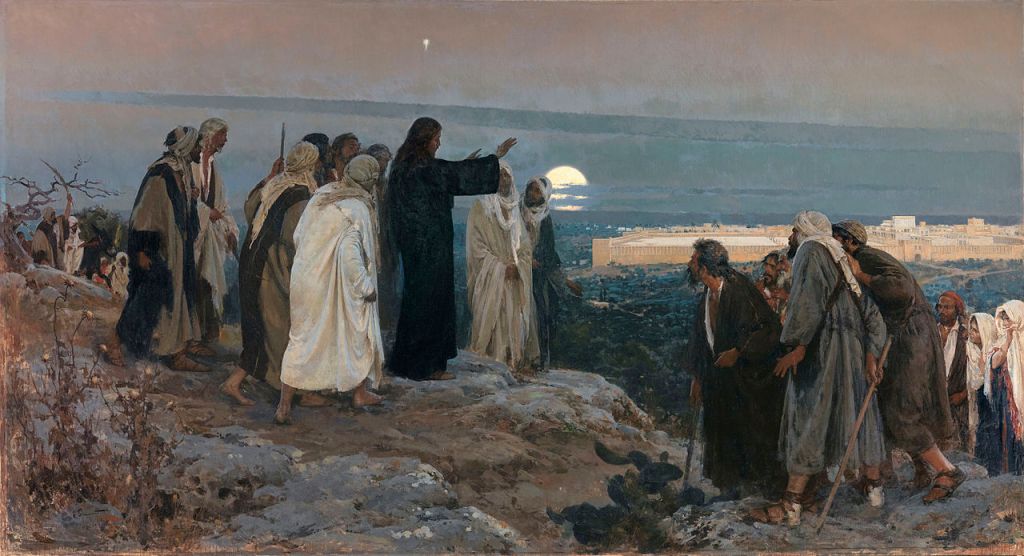
Flevit super illam/He Wept Over It by Enrique Simonet
Five days pass between Jesus’ triumphal entry, which we read about before receiving the palms, and the beginning of the Passion narrative. In those five days, many things happened, including the telling of many great parables, Jesus cursing the fig tree, the institution of the Lord’s Supper, and the washing of the disciples’ feet. Jesus also has several run-ins with the various religious leaders and, at one point, speaks many condemnations to them, saying, “Woe to you scribes and Pharisees, hypocrites.”
Jesus condemns them because of their arrogance in thinking they were better than others, for binding up the people with so many rules and regulations that those who desired to serve God were overwhelmed and disheartened in their faith, for putting faith in things over caring for people, for forgetting to show justice and mercy and to be faithful, for condemning others when they themselves are in error, for hypocrisy and lawlessness, and willful ignorance of their own faults. He then concludes with a lament over Jerusalem,
The lament begins, “O Jerusalem, Jerusalem,”—another way of speaking of the religious leaders and those who have failed to believe—“O Jerusalem, Jerusalem, the city that kills the prophets and stones those who are sent to it! How often would I have gathered your children together as a hen gathers her brood under her wings, and you were not willing! See, your house is left to you desolate. For I tell you, you will not see me again, until you say, ‘Blessed is he who comes in the name of the Lord.’” (Matthew 23:37-39)
With those final words, Jesus repeats to this same group the words proclaimed during the triumphal entry, “Blessed is he who comes in the name of the Lord.” In doing so, He is saying to the religious leaders, “You have not yet believed, but there will come a day when you have no choice but to believe.” As St. Paul said to the Philippians, “God has highly exalted him and bestowed on him the name that is above every name, so that at the name of Jesus every knee should bow, in heaven and on earth and under the earth, and every tongue confess that Jesus Christ is Lord, to the glory of God the Father.” (Philippians 29-11)
“Woe to you, Jerusalem, Jerusalem, you will bend your knee and confess Jesus Christ as Lord, and you will do so either out of love and obedience or out of fear, trembling, and judgment… but you will confess.”
The error we can make today is wrongly believing that these words do not apply to us. That was then; this is now. Woe to those religious leaders and others who do not believe. We are safe, for we are God’s people, but that is the exact same thing those religious leaders thought. Therefore, we must be on our guard so that we do not become Jerusalem, Jerusalem, and it is an easy trap to fall into. We will do so by making the same mistakes as they made in the past—by putting up barriers to God, by caring for things, by not showing justice, mercy, and faithfulness, by condemning the world around us while thinking we are the holy ones, and by being willfully ignorant and turning a blind eye to our own faults.
Declare, not only with your lips but also with your heart and soul—your entire being—declare, “Blessed is he—Blessed is Jesus who comes in the Name of the Lord,” and leave behind that old Jerusalem so that you may become citizens of the New Jerusalem. A city, as St. John tells us in his Revelation—that has been adorned as a bride for her husband, the dwelling place of God, where there are no more tears, no more mourning, crying, pain… no more death. (cf. Revelation 21:1-4) Become citizens of that New Jerusalem where all things have been made new and restored to God.
Question: If I were to say to you, “The world is my oyster,” what would you take that to mean?
{Pause for answers.}
That’s what most would say, but it is actually only half of a line from Shakespeare’s Merry Wives of Windsor.
In Act II, Scene II, two thieves, Falstaff and Pistol, enter and are having a conversation.
Falstaff: I will not lend thee a penny.
Pistol: Why then the world’s mine oyster, Which I with sword will open.
Falstaff: Not a penny.
“Why then the world’s mine oyster,” when the rest of the sentence is added, “Which I with sword will open,” is saying, “Anything I want is mine, and I’ll take by any means necessary, including violence.”
From “Money is the root of all evil” to “Now is the winter of our discontent,” there are many examples of taking a part of a sentence or statement out of context and having it say the complete opposite or never intended interpretation of the original intent. When we do this in working with Holy Scripture, we call it proof-texting, and today, in our Gospel, we have a fine illustration.
“Jesus said to the Jews who had believed in him, “‘If you continue in my word, you are truly my disciples; and you will know the truth, and the truth will make you free.’”
“The truth will make you free,” or “The truth will set you free.” It is everywhere, including titles of books, with those books ranging in topics from psychiatry, finding your true self, and video games. Then you’ve got politicians batting it about, but I don’t know one of them that would know the truth if it smacked them upside the head (but that’s a commentary and not preaching). The trouble is, all of these use the statement out of context, because the truth they are referring to is not the truth Jesus was referring to when he spoke those words. It is not some random truth that will set you free.
St. Thomas Aquinas, that great 13th-century Dominican theologian, wrote, “In this passage, being made free does not refer to being freed of every type of wrong . . .; it means being freed in the proper sense of the word, in three ways: first, the truth of his teaching will free us from the error of untruth …; second, the truth of grace will liberate us from the slavery of sin: ‘the law of the Spirit of life in Christ Jesus has set me free from the law of sin and death’ (Rom 8:2); third, the truth of eternity in Christ Jesus will free us from decay. (cf. Rom 8:2 1)”
There are many truths out there, but the only one that will truly set you free is Jesus, His grace, and His teachings. As Jesus, the Son of God, said, “If the Son sets you free, you will be free indeed.”
You all know that I’m a fan of Stephen King, but many people won’t pick up anything he’s written. Too scary for most, although much of what he writes isn’t what you think it is. To illustrate the point, King tells a story. He says, “I was in a supermarket down here in Florida, and I came around the corner, and there was a woman coming the other way. She pointed at me, she said, ‘I know who you are! You’re Stephen King! You write all of those horrible things. And that’s ok. That’s all right. But I like uplifting things, like that movie Shawshank Redemption.’ And I said, ‘I wrote that!’ And she said, ‘No, you didn’t. No, you didn’t.’” Well, he did write Shawshank Redemption, which is a fantastic story. This week, I was reminded of a particular scene in the movie version.
An old prisoner, Brooks Handlin, has learned that he will be paroled, but instead of being overjoyed, he begins acting very erratic, even threatening to kill another prisoner. It seems odd to most, but Red—another of the characters—understands. Red says, “Brooks is just institutionalized. The man’s been in here 50 years… 50 years! This is all he knows. You know what I’m trying to say? I’m telling you, these walls are funny. First, you hate them, then you get used to them. Enough time passes, you get to depend on them. That’s institutionalized.”
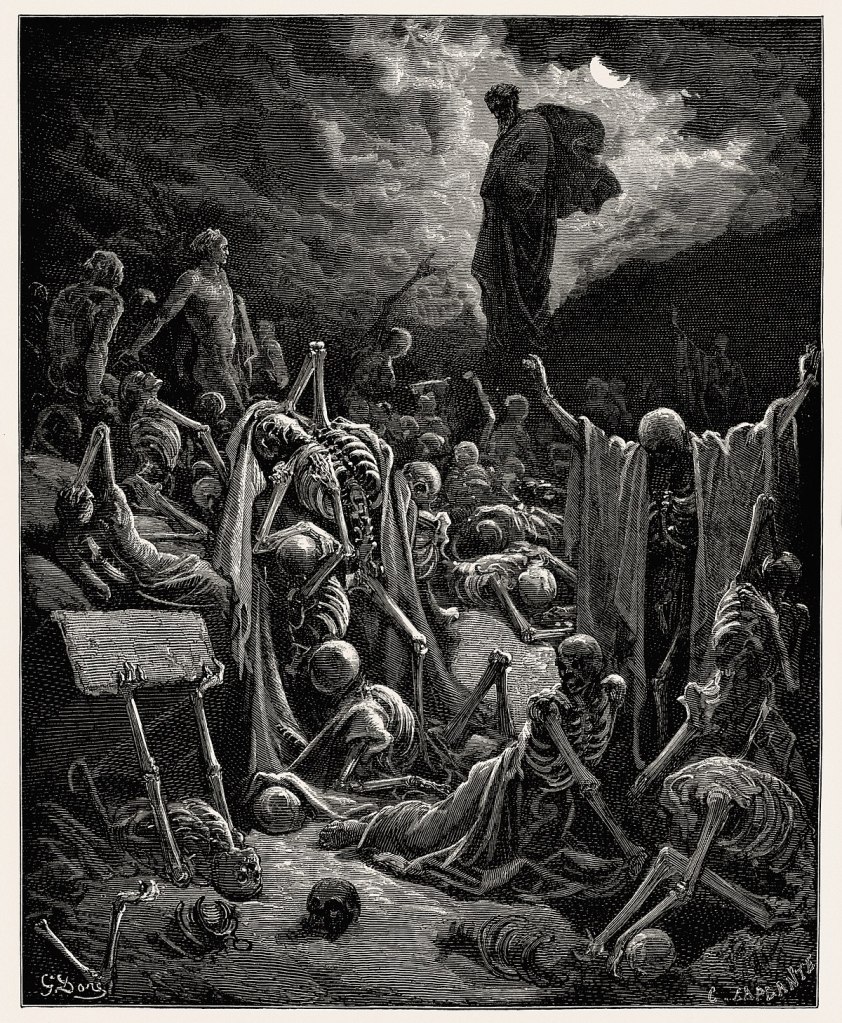
In reading our first lesson today, you would think that Stephen King wrote it—the Valley of Dry Bones. To understand what Ezekiel was writing, we must go back in history.
In Deuteronomy, the Lord says, “If you faithfully obey the voice of the Lord your God, being careful to do all his commandments that I command you today—that is, follow the Law—the Lord your God will set you high above all the nations of the earth.” (28:1) A few verses on comes the “but.” “But if you will not obey the voice of the Lord your God or be careful to do all his commandments and his statutes that I command you today, then all these curses shall come upon you and overtake you.” (28:15) There follows a litany of curses that will befall the people if they break God’s commands, one of which states, “The Lord will cause you to be defeated before your enemies. You shall go out one way against them and flee seven ways before them. And you shall be a horror to all the kingdoms of the earth. And your dead body shall be food for all birds of the air and for the beasts of the earth, and there shall be no one to frighten them away.” (28:25-26) In those days, the victor in a battle would shame the ones they conquered by refusing to allow the bodies of the dead to be retrieved and buried. Those bodies were to lay where they fell as a sign of defeat. God said, if you break my Law, this will happen to you.
We know that the people were disobedient, and in 587 b.c., God had had enough, and the promised curses fell upon the people. Nebuchadnezzar, the king of the Babylonians, sent in his army, sacked Jerusalem, destroyed the temple, and took the people into captivity and exile. During the battle, 4,200 people were killed.
Ezekiel was a prophet and a preacher in Jerusalem. He was there in 587 when the Babylonians attacked, and he went with the people into exile. While in exile, he continued to preach and to have visions. What we read today is one of those visions. It began, “The hand of the Lord was upon me, and he brought me out in the Spirit of the Lord and set me down in the middle of the valley; it was full of bones.” There is no indication in the text that this valley of bones is the land surrounding Jerusalem, but it is safe to assume, given that Ezekiel was there and saw the dead. It is also safe to assume that the Babylonians would not have allowed the dead to be removed from the battlefield so that the Israelites would be further humiliated. So, in his vision, Ezekiel, who was in exile, stood amongst the dried bones of the dead.
While there, God spoke, “Prophesy over these bones, and say to them, O dry bones, hear the word of the Lord.” As he spoke, the bones began to rattle. They put on flesh and skin. Everything was restored except for one thing—life. The Lord spoke to Ezekiel again and said, “Prophesy to the breath; prophesy, son of man, and say to the breath, Thus says the Lord God: Come from the four winds, O breath, and breathe on these slain, that they may live.”
There is a Hebrew word for breath—rûah. There is also the word hārûah—The Breath. Breath is what those corpses needed to have life, but only The Breath—the very Spirit of God that breathed life into the first man, Adam—can give life-giving breath. Both of these words are in what God commanded Ezekiel to do-call on The Breath that life might be restored to those who had been killed, yet not only them but to all. Everyone.
God allowed the Babylonians to conquer the Israelites. It was the fulfillment of the curse that God promised for disobedience. Ezekiel’s vision of The Breath breathing new life into the dead is the sign that God is lifting that curse and restoring the people. For those in exile with Ezekiel, this message is one of great hope because their exile was not only an exile from the land but also an exile from God. Now, they have been given new life.
It is that same new life that we are given. The Breath of God is breathed into us, and we are no longer dried-up bones. Through Jesus, we are fully alive beings in relationship with our God. Yet, we so often still hang around in that valley of dry bones, clinging to our former life. Thomas Merton referred to this clinging as the life of the “old man.”
“For the ‘old man,’” Merton writes, “everything is old: he has seen everything or thinks he has. He has lost hope in anything new. What pleases him is the ‘old’ he clings to, fearing to lose it, but he is certainly not happy with it. And so he keeps himself ‘old’ and cannot change: he is not open to any newness. His life is stagnant and futile. And yet there may be much movement but change that leads to no change. The more it changes, the more it stays the same.
“The old man lives without life. He lives in death, and clings to what has died precisely because he clings to it. And yet he is crazy for change, as if struggling with the bonds of death. His struggle Is miserable, and cannot be a substitute for life.” (A Year with Thomas Merton, p.84)
More simply put, Merton is saying that we are like Brooks Handlin in Shawshank Redemption. We are “institutionalized.” We’ve lived so long in that valley of dry bones that it is all we know. We’ve gotten so used to living that “old man” life that even though we want to change, we cling to… death.
Standing at the tomb of Lazarus, Jesus “cried with a loud voice, ‘Lazarus, come out!’ The dead man came out, his hands and feet bound with strips of cloth, and his face wrapped in a cloth. Jesus said to [the people], ‘Unbind him, and let him go.’” Jesus, The Breath of God, breathed new life into Lazarus, and Lazarus left the tomb, the valley of bones, and removed all that had bound him to it. We are invited to do the same.
Come out! Come out of the valley and enter into this new life. Merton wrote, “For the ‘new man’ everything is new…. The new man lives in a world that is always being created and renewed. He lives in this realm of renewal and creation. He lives in life.” Come out and live in life. It is a gift to you from God.
Let us pray: Breathe in us O Holy Spirit, that our thoughts may all be holy. Act in us O Holy Spirit, that our work, too, may be holy. Draw our hearts O Holy Spirit, that we love but what is holy. Strengthen us O Holy Spirit, to defend all that is holy. Guard us, then, O Holy Spirit, that we always may be holy. Amen.
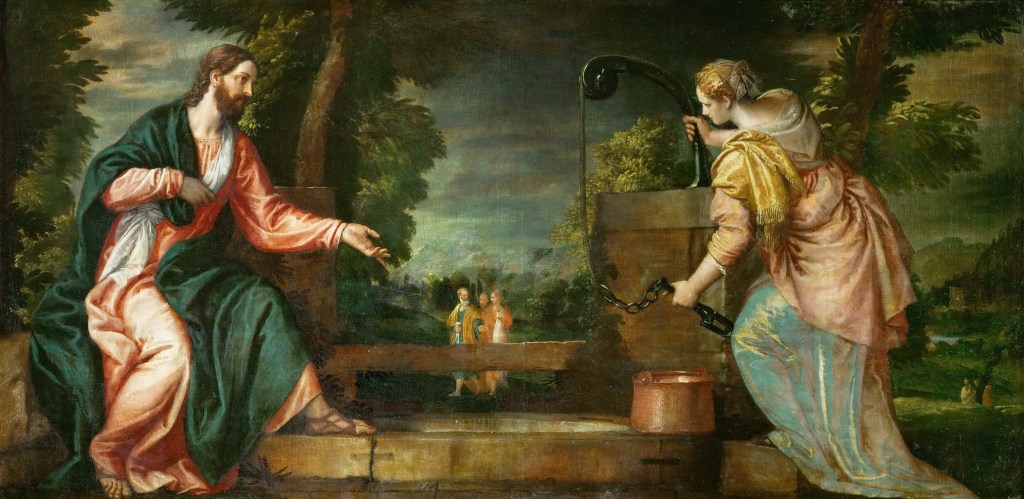
Christ and the Samaritan Woman at the Well by Paolo Veronese
If a company were to commission a study on forgetting things, which company would be the most likely candidate? I would tell you, but I’ve forgotten. No. It is 3M, the parent company of the Post-It Brand, the maker of those brightly colored sticky notes, technically called “repositionable pressure-sensitive adhesive sheet material.” It is estimated that 50 billion of those little sticky notes are created yearly, and I’m a significant contributor to their use.
In the study, it was learned that 56% of men rely on their spouses to remember important things, and over 50% of the women stated that their spouses forgot something important. (Never mind the fact, according to the same study, women are more likely to lie about forgetting something.)
On average, we forget four things daily, totaling 1,460 items per year. A spokesman for Post-It said, “Our days are so jam packed full of tasks whether at work or at home, it’s no surprise people find it hard to keep track of everything. With much longer working hours, financial concerns and just busier lifestyles, even those with the best memory can stumble when it comes to remembering even the most simple of things during a hectic day.”
The top five things forgotten: – Forget what you went into a room for – Misplacing keys – Forgetting things on your grocery list – People’s names when you’re introducing them – Where you put your pen (Source)
We forget things; however, forgetting certain things helps us remember others. There’s quite a bit of science behind it, which does not pertain to forgetting where you put your keys or the effects of dementia and other diseases of the mind, but we forget these additional items because we don’t really need to remember them, and in forgetting, it makes our memories more efficient.
So, with all that talk of memory and forgetting, let’s test yours. Where did Abraham’s servant meet, Rebekah, a wife for Issac? He met her at a well in Haran. Where did Jacob first meet his wife, Rachel? He met her at a well, also in Haran. Where did Moses first meet his wife, Zipporah? He met her at a well in Midian. Do you see a pattern? And today, Jesus meets a woman at the well.
Most women would come to draw water early in the morning or late in the evening, but this Samaritan woman went to the well at noon, the hottest part of the day. Why? As Jesus points out, she has had five husbands, and the man she is with now is not her husband. She likely came to the well when she hoped not to encounter anyone else so that she would not be condemned, criticized, and made to feel ashamed. However, when she arrives, she is met by a Jewish man.
Jews and Samaritans do not associate, and a Jewish man would never address a Samaritan woman. Never. Yet, Jesus says to her, “Give me a drink.” From there, the conversation goes back and forth. Why are you talking to me? How will you draw water? Are you greater than Father Jacob, who dug the well?
She came to the well hoping to avoid others because she knew she would be condemned. Seeing a Jewish man, she probably expected to be ignored entirely or severely condemned. Yet, Jesus spoke to her and pointed her closer to the truth about herself, who He is, and what He has to offer: living water. At first, as she listens, she desires this water that Jesus offers because she believes she will no longer have to return to the well and endure the shame that others pour upon her, but then she begins to understand what Jesus is offering.
Remember Jesus’ words from last week? “Indeed, God did not send the Son into the world to condemn the world, but in order that the world might be saved through him.” The woman begins to understand that Jesus is not talking about water that can be drawn from a well in the ground. She says, “I know that Messiah is coming. When he comes, he will proclaim all things to us.” Jesus said to her, “I am he, the one who is speaking to you.” At that, the woman realizes that the well of the Living Water is Jesus, Himself.
Just then, the disciples return. As for the woman: she “left her water jar and went back to the city.” She forgot her water jar. When she forgot it, was it just one of her four things she was going to forget that day, and all she needed was a post-it note to remind her, or did she forget it because it was something she no longer needed to remember? Not only did she forget her water jar, but she also forgot how others condemned her and that many likely hated her. She forgot the criticisms and the shame she felt because, instead of running away from and avoiding the people of her community, she did just the opposite—she ran to them. Finding them, she said, “Come and see a man who told me everything I have ever done! He cannot be the Messiah, can he?”
She came to the well that was Jesus and drank deeply of the Living Water. The waters of redemption and salvation, of love, mercy, grace, compassion, and more. She drank, and in drinking—like Rebekah, Rachel, and Zipporah—she met her spouse by a well.
In the 19th chapter of his Revelation, St. John writes, “I heard what seemed to be the voice of a great multitude, like the roar of many waters and like the sound of mighty peals of thunder, crying out, ‘Hallelujah! For the Lord our God the Almighty reigns. Let us rejoice and exult and give him the glory, for the marriage of the Lamb has come, and his Bride has made herself ready; it was granted her to clothe herself with fine linen, bright and pure”— for the fine linen is the righteous deeds of the saints.’”
The woman at the well believed and, in believing—she who had had five husbands and was currently living with a man who was not her husband— became a Bride of Christ. She discovered and was wed to the only One who could bring her true happiness and the peace she had been searching for her entire life.
We, each of us, are like the woman at the well. Condemned by Satan, ashamed of our sins, and criticized by our own thoughts and others, but like the Samaritan woman, we can forget our water jars. We can leave behind the bitter poisonous water and come to the Living Water of Jesus, and we can choose to drink the Living Water that is freely offered. In drinking, we are joined to Christ as His Bride. In drinking, we become a new creation. In drinking, we are redeemed and saved and can experience the Messiah’s love, mercy, grace, and compassion.
Forget your water jar. Don’t write yourself a post-it note. You don’t need to remember it. Forget it. Drink the Living Water from the well that is Jesus and enter into this new and eternal life given to you by God.
Let us pray: Come, all who are thirsty says Jesus, our Lord, come, all who are weak, taste the living water that I shall give. Dip your hands in the stream, refresh body and soul, drink from it, depend on it, for this water will never run dry. Come, all who are thirsty says Jesus, our Lord. Amen.
1984 is George Orwell’s great dystopian novel. It deals with how a totalitarian state—Big Brother—can control the people. One tool used in controlling is newspeak—the language used to convey ideology and history. It is described as “a purposefully ambiguous and confusing language with restricted grammar and limited vocabulary used in Oceania [the state] to diminish the range of thought. For example, in newspeak, the term “plusgood” replaced words better and “great.” The goal: if you can control the language, you can control the individual’s thoughts. I’m sure we could study this and prove that it is at play in our world today, but we won’t go there. So why talk about it?
Today in our Gospel, Jesus said he came “to give his life a ransom for many.” In our minds, the word “ransom” has a particular meaning, a payment for the release of an individual, and Jesus uses ransom to describe the work he accomplishes on the cross. However, throughout the scriptures and the Book of Common Prayer, many other words are used: sacrifice, atonement, propitiation, oblation, satisfaction, reconciliation, and others. The sentence in the Rite One service that we’ve heard on Sundays combines several of these: “Almighty God, our heavenly Father, for that thou, of thy tender mercy, didst give thine only Son Jesus Christ to suffer death upon the cross for our redemption; who made there, by his one oblation of himself once offered, a full, perfect, and sufficient sacrifice, oblation, and satisfaction, for the sins of the whole world.” (BCP, p.334)
These words can become confusing. In addition, these words have led to different theories on what was accomplished on the Cross.
There is the Ransom Theory, Satisfaction Theory, Christus Victor Theory, Penal Substitutionary Theory, Governmental Theory… the list goes on. When we study each one, we can think, “Well, that sounds right,” and we will feel so until we read the following theory. It gets confusing and, in some cases, contradictory. However, instead of seeing them as such, it is better to understand them in the same way we understand the four Gospels.
With the Gospels, there are times when they can seem confusing and contradictory when compared one to the other, but they are, in fact, pieces of a mosaic. Only when they are brought together will they create a complete image. The same is likely true with the various theories of what took place on the Cross. Each highlights one piece of the mosaic, one piece of the truth, and it is not until they are held together that the entire truth is made evident.
Unlike Orwell’s newspeak, which seeks to define an idea with the least number of words, the death of Jesus and the work He accomplished on the cross uses many different words. In the end, with all the words we use to describe the event, we are left with a highly nuanced event, depending on how we look at it, and that is the purpose—it is a mystery. Christ’s death upon the Cross and all that was accomplished is far beyond our understanding because we lack the intellect and the language to define or adequately grasp it. Therefore, perhaps the best thing to say is what St. Paul said to Timothy, “Christ Jesus came into the world to save sinners.” (1 Timothy 1:15) If we know nothing else, this one piece of information is all we need to be saved.
A family was sent out into an area to do missionary work, and there were very few services or access to some foods, one of which was peanut butter. This family must have been somewhat like me; I love some peanut butter, so they made special arrangements with a friend Stateside to send over an occasional jar of peanut butter to have with their meals. Soon the news of this regular supply leaked to the other missionaries in the area, and they became quite irritated. Apparently, all the other missionaries considered it a mark of spirituality if you did without those things that the local people could not have or have access to. The other missionaries said, “We believe since we cannot get peanut butter here, then we must not have it with our meals, we must contextualize, we must be like the native people, we must sacrifice for Christ. We must bear the cross by not having peanut butter.” Personally, I think Jesus would have liked peanut butter, but that’s just me. Anyhow…
The young missionary family did not give in to the legalistic pressure and had the peanut butter secretly shipped in and ate it with their meals. However, I suppose they went out with peanut butter breath, and it was discovered they were still eating it, so the pressure grew more and more intense—all for a jar of peanut butter. Ultimately, the family was so discouraged by petty legalism that they left the mission field in disgust.
Thank goodness those other missionaries could keep the faith by not eating peanut butter. If they didn’t stop it there, those radical missionaries might have started ordering some lovely plum jelly to go with their peanut butter.
This week in my studies, something small about our Gospel kept my attention. Jesus said, “Indeed, God did not send the Son into the world to condemn the world, but in order that the world might be saved through him.” I’ve always looked at that statement and focused on the result—Jesus came to save us and accomplished this work through the Cross. When I read it this week, I kept returning to the two words, condemn and save.
You know the definition of the word condemn, but so that we’re thinking the same, from the Oxford Dictionary, condemn means to criticize something or someone strongly, usually for moral reasons, and can include sentencing someone to a particular punishment, especially death.
If we use Jesus’ words with that definition, Jesus said, “The Father did not send me to sentence the world to death but to save it.” Understanding this, St. Paul can say, “There is therefore now no condemnation for those who are in Christ Jesus.” (Romans 8:1)
Jesus did not come to condemn. He came to save. Again, St. Paul tells us, “For in [Jesus] all the fullness of God was pleased to dwell, and through him to reconcile to himself all things, whether on earth or in heaven, making peace by the blood of his cross.” (Colossians 1:19-20) When Jesus said that he came to “save,” we can understand that He came to reconcile us to God.
Put together, Jesus said, “The Father did not send me to sentence you to death but to reconcile you to Himself.” So the question is: if this is why Jesus came, then why do we still condemn one another over everything and anything, including a spoon full of peanut butter, instead of seeking ways to be reconciled with God and to be reconciled with one another? Answer: It is far easier to condemn someone than it is to save them, to be reconciled with them. To condemn someone only requires words. To save or be reconciled to them is going to cost you something.
On the sixth day of creation, the Book of Genesis declares, “Then God said, ‘Let us make man in our image, after our likeness.’” “God said…,” God spoke us into creation, and He can just as easily condemn us and speak us out of creation. To condemn is easy; it only requires words, but to save…
“For God so loved the world that he gave his only Son, so that everyone who believes in him may not perish but may have eternal life.” (John 3:16) “God demonstrates His own love toward us, in that while we were yet sinners, Christ died for us.” (Romans 5:8)
To condemn is easy. It only takes words. To save… that’s going to cost you something. St. John says to us, “By this we know love, that he laid down his life for us, and we ought to lay down our lives for the brothers” (1 John 3:16), and a few verses on, he says, “Little children, let us not love in word or talk but in deed and in truth.” (1 John 3:18)
God the Father could have easily condemned us. He could have spoken, and it would have been over. Instead, he chose to pour out His grace by giving His son so we might be saved. That grace—that salvation—was costly to God, for it was accomplished through a deed: the death of His Son on the Cross.
In The Cost of Discipleship, Dietrich Bonhoeffer writes, “Grace is costly, because it calls us to follow, and it is grace because it calls us to follow Jesus Christ. It is costly because it costs a person his life, and it is grace because it gives a person the only true life. It is costly because it condemns sin, and grace because it justifies the sinner. Above all, it is costly because it cost God the life of his Son: you were bought at a price, and what has cost God much cannot be cheap for us” (p.47), and when we condemn others, we cheapen the grace that has been shown to us by the Father.
The Psalmist writes: Be still before the Lord and wait patiently for him. Do not fret yourself over the one who prospers, the one who succeeds in evil schemes. Refrain from anger, leave rage alone; do not fret yourself; it leads only to evil. (Psalm 37:7-9)
As Christ Jesus has not condemned us, we should not condemn others. As Christ has saved and reconciled us to the Father, we should give of ourselves so that we might be reconciled to God and to one another. This is not easy work, it will likely cost you something, but it is God’s work.
Let us pray: Lord, make us instruments of your peace: where there is hatred, let us sow love; where there is injury, pardon; where there is doubt, faith; where there is despair, hope; where there is darkness, light; where there is sadness, joy.
O divine Master, grant that we may not so much seek to be consoled as to console, to be understood as to understand, to be loved as to love. For it is in giving that we receive, it is in pardoning that we are pardoned, and it is in dying that we are born to eternal life. Amen.
Hattie May Wiatt lived in Philadelphia in the late 19th century and died as a little girl. She must have known how sick she was because she left her life savings to Grace Baptist Church so they could build a bigger building for the children’s Sunday school. Her gift: $0.57. Accepting this gift, the church contributed toward her vision and bought a piece of property. This went on to become Temple College, which later became Temple University and the Temple University Hospital.
No matter how small, a good gift can make a significant difference. A bad gift can also accomplish much. Take, for example, this one. [Holding up a small box.]
It doesn’t weigh much, the box is attractive enough, it doesn’t rattle when you shake it, and I know what it is. How? I’ve received it countless times throughout my life. I’ve received it and opened it more times than I care to remember. This is a gift from the Devil. As the Devil holds this gift out to me, it is a temptation. When I take it from him, I’m on a slide that can lead to sin.
You see, when the Devil holds it out to me, I still have the opportunity to say, “Away with you, Satan!” But when I take it, I concede to the possibility—perhaps even the inevitability—of sin.
Once in my possession, I may place it on a shelf somewhere, but in my heart, I know I’ve likely already lost the battle. I didn’t renounce it outright, so it has power over me. Remember St. Augustine’s prayer? “Lord, Grant me chastity and continence, but not yet.” He wanted what he prayed for, but it still had power over him.
After a time, I may take this gift off the shelf and nonchalantly fiddle with it a bit. “Oh, Lord, I didn’t know I even picked this silly thing up. I’ll just put it right back up here on the shelf. I’m in control.”
Then comes the day when I make a poor decision to open the box. “Lord, I’m just looking to see what’s in here. Nothing more. I’m proving to myself that it has no control over me,” but even as I am assuring the Lord of my conviction, I look down in the box and say in my heart, “Isn’t it so pretty.” From there, it is only a matter of time, which is actually the case from the moment I accepted it from the Devil’s hands.
If we examine our lives, I’m confident that we will discover that the ground around us is littered with opened little boxes like this and that the shelves are overflowing with others that are unopened, just waiting for a more opportune time to remind us of their presence. If we are honest with ourselves, we can say with certainty what sin each of those boxes contains. And, if we look with a sincere and discerning heart, we will likely discover that the gifts in each box may differ from one to the other but are also remarkably similar—slight variations on a common theme. Finally, in completing such an exercise, we may learn that all those boxes fall into three main categories: lust, greed, anger or pride, gluttony, despair, and so on. That may sound odd, but it is what happened to Jesus.
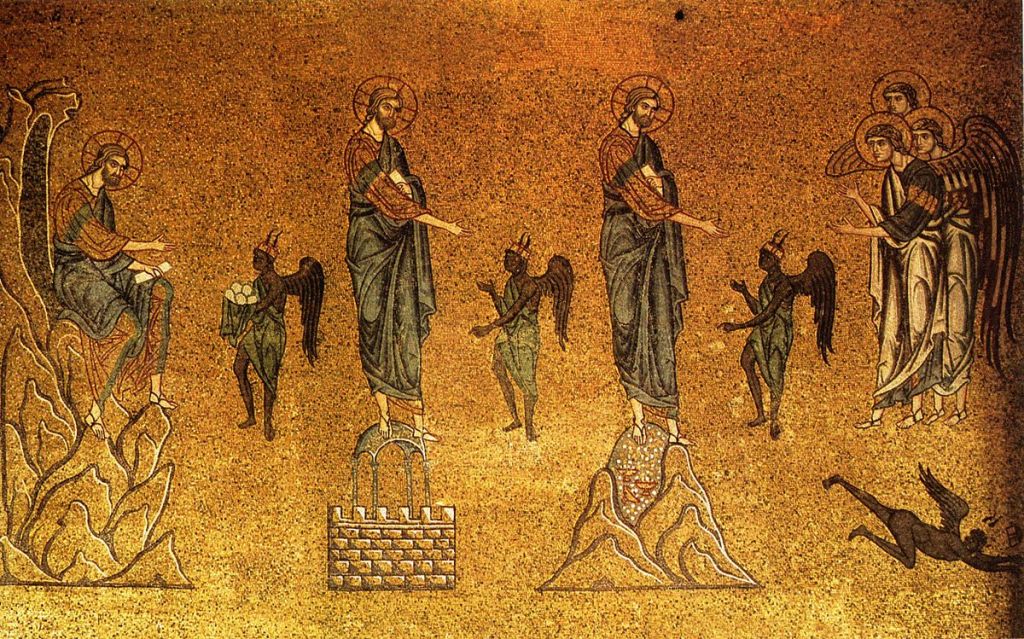
In the first temptation, Jesus was tempted to satisfy his flesh, his physical needs, and his wants. In the second, it was a temptation of pride—taking advantage of his status as the Son of God. Finally, Jesus was tempted to have the world at his command instead of the Father’s. If you want to simplify those, you could say that Jesus was tempted with lust, pride, and greed. Yet, Jesus never accepted the gift from the Devil’s hands. He never even glanced at it except to rebuke it, and He remained without sin.
If the Devil, in his arrogance, would go after Jesus, the very Son of God, in such a way, don’t you think he’ll try the same tactics on you as well? Nod your head, ‘Yes.’ So, spend some time discovering what gifts the Devil gives you, then as a disciple of Jesus, one who wants to be like him, learn from Him and be prepared so that when the gift is offered, you know how you will rebuke it—“Away with you, Satan!”
“‘God opposes the proud but gives grace to the humble.’ Submit yourselves therefore to God. Resist the devil, and he will flee from you. Draw near to God, and he will draw near to you…. Humble yourselves before the Lord, and he will exalt you.” (James 4:6b-8a, 10)
Let us pray: Holy Michael, the Archangel, defend us in battle. Be our safeguard against the wickedness and snares of the devil. May God rebuke him, we humbly pray; and do you, O Prince of the heavenly host, by the power of God, cast into hell Satan and all the evil spirits who wander through the world seeking the ruin of souls. Amen.
The day before Ash Wednesday brings to an end the parades of Mardi Gras (French for ‘Fat Tuesday). Those celebrations likely have their history in some of the pagan festivals of Europe, but when those festivals came to France, they became more closely related to the Church. When they went to England, they became Shrove Tuesday or Pancake Day. Here, at St. Matthew’s, we get the best of both—and now that we’ve done it two years in a row, making it a time-honored tradition—we’ll have to call it Gumbo Day. When these festivals traveled south to the Caribbean and further into Brazil, they became known as Carnivale. Of all the names given, this one perhaps describes it best.
The word carnival comes from the combining of two Latin words: carnem (“flesh”) + levāre (“lighten, raise”)—carnem vale meaning, “Farewell to the flesh.” Farewell to those things that separate us from God. It is this definition that inspired Thomas Merton, in 1953, to write in his journal:
Carnivale, farewell to the flesh. It is a poor joke to be merry about leaving the flesh, as if we were to return to it once again. What would be the good of Lent, if it were only temporary?
Jesus nevertheless died in order to return to His flesh; in order to raise His own body glorious from the dead, and in order to raise our bodies with Him. “Unless the grain of wheat, falling into the ground, dies, itself remains alone.” So we cast off the flesh, not out of contempt, but in order to heal the flesh in the mercy of penance and restore it to the Spirit to which it belongs. And all creation waits in anguish for our victory and our bodies’ glory.
God wills us to recover all the joys of His created world in the Spirit, by denying ourselves what is really no joy—what only ends in the flesh. “The flesh profits nothing.” (A Year with Thomas Merton: Daily Meditations from His Journals, February 19)
“What would be the good of Lent if it were only temporary?” What would be the good of Lent if all the practices we establish for our lives in order to draw nearer to God during this season were cast off on Easter Sunday? What would be the good of Lent if we returned to Fat Tuesday lives?
One of the things I give up most Lents is social media—all that scrolling. I’m not sure how much time I spend on it, which tells me it is probably too much. I also know that I’ll pick it back up again after Easter. It is something I enjoy. That’s a Lenten practice that I think can be temporary, but what if I decided that I would also spend more time in prayer or more time reading the Word of God? Should that be temporary? “Oh, it’s just a Lent thing. Only temporary.” I’ll give a bit of time to God for a few weeks, but when the season is over, I can quit that silliness. That’s not how it is supposed to work. Our Lenten practices should bring about permanent changes, transformations in our lives.
“Remember that you are dust, and to dust, you shall return.” Remember that you are God’s, and your life with Him is not temporary. Let your Lenten practices become—not just something you are doing for a season, but instead, let them become a part of who you are.
I’m not sure who said it, but I came across this quote: “You know you’re a mom when you’ve been washing the same load of laundry for three days because you keep forgetting to put it in the dryer.” I suppose that can be true for all of us, but I’m happy to report that I can do laundry, and I know that I’m supposed to sort the colors. For me, that’s pretty easy. 90% of my laundry is black.
When it comes to laundry, we do a lot—on average, 7.4 loads per week. The average load contains 16 items, and the average household will wash approximately 6,000 items annually. If your water bill goes up, you can look to your washing machine. On average, you use 41 gallons of water per load, resulting in national annual water usage of 19 billion cubic meters. That’s enough water to fill 7,600,000 Olympic size swimming pools. All that to say, we do a lot of laundry, and no matter how much you do, there is always more in the waiting.
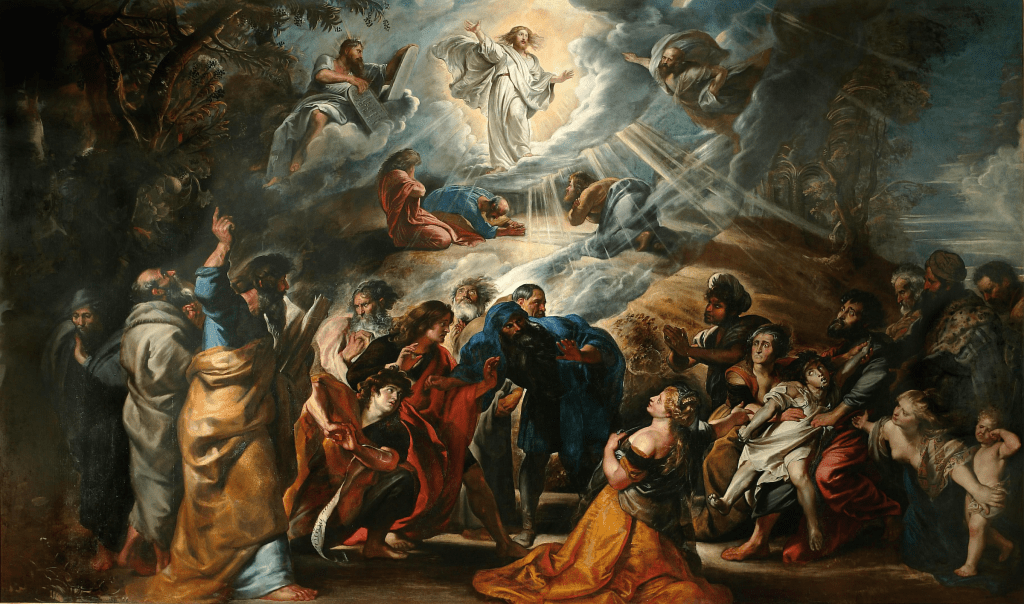
Today is the Sunday of the Transfiguration. It was a revealing of Jesus’ true nature. The light that the apostles witnessed was not a light from above but was instead the glory of God radiating outward from within Jesus. That glory is how we will one day not only see him but see ourselves when we are restored to our Father. As Jesus says, “Behold, I make all things new,” and this is what we will be when we are made new in Christ.
The only problem is that is then, and this is now. Then we radiate the glory of God, but now we have 7.4 loads of dirty laundry that have got to be washed. There is the Transfigured Lord, and there we will one day be, and there lays piles and piles of dirty laundry! How can the two possibly be reconciled in this life?! We ask that question as though we are the first to encounter such a predicament, but as we all know, that’s the way of history.
For example, those two men who were seen with Jesus on the mountaintop, Moses and Elijah. Moses was the great savior of the people from Egypt and the one who presented God’s law to the people. Moses went up on the mountain and witnessed the glory of the Lord. He saw Him in the burning bush. He saw God in the cloud. The glory of the Lord passed before Moses as he stood protected in a crevice in the mountain. Moses comes off the mountain; he is glowing with the glory of the Lord. God has given him the Ten Commandments, written on two stone tablets by God’s own hand, and what does Moses encounter when he gets down the mountain? The people have made a golden calf and are all dancing the hoochie coochie around it. He is literally radiating with the Glory of God, yet piles and piles of dirty laundry surround him.
The prophet Elijah was in fear for his life. The people were trying to kill him. The Lord said to him, “Go out and stand on the mountain in the presence of the LORD, for the LORD is about to pass by.” Scripture details the encounter, “Then a great and powerful wind tore the mountains apart and shattered the rocks before the LORD, but the LORD was not in the wind. After the wind, there was an earthquake, but the LORD was not in the earthquake. After the earthquake came a fire, but the LORD was not in the fire. And after the fire came a gentle whisper. When Elijah heard it, he pulled his cloak over his face and went out and stood at the mouth of the cave. Then a voice said to him, ‘What are you doing here, Elijah?’” Elijah climbed the mountain and encountered God in the still, small voice. He came down off the mountain and found himself back in the laundry room.
The same occurred with Jesus. He was transfigured, and as soon as he came down off the mountain, there were people calling to him for help. The apostles who had witnessed the Transfiguration would not be floating through life on angel wings when they came off the mountain. In just a few short weeks, they would witness the Transfigured Christ being arrested, beaten, and crucified. There is the mountain, the transfiguration of the Lord, the glory of the Lord all around, and no sooner than you think you have found the answer—finally gotten it right—then you crash back down again to what we so simply refer to as the “real world.”
However, even in the midst of that “real world,” you will never be the same because, in the Transfiguration, you have seen what is to come and what will be. Martin Luther King, Jr. referred to this in his famous speech. He declared, “I don’t know what will happen now. We’ve got some difficult days ahead. But it doesn’t matter with me now. Because I’ve been to the mountaintop. And I don’t mind. Like anybody, I would like to live a long life. Longevity has its place. But I’m not concerned about that now. I just want to do God’s will. And He’s allowed me to go up to the mountain. And I’ve looked over. And I’ve seen the promised land. I may not get there with you. But I want you to know that we, as a people, will get to the promised land. And I’m happy. I’m not worried about anything. I’m not fearing any man. Mine eyes have seen the glory of the coming of the Lord.”
We tend to say, “When I get all this laundry done, I will be with God. I’ll stop and pray when the ‘real world’ just isn’t so real.” Yet the Lord would have us understand that what we witness on the mountain is not something we leave there. Instead, we bring it with us. We cherish it. We allow the light of that one transfigured moment to penetrate every aspect of our lives. Not just as a dream of things to come but as a promise for today.
The theologian John Brodie wrote, “Oneness with ultimate reality [with God] is not an abstract idea; it is a spiritual experience of knowing that the timeless God is at the door inviting you to full union. It is an attentiveness to the present, a readiness, at every moment, to receive reality, to enjoy deeply even the simplest things.” In the words of the poet Paul Murray: ‘This moment, the grace of this one raptureless moment… the grace of this one joyfully ecstatic moment.’” It applies to every aspect of our life.
Consider how much time you spend worrying. Can you change yesterday? Can you change tomorrow? You are here. This—right now—is the time of your life. This is where you will encounter the immediate presence of God. You will have to do laundry—everything from turning the nasty socks right side out to dealing with all the other things, good and bad, that life has to throw at you, but there is this confidence in knowing that God is with us. Blessed Bonaventure instructs us wonderfully, “In the midst of our employments—in the midst of our daily lives—we ought to have God present to our minds, in imitation of the holy Angels who when they are sent to attend on us, quiet themselves of the function of this exterior ministry as never to be drawn from their interior attention to God.” The angels don’t allow things outside of themselves to draw them from the glory of God that is within. Here is a challenge for you: the next time you have some menial, tedious task to attend to—the next time you have to do laundry of any sort—perform it well, but do so with the glory of the Transfigured Lord in your heart and see what a difference it makes.
The Transfiguration is a glimpse. It is a sacred snapshot of what is to come, and it reminds us that whether we are on the mountain with God or in the laundry room with piles of dirty laundry—God is with us. The service of Evening Prayer contains one of the most ancient Christian hymns, the Phos hilaron, “O Gracious Light.” In it, we declare of God, “You are worthy at all times to be praised by happy voices, O Son of God, O Giver of life, and to be glorified through all the worlds.” At all times! Not just when we are in church for an hour on Sunday or when it is convenient, or when we are in the right mood, but at all times. At all times, we can know the glory of the Transfigured Lord. We can radiate his glory, not from above, but from within, and today be transfigured as he is.
Let us pray. Holy God, mighty and immortal, you are beyond our knowing, yet we see your glory in the face of Jesus Christ, whose compassion illumines the world. Transform us into the likeness of the love of Christ, who renewed our humanity so that we may share in his divinity, the same Jesus Christ, our Lord, who lives and reigns with you and the Holy Spirit. Amen.





 Candle in a Cave