Sermon: Lent 2 – The Crowning with Thorns


This week, we continue our meditations on Chapter 26, “The Crowning with Thorns,” from The Dolorous Passion of Our Lord Jesus Christ by Anne Catherine Emmerich. 

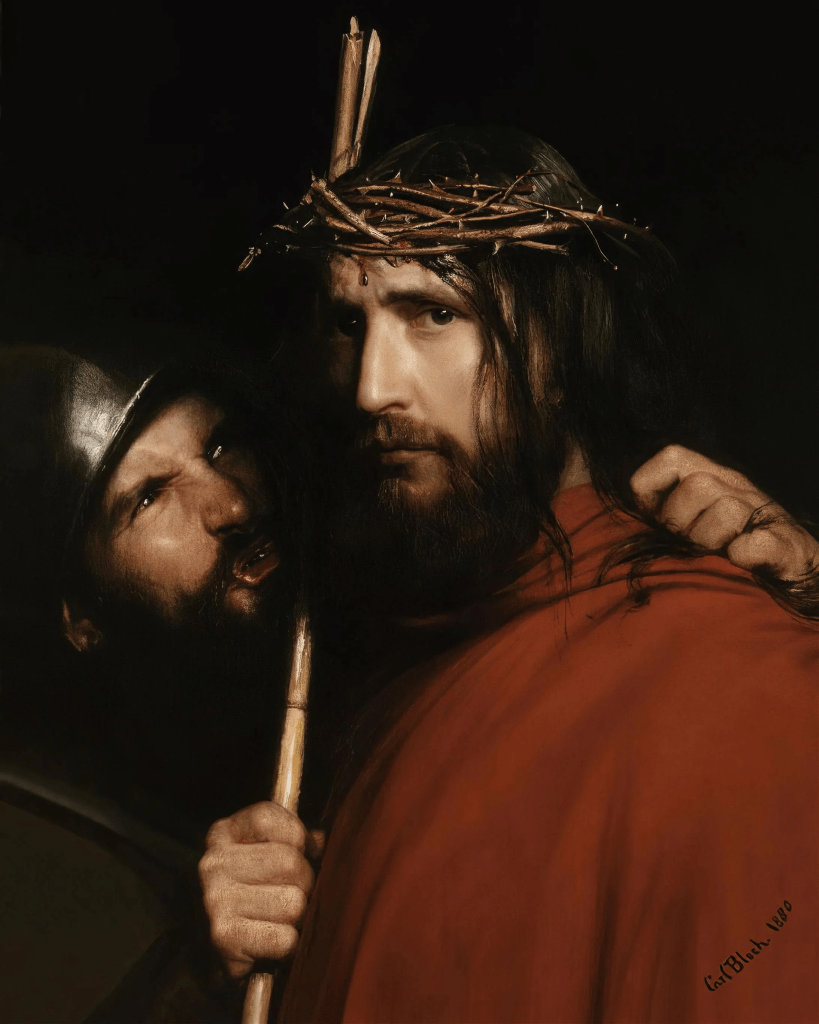
In the middle of the court—where Jesus had been scourged—there stood the fragment of a pillar, and on it was placed a very low stool which these cruel men—who had whipped Jesus—maliciously covered with sharp flints and bits of broken potsherds. Then they tore off the garments of Jesus, thereby reopening all his wounds; threw over his shoulders an old scarlet mantle which barely reached his knees; dragged him to the seat prepared, and pushed him roughly down upon it, having first placed the crown of thorns upon his head. The crown of thorns was made of three branches plaited together, the greatest part of the thorns being purposely turned inwards so as to pierce our Lord’s head. Having first placed these twisted branches on his forehead, they tied them tightly together at the back of his head, and no sooner was this accomplished to their satisfaction than they put a large reed into his hand, doing all with derisive gravity as if they were really crowning him king. They then seized the reed, and struck his head… they knelt before him, derided him, spat in his face, and buffeted him, saying at the same time, ‘Hail, King of the Jews!’ Then they threw down his stool, pulled him up again from the ground on which he had fallen, and reseated him with the greatest possible brutality.

Humility. It is something we all need to learn a bit more about. First, what it is not. Humility does not mean walking around believing you are such a lowly worm that the rest of the world shouldn’t even acknowledge your existence. Humility does not mean becoming a doormat or a punching bag for others. Perhaps C.S. Lewis summed it up nicely when he wrote, “Humility is not thinking less of yourself, but thinking of yourself less.” What does that look like?

Many years back, a Black man walked through an affluent neighborhood of Tuskegee, Alabama, when a wealthy white woman approached him. She asked if he would like to earn a few dollars by chopping wood for her. With no urgent business at hand, the man smiled, rolled up his sleeves, and set about the humble task she had requested. When he finished, he carried the logs into the house and stacked them by the fireplace. The White woman did not know who the man was, but a little girl who passed by did and told her after the man had left. It was Booker T. Washington, professor, and president of the Tuskegee Institute.

The following day, the embarrassed woman visited Mr. Washington in his office at the Institute and apologized profusely. “It’s perfectly all right, Madam,” he replied. “Occasionally, I enjoy a little manual labor. Besides, it’s always a delight to do something for a friend.”

In the Sermon on the Mount, Jesus gave instructions on the core characteristics of humility. He said, “Blessed are the poor, those who mourn, the meek, those who thirst for righteousness, the merciful, the pure, peacemakers, and the persecuted.” However, Jesus did not only teach us through His words. As He stood in that courtyard, enduring the scourging, mocking, spitting, and the crown of thorns, He embodied all these qualities.

He was the King of Kings, yet He wore a crown of thorns. He stood there battered, bruised, and bleeding like one who had nothing or a common criminal. He mourned for those who persecuted Him and showed mercy toward them, later saying, “Father, forgive them.” His hunger and thirst for righteousness—not His own, but ours—was so great that He endured all these trials.

Perhaps the Sermon on the Mount could be summed up in one phrase: “Blessed are you when you wear your own crown of thorns,” for that says, “Blessed are you when you are willing to give up what you see as rightfully yours for the sake of someone else.” Which, ultimately, is the very definition of love: “Willing the good of the other.”

Dutch Reform Pastor Andrew Murray wrote, “Humility is perfect quietness of heart. It is for me to have no trouble; never to be fretted or vexed or irritated or sore or disappointed. It is to expect nothing, to wonder at nothing that is done to me, to feel nothing done against me. It is to be at rest when nobody praises me and when I am blamed or despised.

“It is to have a blessed home in the Lord where I can go in and shut the door and kneel to my Father in secret and be at peace as in a deep sea of calmness when all around is trouble. It is the fruit of the Lord Jesus Christ’s redemptive work on Calvary’s cross, manifested in those of His own who are definitely subject to the Holy Spirit.”

When the pride within you begins to swell and you are feeling puffed up, or when you start to think of yourself as more successful or spiritual than your brothers and sisters in Christ, and something is said that stings your ego, meditate on our Lord Jesus Christ. Visualize the King of Kings and Lord of Lords standing before you with His crown of thorns tightly fitted around His head, and remember how He humbled Himself for your sake.

St. Paul teaches us, “Have this mind among yourselves, which is yours in Christ Jesus, who, though he was in the form of God, did not count equality with God a thing to be grasped, but emptied himself, by taking the form of a servant, being born in the likeness of men. And being found in human form, he humbled himself by becoming obedient to the point of death, even death on a cross.” (Philippians 2:5-8)

Let us pray. “Lord Jesus Christ, glorious King of the saints and radiant Crown of eternal glory… with singular devotion and a heart full of compassion, I praise and glorify you for the brutal punishment you most patiently suffered in the crowning of your sacred head with thorns…. Your sacred head, the most blessed of all Nazarenes, was covered with thorns that pierced so deeply.

“What a sorrowful sight to see the Son of God, in whom no sin could be found, so shamefully and horribly crowned! Because of the soldiers’ raging madness, they did not in the least tremble as they pierced with many a sharp thorn so holy, so handsome, so noble, and so revered a head. They likewise dared to salute the King of angels by publicly ridiculing, striking, and mocking him.

“Most gentle Jesus, King most admirable, Crown of Confessors, Strength of the Church Militant, Delight of the Church Triumphant, and model of all who follow you, how shamefully you were treated, how cruelly tortured! While many a blow was outwardly delivered, you experienced great inward distress, and all this for my sake… to save me from eternal punishment in hell, to cleanse my heart from its vicious habits, and to crown me in heaven with undying glory and honor.

“Cleanse me, Lord Jesus, from the contagion of material possessions. Clothe me with true virtue and grant me to rejoice when I meet contempt. Let me not complain about those who laugh at me, or argue with those who reproach me, but by my remembering your crown of thorns may I calmly accept, for the sake of my salvation, whatever pain and affliction may come my way. Amen.” (On the Passion of Christ: According to the Four Evangelists, p.55-61)

Sermon: Gregory the Great


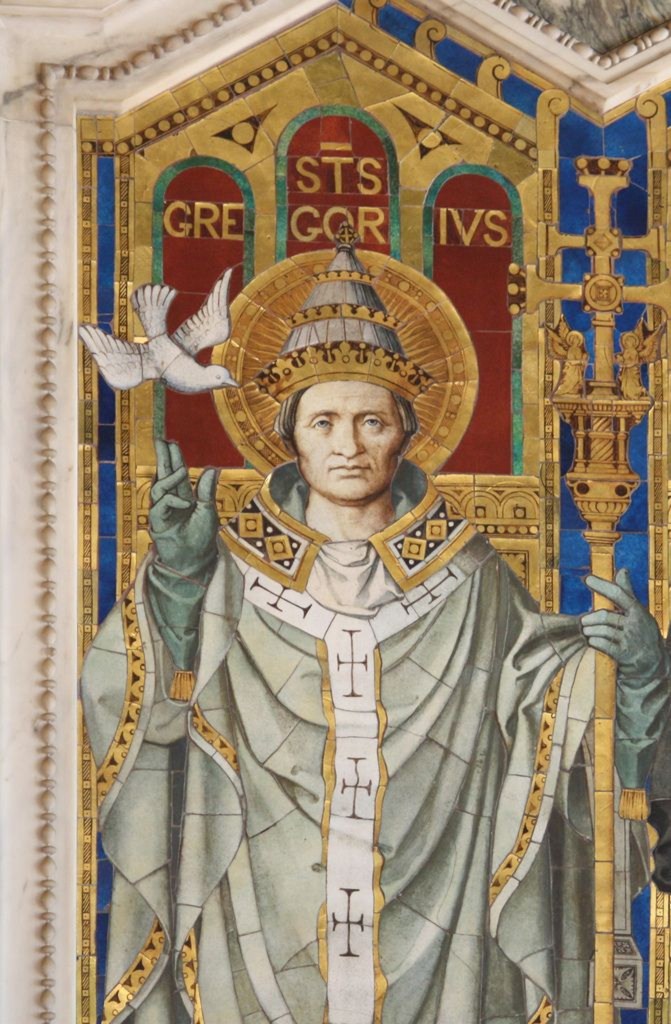
Gregory the Great, whom we celebrate today, was elected Pope in 590 and is one of only four Popes to have received the title “Great,” alongside Leo I, Nicholas I, and John Paul II. 

Gregory accomplished much in his ministry, but significant to us is the fact that he sent Augustine, who would become the first Archbishop of Canterbury, on a mission to the Anglo-Saxons in the year 595. This action led the Venerable Bede to refer to Augustine as the Apostle to the English. 

In addition to his other work, Gregory was also a prolific writer. Perhaps one of his best-known works is the Book of Pastoral Rule, which provides guidance to clergy on how to shepherd their flocks. As Pope, he viewed himself as the “servant of the servants of God,” making it clear why much of this work emphasizes the service and instruction that clergy are to provide to those in their care. One passage that resonated with me says, “Therefore, it should be said to the humble that whenever they lower themselves, they ascend to the likeness of God. At the same time, it should be said to the proud that whenever they take pride in themselves, they fall into imitation of the apostate angel. And what could be worse than pride, which by holding itself above everything, so unwinds itself from the stature of true greatness? And what is more sublime than humility, which by lowering itself unites with the Creator, who is above all things?”

Gregory speaks about humility and pride, but he also addresses how we are to serve one another. When we humble ourselves in service to others, we take on the likeness of our Savior. Additionally, we should not ask, “What’s in it for me?” If we serve with the aim of gaining something for ourselves or trying to elevate ourselves over others, then we are not truly serving them; we are serving ourselves. Remember what Jesus said: “If you love those who love you, what credit is that to you? For even sinners love those who love them. If you do good to those who do good to you, what credit is that to you? For even sinners do the same. If you lend to those from whom you hope to receive, what credit is that to you? Even sinners lend to sinners, to receive as much again. But love your enemies, do good, and lend, expecting nothing in return. Your reward will be great, and you will be children of the Most High.” In our Gospel, Jesus said, “Whoever wishes to become great among you must be your servant, and whoever wishes to be first among you must be slave of all.” These are the ideas that Gregory had in mind when he referred to the role of Pope as being the “servant of the servants of God,” and it is our calling as well.

You and I are called to be humble servants to each other, just as Jesus was to us. When you serve, do so sacrificially. 

One of my favorite prayers by St. Ignatius of Loyola:
Teach us, good Lord,
to serve you as you deserve,
to give and not to count the cost,
to fight and not to heed the wounds,
to toil and not to seek for rest,
to labour and not to ask for any reward,
save that of knowing that we do your will.
Amen.

Sermon: Proper 24 RCL B – “Losers”


Little Johnny’s fourth-grade teacher had very straight hair, so she decided to get a permanent for something different. As she sat at her desk the following morning, all the children began to file in. They all noticed her hair, but Johnny just couldn’t take his eyes off her. Becoming very self-conscious, even from the looks of such a young person, she said, “Is something wrong, Johnny?” Johnny said, “Your hair.” The teacher beamed and said, “You noticed. I just had a permanent, and I love it.” Johnny, still staring, said, “You do? Have you seen it?”

We all need a Little Johnny in our lives to keep us humble—to put us in our place when we start thinking we’re all that and a bag of chips.

When it comes to being humble, I’m always reminded of the fact that you can learn humility or someone will come along and teach it to you, and probably not in a kind way.

In our Gospel, we quickly see the lesson of humility. Still, I do believe that most of us shy away from a real-life application of what Jesus says—“Whoever wishes to become great among you must be your servant, and whoever wishes to be first among you must be slave of all.” Why do we shy away? Because we understand that being a servant or a slave is not humbling. We see it as being humiliating.

Do you remember reading Uncle Tom’s Cabin? One of those books you were assigned in school that, at the time, you thought having to read was punishment for someone in Dante’s Inferno? If so, you may remember the characters Little Eva and her mother, Marie. The two could not be more opposite. Eva is a sweet soul of a girl—seven years old or so—and her mother is a most unpleasant sort and describes Eva as “peculiar.” Why? Eva is kind to the house slaves. She plays with them and reads the Bible to them. She even volunteers to take on some of their duties when they are tired. However, according to Marie, this is not the way things are to be.

Harriet Beecher Stowe also wrote a drama, The Christian Slave, based on a portion of Uncle Tom’s Cabin that Mary E. Webb performed between 1855 and 1856. Here, Harriet gives her characters more life, and Marie talks to Cousin Ophelia in one scene.

Marie says, “Now, there’s no way with servants, but to put them down, and keep them down. It was always natural to me, from a child. Eva is enough to spoil a whole house-full. What she will do when she comes to keep house herself, I’m sure I don’t know. I hold to being kind to servants—I always am; but you must make ’em know their place. Eva never does; but there’s no getting into the child’s head the first beginning of an idea what a servant’s place is… this treating servants as if they were exotic flowers or china vases is really ridiculous.”

I do not believe that any of you hold to this way of thinking (there are many who do.) That said, when Jesus tells his disciples, “Whoever wishes to be first among you must be—servant—slave of all,” we may not hold to Marie’s way of thinking, but it is how we understand a servant or a slave. When Jesus says we are to be slaves, we understand that to mean we are the ones who are to be put down and kept down. When we are servants, we are those who are put in their place and expected to stay there, and you know what? We don’t much like it. To be put down and kept down is, in our minds, to be a loser. And we ain’t no losers!

You know what a huge sports fan I am—everybody roll your eyes. Not judging it, but I don’t get it. Messed up wiring or something. Even so, I do have my opinions, and some things irk me about it all. Take football, for example—“How ‘bout them Bears.” They’re from Philadelphia. Right? Anyhow. Let’s say the offense is on the twenty-yard line, and they’ve got to cover eighty yards to score a touchdown. The ball is hiked, and the quarterback fakes to the left and then hands it off to the running back. The running back does his thing, and, within seconds is sprinting down the field for a touchdown. The crowd goes wild, and the running back does the funky chicken in the endzone. He is a winner, he knows it, and he’s happy to tell everybody about it. Meanwhile, the other ten players on the field are more or less forgotten. Maybe that’s not the case, but that’s the way it always appears to me. Why? To me, it seems as though the other ten players are viewed as nothing more than servants. Maybe you know one or two of their names, but as long as they stay in their place and do their job, the winner can do the rest. It seems as though that winner has forgotten that he would be flat on his backside if it weren’t for those servants. Maybe I have it all wrong, but that’s the way I see it.

We all want to be the one that the camera follows around after the big play. We all want to be the winner. Nobody wants to be one of the forgotten ones. We’re above that. We’re better than that. “Teacher, we are winners. Grant us to sit, one at your right hand and one at your left, in your glory.” Grant us a seat at the winners’ table because that’s who we are.

I am not a sports fan, but I may have mentioned that I’m a fan of Stephen King. “I’m his biggest fan.” A few weeks ago, I told you I had finished reading IT, which is an exceptionally good read. No spoilers here, but I’m sure you know there’s a monster involved and other assorted characters. However, the main characters are seven kids. There’s the stuttering kid, the Jew, the Black boy, four-eyes, a hypochondriac, the girl that everyone thinks is a little tramp, and the fat kid. These are not winners. Individually, they are ridiculed, laughed at, and tormented for their differences. However, through several events, these seven became the closest of friends and formed a club—The Losers Club.

Individually, they were nothing. They were put down and kept down. Individually, they were weak, and they knew it. Yet, they come to understand that together—by serving one another—they could all be winners. Together, well… they could kill a monster.

Jesus says to us, “Whoever wishes to become great among you must be your servant, and whoever wishes to be first among you must be slave of all.” We hear those words and think we are to be the losers that are put down and kept down like Marie in Uncle Tom’s Cabin would have slaves put down; however, this is not what Jesus has in mind. Jesus wants us to be servants with Him and of each other so that together—serving one another—we can kill monsters.

The Pharisees claimed Jesus was able to cast out demons because He Himself was a demon, but Jesus said to them, “How can Satan cast out Satan? If a kingdom is divided against itself, that kingdom cannot stand. And if a house is divided against itself, that house will not be able to stand. And if Satan has risen up against himself and is divided, he cannot stand, but is coming to an end. But no one can enter a strong man’s house and plunder his goods, unless he first binds the strong man.”

There is not one of us greater than the other. We are here to serve the Lord by serving one another so that when we come face-to-face with the monster, we can stand as a house united. It may be that we will fall, but not before we get in a few good licks.

I, for one, would much rather stand as equals with you all and fail than stand alone and most certainly be knocked on my backside. In the words of Richie Tozier, four-eyes in the Stephen King book, “Welcome to the Losers Club.” At least my version of it.

Jesus said, “For the Son of Man—He is speaking of Himself—came not to be served but to serve, and to give his life a ransom for many.” Jesus came not to be served but to serve, and Jesus served us—even unto death on the cross—not because He was forced to or needed to or had to… Jesus served us because He loves us. Go and do likewise.

Let us pray: God of wisdom and love, you have sent your Son Jesus to be the light of the world, and continue to send your Holy Spirit among us to guide us into the way of truth. Open our hearts to your word, and let us ponder your actions among us. Give us your Spirit of wisdom and knowledge, of understanding and counsel. With Mary, may we rejoice in your gifts and walk in the way of truth and love. Amen.