
Sermon: Trinity Sunday RCL A – “Presence”

Photo by Charlota Blunarova on Unsplash

Does anyone recognize the names Frank Lee Morris, John Anglin, and Clarence Anglin? What if I told you Clint Eastwood portrayed Frank Morris in a 1979 movie? Well, the movie is Escape from Alcatraz, and it is about those three men and their great escape from Alcatraz prison on June 11, 1962. 

It was supposed to be the prison that no one could escape from. Still, those three escaped by using a spoon to dig a tunnel through a concrete wall, paper mâché dummies to represent their sleeping bodies in their cells, and fifty stolen raincoats to build a raft to cross a mile-and-a-half of open water to freedom.

Authorities said they drowned in the process, but no bodies were ever discovered. In 2013 a letter was received, reportedly from one of the Anglin brothers, and said they all survived and had been living in Brazil. And in 2016, a photo of the two brothers that was taken thirteen years after the escape was discovered. There’s been no official confirmation on either of these revelations.
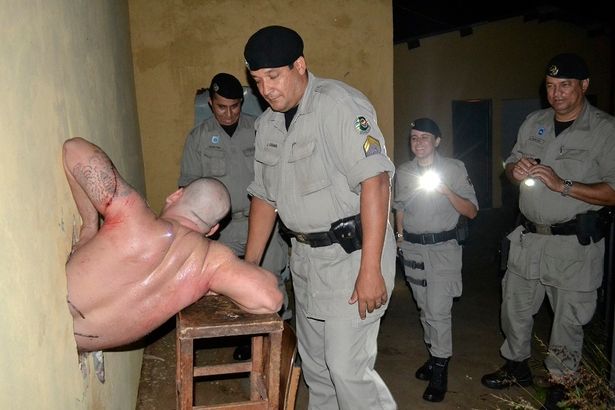
So it seems this was one of the successful prison breaks, but not everyone is so fortunate or intelligent. For example, in 1975, seventy-five individuals attempted to escape via a tunnel out of a Mexican prison. After digging a considerable distance, they surfaced, only to find themselves in the courtroom where they had all been convicted. And in 2012, four men in Brazil attempted to escape through a tunnel they had dug. The first guy got through, but the second, well, he got stuck. The local fire chief said, “[The second man] has a very large physique, and is also very tall. The other prisoners tried to push him, but he stayed stuck in the wall. He started screaming in pain, and that was when the prison guards were alerted.” Jailbirds? More like Jail Dodoes.

Today, in our first lesson, we read the creation account. After all was said and done, God said it was good, but we know the rest of the story. All that God created was still good but became stained by sin, so God removed Adam and Eve from the paradise He had created for them. God drove them “out from the garden of Eden to work the ground from which he was taken. He drove out the man, and at the east of the Garden of Eden, he placed the cherubim and a flaming sword that turned every way to guard the way to the tree of life.” 

We can read about successful and failed prison breaks—those folks trying to get out—but I would suggest to you this morning that we are like them, but instead of trying to break out of someplace, we have been trying to break back in. Break back into that garden. The place where, like Adam and Eve, we can walk with God because the presence of God is our true home.

It is too long of a quote for a sermon, but it is worth it. In Mere Christianity, C.S. Lewis wrote, “The Christian says, ‘Creatures are not born with desires unless satisfaction for those desires exists. A baby feels hunger: well, there is such a thing as food. A duckling wants to swim: well, there is such a thing as water… If I find in myself a desire which no experience in this world can satisfy, the most probable explanation is that I was made for another world. If none of my earthly pleasures satisfy it, that does not prove that the universe is a fraud. Probably earthly pleasures were never meant to satisfy it, but only to arouse it, to suggest the real thing. If that is so, I must take care, on the one hand, never to despise, or to be unthankful for, these earthly blessings, and on the other, never to mistake them for the something else of which they are only a kind of copy, or echo, or mirage. I must keep alive in myself the desire for my true country, which I shall not find till after death.” 

We desire our true country, our true home, which is the presence of God, so we search for ways to get there. At times, we can deceive ourselves into thinking we have found it, but these are only our own machinations. Smoke and mirrors and, in the end, we are like that stocky fella in Brazil and get stuck along the way or like those fellas in Mexico that tunnel out of prison and into the very place where they were condemned. We seek the presence of God through our own devices and are turned away by those cherubim with their flaming sword. So, what is the answer? How do we come into the presence of the Triune God—Father, Son, and Holy Spirit?

There was a TV show called Burn Notice. It has seven seasons. I never saw it, but I came across a quote from one of the episodes. The main character is talking about breaking into a safe, and he says, “There are two schools of safe cracking. Some people like to beat the lock; some people like to break the lock. But it doesn’t matter when the safe is sitting wide open.”

We search for ways to break into God’s presence and our true home, but the door, the Way, is already open and made available to us. And not just when we are dead and gone, but this very day. If that is true, which we believe it is, how do we enter? How do we come into relationship with God and enter into His presence?

Some would say, “Live a good life. Do good works. Be a nice person,” but St. Paul tells us that our salvation “is not your own doing; it is the gift of God, not a result of works, so that no one may boast.” (Ephesians 2:8b-9) A good life, good works, and being a nice person all fall under the category of works. Paul goes on to tell us that we were created to perform good works, but those good works are not how we enter into God’s presence.

Others would tell us that we must pray the sinners’ prayer. A prayer where you confess that you are a sinner, declare Jesus as your Lord and Savior, and that you turn to Him. It is a good prayer, but it is really only a tool because it also falls under the same category as works. If you read any version, the most glaring word is “I.” It is all about what I am doing. I’ll do this. I’ll do that. I’ll work on the other. A good prayer, but too many “I’s” for my taste.

“Fine, Father John, so how? How do I enter into God’s presence?” 

Just before those few verses on works from Ephesians, St. Paul answers the question: “God, being rich in mercy, because of the great love with which he loved us, even when we were dead in our trespasses, made us alive together with Christ—by grace you have been saved—and raised us up with him and seated us with him in the heavenly places in Christ Jesus, so that in the coming ages he might show the immeasurable riches of his grace in kindness toward us in Christ Jesus. For by grace you have been saved through faith.”

We hone in on that word grace, defined as “undeserved favor.” So we are saved by God’s undeserved favor, but that still doesn’t answer, “Why?” But Paul did provide the answer in the first part of that passage—“God, being rich in mercy, because of the great love with which he loved us….” 

To enter into God’s presence, you do not have to break in or work your way in. The gate is already open, and we are allowed entry. We are allowed entry through no action of our own, no great deed, no philanthropic gesture, no nothing. We are permitted entry because we have been loved into God’s presence. Our love for God follows His grace, His love for us. As St. John tells us, “We love because he first loved us.” (1 John 4:19) There it is. The Way to God’s presence is through His love for us.

Today is Trinity Sunday. I’ve shared with you in the past my understanding that the Father, Son and Holy Spirit are united, one to another, through their bond of love. It is that same love that binds Them together that is then extended toward us. We, in turn, then choose to accept or reject this gift of love from the Holy Trinity. 

On the sixth day of creation, God created humankind, yet, even before that day, God knew you and loved you, and through Adam and Eve, we lived in His presence. Yet, there was a time when we were cut off from that Presence, but because God so loved the world, He made The Way possible for us to return. He gave His Son, His Son who is love incarnate, and, as St. John tells us, all who receive Him and all who believe in His name are given the right to become children of God. (cf. John 1:12) Therefore, by receiving Jesus, you receive God’s love, and you enter into your true country—the Presence of Our God. 

Question: what are you waiting for?

Let us pray:
Glory be to the Father,
Who by His almighty power and love created us,
making us in the image and likeness of God.

Glory be to the Son,
Who by His Precious Blood delivered us from hell,
and opened for us the gates of heaven.

Glory be to the Holy Spirit,
Who has sanctified us in the sacrament of Baptism,
and continues to sanctify us
by the graces we receive daily from His bounty.

Glory be to the Three adorable Persons of the Holy Trinity,
now and forever.

Amen.
Sermon: Trinity Sunday RCL C


The first copy of a particular comic strip arrived in my email inbox on Saturday, May 28th while I was still in Italy.  I’m guessing it was in the paper that morning.  It was from Jean Mc. and it was a copy of the Hagar the Horrible comic strip.  As you probably know, Hagar is the Viking that finds himself in various circumstances.  In this instance, Hagar is visiting his doctor and says, “Guess where I’ve been for the last month!”  The doctor replies, “Italy!”  Hagar responds, “Great guess! Did I pick up an accent?” To which the doctor replies, “No, you picked up fifteen pounds!”  

As I said, Jean was the first to send this to me but they just kept coming for the rest of the day.  It got to the point that I was wondering if you all were trying to tell me something!

I spent a week in Florence and a week in Rome.  There is truly something very special about Florence, but from many respects, Rome truly does feel like the center of the world.

Charles Dickens in Pictures from Italy writes, “It is a place that ‘grows upon you’ every day. There seems to be always something to find out in it. There are the most extraordinary alleys and by-ways to walk about in. You can lose your way (what a comfort that is, when you are idle!) twenty times a day, if you like; and turn up again, under the most unexpected and surprising difficulties. It abounds in the strangest contrasts; things that are picturesque, ugly, mean, magnificent, delightful, and offensive, break upon the view at every turn.” And that is so very true. 

You can be walking down a very narrow street that the sun might find its way to shine down on for an hour a day and then walk out into a sun-filled piazza with a bubbling fountain at one end and a cathedral towering above you at the other.  Across the street from a gelato shop, you will find the ruins, many feet below the current street level, of the courtyard where Caesar was assassinated.  And then you can walk into some obscure church and find some of the greatest works of art ever created.  In the end, you are so overwhelmed by it all that you’re more exhausted than you are awed.

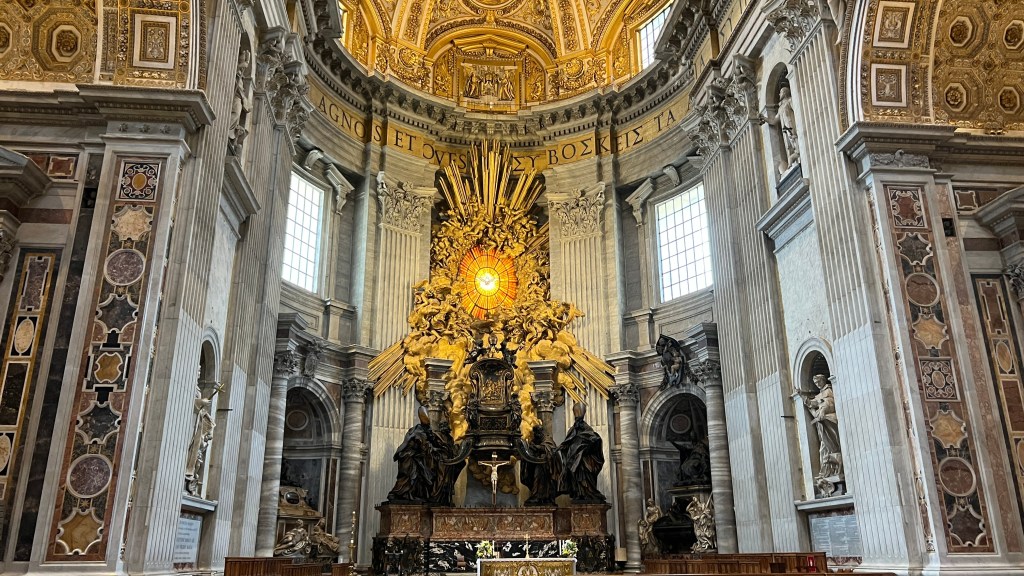
My advice to anyone who walks through these magnificent places: don’t forget to look up!  The ceilings are as impressive (if not more so) as the surrounding walls and it was on one of the ceilings that I saw the one work of art that stopped me cold.

It was on the second floor of the Papal Palace in the Hall of Constantine, Constantine being the first Roman Emperor to legalize and convert to Christianity.  The walls depict scenes in the life of Constantine and the Church, but the ceiling depicts another hall.  In it stands a pedestal and on the pedestal is a crucifix.  On the ground below and broken into many pieces is a statue of one of the old Roman gods.  The fresco, by Tommaso Laureti, is called, The Triumph of Christianity.  Not today, but you’re going to have to hear a sermon on that, but the point is that all of your senses are bombarded from every angle with light, color, sounds, smells… everything and it is amazing.  Yet for me, all of that I was seeing was not what truly moved me.  Let’s go back to Charles Dickens and his travels through Italy.

Dickens and his companions travel outside the old city walls to the Church of St. Sebastian.  There they are met by a “gaunt Franciscan friar, with a wild bright eye” who was their guide through the catacombs that lie below the church.  These catacombs have almost seven miles of tunnels where, in the early years, some 65,000 people were buried and of them, Dickens writes, “Graves, graves, graves; Graves of men, of women, of their little children, who ran crying to the persecutors, ‘We are Christians! We are Christians!’ that they might be murdered with their parents; Graves with the palm of martyrdom roughly cut into their stone boundaries, and little niches, made to hold a vessel of the martyrs’ blood.”  It is at this point that Dicken’s Franciscan guide stops and says to them, “The Triumphs of the Faith are not above ground in our splendid Churches.  They are here! Among the Martyrs’ Graves!”  The faith of so many is not found in the vast buildings and treasures of art.  Instead, the faith is found in the souls of God’s people, both the living and the dead, and I tell you about Dicken’s experience in this place because I also had the opportunity to walk through those very same catacombs.  (I just finished reading Misery by Stephen King.  The crazy lady in the book is Annie Wilkes and when Annie wants to say something is disgusting or creepy, she says it is “Oogy.”)  Well, some may think this “oogy”, but as I was walking through those catacombs, I couldn’t help but trace my fingers through the niches where the bodies of the Saints once lay.  I couldn’t stop from running my fingers along the walls touching what had been touched by so many faithful Christians who had come before me. 

All the painted ceilings, great vaulted ceilings, domes, and masterpieces of art were truly overwhelming, but what truly moved my spirit was being so very near to these holy people and understanding that all that was above is built upon the foundation of those who were below.

I had the blessed opportunity to pray the Rosary at the tomb of one of my greatest heroes of the faith: St. Josemaría Escrivá.  I touched this little medal of mine against his tomb, but as inspiring as it was to be in that place, it was so much more about being near to him and to greater holiness.

I had the opportunity to spend about thirty minutes in the Sistine Chapel.  Before arriving, our guide helped us to understand what we were seeing and all that went into creating it.  Amazing, but as I sat along the side staring up at the ceiling and the surrounding walls, I couldn’t help but think of all the great Saints that throughout the centuries had passed through this one place.

I saw the burial place of St. Paul and I saw a small niche in the catacombs below the Vatican above which, in Greek, was written, ΠΕΤΡΟΣ ΕΝΙ: “Peter is within” and in the niche was a small ossuary containing twenty-two bones of St. Peter.  I confess, I cried, but it wasn’t just that place and those bones, it was more about being so near to one who had spoken to and learned from Jesus.  One who had touched Jesus.  So very close to the holy.

As Dicken’s Franciscan monk said, “The Triumphs of the Faith are not above ground…” they are here below, and it’s what is below that forms the foundation.

There was Escriva, but he was built upon the foundation of the martyrs at St. Sebastian and those like them, who were built upon the foundation of those greats who had passed through the Sistine Chapel, who were built upon the foundations of St. Peter and St. Paul.  And what does Paul teach us about ourselves in his letter to the Ephesians?  “You are no longer strangers and aliens, but you are fellow citizens with the saints and members of the household of God, built on the foundation of the apostles and prophets, Christ Jesus himself being the cornerstone in whom the whole structure, being joined together, grows into a holy temple in the Lord.”  And St. Paul goes on to say, speaking to that church then and this church today, “In him… In Christ Jesus… you also are being built together into a dwelling place for God by the Spirit.”

Today is the celebration of the Holy Trinity and for me, all that I saw and experienced defined that last sentence and the workings of the Holy Trinity: the living and the dead who are in Christ Jesus are being built together into a church, the dwelling place of God—physically represented by the beautiful structures we build of marble and wood and bricks and spiritually represented by the communion of all the saints—and knit together by the very Spirit of God.  Who we are is not only about what happened 2,000 years ago, but it is also about this building and the knitting together of all the saints including us today, and our role as a Christian people is to continue to build and form the foundation upon which others will build in the future, so that they might look upon our works and say, “The Triumphs of the Faith are here, found in those who built upon the solid foundation upon which we stand.”

Of all the greatest masterpieces and cathedrals, it is this foundation, this building, this cornerstone—Christ Jesus—which is the crowning jewel and you are one of the myriads of facets reflecting the light and glory of God: Father, Son, and Holy Spirit.

Let us pray:
We pray You,
almighty and eternal God!
Who through Jesus Christ
has revealed Your glory to all nations,
to preserve the works of Your mercy,
that Your Church,
being spread throughout the whole world,
may continue with unchanging faith
in the confession of your name.
Amen.