Sermon: Holy Saturday


We’ve come this far with Anne Catherine Emmerich, so we might as well continue. Chapter 52 of The Dolorous Passion: The Body of Our Lord Placed in the Sepulchre.

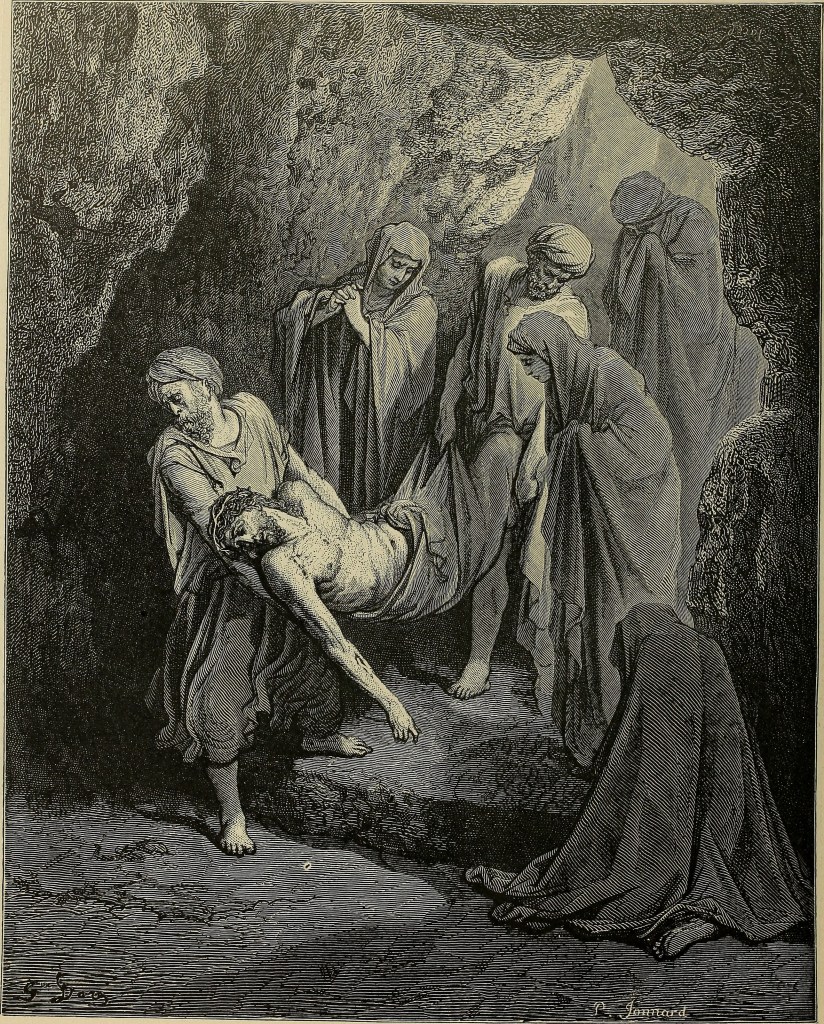
The men placed the sacred body on a species of leathern hand-barrow, which they covered with a brown-coloured cloth, and to which they fastened two long stakes. This forcibly reminded me of the Ark of the Covenant. Nicodemus and Joseph bore on their shoulders the front shafts, while Abenadar and John supported those behind. After them came the Blessed Virgin, Mary of Heli, her eldest sister, Magdalen and Mary of Cleophas, and then the group of women who had been sitting at some distance —Veronica, Johanna Chusa, Mary the mother of Mark, Salome the wife of Zebedee, Mary Salome, Salome of Jerusalem, Susanna, and Anne the niece of St. Joseph. Cassius and the soldiers closed the procession. The other women, such as Marone of Naïm, Dina the Samaritaness, and Mara the Suphanitess, were at Bethania, with Martha and Lazarus. Two soldiers, bearing torches in their hands, walked on first, that there might be some light in the grotto of the sepulchre; and the procession continued to advance in this order for about seven minutes, the holy men and women singing psalms in sweet but melancholy tones. I saw James the Greater, the brother of John, standing upon a hill the other side of the valley, to look at them as they passed, and he returned immediately afterwards, to tell the other disciples what he had seen.

The procession stopped at the entrance of Joseph’s garden, which was opened by the removal of some stakes, afterwards used as levers to roll the stone to the door of the sepulchre. When opposite the rock, they placed the Sacred Body on a long board covered with a sheet. The grotto, which had been newly excavated, had been lately cleaned by the servants of Nicodemus, so that the interior was neat and pleasing to the eye. The holy women sat down in front of the grotto, while the four men carried in the body of our Lord, partially tilled the hollow couch destined for its reception with aromatic spices, and spread  over them a cloth, upon which they reverently deposited the sacred body. After having once more given expression to their love by tears and fond embraces, they left the grotto. Then the Blessed Virgin entered, seated herself close to the head of her dear Son, and bent over his body with many tears. When she left the grotto, Magdalen hastily and eagerly came forward, and flung on the body some flowers and branches which she had gathered in the garden. Then she clasped her hands together, and with sobs kissed the feet of Jesus; but the men having informed her that they must close the sepulchre, she returned to the other women. They covered the sacred body with the extremities of the sheet on which it was lying, placed on the top of all the brown coverlet, and closed the folding-doors, which were made of a bronze-coloured metal, and had on their front two sticks, one straight down and the other across, so as to form a perfect cross.

The large stone with which they intended to close the sepulchre, and which was still lying in front of the grotto, was in shape very like a chest* or tomb; its length was such that a man might have laid himself down upon it, and it was so heavy that it was only by means of levers that the men could roll it before the door of the sepulchre. The entrance of the grotto was closed by a gate made of branches twined together. Everything that was done within the grotto had to be accomplished by torchlight, for daylight never penetrated there.
Sermon: Holy Saturday

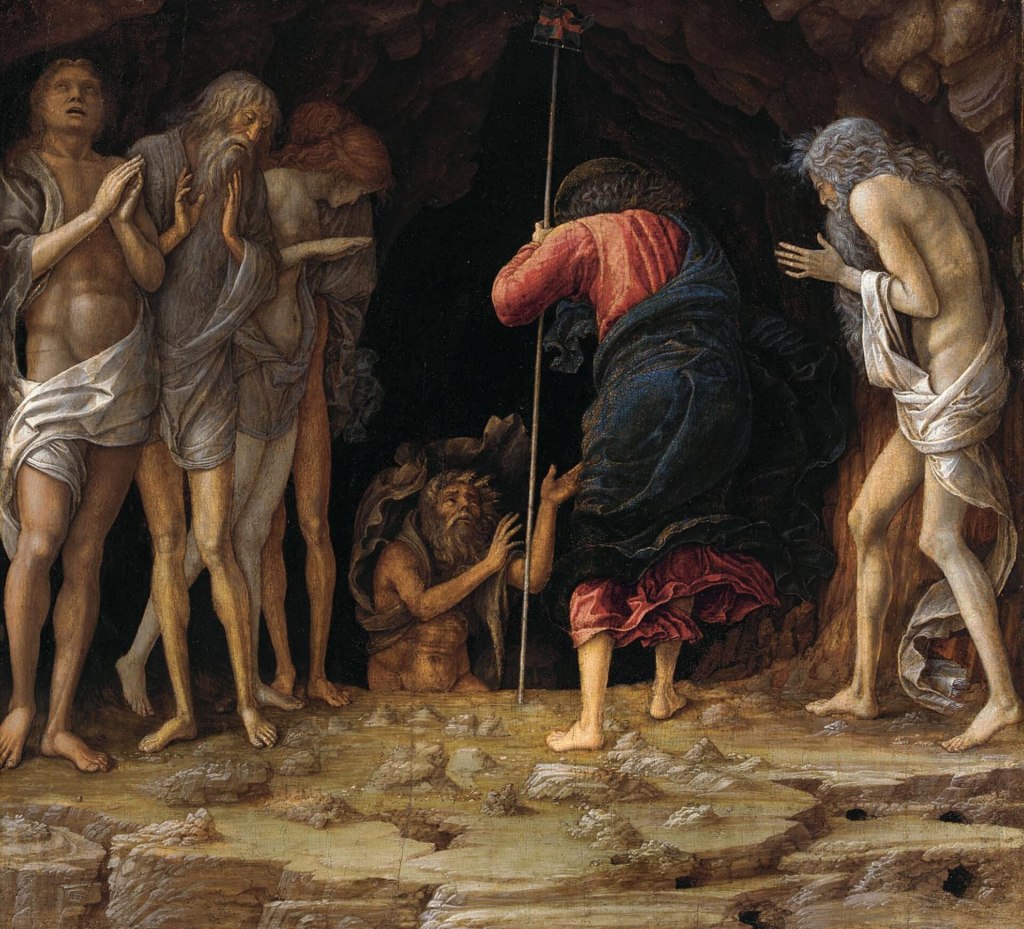
Christ’s Descent into Limbo by Andrea Mantegna and studio, c. 1470

Jesus “did not count equality with God a thing to be grasped. He emptied himself freely accepting death on a cross.” So, if Jesus died, where is He on this day? You know the words of the Creed: “He suffered under Pontius Pilate, crucified, died, and was buried. He descended into hell.” That’s why this Church seems so strangely empty. The one for whom it was built, whose presence draws us on Sunday, is not here. 

Crucified, he died and was buried; he descended into hell. Nineteenth-century Methodists removed that portion of the Creed, claiming it unbiblical. But it’s not. The First Epistle of Peter speaks of Christ’s descent into hell, called by the Church “The Harrowing of Hell.” Harrowing is a military term meaning to “make predatory raids or incursions.” Therefore, after Christ’s burial yesterday and through today, Satan’s territory is being invaded by the One who yesterday died upon the cross.

Following His death, when he breathed his last, Jesus descended to hell. Having preached to us, the living, he descended to the dead and is there proclaiming the Good News to those who lived and died before his coming. 

It is inconceivable that only those who lived during Jesus’s time and afterward would benefit from the salvation He brought to the world, and all those who died before His coming would be excluded from that salvation. So, everyone who died before He came, all the way back to Adam and Eve, had the opportunity to receive His word of salvation.

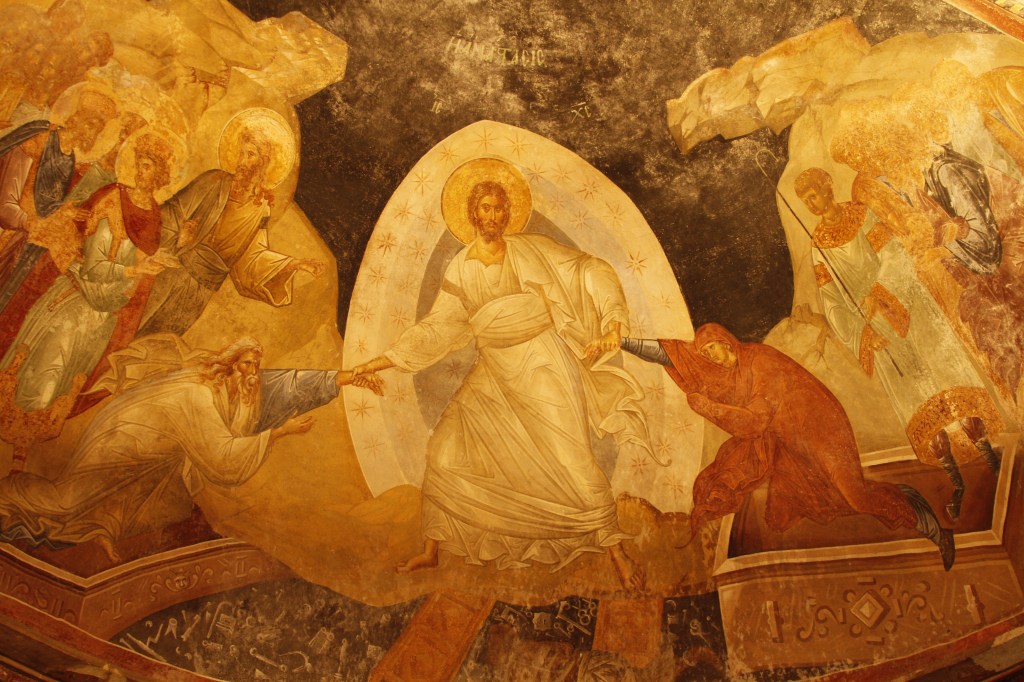
He is there, doing what He does so well: preaching, teaching, touching, relentlessly seeking, persuading, inviting, healing, and announcing God’s love and mercy. As the Psalmist says, “Thou wilt not leave my soul in hell.” Even Byzantine art depicts Jesus in the jaws of hell, giving a hand to those who had died, lifting them out of the darkness.

And though He is down there and, therefore, not here, there is something to be said to those of us He has temporarily left behind—Because I am there, descended into the deadly darkness, confronting the enemy on the enemy’s turf, you have hope. 

If He is there, literally fighting for the souls in Hell, then we can know with all certainty that there is no darkness, sorrow, or pain we can experience that His loving presence cannot enter into. If He is willing and able to risk it all, to wade deep into the death we so fear and avoid, then what might He risk for us? 

Do you remember the stories Jesus told about God and the kingdom of Heaven—the good Shepherd who forever seeks the one lost sheep, the faithful father who awaits the return of the one lost son, and the relentless woman who does not rest until she finds the one coin? Jesus meant those things when He said them. He is willing to fight for our souls today and for the righteous souls who departed this world before His first coming.

On that first Saturday before the resurrection, the disciples, Mary, and the rest mourned the loss of their Savior, but He had not truly left them. He had only gone to continue His Father’s work.

Sermon: Holy Saturday – “The Ancient Homily”

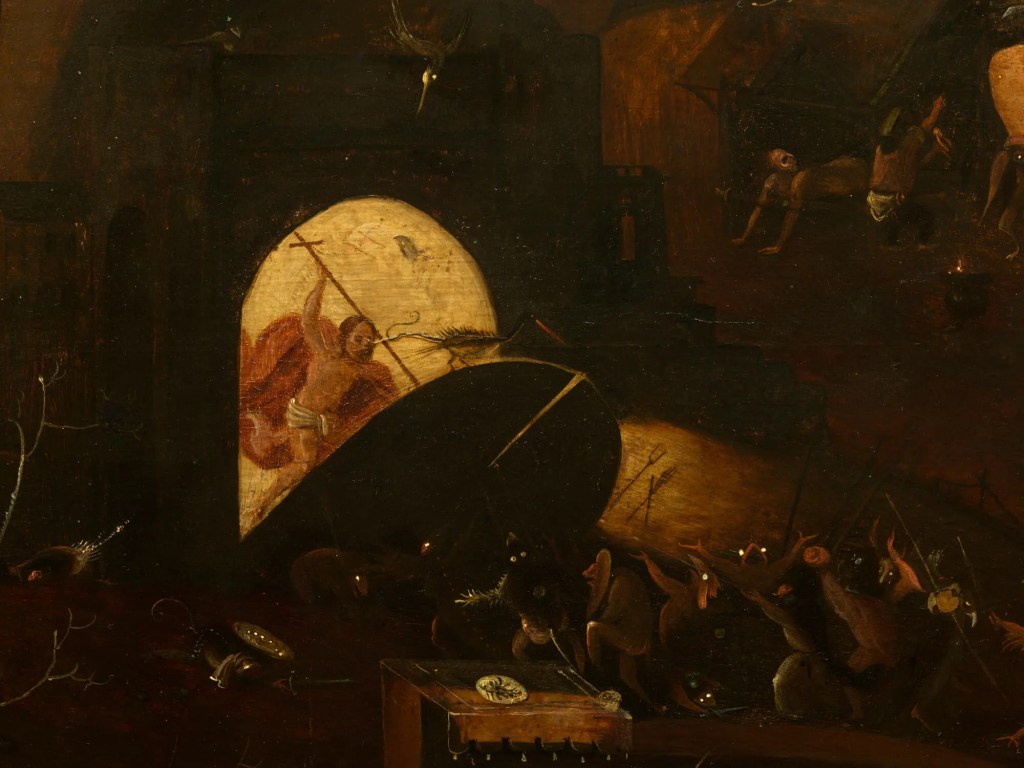
Christ Breaking Down the Gates of Hell
by Imitator of Hieronymus Bosch

An Ancient Holy Saturday Sermon – author is unknown

“What is happening? Today there is a great silence over the earth, a great silence, and stillness, a great silence because the King sleeps; the earth was in terror and was still, because God slept in the flesh and raised up those who were sleeping from the ages. God has died in the flesh, and the underworld has trembled.

Truly he goes to seek out our first parent like a lost sheep; he wishes to visit those who sit in darkness and in the shadow of death. He goes to free the prisoner Adam and his fellow-prisoner Eve from their pains, he who is God, and Adam’s son.

The Lord goes in to them holding his victorious weapon, his cross. When Adam, the first created man, sees him, he strikes his breast in terror and calls out to all: ‘My Lord be with you all.’ And Christ in reply says to Adam: ‘And with your spirit.’ And grasping his hand he raises him up, saying: ‘Awake, O sleeper, and arise from the dead, and Christ shall give you light.

‘I am your God, who for your sake became your son, who for you and your descendants now speak and command with authority those in prison: Come forth, and those in darkness: Have light, and those who sleep: Rise.

‘I command you: Awake, sleeper, I have not made you to be held a prisoner in the underworld. Arise from the dead; I am the life of the dead. Arise, O man, work of my hands, arise, you who were fashioned in my image. Rise, let us go hence; for you in me and I in you, together we are one undivided person.

‘For you, I your God became your son; for you, I the Master took on your form; that of slave; for you, I who am above the heavens came on earth and under the earth; for you, man, I became as a man without help, free among the dead; for you, who left a garden, I was handed over to Jews from a garden and crucified in a garden.

‘Look at the spittle on my face, which I received because of you, in order to restore you to that first divine inbreathing at creation. See the blows on my cheeks, which I accepted in order to refashion your distorted form to my own image.

‘See the scourging of my back, which I accepted in order to disperse the load of your sins which was laid upon your back. See my hands nailed to the tree for a good purpose, for you, who stretched out your hand to the tree for an evil one.

`I slept on the cross and a sword pierced my side, for you, who slept in paradise and brought forth Eve from your side. My side healed the pain of your side; my sleep will release you from your sleep in Hades; my sword has checked the sword which was turned against you.

‘But arise, let us go hence. The enemy brought you out of the land of paradise; I will reinstate you, no longer in paradise, but on the throne of heaven. I denied you the tree of life, which was a figure, but now I myself am united to you, I who am life. I posted the cherubim to guard you as they would slaves; now I make the cherubim worship you as they would God.

“The cherubim throne has been prepared, the bearers are ready and waiting, the bridal chamber is in order, the food is provided, the everlasting houses and rooms are in readiness; the treasures of good things have been opened; the kingdom of heaven has been prepared before the ages.”

Sermon: Holy Saturday – “The Ancient Homily”


In some places, the author is listed as unknown, but in others, it is attributed to St. Epiphanius, Bishop of Cyprus (403 A.D.).  Whatever the case, it is an ancient sermon and speaks of the Harrowing of Hell, when Jesus descended into the dead following his death and prior to his resurrection.  It is of Jesus speaking to Adam, the first human.

Something strange is happening – there is a great silence on earth today, a great silence and stillness. The whole earth keeps silence because the King is asleep. The earth trembled and is still because God has fallen asleep in the flesh and He has raised up all who have slept ever since the world began. God has died in the flesh and Hell trembles with fear.

He has gone to search for our first parent, as for a lost sheep. Greatly desiring to visit those who live in darkness and in the shadow of death, He has gone to free from sorrow the captives Adam and Eve, He who is both God and the Son of Eve. The Lord approached them bearing the Cross, the weapon that had won Him the victory. At the sight of Him Adam, the first man He had created, struck his breast in terror and cried out to everyone, “My Lord be with you all.” 

Christ answered him, “And with your spirit.” He took him by the hand and raised him up, saying, “Awake, O sleeper, and rise from the dead, and Christ will give you light.

“I am your God, who for your sake have become your son. Out of love for you and for your descendants I now by My own authority command all who are held in bondage to come forth, all who are in darkness to be enlightened, all who are sleeping to arise. I order you, O sleeper, to awake. I did not create you to be held a prisoner in Hell. Rise from the dead, for I am the Life of the dead. Rise up, work of My hands, you who were created in My image. Rise, let us leave this place, for you are in Me and I am in you; together we form only one person and we cannot be separated.

“For your sake I, your God, became your son; I, the Lord, took the form of a slave; I, whose home is above the heavens, descended to the earth and beneath the earth. For your sake, for the sake of man, I became like a man without help, free among the dead. For the sake of you, who left a garden, I was betrayed to the Jews in a garden, and I was crucified in a garden.

“See on my face the spittle I received in order to restore to you the life I once breathed into you. See there the marks of the blows I received in order to refashion your warped nature in My image. On My back see the marks of the scourging I endured to remove the burden of sin that weighs upon your back. See My hands, nailed firmly to a tree, for you who once wickedly stretched out your hand to a tree.

“I slept on the Cross and a sword pierced My side for you who slept in Paradise and brought forth Eve from your side. My side has healed the pain in yours. My sleep will rouse you from your sleep in Hell. The sword that pierced Me has sheathed the sword that was turned against you.

“Rise, let us leave this place. The enemy led you out of the earthly Paradise. I will not restore you to that Paradise, but I will enthrone you in Heaven. I forbade you the tree that was only a symbol of life, but see, I who am Life itself am now one with you. I appointed cherubim to guard you as slaves are guarded, but now I make them worship you as God. The throne formed by cherubim awaits you, its bearers swift and eager. The Bridal Chamber is adorned, the banquet is ready, the eternal dwelling places are prepared, the treasure houses of all good things lie open. The Kingdom of Heaven has been prepared for you from all eternity.”