
Of all the places to begin a sermon, a cooking recipe seems like a far reach…but things happen. The recipe I have in mind was written about 50 years or so before the birth of Jesus. The author? The Roman poet Virgil. What is the recipe for? Pesto.
Virgil was writing down a recipe for pesto, but I suppose, being a poet and all, he couldn’t just say, “Add four cloves of garlic, so many leaves of basil, and half a cup of olive oil.” No, that would not do. And he certainly wouldn’t say, “Mash it all together until you have a green paste.” Instead, Virgil wrote, “They one by one do lose/Their proper powers, and out of many comes/A single colour, not entirely green…”
In Latin, “out of many, a single color” is color est e pluribus unus. If we shorten that and add proper grammar, we have the phrase e pluribus unum, which the founding fathers added to the Great Seal of the United States in 1782. Therefore, the de facto national motto of the United States of America did not speak of how great and mighty a nation we were. Instead, it essentially declared that we, as the United States of America, are a salad—a bunch of ingredients, tossed together and pounded into something new and tasty.
It was the unofficial official motto and remained in place until 1956, when it officially changed. You can blame that change on the Soviet Union and the Cold War.
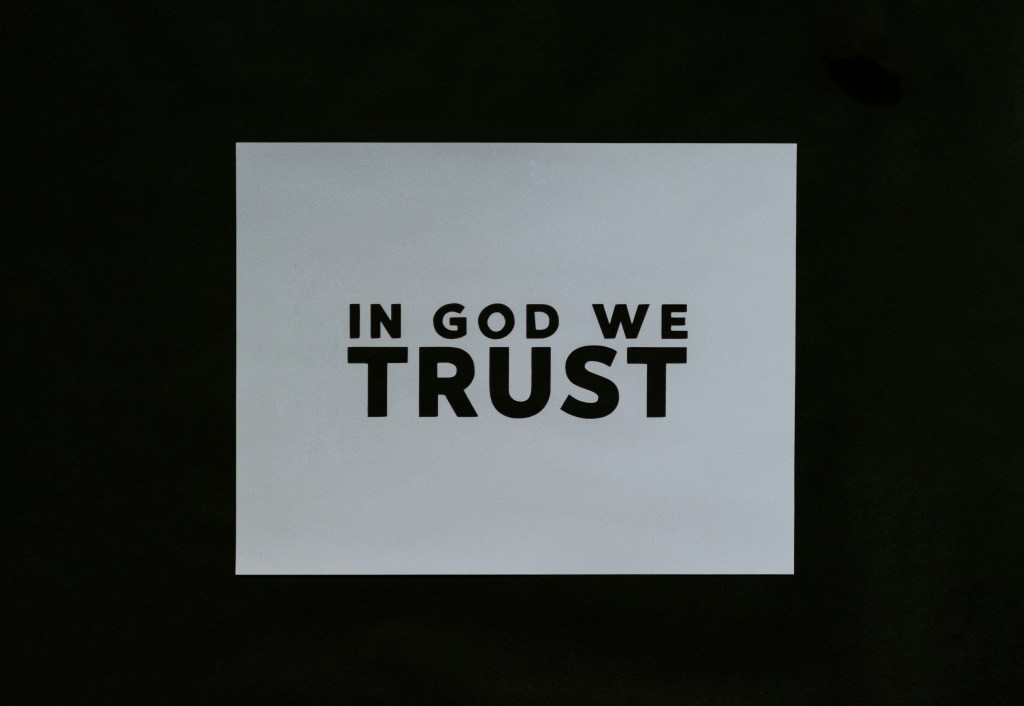
In the USSR, if there was a state religion, it was atheism, and the leaders of our nation looked for many ways to distinguish the USA from them. One of those ways was changing the de facto motto from e pluribus unum to In God We Trust. Unlike the battle cry of the Crusaders, “Deus vult” (God wills it), “In God We Trust” was meant to be a humble recognition of our reliance on a loving God. It is the kind of reliance and trust that the Psalmist speaks of.
Some trust in chariots and some in horses,
but we trust in the name of the Lord our God.
They collapse and fall,
but we rise and stand upright. (Psalm 20:7-8)
So, my question to you on this day, when our nation is 250 years old and one day is this: We declare In God We Trust, but do we really, corporately and individually, or is it just like when we slap our money down on the counter and say, In God We Trust, and here’s 100 bucks in case that doesn’t work out?
Understand, the question is not about belief or faith. I’m not asking whether you believe in God or have faith in God. I’m asking whether you trust God. Isaiah shows the problem clearly.
Hezekiah was king of Judah around 700 BC. He is considered one of the better kings; however, there were several major problems, none of which was their belief in God. The first chapter of Isaiah clearly shows that they were still practicing their religion. Yet God is tired of it because they outwardly serve him while inwardly they are corrupt.
What to me is the multitude of your sacrifices?
says the Lord;
I have had enough of burnt offerings of rams
and the fat of well-fed beasts;
I do not delight in the blood of bulls,
or of lambs, or of goats.
When you come to appear before me,
who has required of you
this trampling of my courts? (Isaiah 1:11-12)
That is the first problem. They do everything they are supposed to do, but in short, they are not practicing what they preach.
The second major problem is that they do not trust God. They believe in God, but they do not trust him.
At the time, the Assyrians were the dominant power, and to keep on good terms with them and avoid complete conquest, the nations paid tribute. However, when there was a shift in power in Assyria, Hezekiah and his royal court sought to free themselves from Assyrian rule and attempted to form an alliance with Egypt. The Lord says through Isaiah, “Don’t be stupid.”
Woe to those who go down to Egypt for help
and rely on horses,
who trust in chariots because they are many
and in horsemen because they are very strong,
but do not look to the Holy One of Israel
or consult the Lord!
The Egyptians are man, and not God,
and their horses are flesh, and not spirit. (Isaiah 31:1, 3a)
Yet it wasn’t until the Assyrian army had conquered all of Judah and stood outside the gates of Jerusalem that Hezekiah repented and truly trusted in God. He prayed, “O Lord our God, save us from his hand, that all the kingdoms of the earth may know that you alone are the Lord.” (Isaiah 37:20)
Hezekiah believed in the Lord, and Hezekiah trusted in the Lord, and the Lord, for his part, sent one of his angels: “The angel of the Lord went out and struck down 185,000 in the camp of the Assyrians. And when people arose early in the morning, behold, these were all dead bodies.” (Isaiah 37:36)
At the end of our gospel reading today, Jesus says, “Take my yoke upon you, and learn from me; for I am gentle and humble in heart, and you will find rest for your souls. For my yoke is easy, and my burden is light.”
Many understand this yoke to be the type designed for two animals that would pull as a team. From this, we can picture ourselves yoked to Jesus, and with Him, we can complete the work. It is a good message, and I have preached it myself. However, this is more of a contemporary understanding of the passage. Not wrong, but perhaps there is a better understanding.
Consider what Jesus said just a short time before: “Whoever does not take his cross and follow me is not worthy of me. Whoever finds his life will lose it, and whoever loses his life for my sake will find it.” (Matthew 10:38) These are actions required of the individual. This is what it means to be his disciple: do what the master did. Therefore, to take Jesus’ yoke upon us is another way of saying this. We all wear a yoke of some kind—the yoke of sin, self, and fear. Jesus is saying to set those aside and take up His yoke of righteousness, forgiveness, and eternal life. Take up His yoke of discipleship. In our attempt to do as He asks, we face the same question Hezekiah and the Israelites faced: Do you trust God?
Do you trust God enough to set aside sin, to set aside the things of the world, to set aside self, your will, and your ego? I know you believe in Jesus. I don’t think you would be here if you didn’t, but do you trust him enough to remove all those yokes and put on his?
In God we trust. That can either be lip service or a way of life. Take on the yoke of Jesus and walk with God. The author of Proverbs writes,
Trust in the Lord with all your heart,
and do not lean on your own understanding.
In all your ways acknowledge him,
and he will make straight your paths.
Be not wise in your own eyes;
fear the Lord, and turn away from evil.
It will be healing to your flesh
and refreshment to your bones. (Proverbs 3:5-6)
Trust in the Lord, and you will find healing and refreshment; you will find rest for your soul, for His burden is light.
Let us pray (a deeply honest prayer from Thomas Merton):
My Lord God,
I have no idea where I am going.
I do not see the road ahead of me.
I cannot know for certain where it will end.
nor do I really know myself,
and the fact that I think I am following your will
does not mean that I am actually doing so.
But I believe that the desire to please you
does in fact please you.
And I hope I have that desire in all that I am doing.
I hope that I will never do anything apart from that desire.
And I know that if I do this you will lead me by the right road,
though I may know nothing about it.
Therefore will I trust you always though
I may seem to be lost and in the shadow of death.
I will not fear, for you are ever with me,
and you will never leave me to face my perils alone.
Amen.


