Sermon: Proper 15 RCL A1 – “Story of the Heart”


Johnny was proposing to his girlfriend. He held the ring and said: “Sweetheart, I love you so much. I want you to marry me. I don’t have a car like Hank Green. I don’t have a yacht like his or a house as big as his. I don’t have Hank Green’s money, but I love you with all my heart.” She looked into his eyes and said, “I love you too, sweetheart… but could you tell me more about Hank Green?”

The Psalms are a constant source of inspiration, and as we study them, we learn they serve different purposes. Like today’s psalm, the ones we share on Sundays are often in praise of God, but there are other Psalms for times when we are scared, angry, sick, and so forth. Perhaps the one that speaks to us most about who we are, who God is, and the relationship we share is Psalm 139.

O Lord, you have searched me and known me!

You know when I sit down and when I rise up;
    you discern my thoughts from afar.

You search out my path and my lying down
    and are acquainted with all my ways. 

The final two verses of the Psalm make a request to God.

Search me, O God, and know my heart!
    Try me and know my thoughts!

And see if there be any grievous way in me,
    and lead me in the way everlasting!

(Psalm 139:1-3, 23-24)

Reading those words, the question I might ask, especially of myself, is, “Do I really want God to do that?” I mean, I know my heart, and sometimes… it’s best left hidden.

We know that within Judaism there is the Law. It has existed since the days of Moses. For the devout Jew, the Law of Moses governs every aspect of their life. Practicing it properly is good; however, the way the Law was practiced in Jesus’ time was often a major issue. The truth is, the problem goes back much further than that.

We will learn more about this when we begin our study of Isaiah next week, but in the first chapter, Isaiah, on behalf of the Lord, writes,

Bring no more vain offerings;
    incense is an abomination to me.
New moon and Sabbath and the calling of convocations—
    I cannot endure iniquity and solemn assembly.

Your new moons and your appointed feasts
    my soul hates;
they have become a burden to me;
    I am weary of bearing them.

When you spread out your hands,
    I will hide my eyes from you;
even though you make many prayers,
    I will not listen;
    your hands are full of blood.

Wash yourselves; make yourselves clean;
    remove the evil of your deeds from before my eyes;
cease to do evil,

    learn to do good;
seek justice,
    correct oppression;
bring justice to the fatherless,
    plead the widow’s cause.

(Isaiah 1:13-17)

On the outside, the Israelites and their leaders appear to be doing everything perfectly. On the inside, God has searched them out and knows their hearts, and what He sees displeases Him. Our gospel reading points to the same issue today.

Just before our reading, the Pharisees and scribes come to Jesus and ask, “Why do your disciples break the tradition of the elders? For they do not wash their hands when they eat.” (Matthew 15:2) In response, Jesus calls them “hypocrites.” (Matthew 15:7) Why? He quotes from Isaiah,

“‘This people honors me with their lips,
    but their heart is far from me;

in vain do they worship me,
    teaching as doctrines the commandments of men.’”

(Matthew 15:8-9)

Now, in our gospel reading, Jesus has just turned from that conversation and faces the people. He says, “Look, it’s not about what goes into the mouth; it’s not crispy fried bacon that makes you a bad person. It’s what comes out of the mouth—it’s what you say, what you believe, your inner dialogue—that’s what makes you bad. Why? Because what comes out of the mouth is from the heart. It is who you truly are. And understand, they did not need to speak these things for God to know them. The Psalm declares, God “knows the secrets of the heart.” (Psalm 44:21b)

“Johnny, sweetheart, I love you so much, but could you tell me a little more about Hank?” You see how that works. What’s in the heart?

The next scene in our Gospel appears to be such an abrupt change in setting and conversation that it is difficult to see how they are related. However, they are intimately connected. The first is the teaching, and the second, with the Canaanite woman, is the application.

The beginning of the second part appears to provide only geographic information, but it is, in fact, the clue to our understanding. (As we said before, the writers of Holy Scripture do not waste words. There is a meaning in them all.) Matthew 15:21 states, “Jesus went away from there and withdrew to the district of Tyre and Sidon.”

Early on, in the understanding of the law of Moses, the Israelites were told not to make a covenant with or marry the Gentiles. Easy enough. However, over time, those laws became even stricter as they were interpreted and reinterpreted. Over generations, those commands were surrounded by traditions intended to preserve Israel’s holiness and identity. The separation could become so profound that Peter would later say to the Gentile Cornelius, “You are well aware that it is against our law for a Jew to associate with or visit a Gentile.” (Acts 10:28). Tyre and Sidon, where Jesus and the disciples go, are Gentile regions. According to the interpretation of the Law, they have essentially broken the Law; at the very least, they have become unclean.

If that’s not bad enough, a Canaanite woman—a Gentile woman—speaks to him. The disciples know what’s what. They know this woman is a dirty Gentile, so they say, “Send her away, as she is crying out after us.” Jesus appears to confirm everything they are saying by responding, “I was sent only to the lost sheep of Israel.” She responds, “Lord, help me.” Jesus answers, “It is not fair to take the children’s food and throw it to the dogs.” She says, “Yes, Lord, yet even the dogs eat the crumbs that fall from their masters’ table.” Now hear this. The woman is saying, “Even if what you say is true, what You, Son of David, can give, even if it is a little, only a crumb, will suffice. It will heal.”

Do you remember from a few weeks back when we talked about Jacob wrestling with God until God did what Jacob asked? This woman is doing the same thing. She is wrestling with Jesus. She is wrestling with God, and she will not let Him go until He blesses her and heals her daughter. And as Jacob was blessed, so is she. “Woman, great is your faith! Let it be done for you as you wish.”

Yes. Good, but now go back to the first part of our Gospel lesson. It is not the following of the Law to the letter that matters. It is not what goes into the mouth that makes a person clean or unclean. It’s what comes out of the mouth, out of the heart, and the Lord knows the heart. Right?

With the Canaanite woman, what came out of the disciples’ mouths? Send her away. She is bothering us. She is a Gentile. They surely agreed with Jesus when he implied she was equal to a dog. What came out of the disciples’ mouths? Prejudice. Contempt. Judgment. Anger. Impatience. On the other hand, what came out of this dog’s mouth? What came out of her heart? “Have mercy on me, Lord, Son of David.” “Lord, help me.” “Yes, Lord, yet even the dogs eat the crumbs that fall from their masters’ table.” What came out of her mouth? Humility. Perseverance. Submission to God. Faith. Not even the disciples had recognized in Jesus what this Canaanite woman did.

Jesus, God, did not see her as something unclean or beneath Him. He saw her as a human being and saw her heart. What came from her heart expressed her inmost being, and Jesus declared, “Great is your faith.”

By the story of their hearts, the disciples had lumped themselves into the same category as the Pharisees and the scribes—hypocrites. By the story of her heart, the woman showed herself to be a child of God and was blessed.

Question: What is the story of your heart?

The Psalmist wrote,

Search me, O God, and know my heart!
    Try me and know my thoughts!

And see if there be any grievous way in me,
    and lead me in the way everlasting! 

That is an invitation for God to look into your heart. What is He going to find? Maybe your heart is nothing like mine, but what He is going to find is not always good. However, the words of the Psalmist are not only an invitation. They are also a request. 

“See if there be any grievous way in me,
    and lead me in the way everlasting!”

“I invite you, Lord, to look into my heart, and if you see anything amiss, lead me out of it and into Your ways, the way of everlasting life.”

That is a good and proper prayer, but I will be honest with you: it is also a scary one. In the Letter to the Hebrews, we read, “It is a fearful thing to fall into the hands of the living God.” (Hebrews 10:31) On that day in the region of Tyre and Sidon, it happened to the disciples. They fell into the hands of a loving God, and it changed their lives forever.

Let us pray: O God, from whom all good proceeds: Grant that by your inspiration we may think those things that are right, and by your merciful guiding may do them; through Jesus Christ our Lord, who lives and reigns with you and the Holy Spirit, one God, for ever and ever. Amen.

Sermon: Proper 10 RCL A – “Soil”

As most of you are aware, Chocolate Mint Ice Cream is an abomination unto the Lord. For those who disagree, I’ve come across some really interesting statistics that prove this point and why it should be banned forthwith. Nearly all sick people have eaten Chocolate Mint Ice Cream at least once in their lives. An estimated 99.9% of people who die from cancer and heart disease have eaten Chocolate Mint Ice Cream. 99.9% of people involved in car crashes ate Chocolate Mint Ice Cream. 93.1% of juvenile delinquents come from homes where Chocolate Mint Ice Cream has been served. Among people born in 1839 who later ate Chocolate Mint Ice Cream, there has been a 100% mortality rate. Given the interpretation of these facts, I rest my case. 

One of my first jobs out of college was as a Statistical Analyst. I was terrible at math, but once someone gave me the right number, I could make it say and do whatever you would like. The example above is not among my better works. One of the difficulties with Holy Scripture is that we can do the same thing with it. Depending on who you ask, you’ll get all sorts of interpretations of even a single verse. However, today Jesus said, “Not so fast,” and, in a rare instance, told us what he meant.

The soil represents the heart. The birds snatching the seed away represent the devil, who snatches the Good News from the heart of one who hears it before they have the opportunity to grow and flourish. The seed that fell on rocky ground represents one who hears the word of God and believes at first, but has no depth and therefore withers and dies, producing no fruit. The seed that fell among the thorns is like one who hears the word of God, but everything going on around them is so overwhelming that they are choked off. Finally, there is the seed that fell on good ground. It grows. It flourishes. It produces. The Word of God grows within the good soil, within the heart of the believer.

If we are ones in whom the seed has been planted in good soil, then we may wonder what this parable has to do with us. It seems to be only about those who have not yet come to faith. But we know that scripture is multivalent, that is, it has many levels, so not only does this parable speak to those who have not yet come to faith, but it also speaks to the believer. Why? Because at this moment, your heart may be good and producing good fruit, but what about when you leave here? The heart is as temperamental and erratic as the Queen, my crazy cat.

Example: You leave here today and, in your heart, feel the presence of God. You feel at peace, and my goodness, what an amazing sermon that was! It’s all good! Then you head home. When you get home, you discover that the water line on the washing machine has decided to blow out, and when you open the front door, you find everything in the house floating in about four inches of water. In that instant, that bird, the enemy of God’s people, snatches the good fruit, the good work that has happened, right out of your heart.

Or, come Monday morning, having just finished your prayer, you know in your heart that God really heard you. Soon afterward, the dog starts barking, and, given the time of day, you know it’s the mail lady. You go out and greet her with a smile; she hands you a few letters, returning the smile, and says, “Oh. I wonder what the bank wants?” You open it, and stamped in bold red ink across the mortgage payment are the words “Insufficient Funds.” It’s only the 11th of the month. What am I going to do? The worries of the world, like that thorn bush growing in the field, just choked the joy of God right out of your soul. 

The soil of the heart is temperamental and erratic; however, it doesn’t always change as quickly as all that. At other times, it changes more slowly, like the seasons of the year.

I’m not sure if it is the case in Oklahoma, but in western Montana, if you do any digging, you will soon discover the ground is full of rocks. Anyone who cuts hay or gardens knows that one of the first chores in spring is to go out into those fields and “pick rocks.” If you are uninitiated, it may seem that someone has played a dirty trick on you by throwing rocks onto your land, but what has happened is that the rocks have worked their way to the surface. 

It is counterintuitive. The rocks should sink because they are heavier than dirt. Yet the soil settles downward, so the rocks rise to the surface. Those who like to garden know that you regularly have to clear the ground of the rocks that have worked their way up, or you’ll end up with a field full of rocks and busted equipment.

The soil of our hearts works in a similar way. The seed, that is, the Word of God, is planted. When it finds good soil, it will grow and produce good fruit. However, if you do nothing to tend the soil, over time the rocks will work their way to the surface, and the once-fertile soil becomes rocky. It has no depth and can no longer support life. The same is true of weeds and thorn bushes. If you don’t tend the soil regularly, weeds and thorns begin to encroach on the good soil and can eventually choke it off, leaving it unfit for growing anything.

St. Paul wrote, “To set the mind on the flesh is death, but to set the mind on the Spirit is life and peace.” St. Josemaria Escriva put it this way, “The world, the devil, and the flesh are a band of adventurers who take advantage of the weakness of that savage you have within you. In exchange for the poor bauble of pleasure [that is the world] which is worth nothing, they want you to hand over to them the pure gold and the pearls, the diamonds and the rubies, drenched in the living and redeeming blood of your God—the price and the treasure of your eternity.” 

The world, the devil, and the flesh want to destroy the good soil of your heart, whether when the seed is first planted or over time. The enemies of God seek to bring death to places where God has sown life. As Peter says, “Be sober-minded; be watchful. Your adversary the devil prowls around like a roaring lion, seeking someone to devour.” (1 Peter 5:8) So how do we defend ourselves? 

The answer begins and ends with God. We pray, “Lead us not into temptation, but deliver us from evil.” We are asking for God’s protection over our lives and, more importantly, over our hearts. God is faithful to His promises. The question is whether we will cooperate with His grace. Yes, there are random things, like broken water lines, that we can’t control and that work against us, but for the most part, we can handle them. It stinks, but call a plumber. The bigger problem is us. We tend to worry when we should pray. We tend to get angry when we should let something go. We tend to treat our relationship with God on an as-needed basis rather than seeking to maintain and strengthen it daily.

We defend ourselves against the world, the devil, and the flesh by asking the Lord our God to continue in that love and care. But as we do, we can’t be shooting ourselves in the foot and then ask God why it happened. We can’t say, “Oh, Lord! I’ve got this big hole in my foot. Yes, I pointed the gun and pulled the trigger, but Lord, why did you let that happen?” Free will is a beautiful thing, but it comes with responsibility and consequences. 

St. Paul wrote in his letter to the Philippians: “Work out your own salvation with fear and trembling” (Philippians 2:12b). Salvation is from God, unearned and freely given. And notice, Paul doesn’t say, “Work for your salvation…” He says, “Work out your salvation…” We are not working to earn God’s free gift. So Paul is saying, work out this gift, hold on to it, and nurture it with deep reverence and holy seriousness. God has done and will continue to do His part, but if you want to produce good fruit and not have it stolen, withered, or choked off, you must engage and be vigilant in tending the good soil of your heart.

Our Father has planted a seed in the good soil of your heart. Guard that soil. Tend it. Water it. Keep it clear of predators and of anything that does not belong. Then produce fruit worthy of God’s glory.

Let us pray: Lord, if what we seek be according to our will, then let it come to pass and let success attend the outcome. But if not, Dear Lord, let it not come to pass. Do not leave us to our own devices, for you know how unwise we can be. Keep us safe under your protection, Lord our God, and in your own gentle way, guide us and rule us as you know best. Amen.

Sermon: Maundy Thursday – “Upper Room”


“On the first day of Unleavened Bread, when they sacrificed the Passover lamb, [Jesus’] disciples said to him, “Where will you have us go and prepare for you to eat the Passover?” And he sent two of his disciples and said to them, “Go into the city, and a man carrying a jar of water will meet you. Follow him, and wherever he enters, say to the master of the house, ‘The Teacher says, Where is my guest room, where I may eat the Passover with my disciples?’ And he will show you a large upper room furnished and ready; there prepare for us.” (Mark 14:12-15)

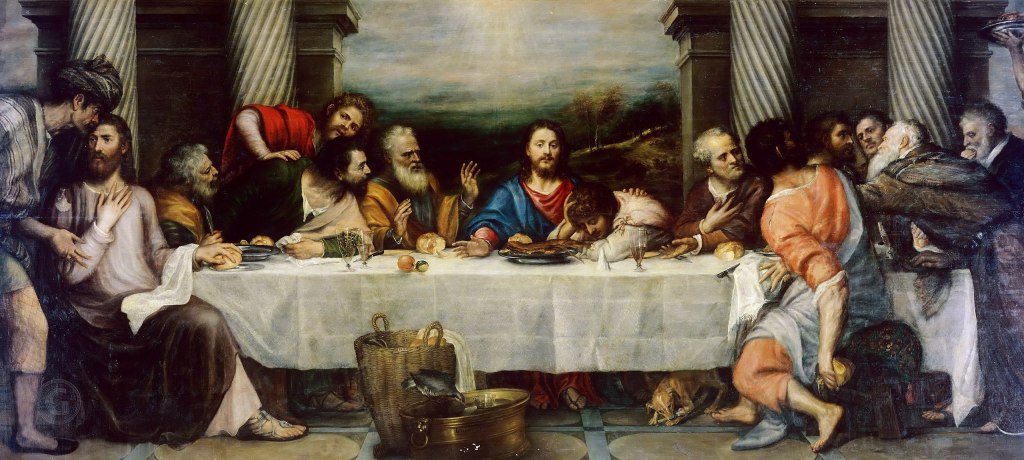
The Last Supper by Leonardo da Vinci is perhaps the most famous, but many others have attempted to capture that scene. The one on the cover of your bulletin was painted by Titian, an Italian artist from the 16th century. If you study it, you will discover many symbols that help identify who each person represents. 

Second, from the left, I believe, is James because of the shell on his shoulder. Second, from the right, I think, is Bartholomew. You see, he is wrapped in a cloak, and the edge hangs over the side of the table. If you look closely, the part that hangs over appears to be an upside-down face. Bartholomew was flayed alive, and he is often pictured holding his skin. And, of course, beside him is Judas, the money bag in his left hand. Behind Jesus and to the right is the tree—a representation of the cross that was near to Jesus since his birth. You can notice all these things as you study the painting, but then you see Jesus’ eyes. Everyone else is distracted, looking here and there and engaged in some conversation (except for John, who is sleeping on our Lord’s breast), but not Jesus. Jesus is looking at you. When you see Jesus’ eyes, everything else becomes a bit blurry. Less important. With his hand, he is gesturing. He is inviting you to pull up a chair and join him, but there are so many years between that meal and today. How could we?

Link to higher resolution image.

in Book 4, Chapter 12 of The Imitation of Christ, my friend, Thomas à Kempis, speaks about Jesus preparing for that last meal with his disciples. Thomas imagines the words of Christ—“I AM the Lover of purity, the Giver of all holiness. I seek a pure heart, and there is the place of My rest. Prepare for Me a large room furnished, and I, with My disciples, will keep the Passover with you. If you wish that I come to you and remain with you, purge out the old leaven and make clean the dwelling of your heart.”

We cannot join Jesus in the upper room that was prepared those years ago, but we can prepare the upper room of our hearts. We, through our confession and devotions, can set the table within. A table covered in fine white linen, adorned with our very best. We can prepare this table of our hearts and say, “Come, Lord Jesus. Dine with me,” and He, with His disciples, will enter in.

Following such a meal, the Lord will get up from the table, take off his outer robe, and tie a towel around himself. Then he will pour water into a basin and wash the feet of all those in the room, including yours, cleansing you of the final remnants of your former self. Making you worthy to enter into His Kingdom.

Look into the eyes of Jesus. He is all that matters. Allow him entry into the banquet you have prepared for Him within your heart.