Sermon: Holy Saturday

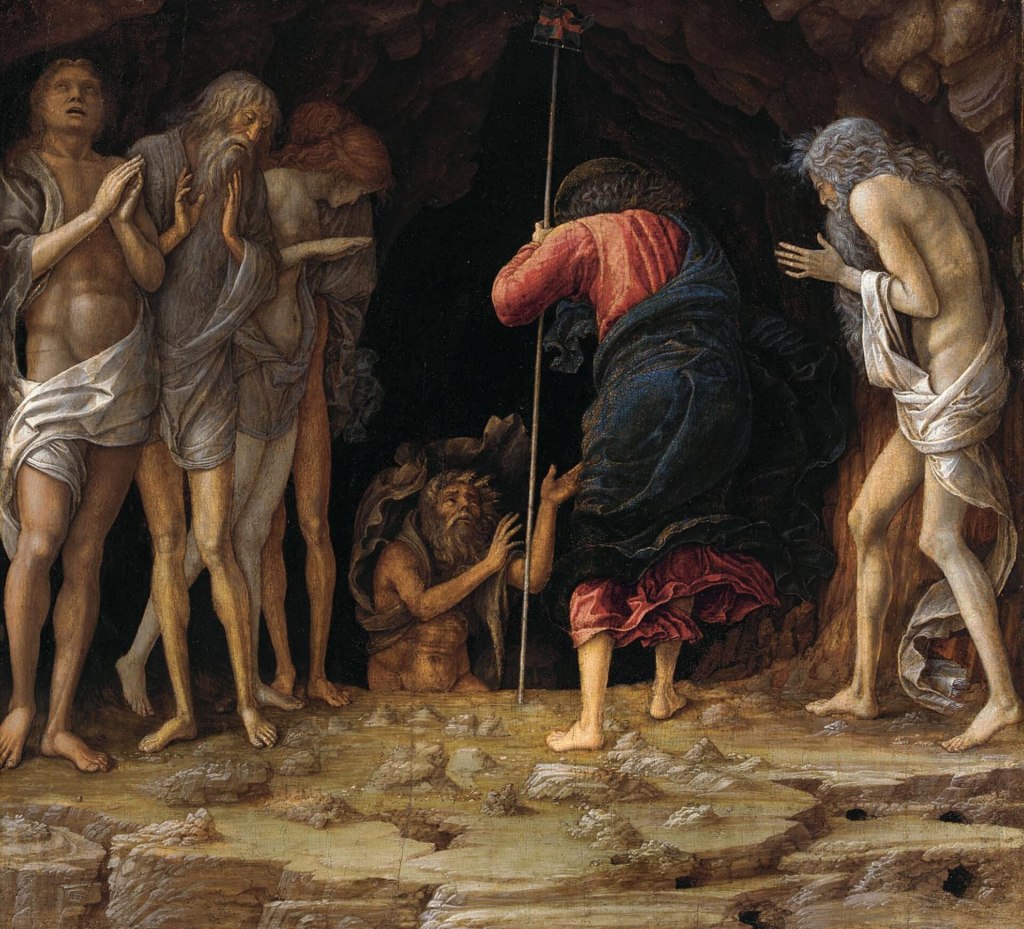
Christ’s Descent into Limbo by Andrea Mantegna and studio, c. 1470

Jesus “did not count equality with God a thing to be grasped. He emptied himself freely accepting death on a cross.” So, if Jesus died, where is He on this day? You know the words of the Creed: “He suffered under Pontius Pilate, crucified, died, and was buried. He descended into hell.” That’s why this Church seems so strangely empty. The one for whom it was built, whose presence draws us on Sunday, is not here. 

Crucified, he died and was buried; he descended into hell. Nineteenth-century Methodists removed that portion of the Creed, claiming it unbiblical. But it’s not. The First Epistle of Peter speaks of Christ’s descent into hell, called by the Church “The Harrowing of Hell.” Harrowing is a military term meaning to “make predatory raids or incursions.” Therefore, after Christ’s burial yesterday and through today, Satan’s territory is being invaded by the One who yesterday died upon the cross.

Following His death, when he breathed his last, Jesus descended to hell. Having preached to us, the living, he descended to the dead and is there proclaiming the Good News to those who lived and died before his coming. 

It is inconceivable that only those who lived during Jesus’s time and afterward would benefit from the salvation He brought to the world, and all those who died before His coming would be excluded from that salvation. So, everyone who died before He came, all the way back to Adam and Eve, had the opportunity to receive His word of salvation.

He is there, doing what He does so well: preaching, teaching, touching, relentlessly seeking, persuading, inviting, healing, and announcing God’s love and mercy. As the Psalmist says, “Thou wilt not leave my soul in hell.” Even Byzantine art depicts Jesus in the jaws of hell, giving a hand to those who had died, lifting them out of the darkness.

And though He is down there and, therefore, not here, there is something to be said to those of us He has temporarily left behind—Because I am there, descended into the deadly darkness, confronting the enemy on the enemy’s turf, you have hope. 

If He is there, literally fighting for the souls in Hell, then we can know with all certainty that there is no darkness, sorrow, or pain we can experience that His loving presence cannot enter into. If He is willing and able to risk it all, to wade deep into the death we so fear and avoid, then what might He risk for us? 

Do you remember the stories Jesus told about God and the kingdom of Heaven—the good Shepherd who forever seeks the one lost sheep, the faithful father who awaits the return of the one lost son, and the relentless woman who does not rest until she finds the one coin? Jesus meant those things when He said them. He is willing to fight for our souls today and for the righteous souls who departed this world before His first coming.

On that first Saturday before the resurrection, the disciples, Mary, and the rest mourned the loss of their Savior, but He had not truly left them. He had only gone to continue His Father’s work.
Sermon: Wednesday in Holy Week – “Cognitive Dissonance”

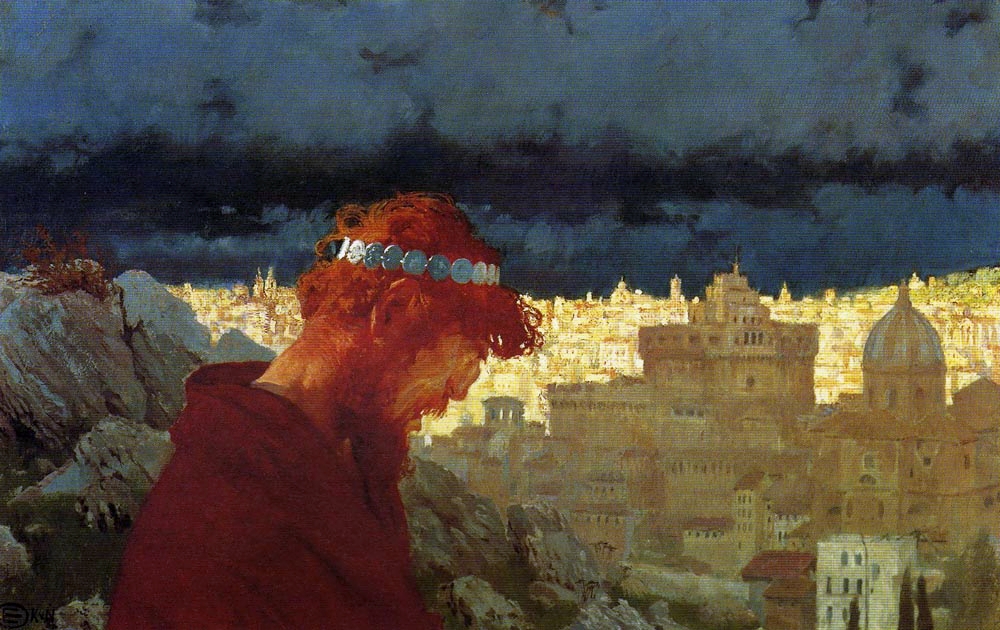
Judas by Edward Okuń

Psychology Today defines cognitive dissonance as “the state of discomfort felt when two or more modes of thought contradict each other. The clashing cognitions may include ideas, beliefs, or the knowledge that one has behaved in a certain way.” (Source)  So, you believe A to be true but then through study or enlightenment, you come to believe the exact opposite, Z, to be true.  However, you’ve invested so much time and energy into A that regardless of how much you believe Z to be true, you won’t give in, so you now have this tension/guilt between the two or maybe a deep sense of confusion.  That said it seems I tell you this story during Holy Week at least every other year.  It involves Bishop Jack Nicholls, the Bishop of Sheffield, who once asked a sixth-grade girl where she thought Jesus was between Good Friday and Easter. 

As a church, we understand the answer to be related to the Harrowing of Hell.  The Harrowing of Hell is understood from two passages of scripture: 1) Ephesians 4:7-9 — “But each of us was given grace according to the measure of Christ’s gift.  Therefore it is said, ‘When he ascended on high he made captivity itself a captive; he gave gifts to his people.’ (When it says, ‘He ascended,’ what does it mean but that he had also descended into the lower parts of the earth?” and 2)  1 Peter 4:6 — “For the gospel has for this purpose been preached even to those who are dead, that though they are judged in the flesh as people, they may live in the spirit according to the will of God.”  Combined, we understand the Harrowing of Hell as Jesus descending into hell and proclaiming the Good News to those who had died before his first coming giving them the option to also accept him as Lord and Savior.  Those who do are allowed to rise in glory.  The iconography shows Jesus pulling people up out of the depths.

When Bishop Nicholls asked the child what Jesus was doing between his death and resurrection, the answer he was looking for was likely associated with this Harrowing of Hell, but instead of answering the question in general terms, the little girl answered it in very specific terms.  After she had thought a little, she replied, “I think he was in deepest hell looking for his friend Judas.”

For me, this is where the cognitive dissonance kicks in.  We are told, “Satan entered Judas, the one called Iscariot.” (Luke 22:3)  In speaking to the Father about the twelve and referring to Judas, Jesus says, “I guarded them, and not one of them perished except the son of destruction.” (John 17:12)  He was a thief, traitor, betrayer, and more.  Yes, he did try and return the silver, but by then it was too late.  So, could the little girl have been right?  Would Jesus have gone looking for his “friend” Judas?  Answer: No!  Absolutely not!  Let him burn.  Answer: Yes!  “God is love.” (1 John 4:8)  God “desires all people to be saved and to come to the knowledge of the truth.” (1 Timothy 2:4)  Jesus said, “What man among you, if he has a hundred sheep and has lost one of them, does not leave the other ninety-nine in the open pasture and go after the one that is lost, until he finds it?” (Luke 15:4)

Dante placed Judas in the lowest level of hell and I think that is where he belongs, but… I also want Jesus to go looking for him and maybe even find him.  Why?  Because I want Jesus to come looking for and find me.  

Cognitive dissonance.