Sermon: Good Friday


Today, after the Solemn Collects, there is the Veneration of the Cross. Three times, the person presenting the Cross will chant, “Behold the hard wood of the Cross on which was hung the world’s salvation.” It is a time to meditate on these great acts.

I’m sure there are others, but I have read several different meditations on that scene. Thomas à Kempis, St. Alphonsus Ligouri, and Catherine Emmerich are among the authors who have stayed with me, but they are all quite graphic. You need to prepare your soul a bit before engaging with them. However, I wonder, have you ever truly considered what you would have witnessed, how it would make you feel, and, more importantly, how you would respond? It’s not an easy thing to do, but many saints point out that it is an edifying practice. As we have been studying the virtues during this Season of Lent, St. Bonaventure wrote, “He who desires to go on advancing from virtue to virtue, from grace to grace, should meditate continually on the Passion of Jesus. There is no practice more profitable for the entire sanctification of the soul than the frequent meditation of the sufferings of Jesus Christ.” So, without making you squeamish by sharing some of the other writings, consider these things.

The head of Jesus was often lifted to look into the crowds as He taught them about the things of God. And, perhaps as often, it was bowed in prayer, talking with His Father. Now, it is pierced with the thorns of the crown that the soldiers so roughly pressed upon Him.

The hands of Jesus—how many people did He touch and heal? Imagine Him reaching down and making the mud He would use to give sight to the man born blind. How gentle He was with the child that He picked up and placed in His lap. See Him writing in the dust, turning back those who accused and wanted to stone the adulterer. See them raised as He gave thanks over the few loaves of bread and fish that would then feed thousands. Now, they are pierced with two nails and fixed to the Cross.

His feet were washed by the hands of the unclean woman, and later anointed with costly perfume by Mary of Bethany. Those same feet walked on the waters and traveled many miles, bringing God’s message of love to a dying world. Yet, like His hands, those feet are now nailed to the Cross.

We could look upon Him, seeing His back, born to carry the sins of the world, now whipped and bruised, or His chest, where within that most Sacred Heart beats with the fire of the Spirit, is now pierced. Christ is upon the Cross. St. Alphonsus Liguori wrote, “Behold Jesus, at length, actually dying. Behold him, my soul, how he is in his agony amid the last respirations of his life. Behold those dying eyes, that face so pale, that feebly palpitating heart, that body already wrapped in the arms of death, and that beautiful soul now on the point of leaving that wounded body. The sky shrouds itself in darkness; the earth quakes; the graves open. Alas, what portentous signs are these! They are signs that the Maker of the world is now dying.”

Seeing these things isn’t easy, but seeing is necessary. As difficult as it is to witness, don’t turn away. Stay with Him for a while and see with your eyes and your soul. This is God’s love story. St. Thomas Aquinas once asked Bonaventure which book he used to learn about the great love of Jesus. Taking a crucifix from the wall, Bonaventure replied, “This is my book whence I receive everything that I write; and it has taught me whatever little I know.” 

Jesus tells us, “Greater love has no one than this, that someone lay down his life for his friends” (John 15:13). You are Jesus’ friend and His love. The Cross is the love story Jesus wrote. He wrote it for you, and He wrote it in His own Blood.

Sermon: Good Friday


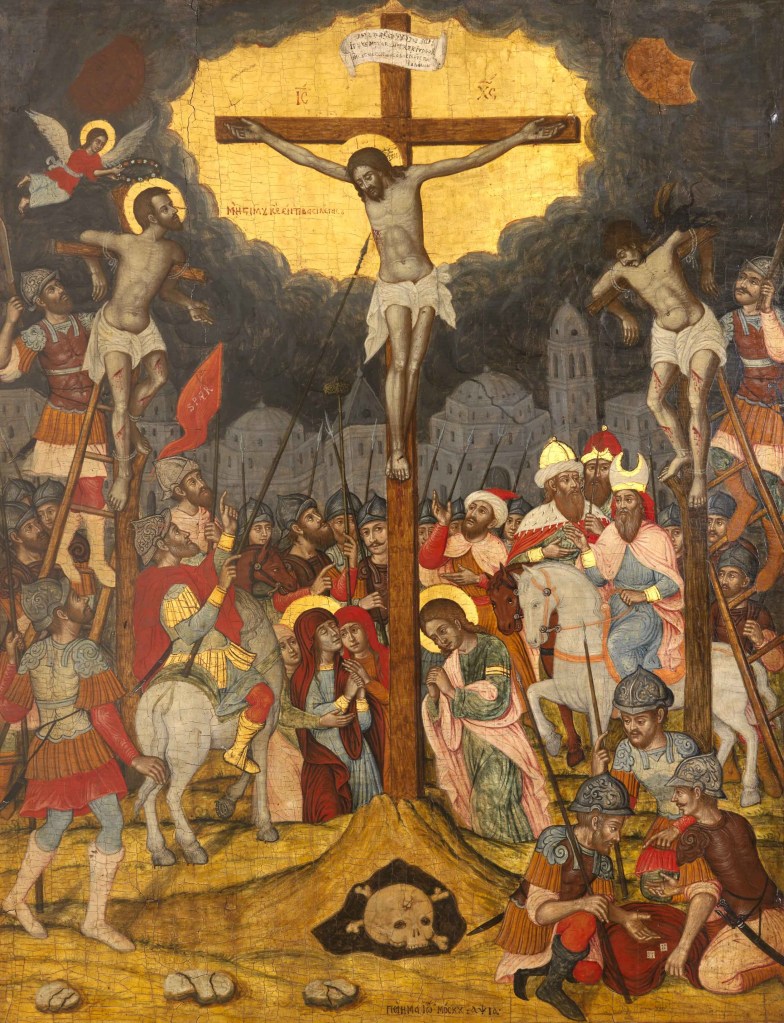
Pilate said to the Jews, “Here is your King!” They cried out, “Away with him! Away with him! Crucify him!” Pilate asked them, “Shall I crucify your King?” The chief priests answered, “We have no king but the emperor.”  So the soldiers took him to be crucified.  It took Jesus six hours to die; then he breathed his last.

All this time, the people were gathered around or passing by.  Yes, there were a few followers, but mostly, it was the soldiers, the religious leaders, and those who had called out, “Crucify him!”  Thomas à Kempis describes this mass of unbelievers:

“Like mad dogs they huddled together to attack your innocence. With their mouths they barked like dogs, they gnashed their teeth like lions, and with their tongues they hissed like snakes. They cursed with their lips and their faces they turned into sneers; they clapped with their hands, their feet danced, and their hearts rejoiced, all because they saw you nailed to a Cross—one whom they did not want to see die without first being mocked and jeered. Those who passed by shook their heads like crazed, drunken men, and filled with bitterness, arrogance, and ill will, they shouted: Ah, there’s the man who destroys God’s Temple and rebuilds it in three days.” (On the Passion of Christ: According to the Four Evangelists, p. 91)

Creation itself shuddered and wept at the crucifixion of Our Lord, but those gathered around gawked, laughed, insulted, cheered.  All creation wept, but those passing by may have given a quick glance, but they didn’t linger, too afraid to be caught up in these upheavals.  All creation wept, but his clothes they gambled for were worth more than his life.  All creation wept, but for a few still gathered at his feet—who listened for one last word, who desired one last touch, who refused to let go, even when all appeared lost and without hope.  

On that day, two very distinct groups gathered around the cross. Today, those same two groups exist. Be a part of the smaller one—those listening and desiring a touch from the King of Heaven. Christ is upon the cross. Be one who is still hoping. 

Sermon: Good Friday – “Known”

Photo by Joeyy Lee on Unsplash

Broken Windows is the title of an article in an issue of The Atlantic from 1982. It stated, “Social psychologists and police officers tend to agree that if a window in a building is broken and is left unrepaired, all the rest of the windows will soon be broken. This is as true in nice neighborhoods as in rundown ones.” (Source

Years before the article, a psychologist at Stanford, Philip Zimbardo, had already tested the theory. Instead of looking at windows, he put out cars. One in a “good” neighborhood and the other in a “bad” neighborhood. He removed the license plate on both and left the hood open. Ten minutes after being abandoned in the “bad” neighborhood, a family came along and took the battery and the radiator. Within twenty-four hours, the car was completely stripped and vandalized.

After a week, in the “good” neighborhood, nothing had happened, so Zimbardo went down with a sledgehammer and did some minor damage—nothing like a bit of inspiration. Within twenty-four hours, the car was completely trashed and flipped over. 

“Good” neighborhood or “bad” neighborhood did not make a difference. Once the destruction began, it continued until the job was finished. Break a window in a building, and eventually, all the windows will be broken. 

In the beginning, God created the Heavens and the Earth. On day six, God created Adam and Eve. They were free to live in the Garden for as long as they liked, provided they didn’t eat from one tree—The Tree of the Knowledge of Good and Evil. Yet, “when the woman saw that the tree was good for food, and that it was a delight to the eyes, and that the tree was to be desired to make one wise, she took of its fruit and ate, and she also gave some to her husband who was with her, and he ate.” (Genesis 3:6) 

Adam and Eve took a bite of the fruit, and the Devil picked up a rock, threw it, broke the first pane of glass, and damaged the image of God that is within each one of us. Since that day, the Devil and the world have continued the destruction. We have also thrown a few rocks. Every harsh word, injustice, lack of mercy, bigotry… every sin has been one more broken pane until there are more broken panes than whole.

Even so, God still loves us.

Thomas Merton wrote, “At the end of the first Epistle of Saint Paul to the Corinthians: ‘I shall know even as I have been known.’

“It is in the passion of Christ that God has proved to us that He has ‘known’ us. That He has recognized us in our misery. That He has found His lost image in our fallen state and reclaimed it for His own, cleansed in the charity of His Divine Son.

“It is on the Cross that God has known us: that He has searched our souls with His compassion and experienced the full extent of capacity for wickedness: it is on the Cross that He has known our exile, and ended it, and brought us home to Him.” (A Year with Thomas Merton, p.57)

God looked and saw all that was broken within us, yet He could still see His image, so He declared, “These are My children—they are broken. Through their sin, they are separated from Me, but they are Mine, and I will not abandon them to be utterly destroyed.” So God, in His great love, chose to allow Himself to be destroyed. Destroyed upon a Cross that we might once again be whole.

Jesus said, “‘It is finished.’ Then he bowed his head and gave up his spirit.” Jesus said, “I choose to be destroyed so that you may be made new.” 

Why?

For God so loved the world.

Sermon: Good Friday – “Thief”

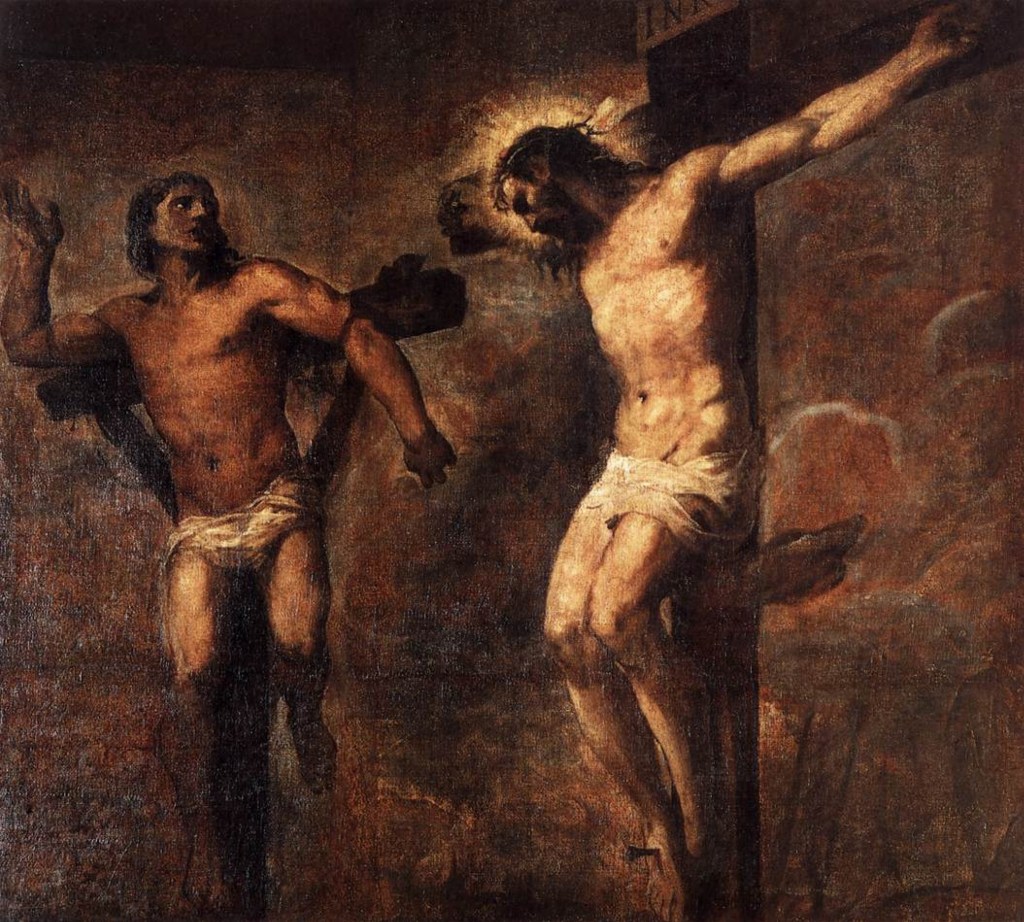
Christ and the Good Thief (c. 1566) by Tiziano Vecellio (Titian) (c. 1490-1576)

According to legend, his name is Dismas.  He and his family lived in the barren land between Israel and Egypt and at a very young age he contracted leprosy.  One day, a man and a woman with a baby boy were fleeing Israel and passed through that region.  They were tired and hungry and in need of shelter and it was Dismas’ mother who took them in.  She fed them and even provided water to bathe the baby.  After the bath, Dismas also took a bath in the same water and by doing so, was cured of his leprosy.

Another legend, taking place in that same barren land between Egypt and Israel tells of how a mother and father with their young baby were fleeing Israel and encountered two thieves, Dismas and Gestas.  At first, they both were determined to rob the family, but something turned in Dismas’ heart and he instead bribed Gestas not to rob them.

Either or possibly even both these events (or none of the above) had an effect on Dismas, but not enough of an effect for him to change his ways, so in the end, he and Gestas found themselves crucified on a hill outside of Jerusalem alongside a man whom many believed to be the Messiah, Jesus.  Perhaps it was because of one of those earlier encounters with Jesus that caused Dismas’ heart to turn once more toward Jesus.  Perhaps something in him, since he was a boy, had also been longing for a Messiah, whatever the case, at that moment, like so many others before him, Dismas understood that this Jesus was the only one who could save him, so he asked Jesus to remember him: “Jesus, remember me when You come into Your kingdom!”

At the time, to be remembered was the best most could hope for.  They had not heard about the Kingdom of God.  They did not understand the resurrection.  The only way to experience eternal life was to be remembered by others following your death, but who was going to remember a thief.  No one.  A thief was no more worth remembering than yesterday’s garbage.  Yet this thief with his death imminent, wanted just one person to remember him: “Jesus, remember me when You come into Your kingdom!”  But Jesus is not in the business of simply remembering people.  Jesus redeems, atones, and makes all things new.  Jesus gives eternal life to those who call on him, even if the time is 11:59 p.m., so Jesus said to Dismas, “Truly, I say to you, today you will be with me in paradise.”  Archbishop Fulton J. Sheen commented, Dismas “was a thief to the end and he even stole heaven!”

St. Paul tells us in his letter to the Hebrews, “Since then we have a great high priest who has passed through the heavens, Jesus, the Son of God, let us hold fast our confession.  For we do not have a high priest who is unable to sympathize with our weaknesses, but one who in every respect has been tempted as we are, yet without sin.  Let us then with confidence draw near to the throne of grace, that we may receive mercy and find grace to help in time of need.” (Hebrews 4:14-16)

Jesus’ throne on this earth was his cross, therefore, like Dismas, let us come boldly before that throne, but instead of asking Jesus to remember us, let us ask him to grant us entry into his paradise that we might have eternal life with him.  Whether you are a saint or sinner, if you believe and call on him, he will not deny you entry.